Prusa Releases Core One Designs Under New License: Free to Tinker, Dangerous to Sell

Years in the making, Prusa steps forward with a prickly new license that keeps things open for community and internal business use, but increases the risk for those who try to copy and profit from others' work as their own.
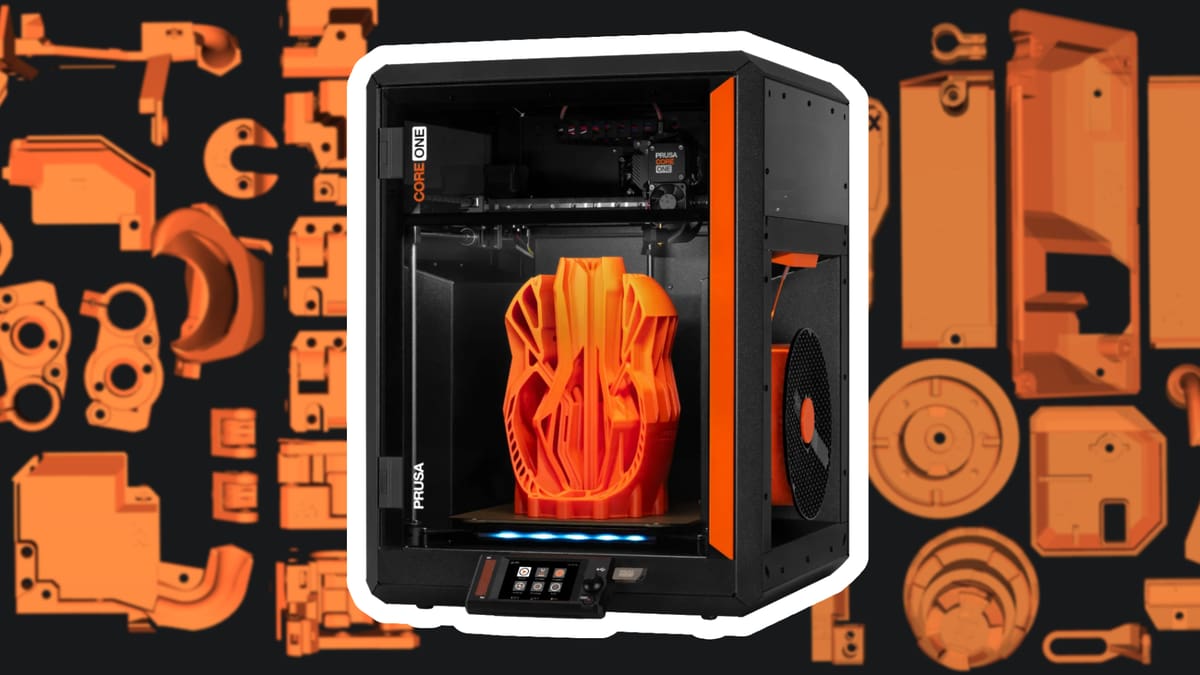
There’s an early Christmas gift for modders and makers interested in adapting the basic Prusa Core One or Core One L 3D printers to their will today, as Prusa Research releases the CAD files for both printers on Printables.
That’s great news for those looking to design custom parts, improvements or changes that integrate naturally with the printers. You have the exact dimensions, fixtures and fittings all mapped out for you to work accurately.
But that’s not all.
Announced in a post penned by Josef Průša on the Prusa Research blog, the new machines are released under a brand new license, one Prusa will tactically use to release innovative designs it wishes to protect while also sharing them openly for its customers to use. It’s called Open Community License (OCL) and for users, the new license presents unambiguous terms:
You can:
- Download, inspect, and learn from the full STEP + Fusion assemblies.
- Modify them and share your mods (under the same OCL).
- Use modified or unmodified designs in your own workshop, print farm, or production line.
- Produce spare parts to keep your machines running (home or business).
You cannot:
- Sell complete machines or remixes based on these files, unless you have a separate agreement with us [Prusa Research].
But that’s just what you can and cannot do. Behind this, lies an interesting twist on the expected non-commercial licensing that gives Prusa, and others who use OCL, better weapons to fight back against bad actors claiming their homework as their own.
Like other non-commercial licenses, OCL operates as some kind of open quarantine for works – a one-way turnstile of sorts: designs can flow in and be used per the license terms, but must stay in under the same non-commercial conditions. The only exceptions are specific cases of a design being commercially licensed, a separate, negotiated agreement beyond the scope of the plain OCL license.
Otherwise, designs within this permeable glass box stay there. You can see them, interact with them, do whatever you want privately – you just aren’t allowed to take them and profit directly from them. This is very much a familiar modus of non-commercial licensing.
Prusa distinguishes OCL from similar non-commercial licenses by framing it not as simply granting permission, but a contract based on a patent rights grant. By downloading the file, you are given the rights to access and use the holder’s respective patents. That’s the binding deal you enter into when you hit “download” – backed up by Printables’ terms of service and the stipulation you are bound to the license terms of what you download.
A Big Stick
If you then take that design and attempt to patent it for yourself it would constitute a breach of contract, which Prusa argues is often much easier and cheaper to prosecute than patent invalidation – the general situation it has pointed to as the issue at the heart of this action (the high bar to fight bogus patents). For Prusa, OCL puts additional sticks in place for them (and others who use it) to whack any commercial entities that try to patent work from under them.
Exploiting a company that publishes its designs in the spirit of sharing may be a little less appealing if it can attack you for it on other grounds than a costly and lengthy patent invalidation or copyright claim.
Where there is a patent in dispute, patent violation still exists and can be pursued, but the OCL contract violation provides a shortcut to action for anyone.
Going beyond this, it appears OCL aims to clear up ambiguities in non-commercial licensing with regards to what exactly non-commercial means. Even commercial entities – businesses – are free to use OCL-licensed designs as they wish within their operations, even if the resulting modification or usage results in what could be considered commercial gain (say, a more efficiently designed printhead that increases output). As long as they do not sell that printing hardware, as is or a derivative from the OCL source, then they have not breached the non-commercial terms of OCL and things are green. No issues.
The license, at least from my non-legal perspective (I am not a lawyer) appears to tick a few boxes that were not there before. It does further crystallize Prusa’s departure from fully open source hardware, but then I don’t think anyone expected the company to about-face when a key issue has been the unfair exploitation of its work. The company is entitled to protect its innovations, and that it’s found a way to do so while continuing to share its designs it extremely welcome and continues to help it stand apart from the crowd. The post also explains that the company will continue to use open source licenses “where it makes sense” – PrusaSlicer and the recently launched OpenPrintTag being a couple such examples.
As with other non-commercial licenses, the water gets muddy for OCL when projects incorporate components under strong copyleft licensing, too. Those licenses, say CERN-OHL-S for example, stipulates any full composite of which they are part is shared under that same license, which allows for commercial use. That clashes with OCL. The project would not be able to be shared in such a configuration.
Regardless of the fringe cases and stresses OCL may well meet from here on out, it is nevertheless a public step forward on an issue Josef Průša has made a mission over tackling. There’s also talk of a patents alliance, which could be a thing to foster a more secure and innovative environment in desktop printing. Such groups typically create a pool, sharing access to members’ patents in exchange for defense against patent trolls, improving standards and leveling the playing field.
OCL is now a selectable license option on Printables, meaning anything you design and upload can be shared under the same conditions. You can read more about the launch over on the Prusa Blog.
Read more recent news:
- Creality K2 Pro Combo Review: The Creality Flagship I've Been Waiting For
- Einstar Cuts More Cords with Two New Handheld Laser 3D Scanners
- Time Magazine Names Two Bambu Lab Products as "Best Inventions of 2025"
Tired of Reading? Try Listening
License: The text of "Prusa Releases Core One Designs Under New License: Free to Tinker, Dangerous to Sell" by All3DP is licensed under a Creative Commons Attribution 4.0 International License.