Einstar Cuts More Cords with Two New Handheld Laser 3D Scanners

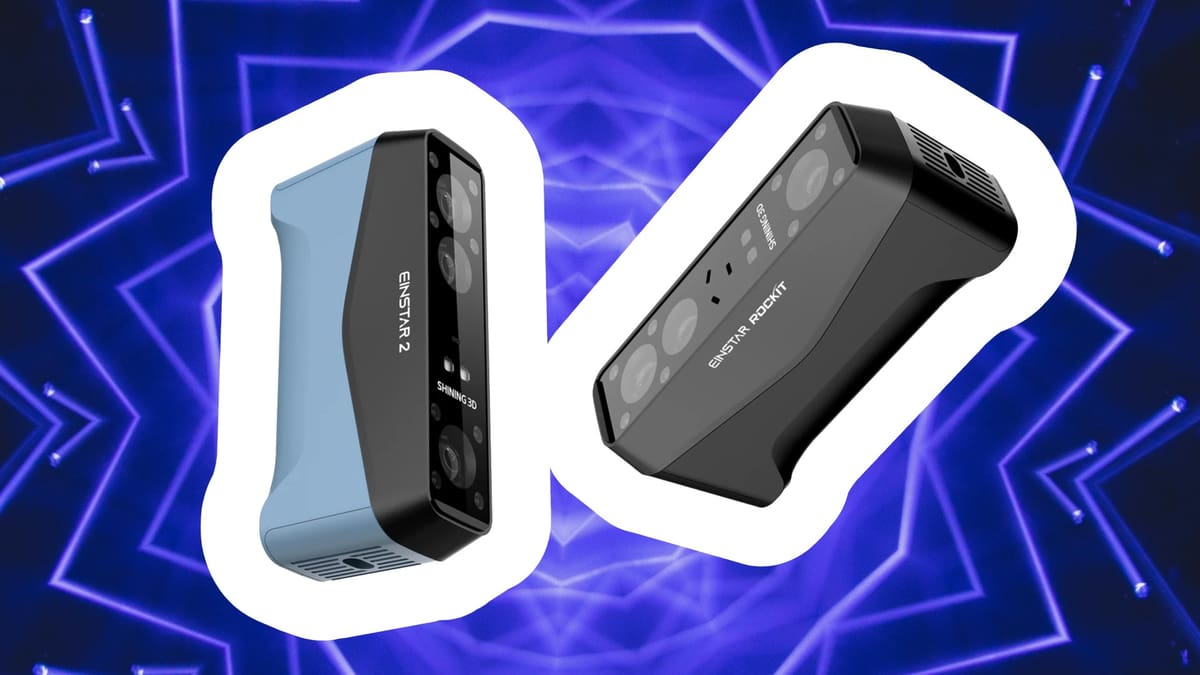
The Einstar 2 and Einstar Rockit both pack IR and laser line-based scanning tech, promising outdoors performance and convenience in pocketable form.
Single-handedly demonstrating why Friday is the worst day to announce a new product, here we are three days later picking up Shining 3D’s announcement of not one, but two new 3D scanners that are, unquestionably, interesting. The new devices, both a part of Shining’s entry-level Einstar brand, appear to double down on the freedom of movement and portability the brand’s last release, the Rigil.
Unlike the Rigil, which costs ~$5K, introductory pricing has the new scanners starting at more accessible $1,049 for the Einstar 2, and $1,699 for the Einstar Rockit. Limited time discounts available for past Einstar customers to knock $50 and $100 off each, respectively, plus bonus access to Einstar’s scan-to-CAD ExModel software.
Einstar 2: What’s new?
As its name suggests, the Einstar 2 is a direct successor to the Einstar, a 3D scanner we quite liked when we tested it a couple of years ago. The Einstar 2 keeps the wand form factor but eliminates the need to tether to a computer, using WiFi 6 for fast data transfer. The scanning tech has evolved, too, with the Einstar 2 making use of infrared and blue laser scanning types to cover a wide range of possible uses. An RGB camera for color data capture is present, too.
The benefit of such a hybrid system is that it can, theoretically, cover a wide set of lighting conditions and object types without the need for trackers. A product page for the Einstar 2 claims you can “take it outside” and operate, for example, in laser mode in lighting up to 110,000 lux, which the internet tells me is direct sunlight, basically.
The Einstar 2’s biggest party trick by far is that its battery life (three hours, according to Shining) can be extended by yanking the spent battery out and inserting a replacement. This is a great, consumer-friendly move by Shining, removing the limitation of non-replaceable batteries that put the device out of action when they need to be charged, and adding to the long-term longevity of the device as the batteries inevitably degrade.
Einstar Rockit: What Is It?
If the Einstar 2 is the budget all-rounder, then the Einstar Rockit is the upgrade. Packing what appears to be the scanning tech of the Rigil, Einstar’s $5K pro handheld scanner, but trimming away the display and onboard processing capabilities, the Rockit has two laser projectors: a 19+19 crossed mode for large area capture, plus the 7 parallel laser mode as found on the Einstar 2. Additionally you get the infrared scanning, too. In practical usage, the crossed laser mode offers a larger scanning area, opening the Rockit up to easier processing of larger objects.
Texture capture in full color is emphasized here, with the Rockit sporting a 5MP camera to capture the data compared to the Einstar 2’s 2.3MP snapper.
As with the Einstar 2, the Einstar Rockit also makes use of a replaceable battery. Two are provided with the scanner, plus a charger, meaning while one battery is in use, the other can be charged.
Both scanners can capture dark or reflective objects without the use of scanning sprays, Shining says. You can pick up the Einstar 2 and Einstar Rockit now, from the Einstar webstore, where you’ll also find more details about the launch promo for past customers.
Read more recent news:
- Time Magazine Names Two Bambu Lab Products as "Best Inventions of 2025"
- Cura 5.11 Beta Unveils Advanced Painting Tools & Enhanced S6, S8 Performance
- Best 3D Scanners in 2026: Our Top Picks in 6 Categories
Tired of Reading? Try Listening
License: The text of "Einstar Cuts More Cords with Two New Handheld Laser 3D Scanners" by All3DP is licensed under a Creative Commons Attribution 4.0 International License.