Rosa3D’s Glass-Fiber TPU 75D Is Built for the Engine Bay, Not the Parts Bin

Tough, durable, and chemically resistant, this new glass-fiber reinforced TPU is a technical composite for demanding environmental and mechanical conditions, say Rosa3D. At a Shore hardness of 75D, it bends, but it'll take a lot to break.
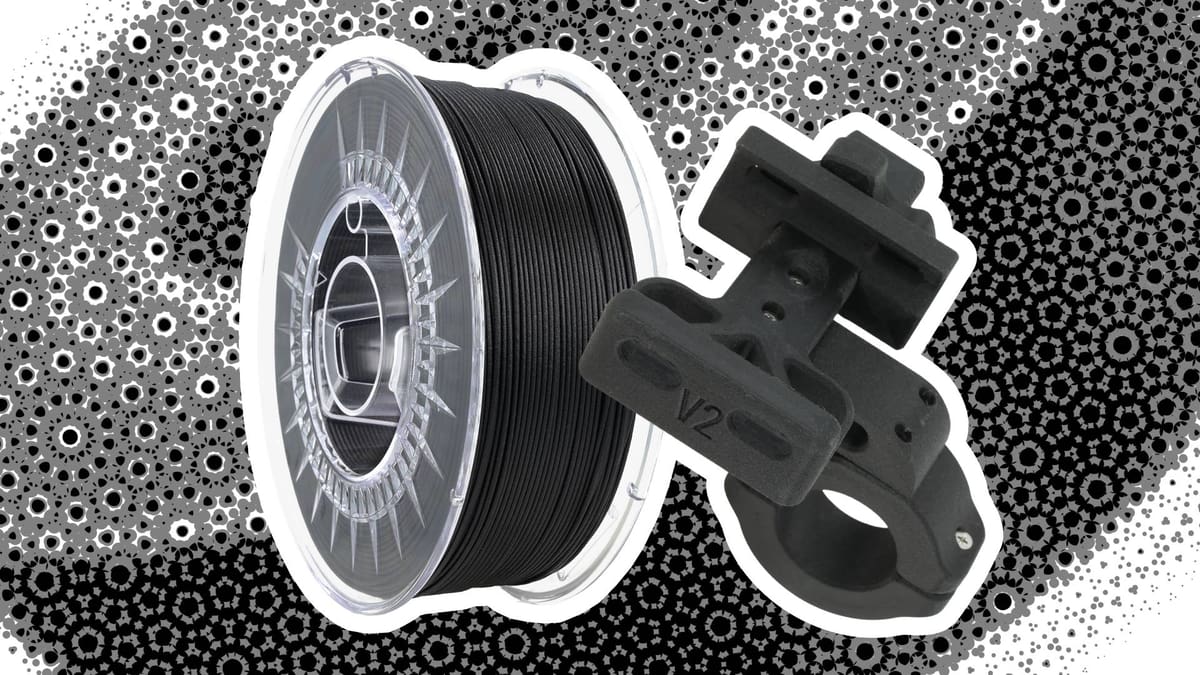
Polish filament manufacturer Rosa3D launched a glass-fiber-reinforced TPU at the start of April. Called Rosa3D TPU 75D Automotive 15 Glass Fiber – the 15 signifies the 15% glass fiber content – the material pointedly targets a particular vertical in functional end-use parts in automotive and industrial environments, though we can see why it might be a useful choice in other areas.
Parts destined for under-hood or high-heat exposure need to survive temperatures that would typically compromise standard TPU. Rosa3D claims a heat deflection temperature of 155°C under load, which would puts this material in contention for brackets, grommets, cable guides, and vibration mounts in environments where standard 95A TPU softens and deforms.
The company also cites a Charpy impact value of 100 kJ/m². Both figures appear on Rosa3D’s own blog without third-party lab attribution, so treat them as manufacturer claims until independently tested, but they’re consistent with what a glass-fiber-loaded semi-rigid TPU matrix would plausibly deliver.
What differentiates the material from many other TPU filaments is its Shore hardness: at 75D, it’s stiff; stiffer than what we’d consider a direct technical-consumer competitor in Siraya Tech’s Fibreheart TPU-GF, which sits at 64D.
Both are hardwearing and tough materials, but this slight numerical difference shapes the sorts of things you would consider the material for, even though they’re both TPU. At 75D, Rosa’s Automotive 15 is not the material you reach for when you want soft-touch grip surfaces or compliant seals: pressed between your fingers it will give slightly, but it behaves more like a firm engineering plastic than a rubber. It’s a different beast from the typical flexible 95A TPU you may have used for phone cases or cable strain relief.
The glass fiber reinforcement adds dimensional stability and stiffness in the Z-axis in particular, which is where unreinforced TPU can lose integrity under sustained load.
Rosa3D TPU 75D Automotive 15 Glass Fiber: At a Glance
Recommended print settings run at 230–255°C for the nozzle and 60–90°C for the print bed.
Printing it successfully requires a hardened steel nozzle and a closed chamber – the glass fiber content will destroy a brass nozzle and the material is sensitive to draft cooling during the print. Second, and significantly, Rosa3D explicitly rules out use with multi-material systems like Bambu Lab’s AMS, warning the glass fiber content will abrade PTFE filament guide tubes. Print speed is also a ceiling to keep in mind – a blog post on Rosa 3D’s site recommends 5–40mm/s – it’s a slow print speed, even by already slow TPU standard. It’s recommended to dry the filament at 70 °C for four hours before use.
Rosa3D TPU 75D Automotive 15 Glass Fiber is available now on 0.5kg (~€31/PLN 129.90) and 1kg (~€51/PLN 209.90) spools in black only, shipping to the EU and UK.
Read more recent news:
License: The text of "Rosa3D’s Glass-Fiber TPU 75D Is Built for the Engine Bay, Not the Parts Bin" by All3DP is licensed under a Creative Commons Attribution 4.0 International License.