Coming Soon, a Double-IDEX 3D Printer That’s Not a Toolchanger

Launching soon on Kickstarter, the LightMake L4 is a large, quad-printhead 3D printer packing linear motors, print farm-friendly features and, exotically, OpenClaw integration.
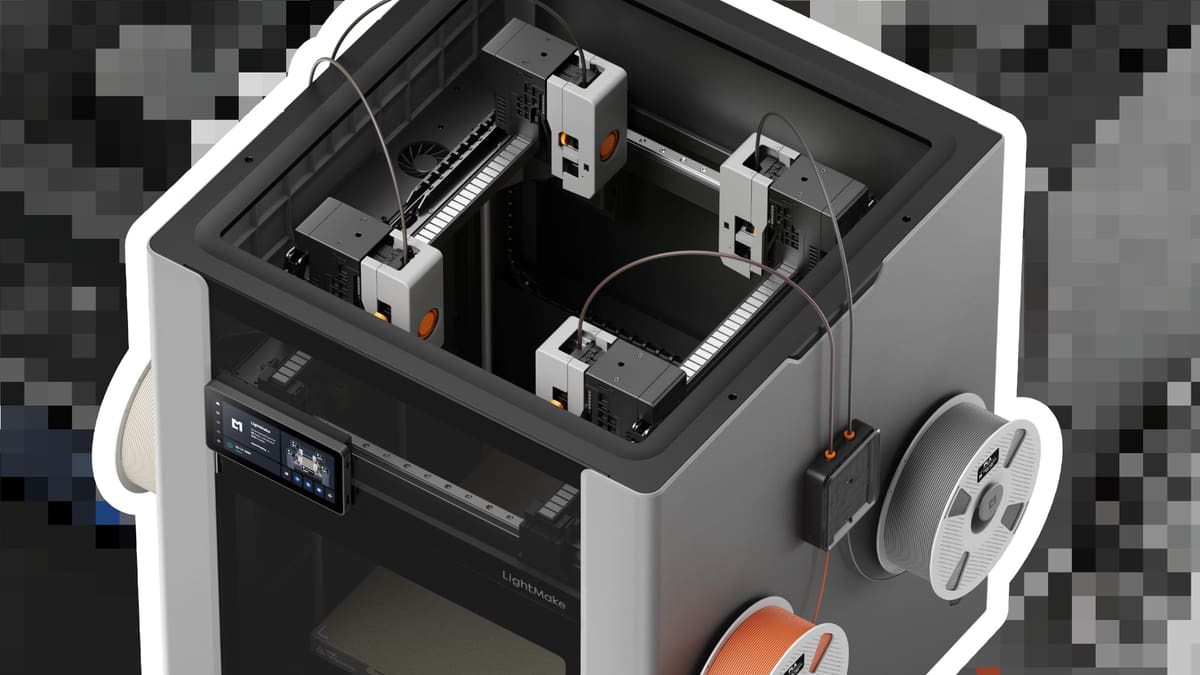
Didn’t you hear? Even toolchangers are too slow and wasteful now. Or at least that’s the impression you get when you see the LightMake L4, which crams four independent printheads inside the four corners of its print volume. It’s not a toolchanger, mind. Every printhead is independently callable and no central carriage picks nor parks the tools.
Launching soon on Kickstarter, a $50 pre-launch deposit scheme currently bags a “VIP” pledge lane with the printer available for backing at $1,099 – some $1,300 off LightMake’s stated MSRP of $2,399. The machine itself promises build volumes of 354x 370 x 386 mm (single color) and 354 x 350 x 386 mm (multicolor), with the four independent printheads each capable of 320°C. The expected PEI-coated steel print bed beneath it all, on a bed that LightMake says heats to 110°C. Two spools of filament mount to either side of the machine, with RFID material recognition coming as standard – it’s unclear at this point if this uses a closed LightMake RFID standard or an open one.
On the optics of it alone, it looks wrong. The tools themselves are not the type of slim, space-efficient thing we find ourselves craving in something like BondTech’s INDX – they look like they’ll crash into each other. Or at the very least put a major damper on the available print volume. But work, apparently, it does. LightMake’s campaign page for the L4 shows how the unused printheads tuck out of the way at the extremes of their axes.
LightMake documentation puts the smallest segmented print volume at 145.5 x 167.5 x 386 mm – that’s per printhead when all four are printing in parallel.
How does it actually work? If you’re familiar with the IDEX motion system, you’re halfway to knowing. The LightMake L4 effectively marries two independent IDEX systems over one build volume – it’s an IDIDEX, if you will.
Each side’s gantry can call one or both printheads to bear in a given layer, but not concurrently in the same print model. That is to say, either they take it in turns to add to a layer in a distinct model, or they can share their half of the build volume and print duplicate models independently, simultaneously. The key thing to know here is that each pair shares a fixed movement through the X-axis, but can move independently through the Y-axis.
Now, double it. An identical IDEX system sits on the opposite side of the bed, following the same rules, but also respective of each other. All of the printheads can take turns to print on a given, discrete multicolor or multi-material model. LightMake claims such a printhead change takes just 1 second. Or they can all run in parallel, confined to their quadrant of the bed, making identical moves to produce multiples of the same model. LightMake claims near-zero purge waste for multicolor printers on the L4, saying it “swapped massive, wasteful purge for a minimal prime tower.” That prime tower is not pictured anywhere, only tiny amounts of “purge waste.”
The quad-head printing is, largely, the party piece of the L4. The printer makes use of linear motors, enabling a beltless, closed-loop motion system that’s ostensibly very accurate and capable of high speeds. More commonly seen in industrial machines than desktop printers, the last time we saw linear motors used in such a printer (the Peopoly Magneto X) its manufacturer even admitted the perception of it being “overkill for a printer with a 0.4mm nozzle diameter.” In our coverage for that printer we learned that linear motors are “costly, complex, and lack a broad supply chain and software support.”
One potential upshot of using such a motion system, though, is reduced wear and tear. The axes that use the linear motors are effectively floating on a cushion of magnetism, and guided by linear rails.
The L4’s feature list continues out with the embracing of AI into its systems and workflow. The campaign cites fleet cluster management and auto-queuing (things we’re fairly certain were possible before “AI”.) More substantial is the introduction of a “conversational AI slicing” to translate your written instructions into parameter changes in the slicing, plus OpenClaw integration.
For the uninitiated, OpenClaw is basically an open-source framework that lets AI agents under your control interact and communicate with other tools and services. You control and interact with your OpenClaw agents via instant message apps like Whatsapp, Slack and others, and then they beaver away in the background to do your bidding. In LightMake’s case, the company specifically mentions interaction via Whatsapp, which may prove a blocker for privacy-minded folks looking to keep Meta out of the loop.
The impression we get is that LightMake is positioning the L4 primarily as a print farm machine. For the regular user, much of the fleet management stuff is surplus to your actual use of the printer, and productivity boosting print modes like duplication and mirror are fringe-use features that, sure, can double (or, here, quadruple) output in a given machine, but also severely cuts the printable size and can expose all the parts printing to failures of the others.
It’s a brand new company with a brand new product pitching for money via Kickstarter, so as always our typical caveat that you shouldn’t back anything with money you can’t afford to lose applies here. IDEX didn’t really capture the public’s imagination – will smashing together two fare any better? In today’s multicolor printing reality, it’s possible.
An image on the deposit page indicates a single printhead version, the L1, will also be available for backing with pledges starting at $899. LightMake indicated that machine has a larger volume and fewer linear motors, both feature changes by virtue of not having to accommodate multiple printheads.
For now, LightMake is taking deposits ahead of the crowdfunding via its own website. Check out the campaign page for more details.
Editor's Note – This article highlights a Kickstarter crowdfunding campaign. Kickstarter is not a shop; campaigns are under no legal obligation to deliver on crowdfunding promises, nor offer refunds on unfulfilled campaign rewards. For more insight, read our article 8 Things to Watch for When Backing a 3D Printing Kickstarter.
Read that? Now read these…



License: The text of "Coming Soon, a Double-IDEX 3D Printer That’s Not a Toolchanger" by All3DP is licensed under a Creative Commons Attribution 4.0 International License.