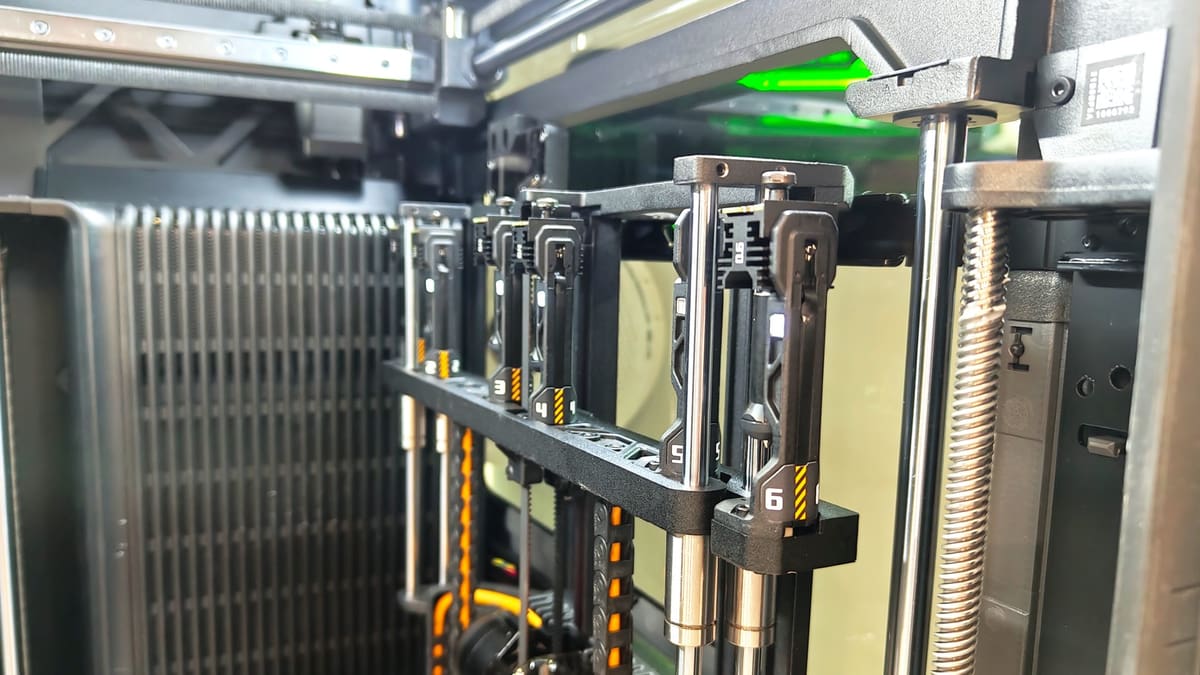
Bambu Lab CEO Ye Tao Explains Why the H2C Is the Ultimate Machine for Lazy Makers

Amid the bustle of a busy Formnext week, we sat with Bambu Lab CEO Ye Tao for a casual chat about company's just-launched nozzle-swapping 3D printer. Surprisingly, the printer's real value to Tao isn't necessarily in saving material at color changes.
When 3 p.m. rolled around on Tuesday, Nov. 18, Bambu Lab effectively took over a section of Hall 12.1 at Formnext. A ticking countdown clock and several sheet-covered machines built the tension before Bambu Lab Europe CEO Cedric Mallet unveiled the company’s new H2C 3D printer.
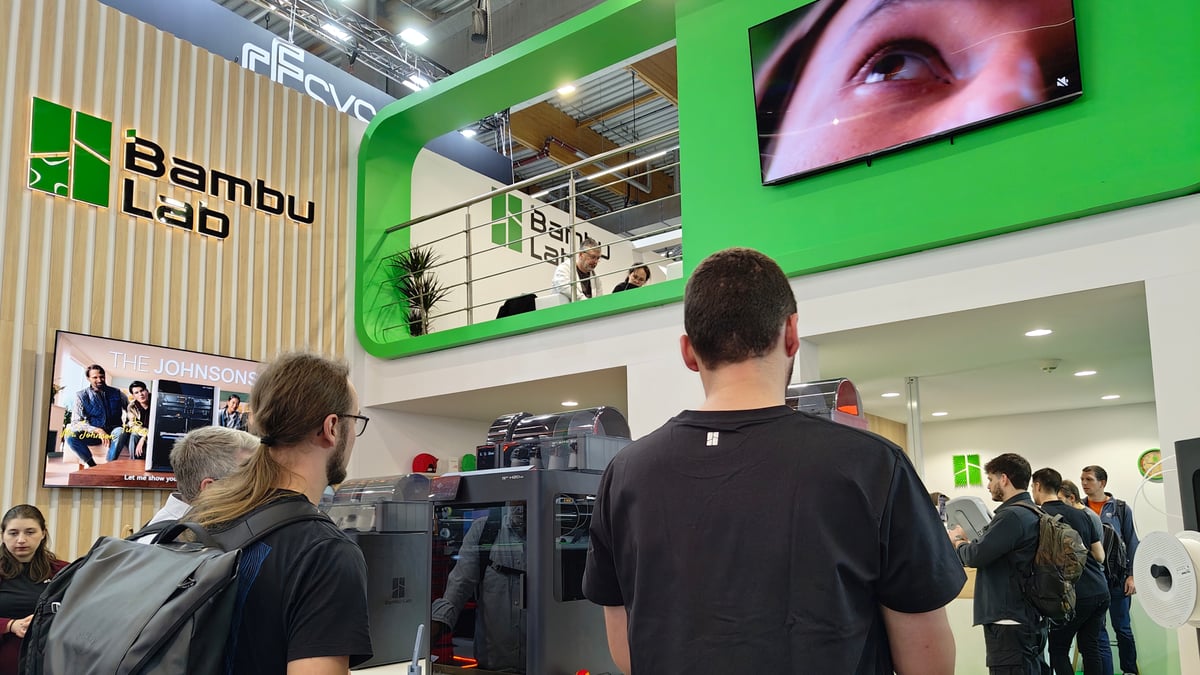
A couple of days later, with the dust settled, I headed up to the press lounge of Bambu Lab’s two-story booth to speak with co-founder and CEO Ye Tao. The view over the expanse of Hall 12.1 felt poetic: much like their towering booth, the company now looms over the industry. They are shifting mountains of machines and dominating the conversation, even among unlikely industrial competitors.
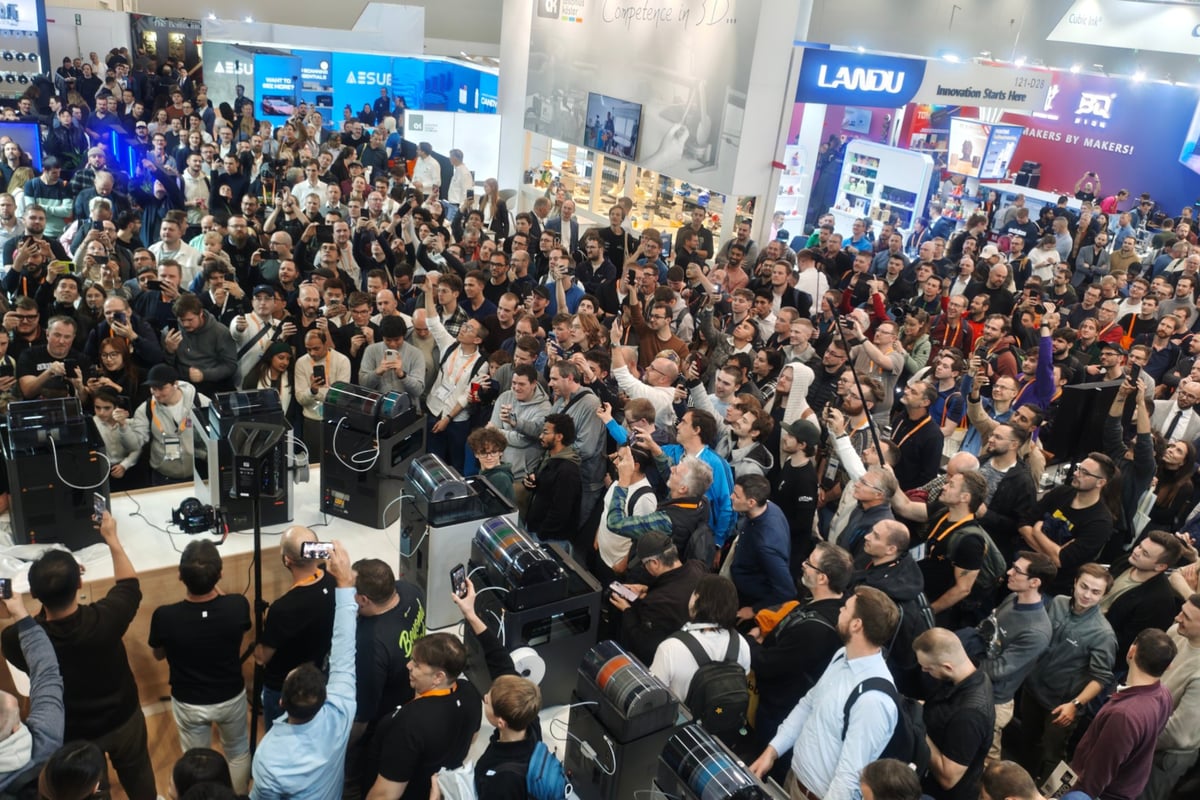
But Tao is unbothered. “We are a vision driven company… We believe 3D printing can or personal manufacturing can make a big impact on the world and we want to have millions of customers – normal people. We have more added value there instead of focusing on providing a solution for a certain vertical.”
The H2C’s party trick is, of course, its ability to swap one of its two nozzles with five alternates as required, allowing the near-waste-free printing of up to seven materials. “The elegance of the whole motion changing is beyond my imagination. I mean, even for me, sometimes I find myself staring at that thing for longer than I should.”
It is the culmination of some three years of R&D, design and engineering to solve an issue that Bambu Lab not only inadvertently popularized, but anticipated. “You realize immediately that the limitations and constraints of a single nozzle solution, especially when it comes to multicolor printing – everybody feels the pain and guilt of wasting that much plastic, of course. We started to brainstorm how to solve the problem before we had even finished the project of X1C.”
“For the H2C, even though we had a much larger group of engineers [working on it] it still took us 36 months to get it right.” After two of those three years, the company had hundreds of machines operational and printing, but even despite this, it would be some time before we ever saw the Vortek, with quality standards and process optimizations cited as the reason, one Tao chuckles is “the nice way to say ‘delayed’.”
The H2C launched at a Formnext that saw three attention-grabbing and competing approaches to multi-material printing: the H2C, with its Vortek nozzle-swapping mechanism and nozzles sharing a filament path fed by AMS devices; Prusa’s upcoming INDX upgrade for its Core One machines, making use of similar inductively heated nozzles but independent filament paths managed exclusively by the INDX smart printhead; and Snapmaker’s toolchanger, the U1, which uses a “traditional” near-full toolhead swap.
Together, they present an exciting time in desktop 3D printing. “You can see them everywhere. That’s where the industry – the competition – is interesting and inspiring. We were never sure that [Vortek] is the best – I don’t think anyone has a clear conclusion right now, and it’s very dynamic. You always find new pros and cons of every solution, and at the end of the day only the customer and time will tell which one is the best.”

Prompted on early reports of the nozzle changes not being as quick as some may have anticipated, Tao’s response doesn’t inspire much confidence for any imminent, massive improvement. “There’s always room for improvement, but it doesn’t mean you have infinite room for improvement. You can only push it to certain, say, boundaries.” Between this and the “delay” for optimizations, I can’t help but wonder if the Vortek, as we see it, is it for now. The timeline for its development would suggest that Bambu Lab is already deep in development on whatever supersedes the Vortek. To the system’s credit, having now used the one sitting in the All3DP lab, it seems reasonably quick to me, given the hard limit of a single shared filament path for all the Vortek nozzles.
For all the talk of material savings in multicolor use, it’s possible that heavy use of the active nozzle changing during a print is missing the H2C’s secret purpose as the ultimate 3D printer for lazy makers. “I think I represent a typical Bambu Lab customer,” Tao explains. “I basically throw everything from my computer or mobile phone to that printer – sometimes it’s a very simple task, sometimes I want to print a Hueforge with a 0.2 mm nozzle. For the H2C, it’s instant go. But for the X1C or A1, I really have to judge ‘Do I want to spend that time, to change the nozzle and calibrate it, you know?” He concedes “I think 60% of the time the laziness gets the better of me, but with the H2C, it’s the ultimate convenience machine.”
Outside of the specific hardware, it’s impossible to escape Bambu Lab’s orbit. Casual conversations with key figures in larger, more industrially focused companies inevitably turn to Bambu Lab and what it has achieved.
In parallel to this, alarm bells are raised, as they typically are, around upwardly mobile tech companies from China. Some paint it as the elephant in the room: Security. For Bambu Lab, it’s an artificial argument. “Of course, some verticals found our printers useful, and we are happy that they adapted and use it” but ultimately the company considers itself a consumer brand, aiming to make the best mass-appeal machines it can.
Bambu Lab’s argument on the security of its machines is simple. “I think if you really look into facts – not guesses, forecasts or assumptions – we have a very good track record. Yes, there was a great controversy over the firmware thing, but it’s all based on assumptions. You know, ‘Bambu could do something in the future’.”
“I don’t like the narrative that ‘Bambu Lab is evil because it could do something in the future’ – that goes with any electronics maker; Apple could do evil things to you. Google could do that.” The company’s larger point, drawing animated responses from three around the table, is that in the consumer industry it sees a trade-off of pervasive consumer-centric companies and the – crucial word here – potential for abuse. “Given the number of printers we’ve sold [a number in the millions], if there was something wrong, why has no one revealed it already.”
Widening the context not simply to 3D printing but electronics and infrastructurally involved companies from China meeting resistance at the governmental level – apt given Tao’s history as a key member at DJI during its rise to dominance in the drone space – the company’s strategy is clear, laid out with its pursuit of certifications. “I think third-party certification have more credit. They have more skills to judge or to examinate everything. I think that’s the way we go.”
Ultimately, he concludes: “it’s not up to us, right? We can simply do as much as we can to make us trustworthy, and anything else is beyond our control.”
Read more recent news:
- Bambu Lab P2S Now Available in the U.S., H2C Preorders Open
- 3D Printing Black Friday: Honest Look at Elegoo, Creality & Bambu Lab Offers
- The 20 Top New 3D Printers from Formnext 2025: Tool Changers, 6-Laser Metal, and PEEK Printing
Tired of Reading? Try Listening
License: The text of "Bambu Lab CEO Ye Tao Explains Why the H2C Is the Ultimate Machine for Lazy Makers" by All3DP is licensed under a Creative Commons Attribution 4.0 International License.