The 20 Top New 3D Printers from Formnext 2025: Tool Changers, 6-Laser Metal, and PEEK Printing

Next-gen multi-color, continuous fiber breakthroughs, and a massive surge in robotics dominate the year's most important hardware show.
All3DP’s editors spent four long, lively days roaming the vast halls of Formnext 2025 in Frankfurt—the planet’s biggest playground for 3D printing and additive manufacturing. We logged thousands of steps, watched hundreds of machines whir and hum, handled more printed parts than we could count, and spoke with scores of company reps to get the clearest picture of where the industry is heading. All in the name of bringing you the inside scoop on what’s new, what’s coming, and what made the crowds stop mid-stride.
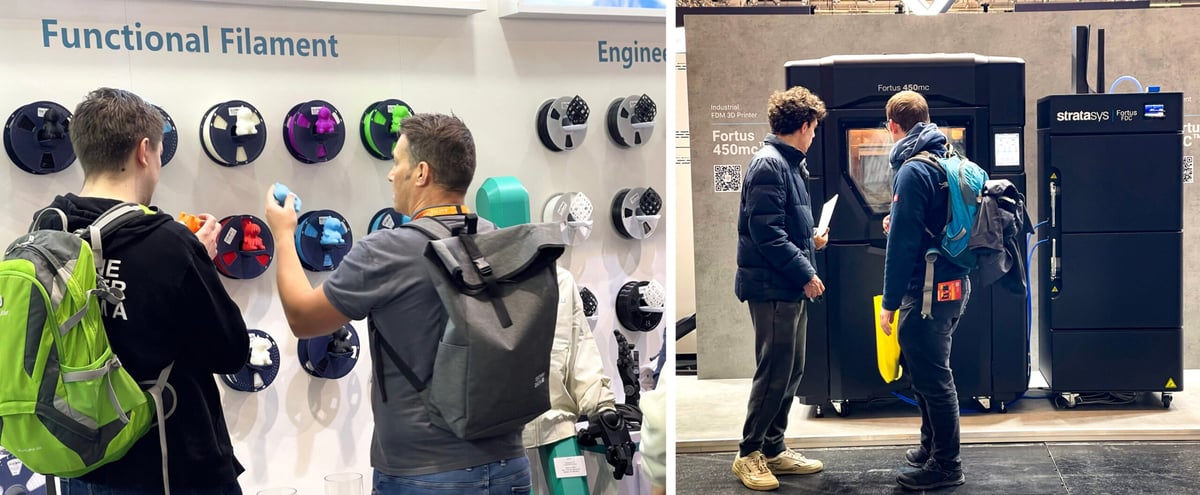
Boats & Drones & Robots
This year’s show delivered a welcome surge of fresh hardware compared to last year’s drought, but the real story was the explosion of applications, especially anything that flies. Aerospace and defense loomed large; if you were even thinking about building a drone, Formnext had you covered from concept to composite. And unexpectedly, boats were everywhere too. Not just the full-size kind—though those made appearances—but models, prototypes, and even a 3D-printed Jet Ski cruising into the spotlight.
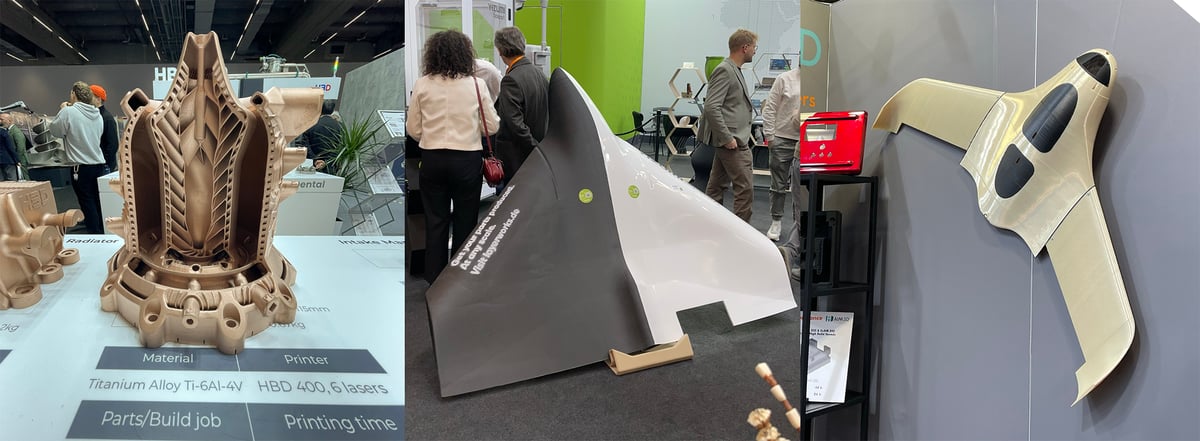
Robotics also muscled in, with more robotic arm 3D printers than ever and a flood of robotics companies eager to join the additive manufacturing club. Yet, true to tradition, Formnext remained a home for every corner of the industry, from scrappy prosumer brands to the industrial heavyweights.

What follows is our annual roundup of the most promising and notable printer debuts of Formnext 2025. Fair warning: many aren’t shipping yet. Expect announcements to roll out over the next three to eight months—and rest assured, we’ll keep our new-printer guide updated as they land. Let’s dive in.
New FDM 3D Printers
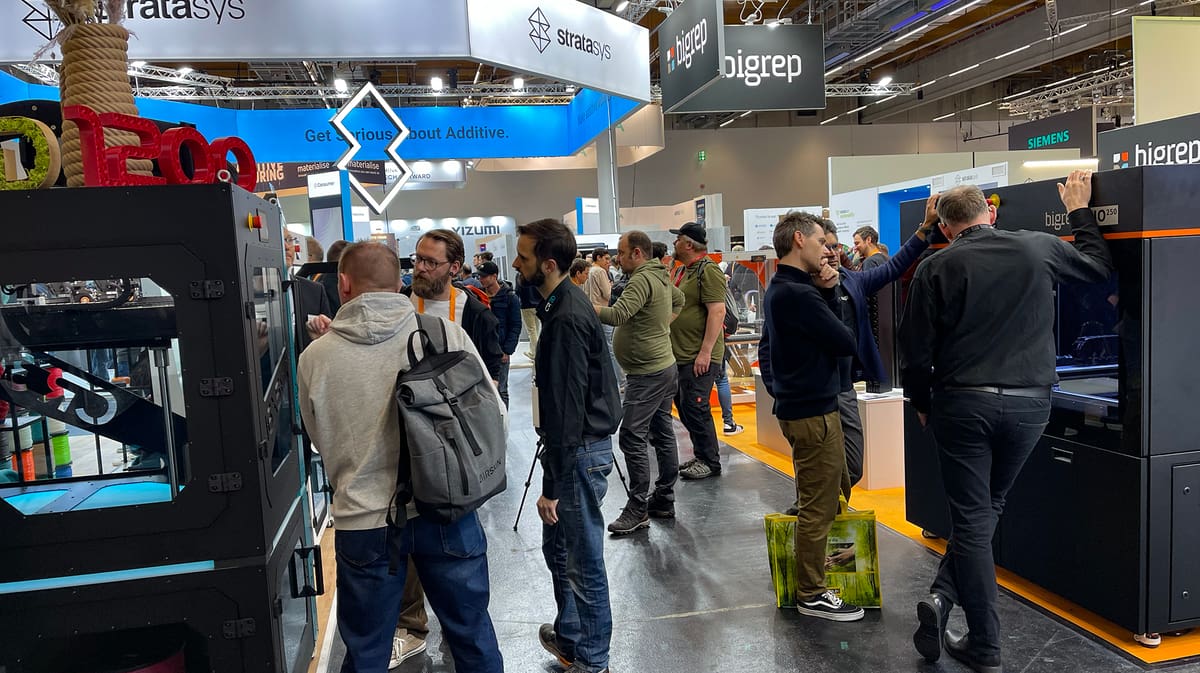
Material-extrusion debuts at Formnext ran the gamut from high-temperature brutes to color-slinging crowd-pleasers—proof that the humble filament printer is still evolving at breakneck speed.
Bambu Lab H2C Unleashes Next-Gen Nozzle Swapping
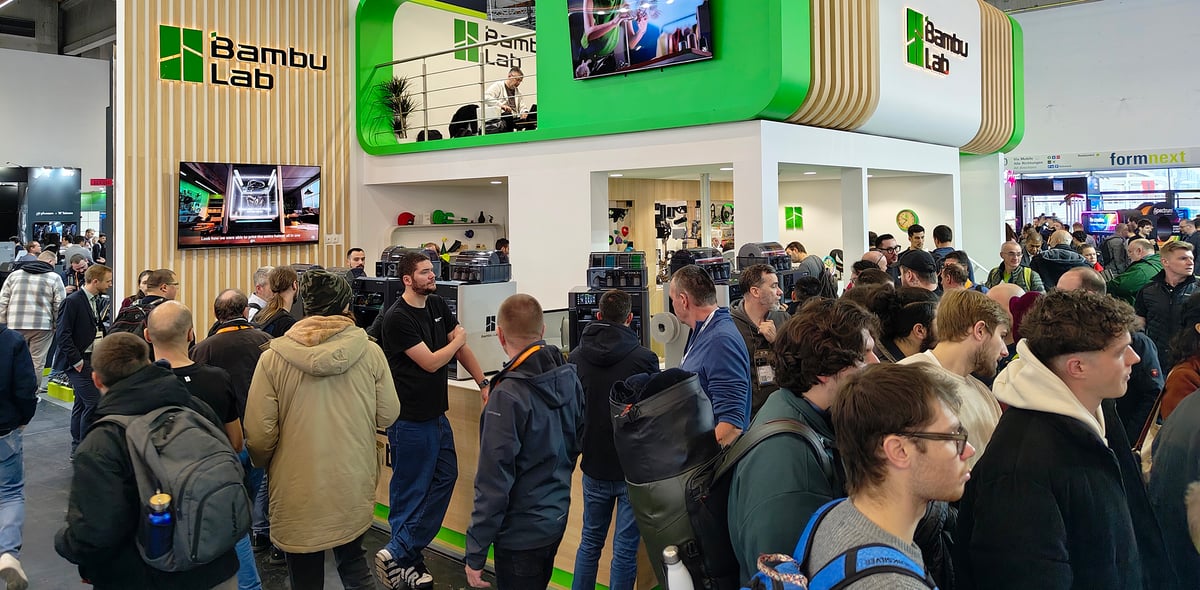
Formnext may be a pro-focused expo, but it’s clear what the pros want: Bambu Lab performance at Bambu Lab prices. The company’s booth was perpetually mobbed, culminating in a shoulder-to-shoulder crush when the new H2C took the stage.
The Bambu Lab H2C ($2,399) is the “high-end” evolution of the H-series, retaining its generous 330 × 320 × 325 mm build volume (actual usable space per nozzle may vary). Like the H2D, it sports dual nozzles—but instead of two manual hot ends sitting side by side, the H2C pairs a single manual left hot end with Bambu’s brand-new Vortek quick-swap system on the right.
The headliner is multi-material magic: a purge-saving system with seven smart-swapping hotends capable of handling up to 24 filaments. And unlike traditional toolchangers that park and retrieve entire printheads (Prusa XL, Snapmaker U1—we’re looking at you), the H2C swaps only the nozzle. It’s automatic, fast, and shockingly seamless.
Our unit just landed in the All3DP lab, so expect hands-on coverage soon.
Prusa Adds INDX to the Core One: A “Passive” Toolchanger With Big Ambitions
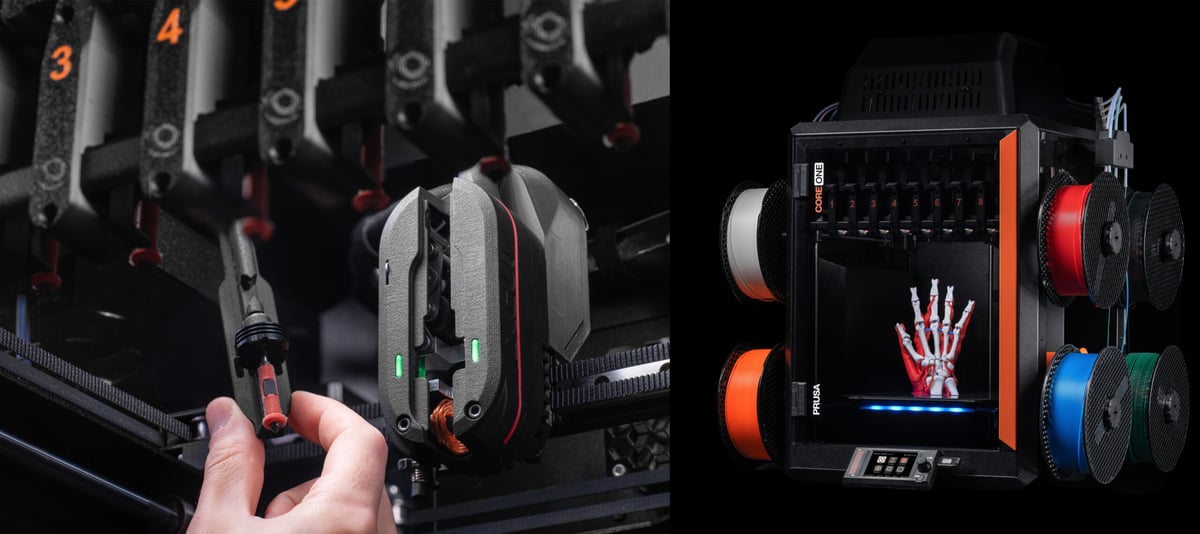
Calling Prusa’s latest announcement an “upgrade” feels modest. Debuting at Formnext, the new INDX-enabled Core One platform integrates Bondtech’s cleverly engineered system for what Prusa describes as “passive tool-changing.” In practice? It behaves like a full toolchanger without the usual mechanical sprawl.
The setup revolves around one active smart head—responsible for sensing, extrusion, and delivering power–to the up to eight slim, wireless passive tools that clip in to provide multi-material capabilities. No bulky carousels, no gantry gymnastics. Just fast, clean, low-waste swaps that turn the Core One and Core One L into compact, production-capable machines.
Prusa expects a full rollout in Q2 of next year.
Elegoo Unveils Centauri Carbon 2 With New Multicolor “Canvas” Feeder
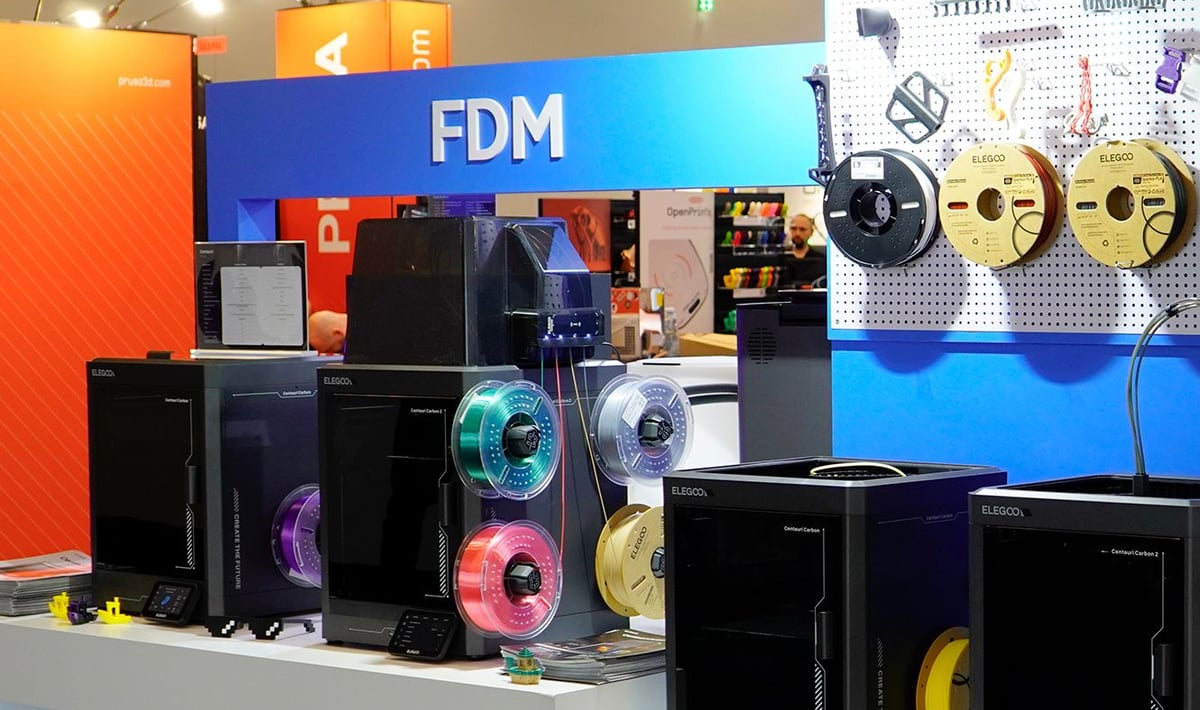
Elegoo didn’t waste any time following up its Centauri Carbon—maybe a bit too little time for recent buyers’ comfort–but the company assures us it’s a full sequel, not a rushed redux.
The freshly revealed Centauri Carbon 2 brings multicolor printing into the mix via the new “Canvas” automatic feeder, mounted to the side of the machine like a proud backpack.
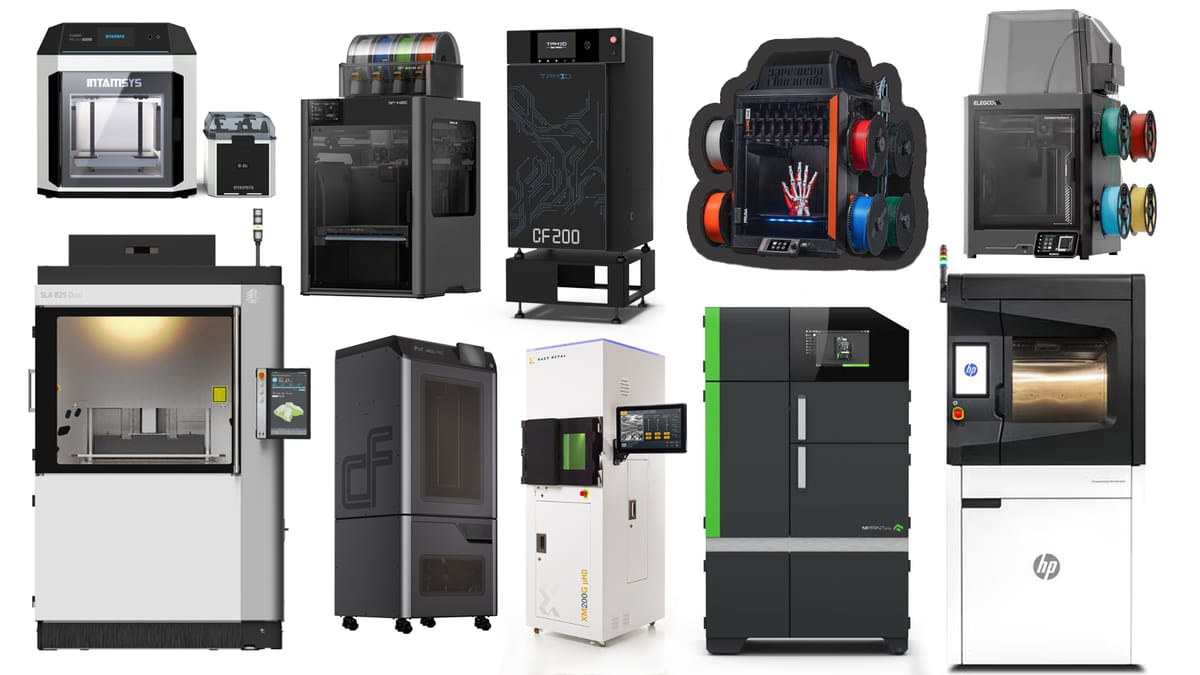
Here’s what seems clear: four-filament support, RFID material recognition (using Elegoo’s promised open standard), and automatic chamber venting for thermal management. The top temps get a boost over the original Centauri Carbon, too: 350°C and 110°C at the hot end and bed, respectively.
HP Gets Into the High-Temp FDM Game
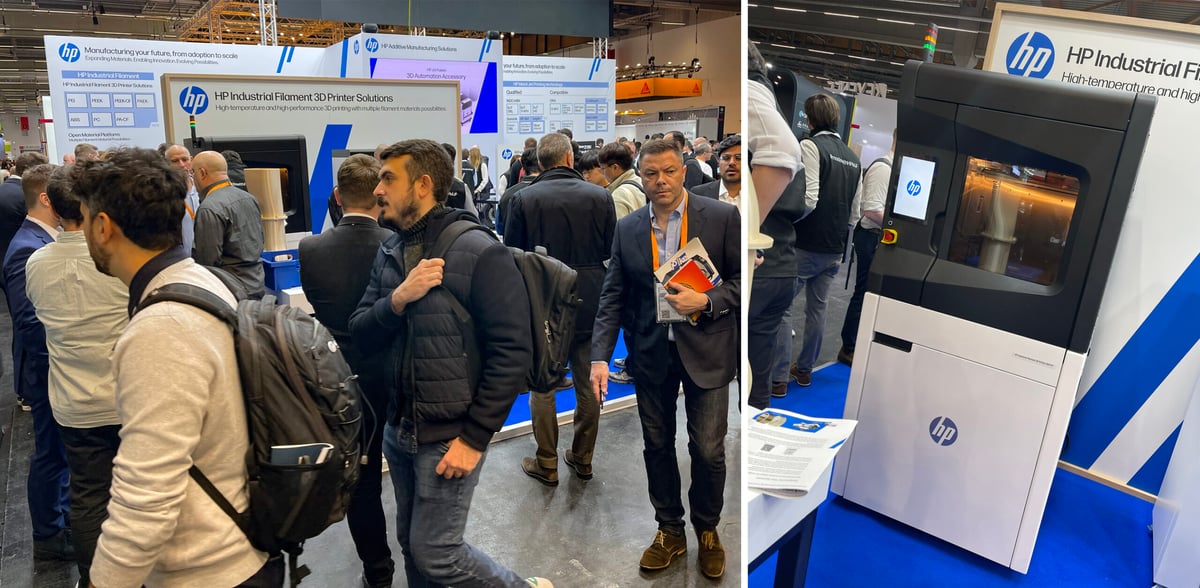
Yes, you read that right: HP is officially stepping into filament extrusion. The HP Additive Manufacturing booth buzzed with curiosity as the company showed off its new HP IF 600HT and HP IF 1000 XL, which are industrial FDM systems sourced not from HP’s labs but from Texas-based 3DGence.
From what we can tell, the machines correspond to the 3DGence Industry F421 and F1000: large-format, high-temperature brutes with swappable print modules for everything from PLA to reinforced composites to PEEK. HP’s versions add extra certifications and security features meant for the enterprise world.
It’s a notable expansion for HP and a signal that filament extrusion still has serious industrial pull.
Intamsys Brings PEEK-Grade Printing to the Desktop
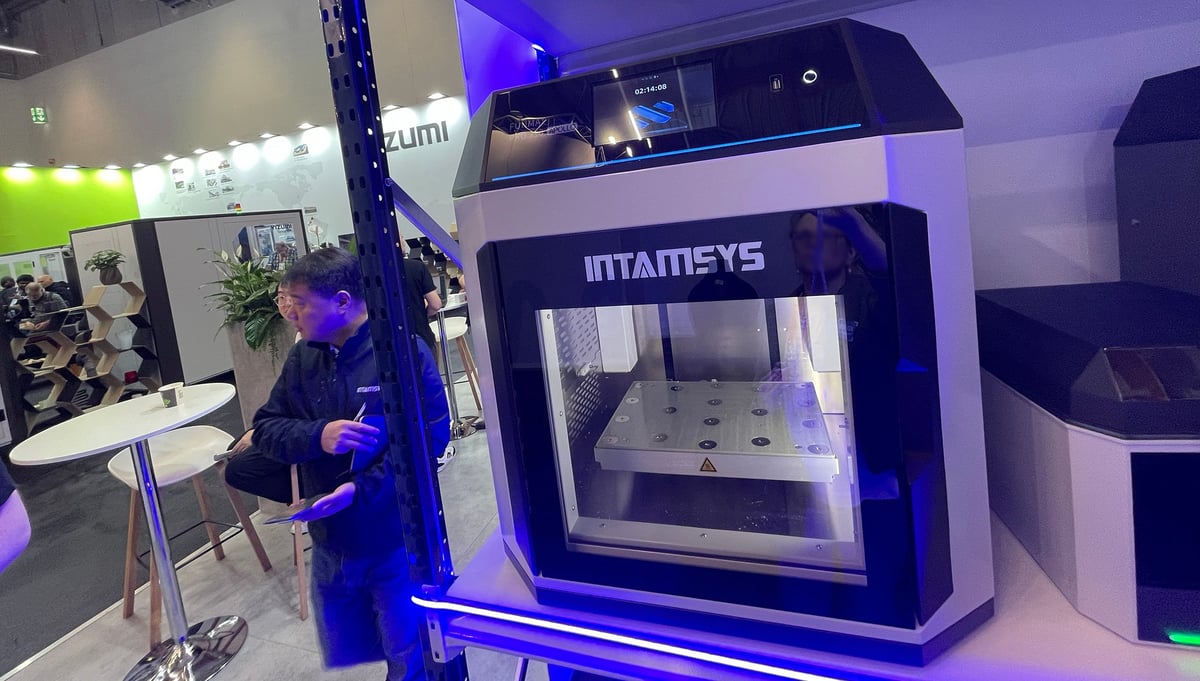
Intamsys used Formnext to roll out the Funmat Pro 310 Apollo, the latest iteration of its industrial desktop FDM line. It keeps the independent dual extruder and build volume of the Pro 310 Neo, but cranks the nozzle temp from 350°C to a blistering 450°C.
That bump unlocks roughly half a dozen new PAEK-family materials, including PEEK, PEKK, and both carbon-fiber and glass-fiber reinforced PEEK. Intamsys is pitching the Apollo as a production-ready platform, boasting 4× faster print speeds and more than double the Z-axis strength of earlier models.
Twin 3-kg active-drying filament boxes, RFID tracking, and the IntamQuality traceability system push it squarely into factory territory—logging every parameter to create a digital fingerprint for every part.
FibreSeeker 3 Launches Big: Triple-Material Printing and Real Carbon-Fiber Strength
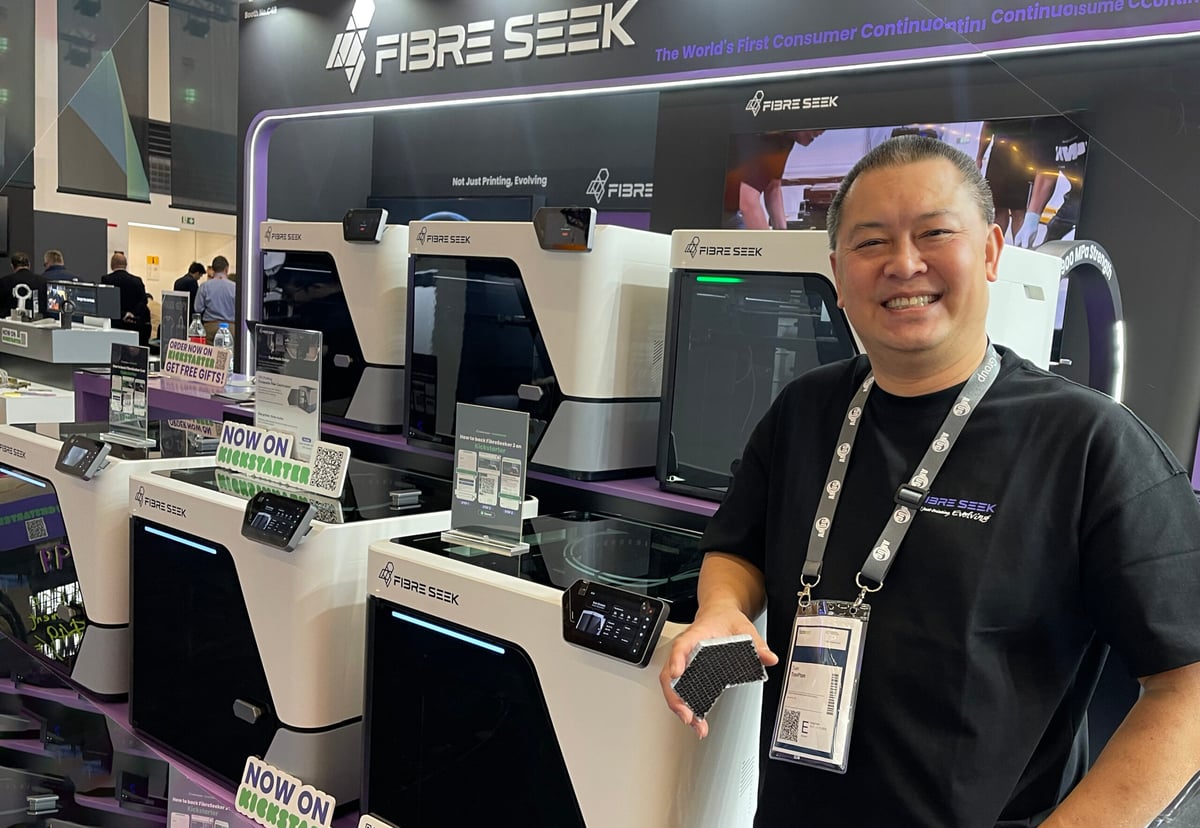
Fresh off a blockbuster Kickstarter (nearly $2M at the time of writing), FibreSeek’s FibreSeeker 3 ($2,795) aims to bring continuous carbon-fiber strength to the desktop at a fraction of Markforged’s cost.
Its Composite Fibre Co-extrusion (CFC) process embeds continuous, unbroken strands of fiber directly into molten polymer—unlike carbon-fiber-filled filaments, where chopped fibers serve mostly for stiffness (or aesthetics, in the case of PLA-CF). Intact strands mean true structural reinforcement.
The design echoes FibreSeek’s earlier life as Anisoprint, with similar software (Aura Slicer) and the same dual-nozzle architecture: one for polymer, one for fiber. It can even combine three materials in a single print, assigning reinforcement only where needed.
It’s shaping up to be one of the most compelling composite startups to watch in 2025.
CFSYS Steps Into the Continuous-Fiber Spotlight With Its New A500 Printer
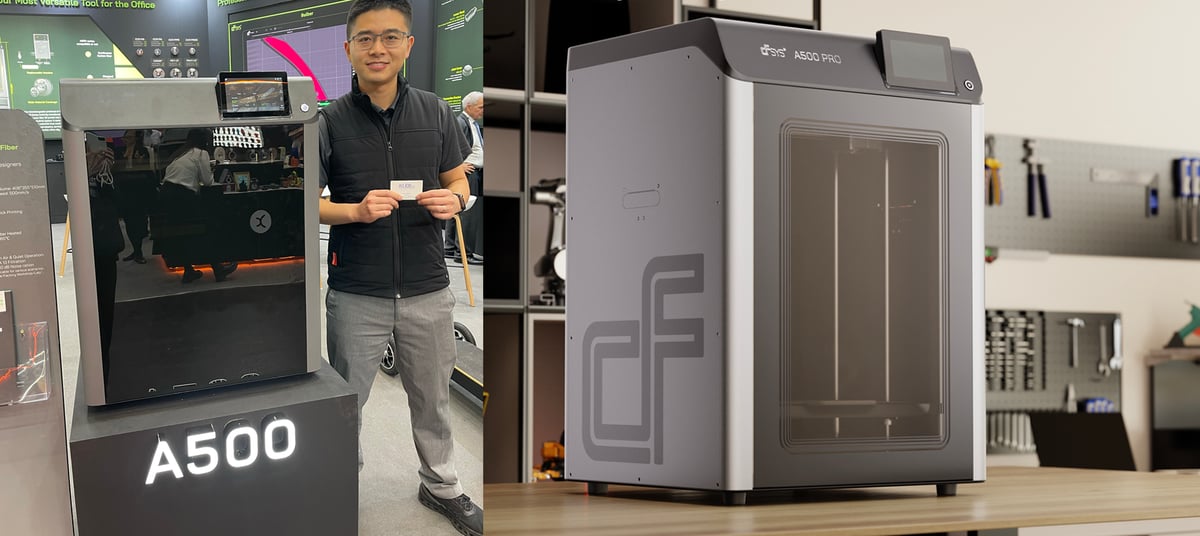
With all the talk of continuous carbon fiber trailblazer Markforged not being at Formnext this year, we couldn’t not mention another continuous fiber desktop 3D printer debuting at Formnext looking to fill the void. Chinese company CFSYS offered up the A500, its flagship continuous-fiber FDM 3D printer.
The A500 boasts a roomy 410 × 360 × 510 mm build chamber, claimed speeds up to 500 mm/s (unusually fast for composites), modular hotends that swap in seconds, and a dual thermal system combining a heated chamber with active cooling. A fully enclosed filtration system keeps emissions in check.
Material support includes continuous carbon and glass fibers, plus engineering polymers like PA-CF, PET-CF, ABS-CF, PC, PA, ASA, and PP.
But there’s a twist: the printer isn’t available in the U.S. yet due to unresolved disputes over continuous-fiber patents. While Anisoprint/FibreSeek and Markforged hold known IP in this area, CFSYS has been less transparent about its tech stack.
Still, as a “lab-to-reality” machine for composite production, the A500 drew plenty of curious attention.
New Resin & SLS 3D Printers
If your polymer preferences skew toward liquids or powder, Formnext 2025 wasn’t overflowing with brand-new launches—but the few that did appear came from some of the biggest names in the game. 3D Systems and Farsoon both pushed the boundaries of scale and speed, while a handful of ambitious newcomers aimed straight at the market leaders.
3D Systems Goes Big With Tighter Specs and New High-Performance Resins
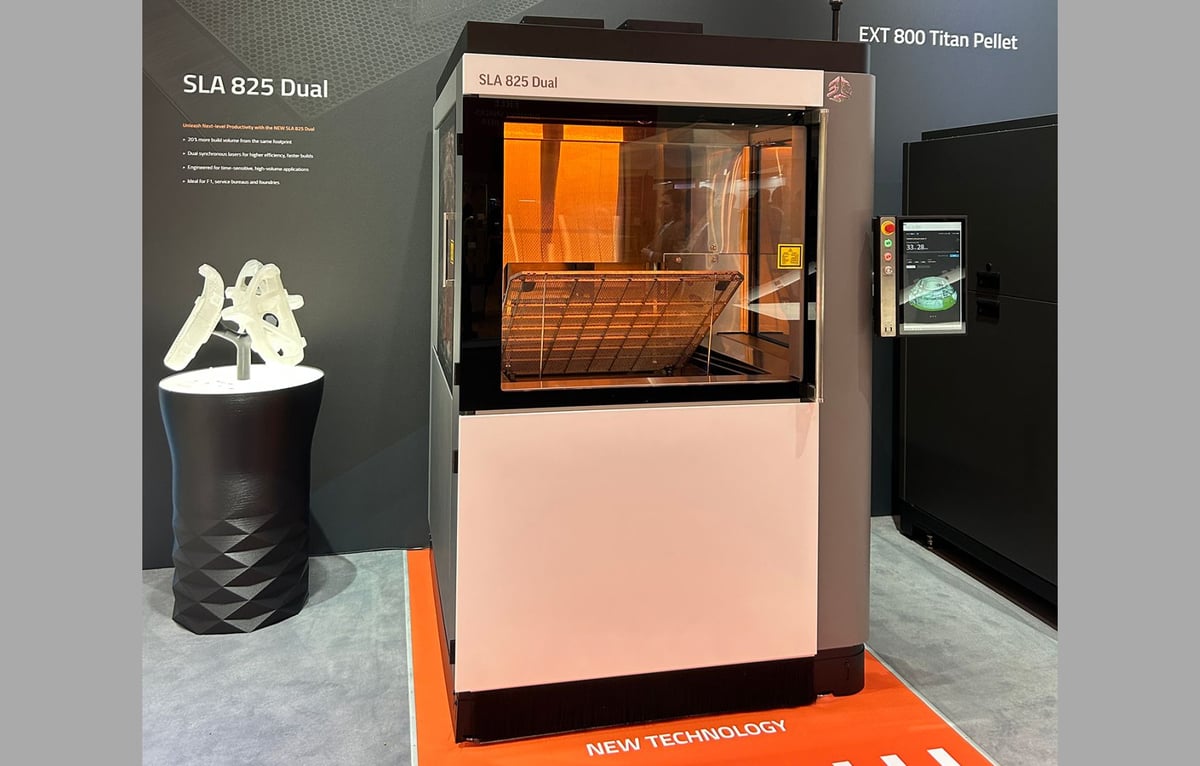
Just days before Formnext kicked off, 3D Systems unveiled the SLA 825 Dual — a beast of a stereolithography machine with a footprint roughly 20% larger than the SLA 750 Dual. But size isn’t the only upgrade: the company is now unusually transparent about specs, listing 50–150 µm layer thickness and a razor-sharp 0.0127 mm XY feature size. The SLA 750 never offered such explicit figures, instead leaning on “2000 dpi” claims.
The SLA 825 Dual configuration leverages two 4 W lasers tied together using the company’s proprietary HyperScan Technology. Throughput numbers aren’t public yet, but 3D Systems is already touting the SLA 825 as its “most advanced” large-frame SLA machine, aimed squarely at motorsports, foundries, and service bureaus that run big parts daily.
Based on the reaction at the booth—crowds gawking at huge components sprawled across every available surface—it’s clear the focus here is volume. Supporting the hardware is a set of new materials, including Accura SbF and Accura Xtreme Black.
UnionTech Targets Large-Scale SLA With 60% Efficiency Boost
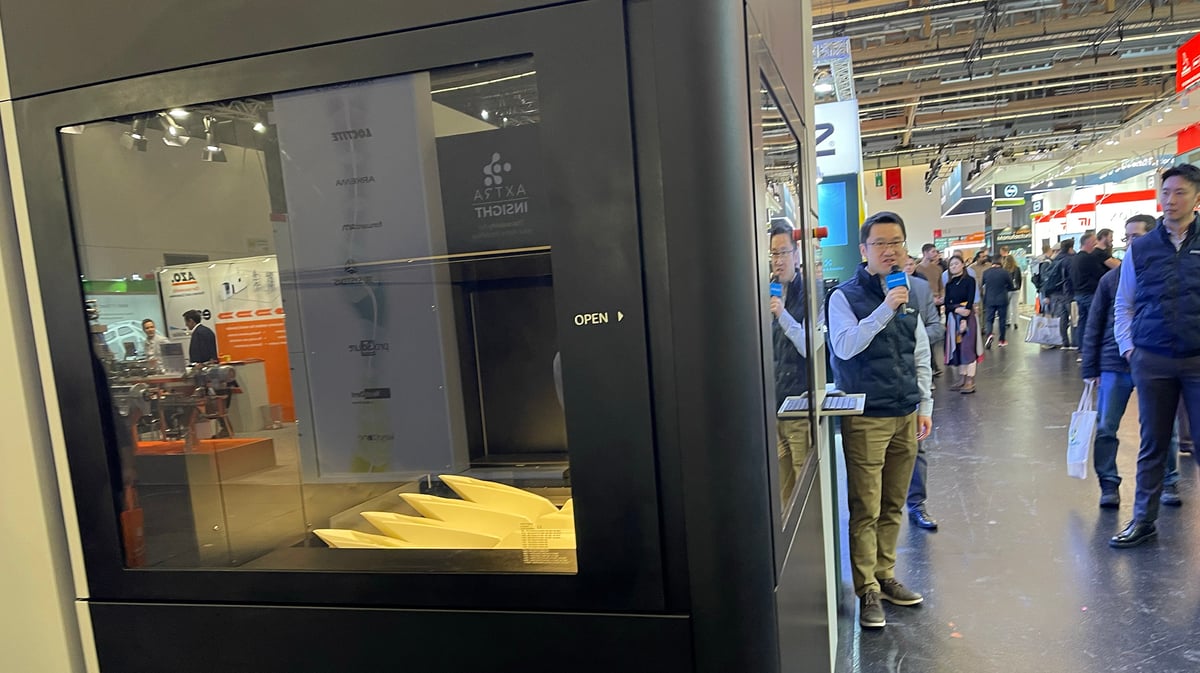
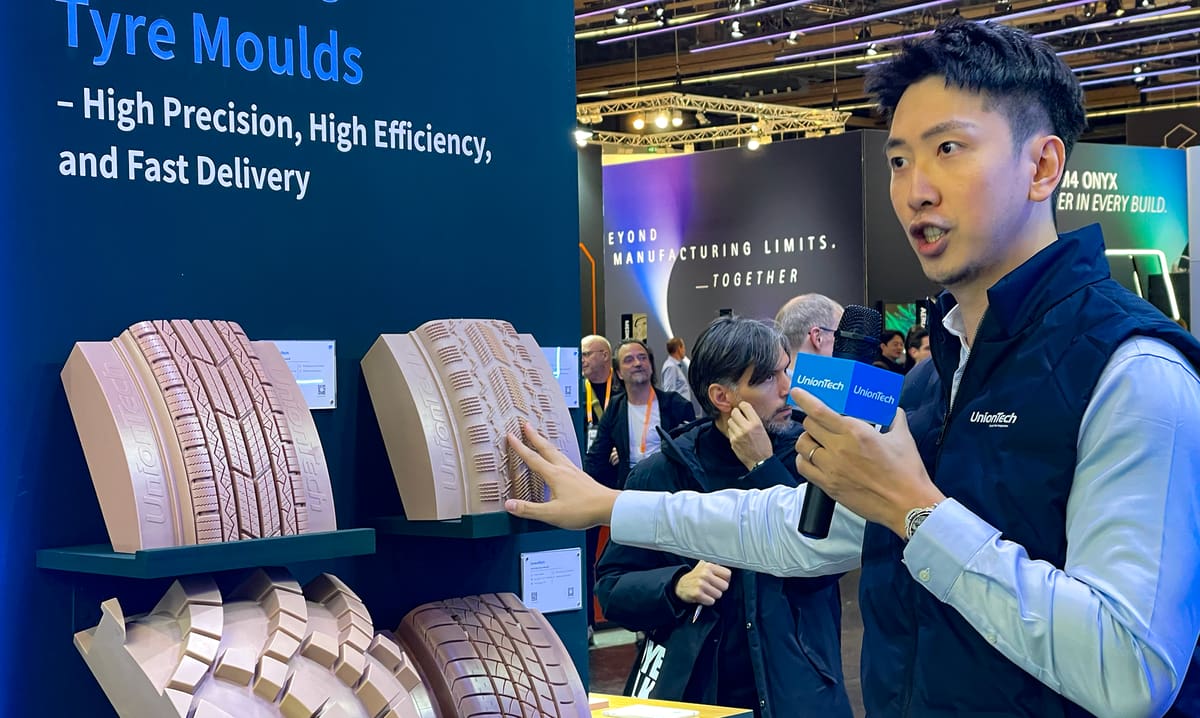
If there was any doubt that SLA is drifting toward large-format, high-throughput territory, UnionTech’s Formnext showcase settled it. The company debuted another new large format SLA systems, along with in-house resin formulations.
All3DP was on site for the launch of the RSPro800 X, which UnionTech calls the first large-format SLA printer with a four-laser architecture. The system uses a custom load-balancing algorithm to coordinate the quartet of lasers, allowing all four to work simultaneously across the build plane. The result, UnionTech says, is up to 60% higher efficiency without sacrificing precision.
As SLA gives way to LCD and DLP for small parts, UnionTech seems intent on claiming the high-volume industrial end of the spectrum.
TPM3D’s SLS Printer Promises Sub-$25K Pricing and Industrial Performance
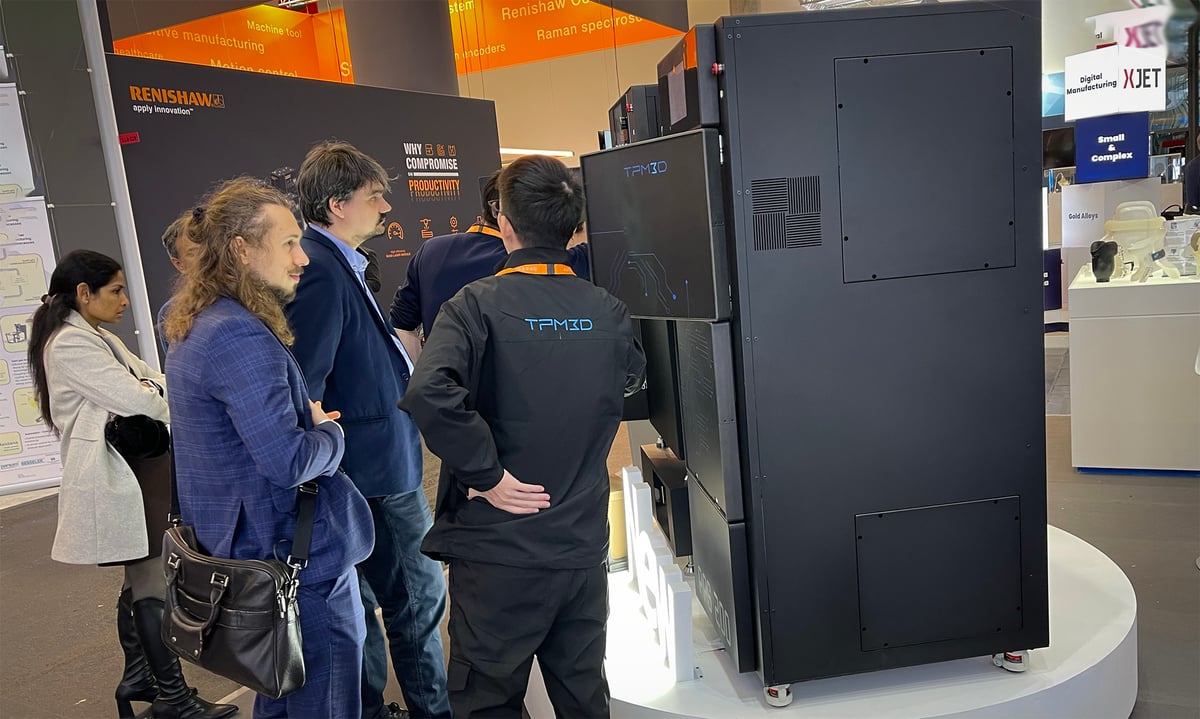
On the powder side of the hall, China’s TPM3D revealed its new benchtop-friendly SLS machine, the CF200, paired with the PPS200 material prep station. The live on-stage debut drew a solid crowd—and for good reason. TPM3D, a company with more than 20 years of SLS experience and a thick portfolio of industrial machines, is clearly targeting Formlabs’ Fuse line with this release.
The specs tell the story: a 30 W laser (matching the Fuse 1+ 30W), a larger build volume (200 × 200 × 320 mm vs. 165 × 165 × 300 mm), and a 100 µm layer thickness. The CF200 also advertises a print speed of 0.5 – 0.8 L/h—numbers Formlabs has never publicly quantified. Material support includes PA11, PA12, TPU, and “other engineering-grade powders.”
Pricing isn’t final, but TPM3D says the CF200 alone will land under the Fuse 1+ 30W’s ~$25K price tag. The printer plus the PPS200 together should come in around $40K. If those numbers hold, the small-SLS market has a serious new contender.
HT601P-2 Launches as Farsoon’s Balanced, Industrial SLS Workhorse
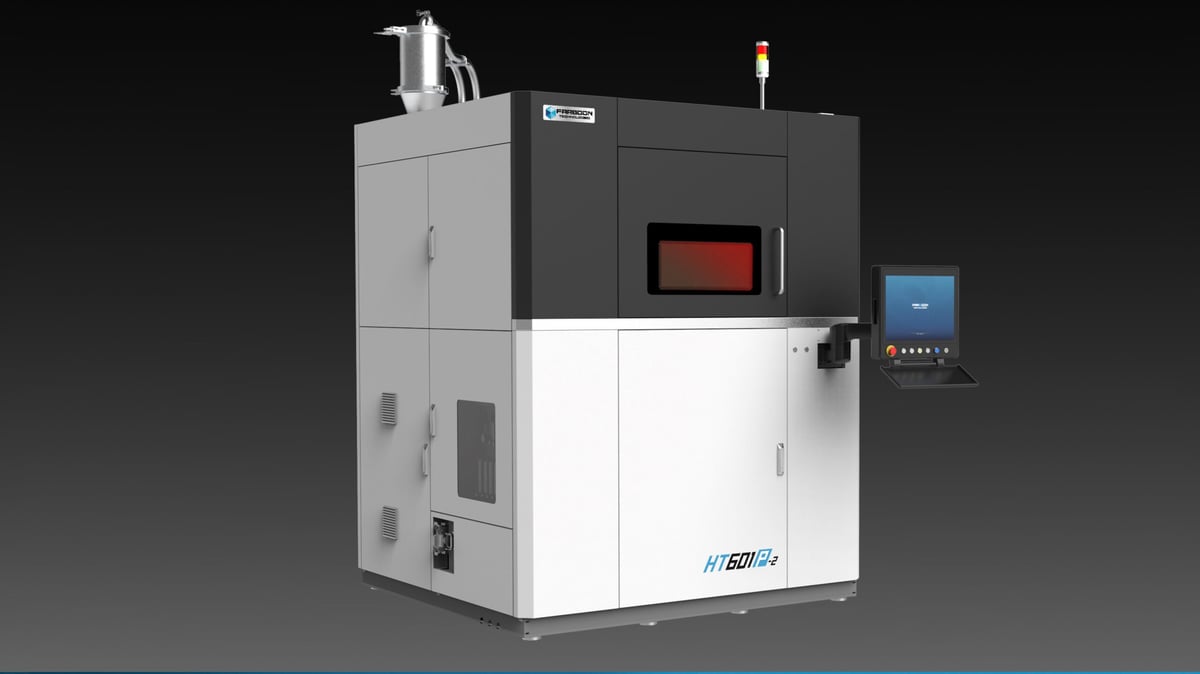
Farsoon Technologies expanded its portfolio with the HT601P-2 CO₂ PBF system, a large-format SLS machine sporting a 600 × 600 × 600 mm build chamber and dual 100 W CO₂ lasers. The system supports polymers including PA6, PBT, PA11/12, and TPU, and is tuned for serial production.
This model follows Farsoon’s previous HT601P-4, which used a quad fiber-laser setup. The new HT601P-2 trades raw laser count and scanning-speed potential for broader material compatibility and more streamlined production economics. Farsoon emphasizes full-field uniformity (<5% mechanical variation), ±3°C thermal control, and an interchangeable build cartridge designed for true continuous-operation workflows.
If the HT601P-4 was built for maximum power, the HT601P-2 is its more refined sibling—optimized for real-world, large-scale polymer production where consistency often matters more than sheer wattage.
New Metal & Ceramic 3D Printers
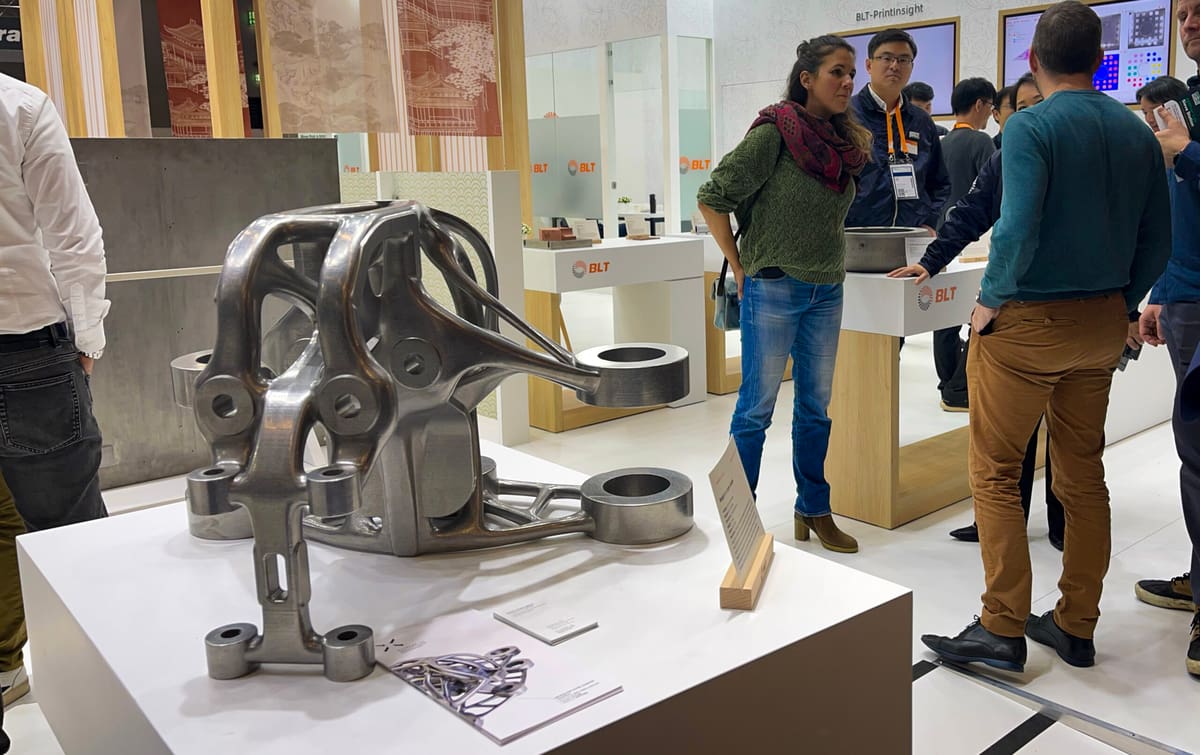
No Formnext is complete without the giants—the metal 3D printers so massive they cast literal shadows across the hall. Attendees once again clustered around towering builds of heat exchangers, rocket thrusters, manifolds, and aerospace-grade spare parts. And this year, the metal category delivered everything from multi-kilowatt production platforms to micron-scale precision machines.
But accessibility and affordability continue creep in to this segment of the market. Several companies redefining the entry point to metal laser powder bed fusion with benchtop and desktop LPBF machines were on hand claiming to be focused on the dental market, but likely with larger ambitions.
EOS’ New M4 Onyx: Six 400-W Lasers, 50% Higher Throughput
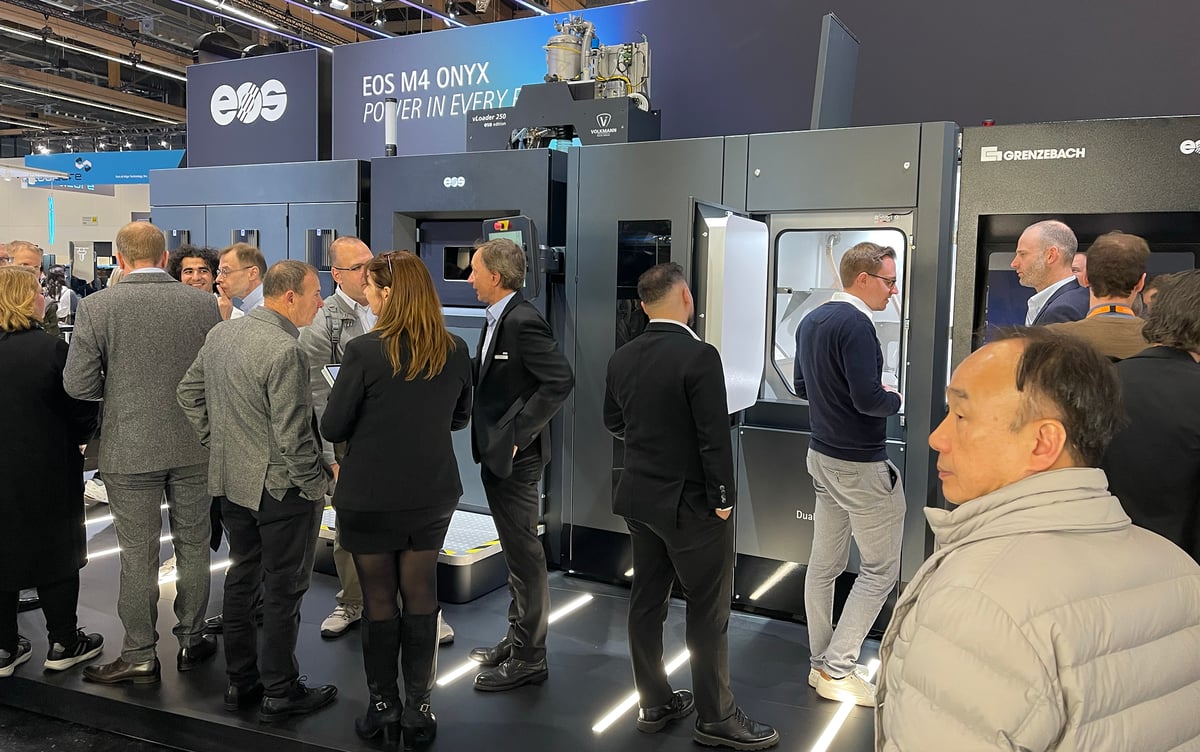
We’d already covered the EOS M4 Onyx before arriving in Frankfurt, but nothing beats a backstage tour. EOS CTO Joachim Zettler walked us behind the machine to show off what he considers its crown jewel: a next-generation recirculating filtration system designed to slash hazardous waste by 90%.
Yes, the M4 Onyx sports a larger build volume and six 400 W lasers delivering up to 50% higher throughput—but Zettler argues the waste-management breakthrough is the real story. Metal LPBF produces reactive condensate, soot, and ultra-fine particles that are costly and tricky to neutralize. According to EOS, no other system addresses this issue as comprehensively.
In a field obsessed with lasers, throughput, and speed, EOS is reminding everyone that responsible scaling matters too.
Eplus3D’s EP-M550 8-Laser Workhorse
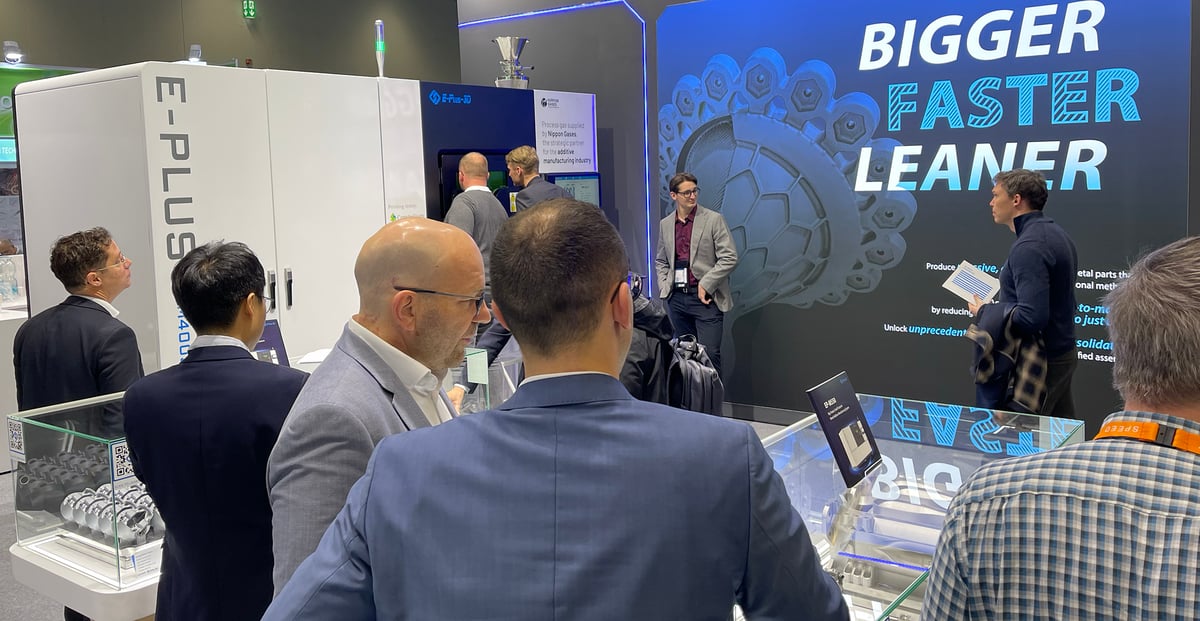
Eplus3D’s new EP-M550 is a heavy-hitting LPBF system packed into a surprisingly modest 7.6 m² footprint. Its 550 × 550 × 450 mm build chamber can be driven by four, six, or eight lasers—ideal for manufacturers ramping into true serial production without expanding their factory floor.
Compatible alloys span titanium, aluminum, nickel, stainless steel, maraging steels, and cobalt-chrome. Positioned as the next step beyond the EP-M400S, the EP-M550 clearly targets aerospace, energy, tooling, automotive, and semiconductor suppliers ready for high-throughput metal AM.
Eplus3D has deep roots—its team developed China’s first metal PBF system back in 1993. With the EP-M550, the company is signaling its continued push into the top tier of industrial metal additive manufacturing.
Xact Metal launches XM200G μHD metal 3D printer; XM300G development continues
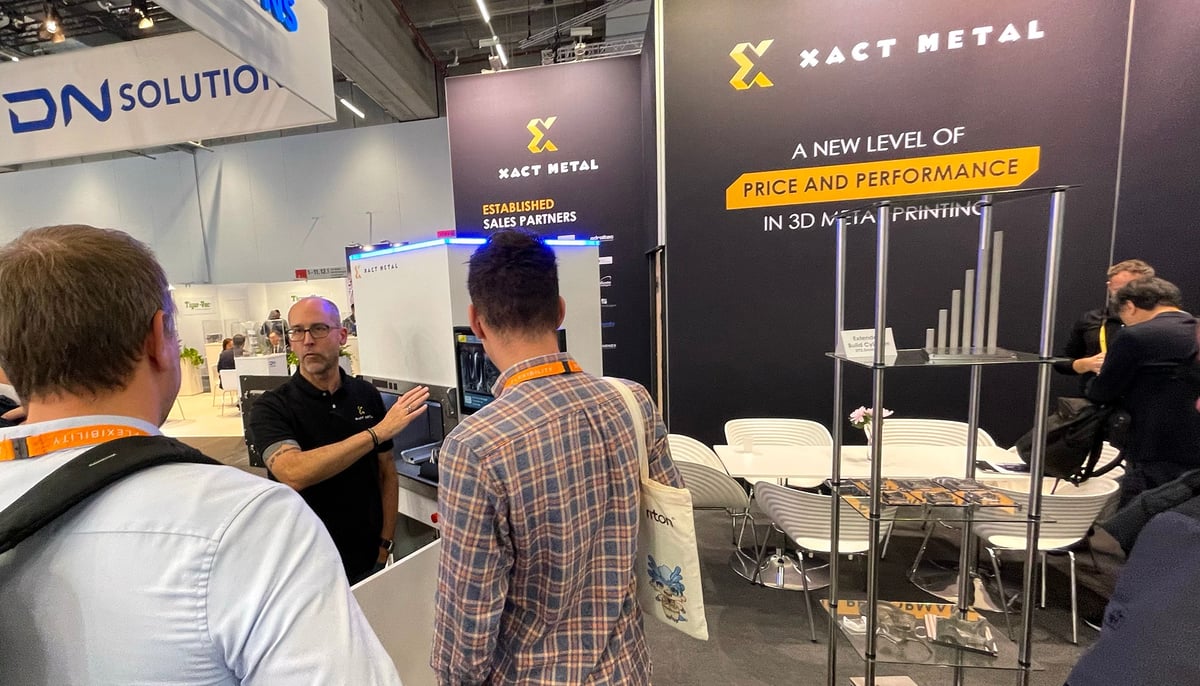
Xact Metal used Formnext to launch the XM200G μHD, a micro-precision LPBF system designed for tiny features and ultra-fine powders (5–15 µm). A 25 µm laser spot enables extremely detailed builds in a compact 140 × 140 × 150 mm volume—extendable to 290 mm in Z.
Laser power options scale from 100 W to 400 W, and shipments begin mid-2026.
Xact Metal also announced new materials partnerships with Sandvik (Osprey MAR 55 tool steel) and Equispheres (NExP-1 non-reactive aluminum), as well as progress on the larger XM300G. That system—300 × 300 × 400 mm with one to four 500 W or 1,000 W lasers—has entered order-taking, with shipping expected in late 2026.
For a company built around affordability and accessibility, these moves show a clear march into more advanced industrial territory.
One Click Metal Targets Production Users With High-Power Proline
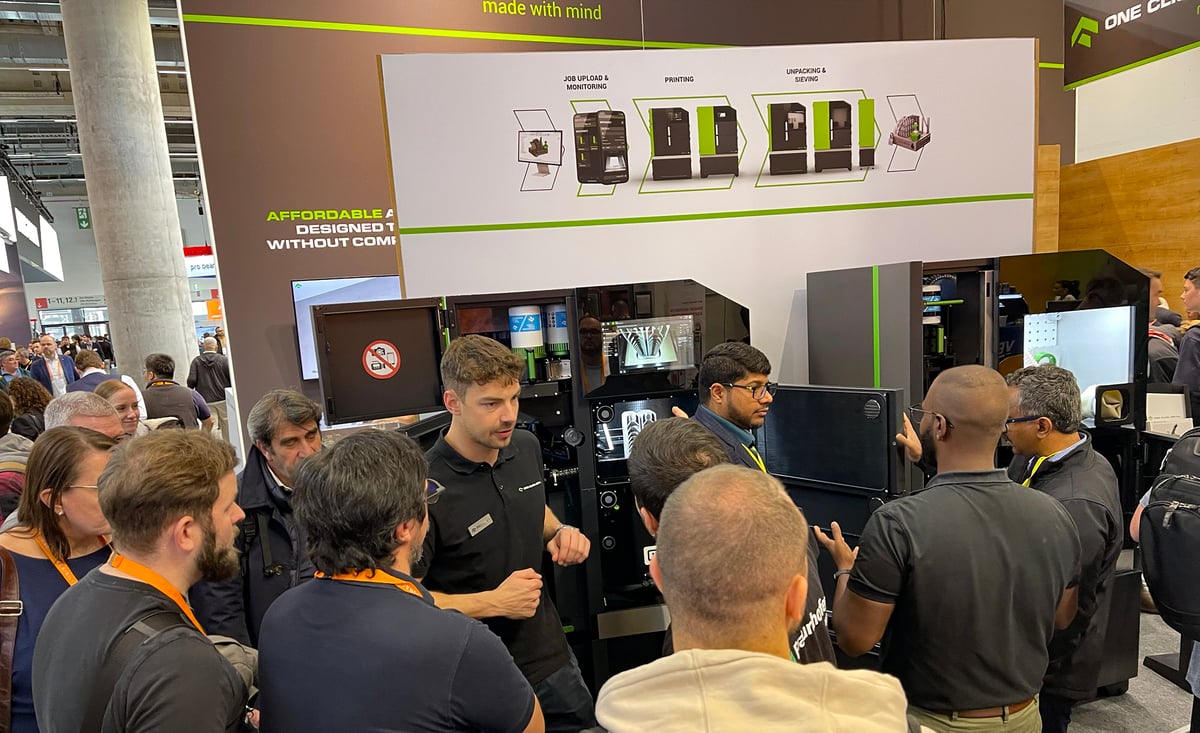
One Click Metal revealed its new Proline LPBF system just weeks before Formnext, but we’re counting it—the show was its first public stage appearance. Best known for its entry-friendly Baseline series, the German company is now aiming at customers scaling from R&D to industrial production.
The star upgrade is a 500 W laser, enabling faster build rates and opening the door to higher-performance, harder-to-melt alloys. A new self-cleaning filter system, co-developed with Herding Filtertechnik, promises up to 500 hours of operation without user intervention—a huge draw for production environments where uptime is everything.
The new line centers on the MPrintPro printer and the MPurePro powder-handling station, firmly planting One Click Metal in the industrial LPBF arena.
XJet Unveils Carmel Pro, Aiming NPJ at Small and Mid-Size Manufacturers
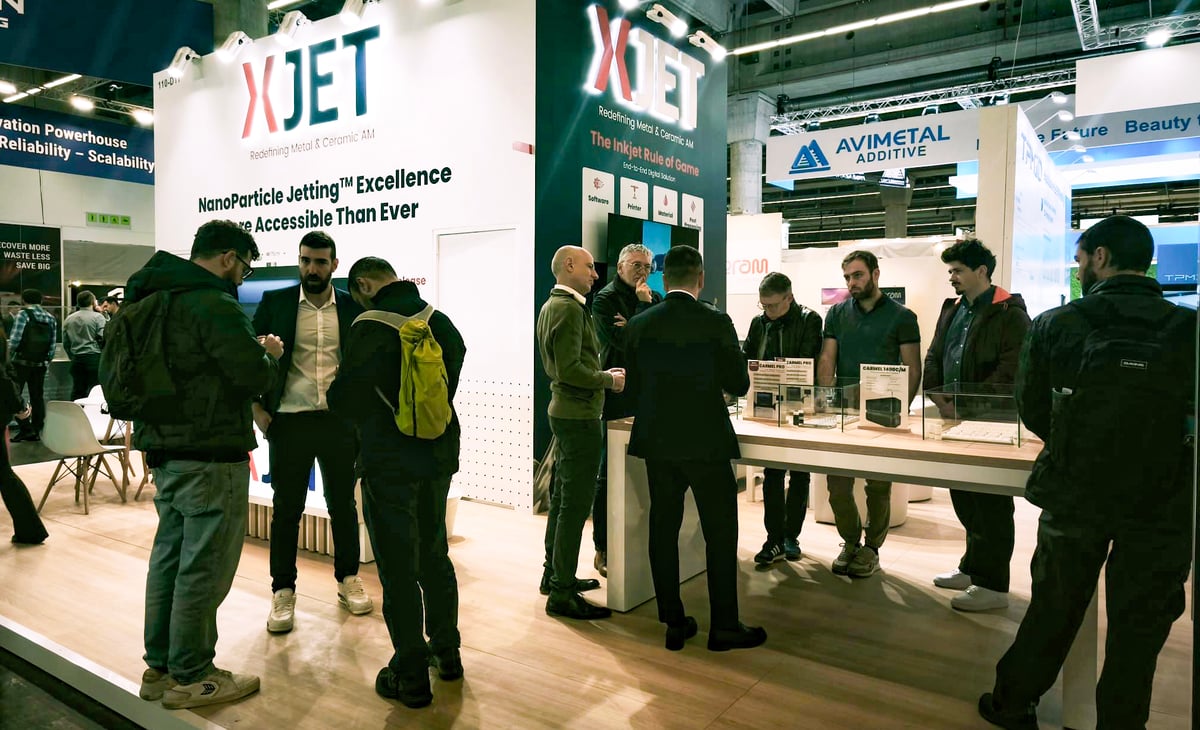
Just ahead of Formnext, XJet announced the Carmel Pro—a major shift in strategy aimed at finally bringing its NanoParticle Jetting (NPJ) technology within reach of smaller and mid-sized businesses. The company says the Carmel Pro will require 60–70% lower initial investment compared to its industrial Carmel machines, though no official pricing is available yet.
The key technical highlight: four-channel multi-material jetting, allowing direct deposition of metals, technical ceramics, and even precious metals from XJet’s full material portfolio. If the price lands where XJet suggests, the Carmel Pro could introduce powderless metal and ceramic printing to entirely new segments.
Rebranded AltForm Launches Scalable Multi-Laser LPBF Line
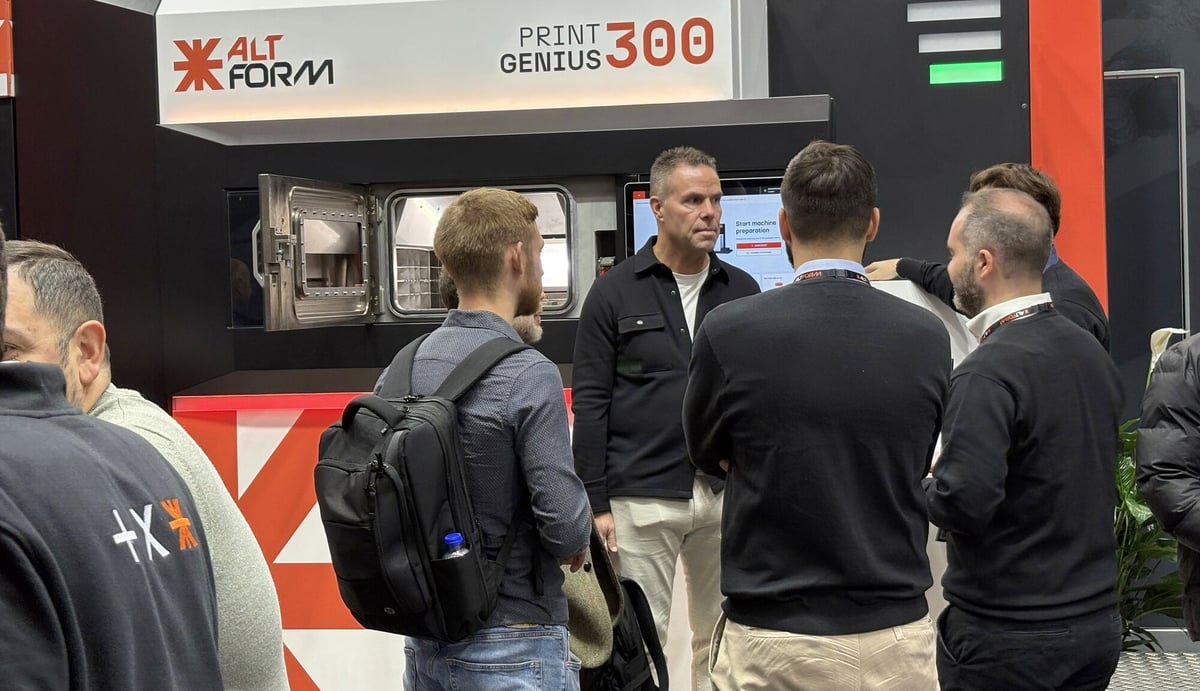
Freshly rebranded from Prima Additive, Italy’s AltForm introduced two new LPBF series at Formnext: the Print 300 and Print 400 families. Each printer in the 300 series has the same build volume (330 x 330 x 450) but differ in the number of lasers (1, 2, or 4). Same with the larger 400 series (420 x 420 x 450), which is available in a dual or quad laser format, plus and XL version boosting the build size to 420 x 420 x 1,000.
AltForm calls these “new-generation LPBF platforms,” built for uptime, precision, and automation. Enhancements include redesigned gas flow, improved multi-laser coordination, tighter thermal control, and chamber architectures tuned for integration with automated powder-handling systems.
It’s a serious attempt to compete with the established leaders in scalable metal AM.
New Robotic Arm 3D Printers
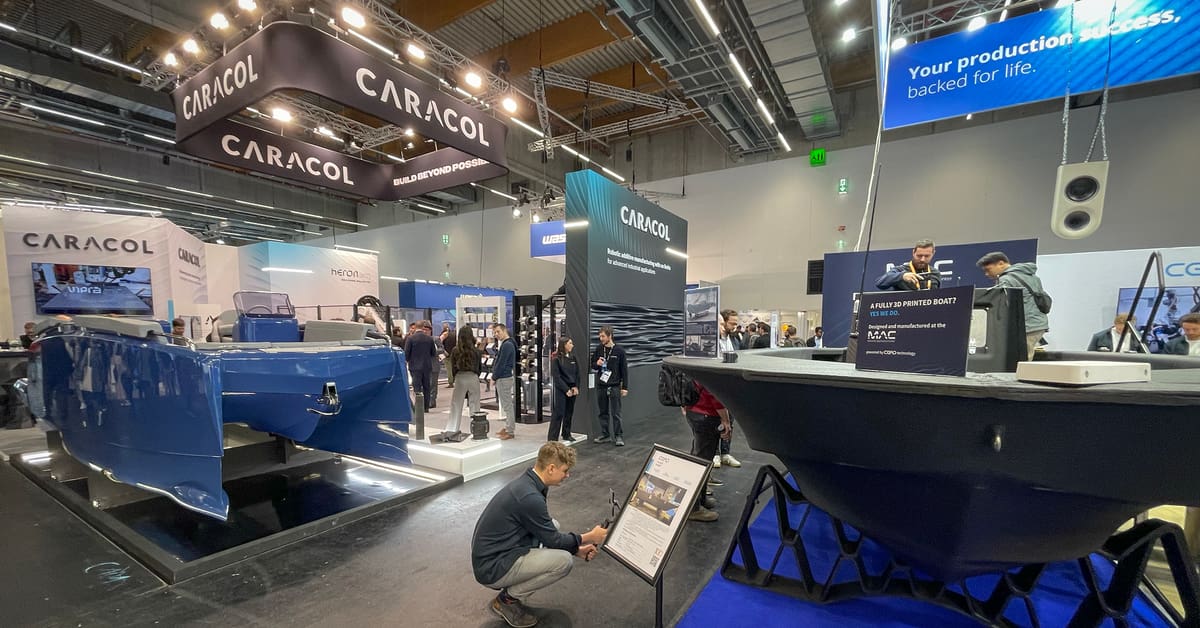
Robotic-arm 3D printers were seemingly everywhere at Formnext this year. Sure, the usual suspects—CEAD, Caracol, WASP—commanded a prominent corner of the show floor, but wander a few aisles in any direction and suddenly another robotic system would be mid-swing, mid-print, or mid-mill.
Manufacturers appear to have found a sweet spot: robotic platforms are surprisingly accessible, particularly when packaged as hybrid cells (3D printing + CNC) or as modular extrusion heads designed to bolt onto existing robot arms or gantry systems. The result? A surge of flexible, mix-and-match solutions aimed at industries hungry for large, tough, and quickly produced composite or polymer parts.
Moi Composites Unveils Plug&Print Robotic Cell for Fast, Waste-Free Composite Parts
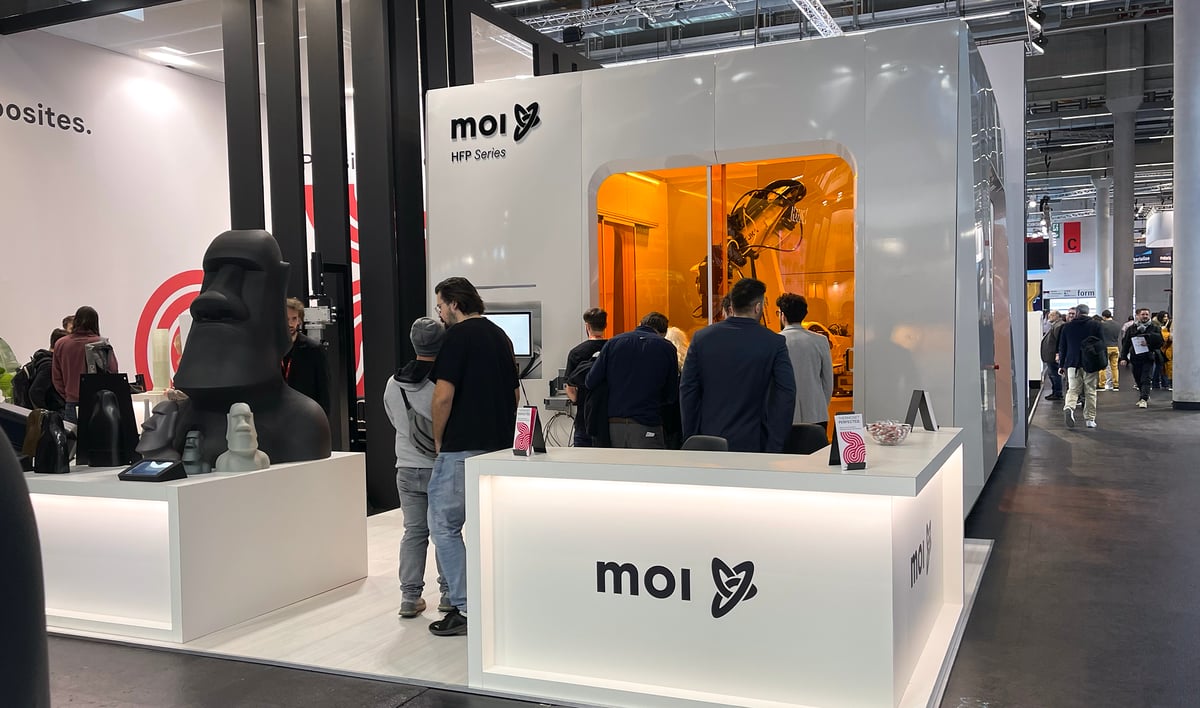
Moi Composites arrived with a major launch—the HFP Series, introduced just before Formnext—and it drew steady interest from anyone dealing with composite production bottlenecks. Marketed as a “Plug&Print” robotic cell, the system merges additive and subtractive workflows into one tightly integrated environment.
At its core is the company’s Short Fiber Manufacturing (SFM) process, in which a robotic arm deposits short-fiber-reinforced, rapid-curing thermoset pastes. The same cell also houses precision milling, allowing printed parts to be trimmed, surfaced, or finished without ever leaving the workspace. No more shuttling large composite parts between multiple machines.
The SFM S18 toolhead—also sold standalone—prints at speeds up to 180 mm/s with proprietary thermoset materials such as glass-fiber-reinforced vinyl ester. The result is fast, support-free printing with high stiffness, thermal stability, and chemical resistance, and near-zero waste. It’s a compelling vision for streamlined composite fabrication.
Fanum Debuts Giant Gantry Printer for Fast, Lightweight EPS Prototyping
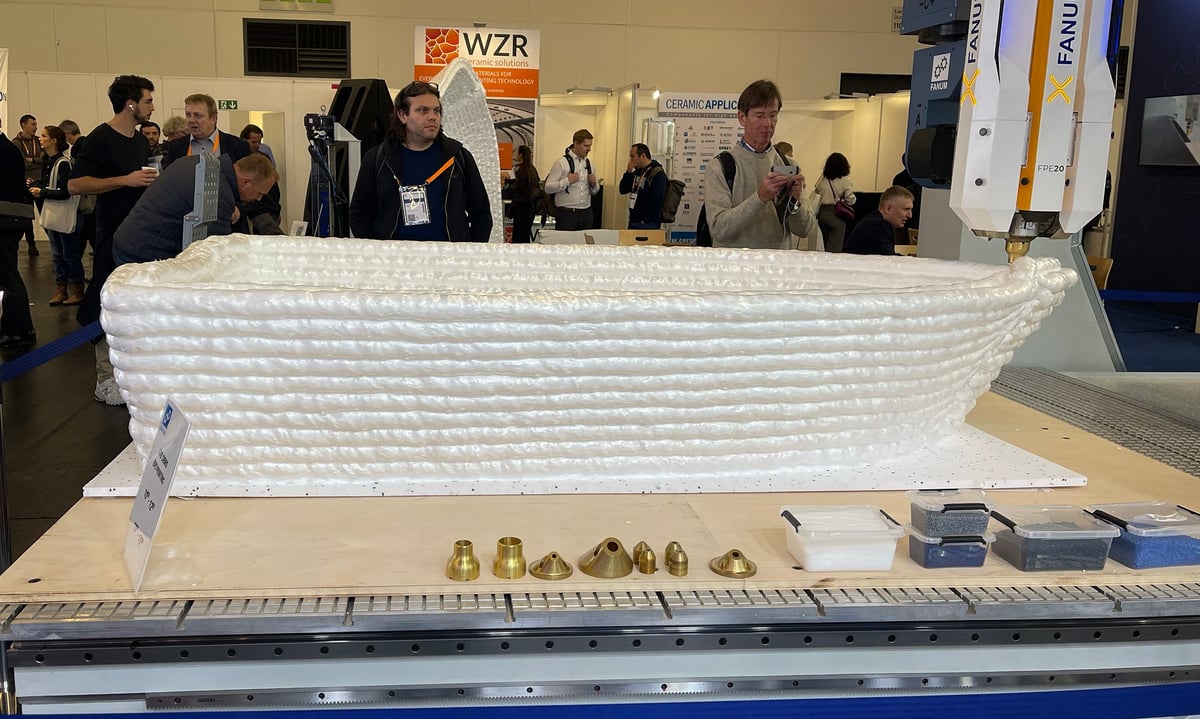
Polish CNC manufacturer Fanum showed off a massive gantry-based robotic printing system that, from afar, looked like it was making a boat out of marshmallows. Closer inspection revealed the “marshmallows” were actually EPS (expanded polystyrene)—a material the company uses to form large, lightweight shapes for prototyping, mold-making, marine design, and architectural elements.
Fanum offers multiple print heads and robotic configurations tailored to various foam-processing workflows, demonstrating how hybrid gantry/robot systems can expand into oversized 3D fabrication without exotic materials or complex post-processing.
WASP Penelope Launches at Formnext, Blending 3D Printing and CNC in One Toolhead
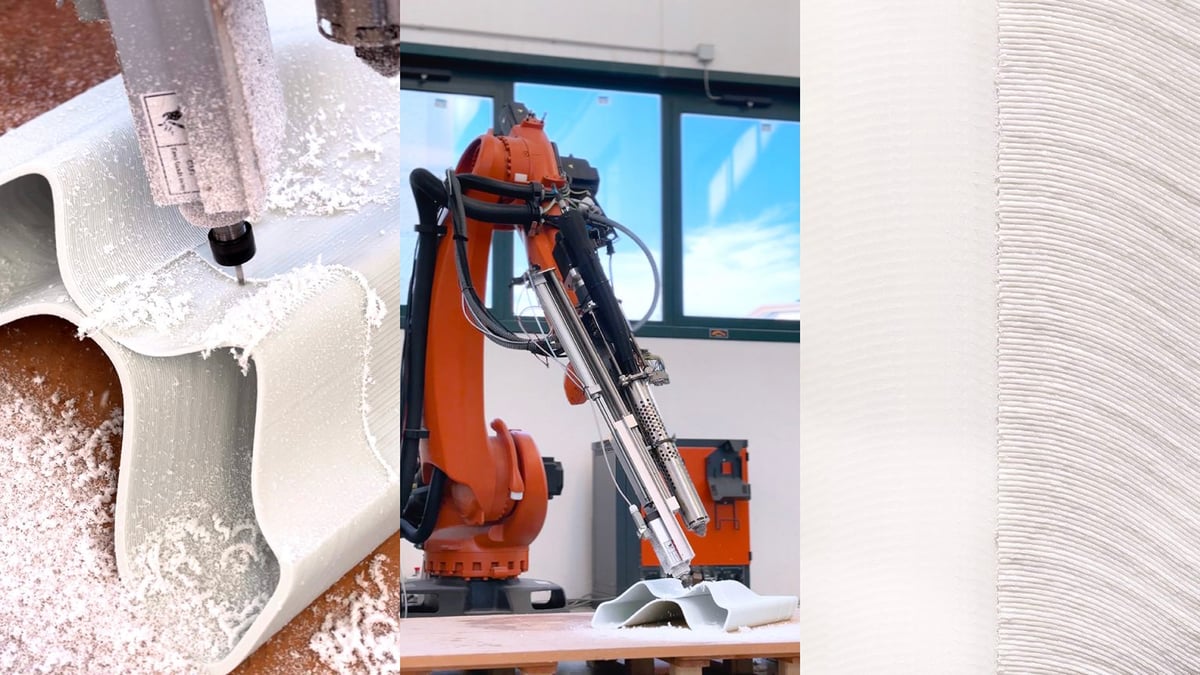
Italy-based WASP, long known for its large-format clay and polymer printers, is increasingly putting its focus on tool heads. Its new (upcoming) Penelope system—debuted at Formnext—combines both 3D printing and milling into a single, fast-switching toolhead. It can transition from deposition to subtractive machining in mere seconds, making it well-suited for producing large functional prototypes or tools with refined surface finishes.
Availability details are still under wraps, but WASP’s hybrid approach is clearly part of a broader industry push toward modular, task-flexible robotic manufacturing.
Look for more new printer details here on All3DP as they become commercially available.
You May Also Like:
Listen to All3DP’s News Podcast:
License: The text of "The 20 Top New 3D Printers from Formnext 2025: Tool Changers, 6-Laser Metal, and PEEK Printing" by All3DP Pro is licensed under a Creative Commons Attribution 4.0 International License.