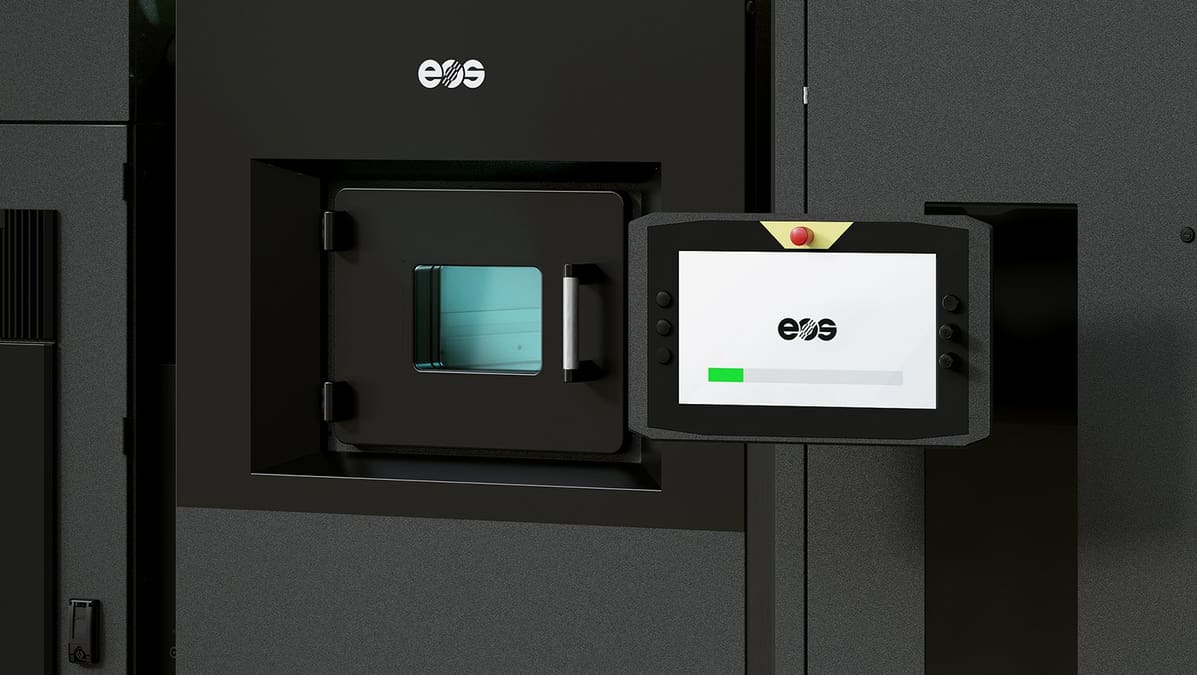
EOS’ New M4 Onyx Bundles the Best of Its Tech with Six 400-W Lasers

The new M4 Onyx promises 50% higher throughput and part costs slashed by about 30% compared to previous systems, plus 90% powder recovery.
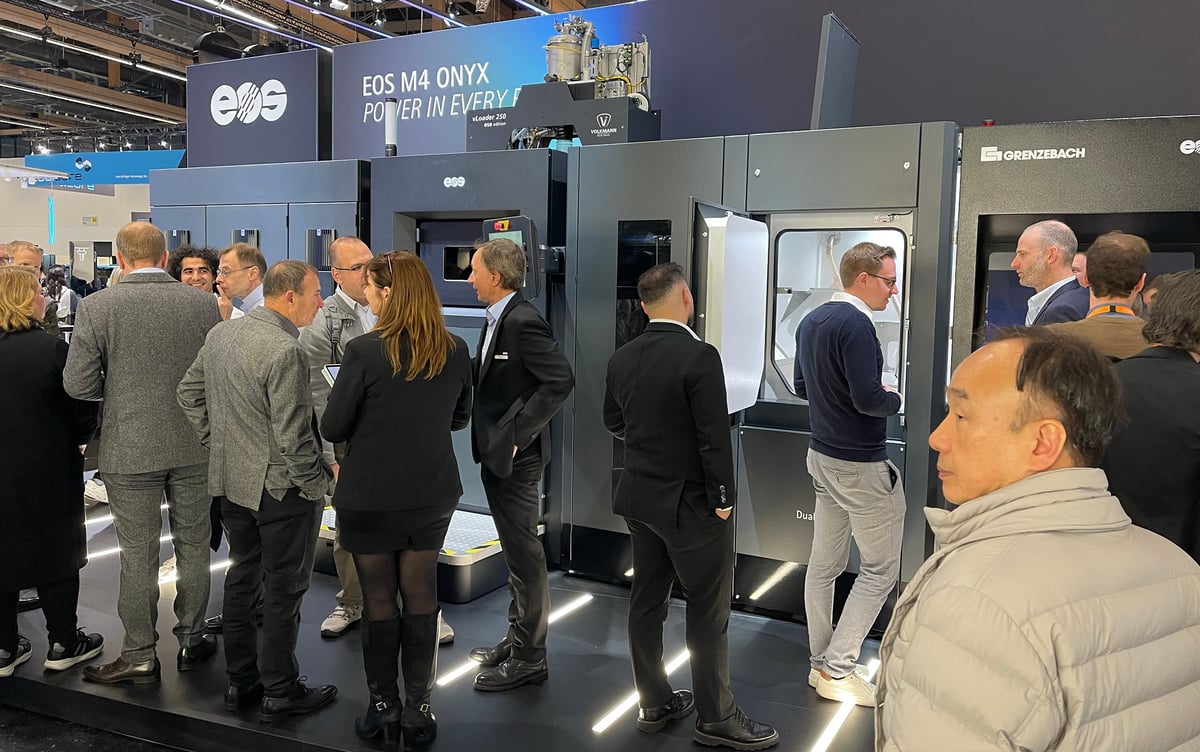
EOS unveiled its newest metal additive manufacturing system, the EOS M4 Onyx, at Formnext today positioning the machine as a next-generation platform for industrial-scale laser powder bed fusion (LPBF).
The system introduces a combination of higher throughput, expanded automation, and new process-stability features aimed at sectors including aerospace, energy, defense, space, and semiconductors, EOS says.
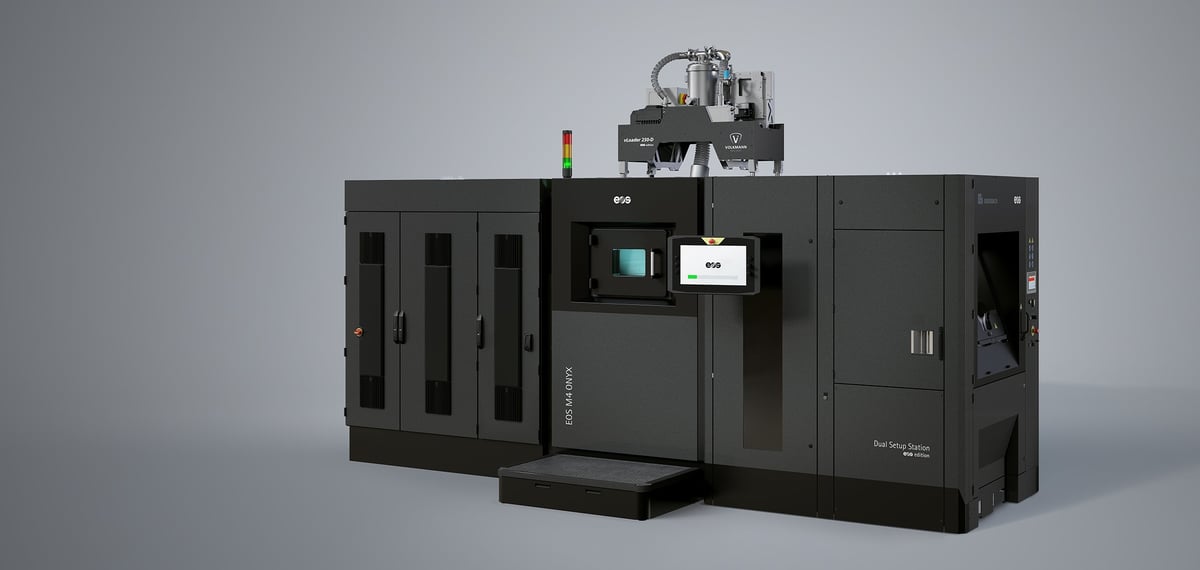
Essentially, compared to EOS’ existing lineup (M290, M300, M400) metal platforms, the M4 Onyx is basically EOS taking everything they’ve been developing in parallel — more lasers, 1 kW laser shaping tech, larger build volume, advanced monitoring & error-detection, powder handling, sustainability — and bundling it into one large, heavily integrated production platform. This is far from repackaging, though. There are notable advances especially in powder handling (90% powder recovery, no consumable filters).
Marie Langer, CEO of EOS, describes the launch as an extension of the company’s long-term focus on enabling customers to scale AM production. “The launch of the EOS M4 Onyx is a testament to our legacy as pioneers in additive manufacturing.”
Larger Builds and Higher Productivity
The M4 ONYX features a 450 × 450 × 400 mm build volume and ships with six 400 W lasers, which EOS says deliver 50% higher throughput and can lower part costs by about 30% compared to previous-generation systems.
A second variant, the M4 Onyx Flx, includes four 1 kW “beam-shaping” lasers designed for applications requiring higher speed and processing flexibility.
EOS is also emphasizing reliability and stability. The machine includes redesigned gas flow management, active temperature control, and integrated error-detection tools that the company claims can cut quality-assurance costs by up to 50%.
System uptime is another focus: with a full-service contract, EOS reports the platform can achieve up to 97% availability.
Automation and Sustainability Features
Several features revolve around material handling and closed-loop workflows, areas where industrial customers often face bottlenecks.
The RFS Pro filtration module offers over 90% powder recovery, eliminates consumable filtration components, and neutralizes hazardous condensate, the company says. EOS says this reduces maintenance overhead as well as material waste.
Automation partnerships also play a central role.
- The Volkmann Automated Powder Handling – EOS Edition: automated powder handling system provides closed-loop, scalable delivery and collection.
- The Grenzebach Dual Setup Station – EOS Edition: automates job turnarounds, enabling users to start overnight builds and switch jobs in under 30 minutes.
Sebastian Becker, Head of Product Management Metal at EOS, said these collaborations were essential to the M4 Onyx’s development. “Our customers will benefit from our deep collaborative relationships to successfully scale their AM production with confidence and consistency,” he said.
Software and Process Intelligence
EOS is pairing the hardware launch with expanded software capabilities. The system integrates EOS Build+ process controls, Siemens automation, early-warning notifications, and open APIs for workflow connectivity. According to EOS, these features can shorten order-to-print lead times by up to 30% and improve utilization by a similar margin.
Digital fingerprinting and statistical-control tools aim to reduce nondestructive inspection requirements, while Smart Fusion and Smart Fusion Replay technologies automatically minimize support structures and refine surface quality.
The EOS M4 ONYX will be commercially available in Q1 2026, with the FLX variant following in Q3 2026. Initial compatible materials include titanium, nickel, and stainless steel, with further alloys available upon request.
The system is being showcased at Formnext 2025, Hall 11.1, Booth D41.
You May Also Like:



Tired of Reading? Try Listening
License: The text of "EOS’ New M4 Onyx Bundles the Best of Its Tech with Six 400-W Lasers" by All3DP Pro is licensed under a Creative Commons Attribution 4.0 International License.