Bambu Lab Clarifies Situation Amid Reports of Partially Melting A1 3D Printers

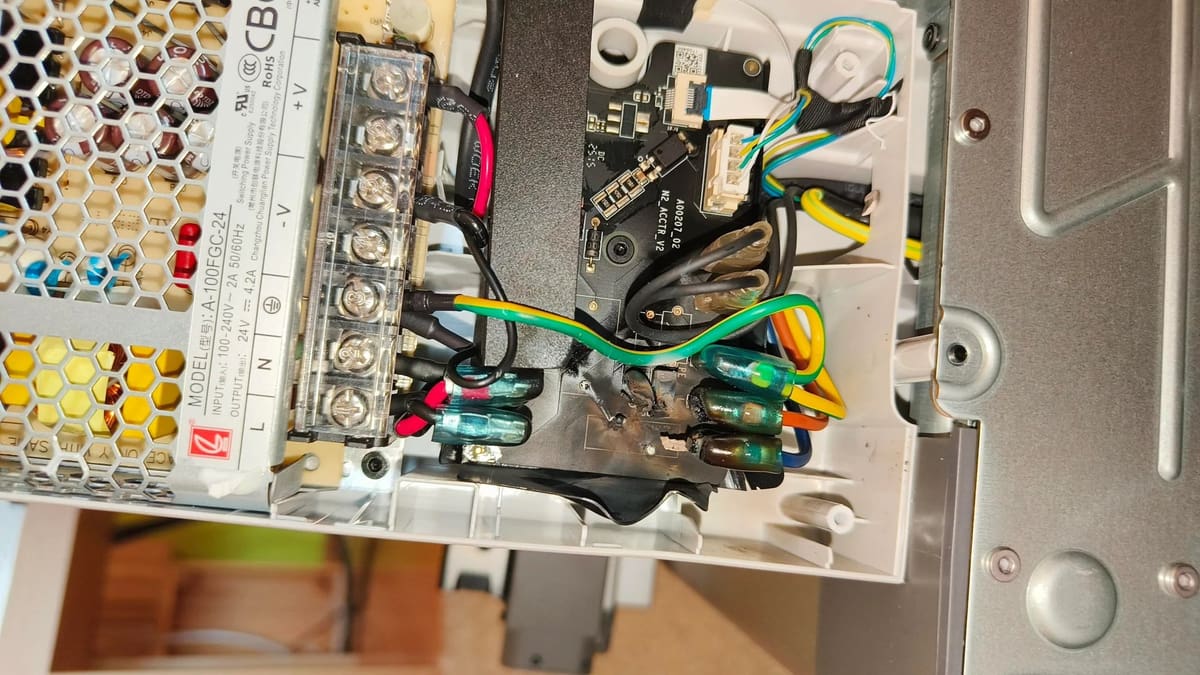
A number of posts to social media, plus an independent investigation by YouTube channel 3D Musketeers, suggests the A1's original power distribution board at risk of melting components in rare situations. Bambu Lab assures us the risk is minimal and remedied in newer machines.
Trouble has been brewing for Bambu Lab and potentially users of its A1 3D printers, as a growing number of reports pop up on social media of some printer’s power distribution boards melting themselves inoperable. An independent investigation by YouTube channel 3D Musketeers has collected numerous examples of the printers, drawing its own conclusion that the printers cannot be trusted to be left printing unattended. In light of the mounting concerns, we contacted Bambu Lab for clarification, corroboration that they acknowledge the claims, and what the company has or will do about it – which we received responses to today.
The flaw, which sees one component under specific conditions getting hot enough to soften or melt nearby components and the plastic frame of the printer, was prominently highlighted by 3D Musketeers in April as a part of the channel’s #PrintFix Friday series. Since then, the channel has campaigned for A1 owners with similar cases to contact it, gathering together enough examples of the same issue to then make the case that there is a flaw with the A1’s design and claim that the machine is a hazard. Their conclusion: the A1 requires additional precautions for use at a minimum, if not outright rejection.
The ‘Meltdown’ Claim
Bambu Lab has acknowledged the issue, claiming it has been fixed since Q3 2025 with a redesigned board, but downplays the scale and severity of the problem.
Bambu Lab says that users could always use their A1 printers in with confidence but, in response to my questions, advises users operate the printer in combination with adequate surge protection in place, such as a surge-protecting power strip. 3D Musketeers’ latest video on the issue, posted December 26 (before Bambu Lab’s response), advises users to either wash their hands of the printer or to never leave it unattended – basically, they say it can’t be trusted.
As ever with any story hinging on safety, particularly electrical and the theoretical risk of fire, it’s alarming. That being said, social media furores often end up more a storm in a teacup than a firestorm, so here’s a breakdown of what happened, and what Bambu Lab has, or hasn’t done.
Technical Diagnosis
In April 2025, a 3D Musketeers’ video titled “This Bambu A1 is SMOKIN’!” features a segment about a Bambu Lab A1 user in Ukraine with a printer that appears to have melted a hole in itself. That video diagnoses the issue to a negative temperature coefficient (NTC) thermistor, which typically protects the printer from power spikes while getting up to temperature. In this case, the NTC thermistor performed abnormally, seemingly heating beyond its effective operational range and melting out to the extent it burned a hole in the printer.
Bambu Lab has confirmed the assessment that the NTC thermistor was at fault in such situations. A representative told us “The A1, as well as our X1 and P1 series printers, incorporates an inrush current protection circuit designed to reduce the transient current that can occur at power-on. This circuit includes a negative temperature coefficient (NTC) thermistor and a metal-oxide varistor (MOV).”
“Based on our investigation, the reported failures are associated with abnormal surge or overvoltage events on the power grid, such as those caused by lightning or similar disturbances… Repeated or severe surge exposure may damage the NTC over time. In some cases, this damage can cause abnormal heating during subsequent operation, with temperatures potentially reaching approximately 160 °C, leading to softening or melting of nearby plastic components.”
By the Numbers
Bambu Lab says it was first made aware of the issue in the summer of 2025, and across the mentioned product lines, has since logged an incidence rate of 0.052% from users contacting the company’s support channels. Seemingly, the issue is rare enough that Bambu Lab is content to deal with them as and when they pop up – there is no recall, unlike two years ago for a separate matter.
For those out of the loop, the A1 initially featured a bed cable design that was later deemed inadequate, resulting in recalled printers and a home-repair option (urging independent certification in some regions after the repair) to remedy the problem.
The company defends the design of the board and components in question, saying “The power circuit design and the surrounding plastic materials comply with applicable safety standards and use flame-retardant materials. While a damaged NTC may generate sufficient heat to deform or melt adjacent plastic, it does not lead to ignition or sustained combustion. As a result, the risk of fire is considered extremely low… there have been no reported cases of fire associated with this issue.”
The specific wording there, of course, does not say there is zero risk of fire in these circumstances. No lawyer would ever approve the company making such a claim. But these theoretical grounds are enough for 3D Musketeers to have “reasonable confidence to say that it’s a matter of time before we see housefires from these machines; whether it’s the user’s fault or not, eyes are on Bambu for this.”
The Path Forward
For Bambu Lab, the issue was considered fixed in 2025. “Although the problem affected a very small number of devices and occurred only under very specific conditions, we made the necessary changes nonetheless. The issue, from a technical standpoint, was resolved in Q3 2025.” There will be a lag in cases though, few as Bambu Lab claims they are.
Consequently, users who have experienced the issue can get replacement boards by contacting the company’s support team. We’ve confirmed that Bambu Lab is treating this issue separately from general warranty conditions, meaning any machine affected by this problem, whether in warranty or out, gets full support.
In the intervening time, it’s not difficult to find public posts from the last nine months pointing to the same issue, especially following 3D Musketeers’ most recent video. It stands to reason that the more attention drawn to the issue, the more cases will be publicly shared and discussed.
Echoes of 2024
Bambu Lab considers the issue adequately dealt with, particularly with its precaution you simply use an appropriate surge protector between the printer and its power supply. With that said, some of the public posts we’ve found claim their printers burned up even while using surge protectors and uninterruptible power supplies, which somewhat contradicts Bambu Lab’s position that surges and abnormalities are the sole factor causing the problem. Possibly there is a grey area between, with the parts fatiguing over time.
There are two key differences between this situation and the print bed cable issue in 2024. That crisis started as a quiet notice to affected users before snowballing into a full product recall, but was transparently communicated throughout, with several blog posts and communications outlining a plan. Bambu Lab has sat on this since the summer and allowed discontent to bubble up, forcing clarification now. A miscalculation, perhaps, which may be a consequence of the second key difference – the company’s confidence that the number of affected units is much lower than the 0.1% that triggered the recall action.
Whether this is enough comfort for you as an A1 user concerned about your printer sits with you personally. If you look purely at the numbers, then you’re unlikely to ever be affected and can hedge against it happening by taking additional precautions against power surges. That’s the gist of Bambu Lab’s response. But then numbers rarely if ever win out against a scenario as visceral as a hole potentially melting in the side of your machine. Fear of it happening, remote as the chance may be, is to be expected.
Correction – 07.01.2025: This article previously stated it was a requirement for A1 printers with the redesigned beds (2024 recall) to be certified in some regions. It wasn't legally required – we've updated the language to "urged".
Read more recent news:
- Finally, a Plant-Based 3D Printing TPU That Truly Biodegrades in Your Backyard?
- 3D Printing Merch That's Actually Worth Buying (No T-Shirts)
- Official: Creality’s SparkX i7 Is a Entry-Level ‘Lifestyle’ Printer
Tired of Reading? Try Listening
License: The text of "Bambu Lab Clarifies Situation Amid Reports of Partially Melting A1 3D Printers" by All3DP is licensed under a Creative Commons Attribution 4.0 International License.