Anycubic Kobra X Dumps the External Filament Box for Internal Color Switching

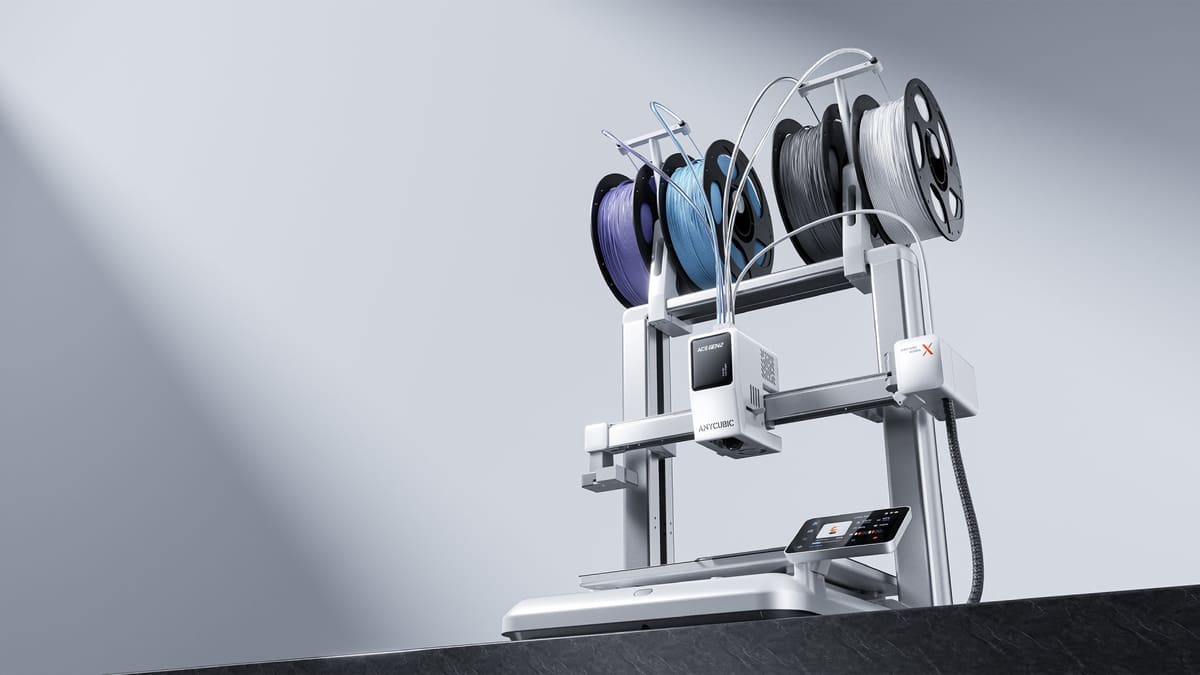
More details of Anycubic’s upcoming Kobra X shows the company's intentions to twist the single-nozzle multicolor printing experience into one of multi-material reliability and greater efficiency.
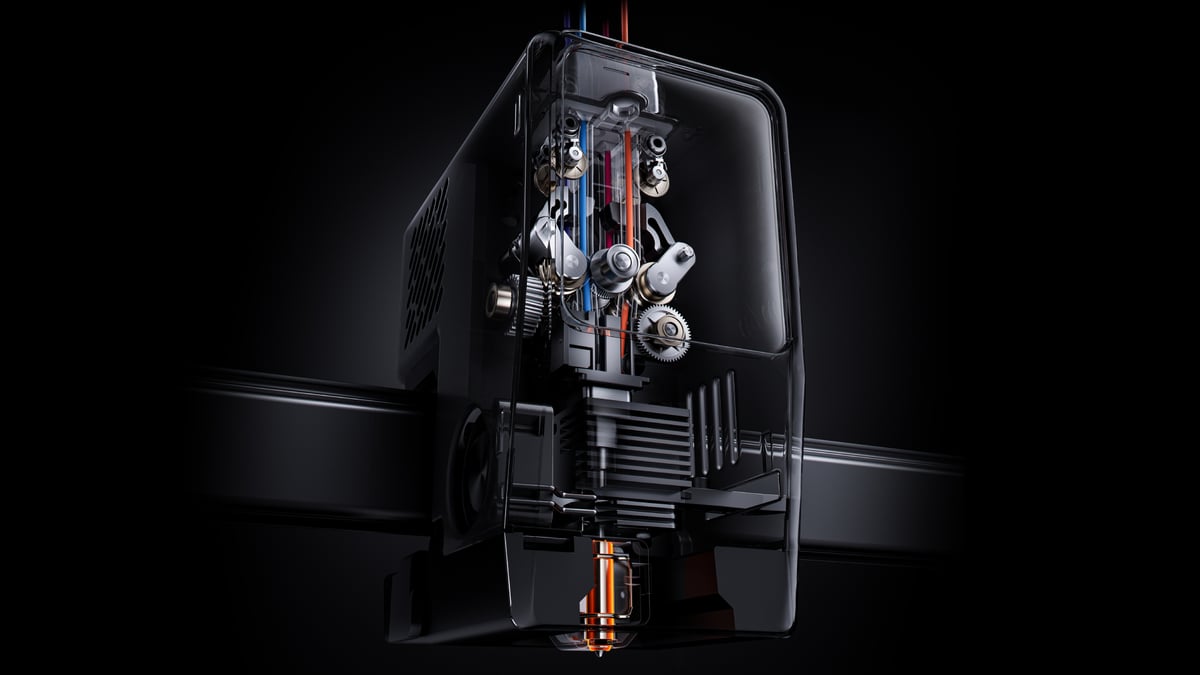
For the last two years, “multicolor” in the desktop printing space has mostly meant “buying a printer plus a separate box for your filament.” The core of the Kobra X’s pitch is what Anycubic calls its “ACE GEN2” architecture. Unlike the current crop of external filament switchers (such as Anycubic’s own ACE Pro effort for the Kobra 3 & S1 printers), the Kobra X handles color switching internally. The company claims this allows for native 4-color printing without an external multi-material unit to withdraw and feed the filament.
If the implementation works as advertised, it addresses a specific annoyance with external box systems: waste. Anycubic states that by moving the switching mechanism closer to the action – inside the printhead – they have shortened the purge path down to just ~30 mm. Theoretically, this reduces the “poop” (purge waste) generated during filament swaps and cuts the travel time for color changes by roughly 80% compared to the company’s Kobra 3 V2 printer, they say.
Perhaps more interesting than the color swapping is the multi-material implication. Single-nozzle systems often choke when tasked with mixing rigid and flexible filaments, not least because the feeding of softer materials from external filament switchers isn’t usually possible. The Kobra X’s extruder adapts the feed pressure, supposedly handling the disparity between hard and soft materials and how they should be fed to the hot end. The spec sheet explicitly lists support for printing PLA with TPU or PVA, a capability that has historically been the domain of dual-extrusion 3D printers and tool changers, not single-nozzle bed slingers.
Structurally, the machine mounts its four spools on top of the gantry. Anycubic argues this isn’t just for storage. This so-called “mass-loading” strategy is designed to shift resonant frequencies and reduce ringing. Whether loading several kilograms of plastic onto the top of the frame actually helps stability rather than hurting it will be something we’ll need to see. Separate from the stability claim, a more straightforward benefit is clear: keeping the filament path into the printhead straight. This makes perfect sense for flexibles printing, which would otherwise stretch and snag through long bending filament paths involving guide tubes.
As for the standard numbers, the Kobra X fits the current “fast bed slinger” archetype: a 260 x 260 x 260 mm build volume, a max speed of 600 mm/s (more likely 300 mm/s), and a quick-swap nozzle system that’s heatable to 300°C. It also features Anycubic’s “LeviQ 3.0” bed leveling system, which maps out a 49-point mesh for first layer consistency.
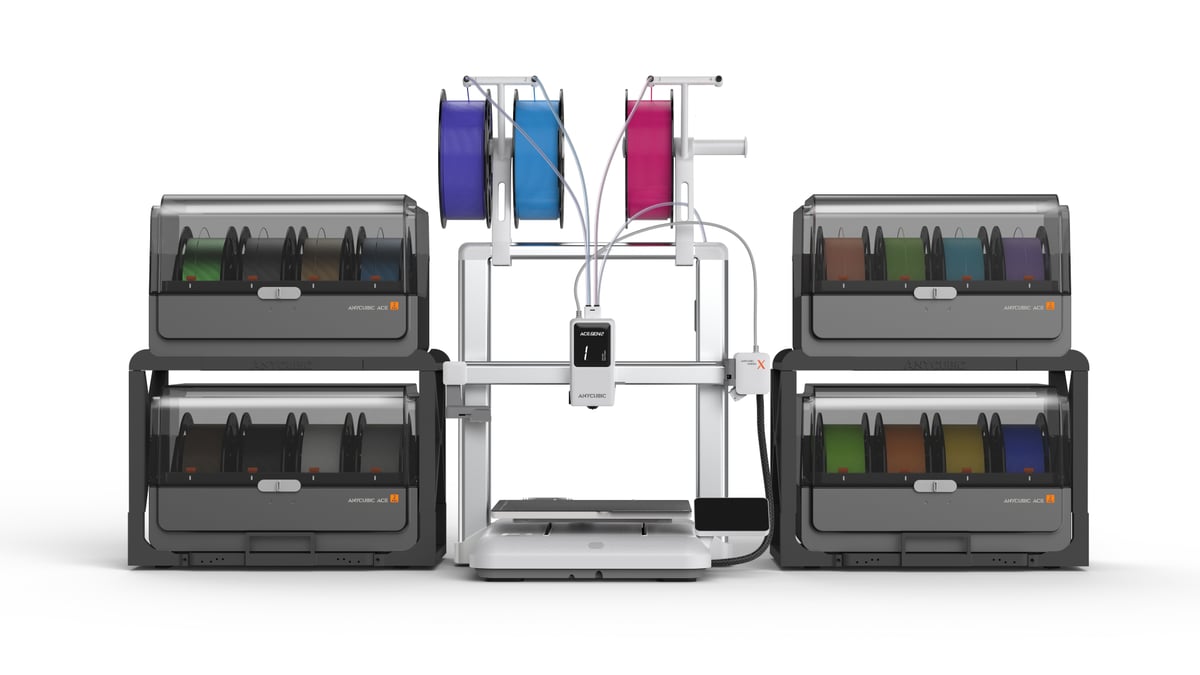
While the base unit handles four colors, Anycubic notes that users can expand this up to 19 colors by adding external ACE Pro modules, which somewhat undermines the “no external box” purity, but is nice to have as an option. This expansion to more filament appears to follow similar logic to what Bambu Lab offers with its new H2C machine, letting you feed multiple boxes to one filament path and reserving the other (in the Kobra X’s case, other three) for specific individual filaments.
Pricing for the Kobra has yet to be revealed, though a countdown on the company’s website points to December 22 as the day to watch for launch pricing.
Read more recent news:
- Europe’s Largest 3D Printed Housing Project Hints at How Far 3D Printing Houses Has Come
- 3D Printing Hack: How to Build a Filament Dry Box for Under $20
- Prusa Drops New Limited Edition 'Goldfish' Filament for 2025
Tired of Reading? Try Listening
License: The text of "Anycubic Kobra X Dumps the External Filament Box for Internal Color Switching" by All3DP is licensed under a Creative Commons Attribution 4.0 International License.