Europe’s Largest 3D Printed Housing Project Hints at How Far 3D Printing Houses Has Come

With the concrete shells now printed—the last taking just five days—Denmark’s Skovsporet project moves toward final completion in summer 2026.
By all accounts, the Danish six-building, 36-apartment housing project is a pioneering endeavor. The development, known as Skovsporet (“The Forest Trail”), represents the largest 3D printed housing project in Europe to date, but it’s more than its size that’s setting a benchmark. Skovsporet showcases the growing capabilities of additive manufacturing in residential building, from speed and design to sustainability and aesthetics.
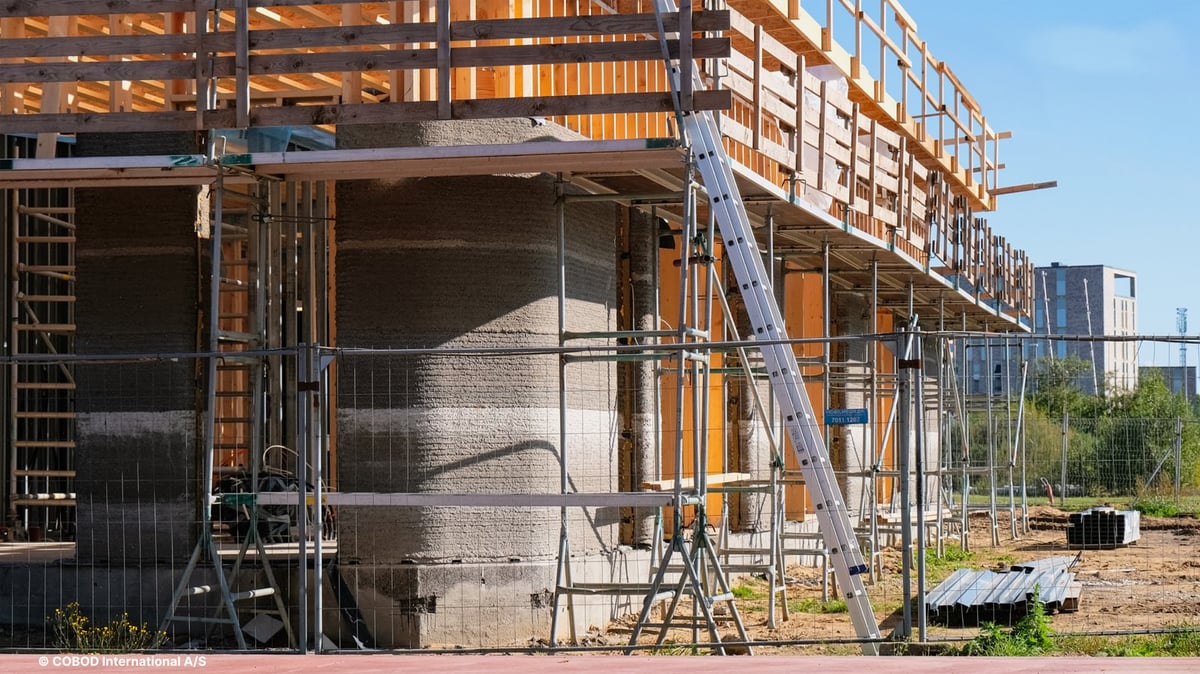
One of the standout achievements of the project is the rapid improvement in construction speed. While the first building in the series took several weeks of printing, the final one was completed in only five days — effectively printing more than one apartment per day by the end of the sequence. This acceleration demonstrates how automation and refined 3D printing workflows can shrink timelines compared with traditional construction methods.
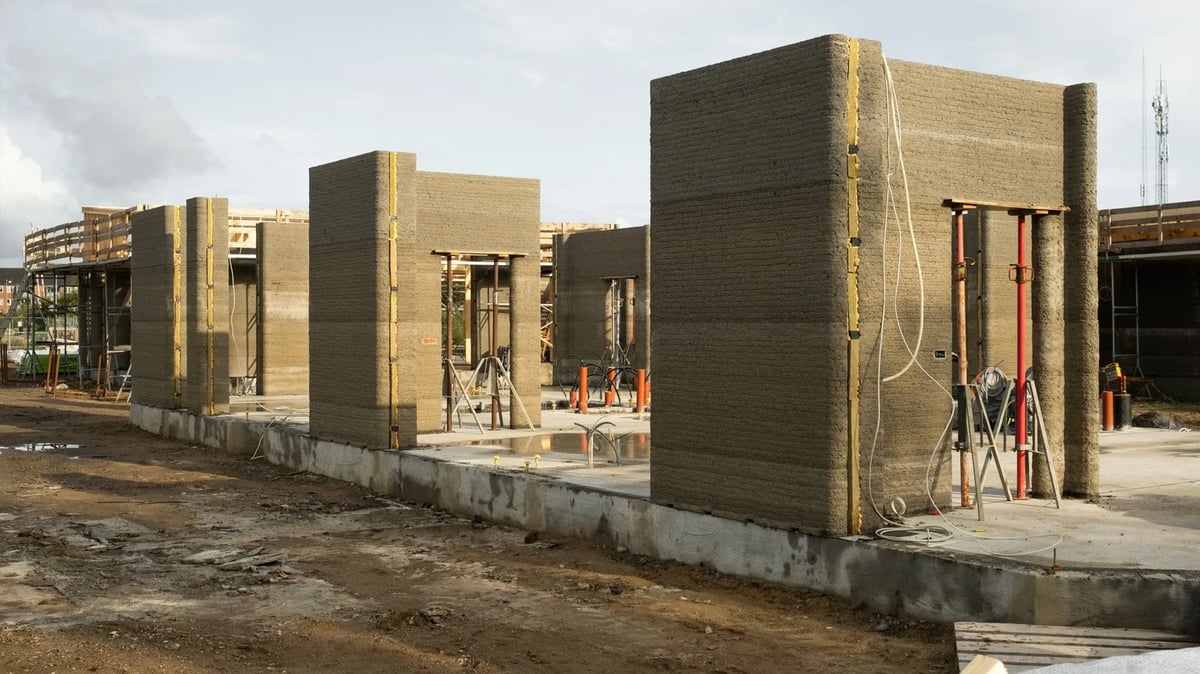
Using COBOD International’s BOD3 3D Construction Printer, Danish firm 3DCP Group finished printing the structural walls for all six buildings, totaling 1,654 square meters (17,804 sq ft) of built area.
The project’s ground-mounted track system and automated printing process enabled millimeter-level precision, according to COBOD, over long wall sections with just a three-person team, highlighting how labor needs can be reduced while maintaining quality.
Material Efficiency and Environmental Benefits
Skovsporet also illustrates several environmental advantages tied to 3D construction printing. The concrete walls were printed using a mix formulated with low-carbon cement (FututeCam), and the additive process itself deposits material only where structurally needed — meaning less waste compared to conventional formwork and pour techniques.
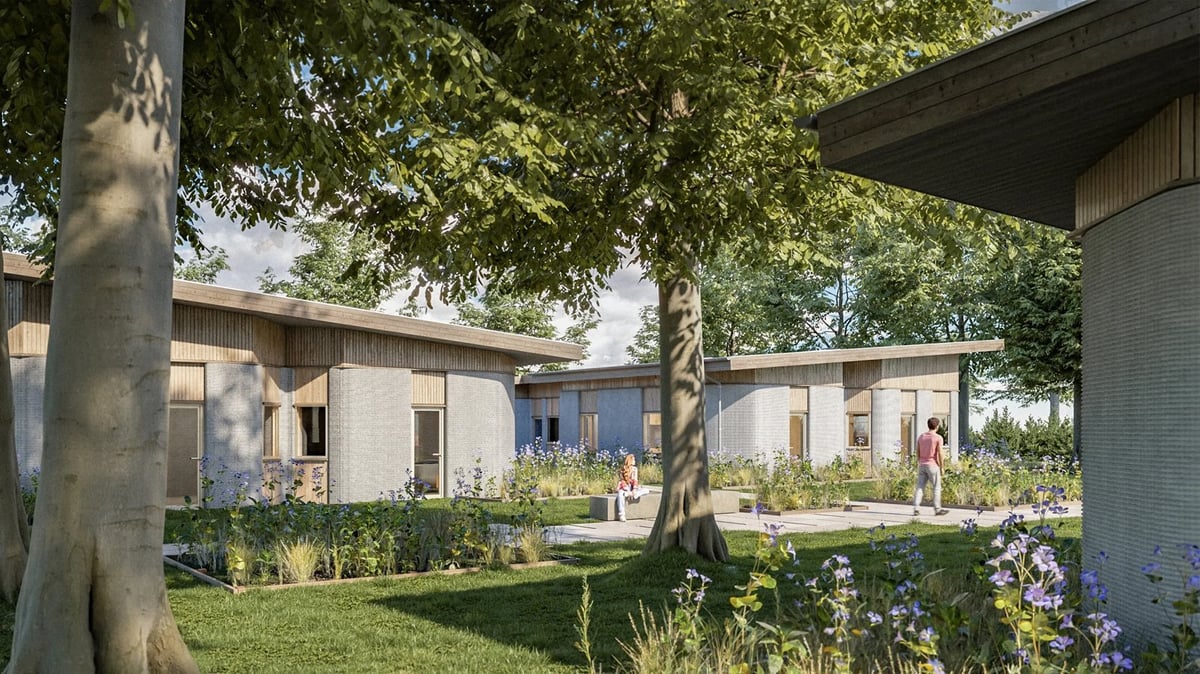
Site planning was conducted with ecological sensitivity in mind: print beds were arranged to preserve 95% of the existing trees on the site, underscoring how technology and landscape conservation can align in modern residential projects.
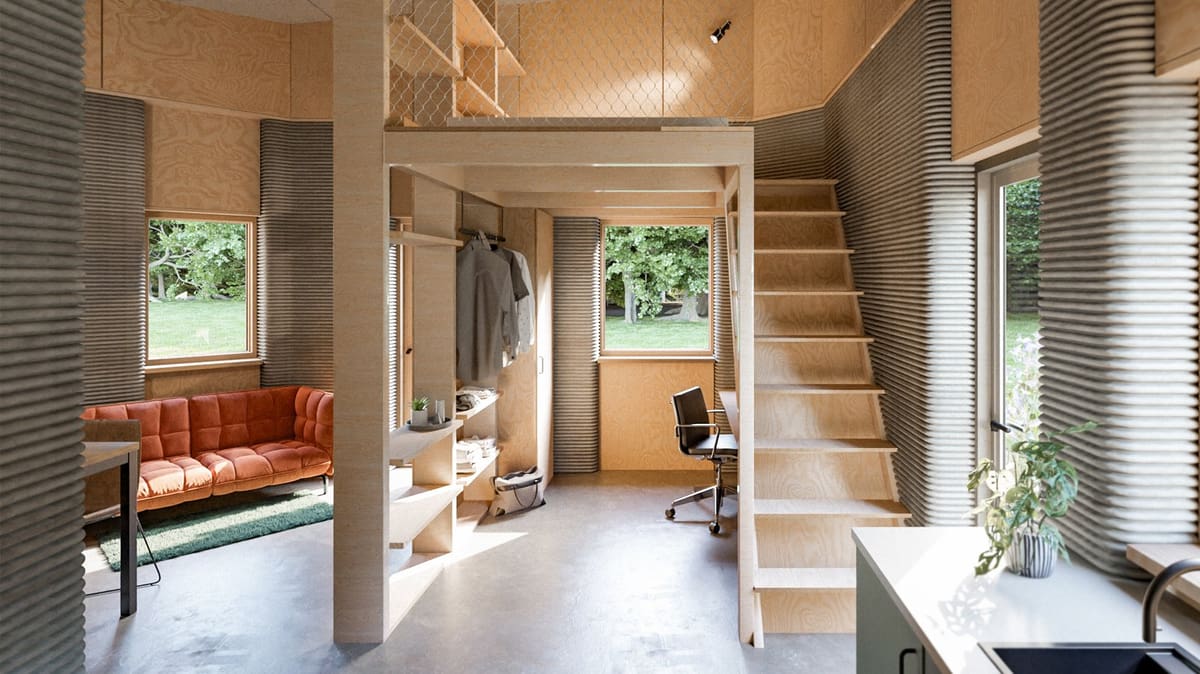
Beyond speed and sustainability, the technology expands architectural flexibility. The design by SAGA Architects aimed to soften the 3D printed concrete walls with warmer timber and modern glass finishes to create overall functional spaces. Each student apartment has a kitchen, living space, study areas, bathroom, and bedroom. Large roof windows and slanted ceilings enhance natural light and comfort in the small units.
With the 3D printing phase now complete, Skovsporet is transitioning toward interior finishing and systems installation. Once complete, the development will deliver 36 affordable student homes.
Despite repeated references to efficiency and scalability, COBOD does not disclose cost per square meter compared with conventional construction, or costs overall. So it’s unknown if the project is economically competitive or still dependent on demonstration-phase economics, rather than market viability.
Yet, the progress at Skovsporet suggests that 3D construction printing is moving beyond single prototype structures into scalable, multi-unit residential applications. Although it still faces significant practical, financial, and institutional barriers before becoming a mainstream construction method worldwide, the particular project shows that, built efficiently, sustainably, and with fewer labor inputs than some traditional builds, construction 3D printing may shift in how affordable and social housing is delivered across Europe and beyond.
You May Also Like:


Listen to All3DP’s News Podcast:
License: The text of "Europe’s Largest 3D Printed Housing Project Hints at How Far 3D Printing Houses Has Come" by All3DP Pro is licensed under a Creative Commons Attribution 4.0 International License.