30 “Impossible” Puzzles to Challenge Your Brain and Your Printer

Push your printer to the limit with 30 mechanical 3D printed puzzles. From secret boxes to complex jigsaws, these designs are ready to print.
Looking for your next weekend project? 3D printed puzzles are the ultimate test of a maker’s skill—and that of their printer, combining intricate moving parts with mind-bending logic. We’ve scoured the web to find the absolute best puzzles you can print right now, including some that look truly ‘impossible’ to solve.
If you don’t have a printer handy, you can still get these delivered to your door via Craftcloud. Jump in and discover the most creative brain-teasers the community has to offer.

2D Arrangement Puzzles
The classic puzzle. Easy to print, difficult to assemble.
Puzzle of Evil
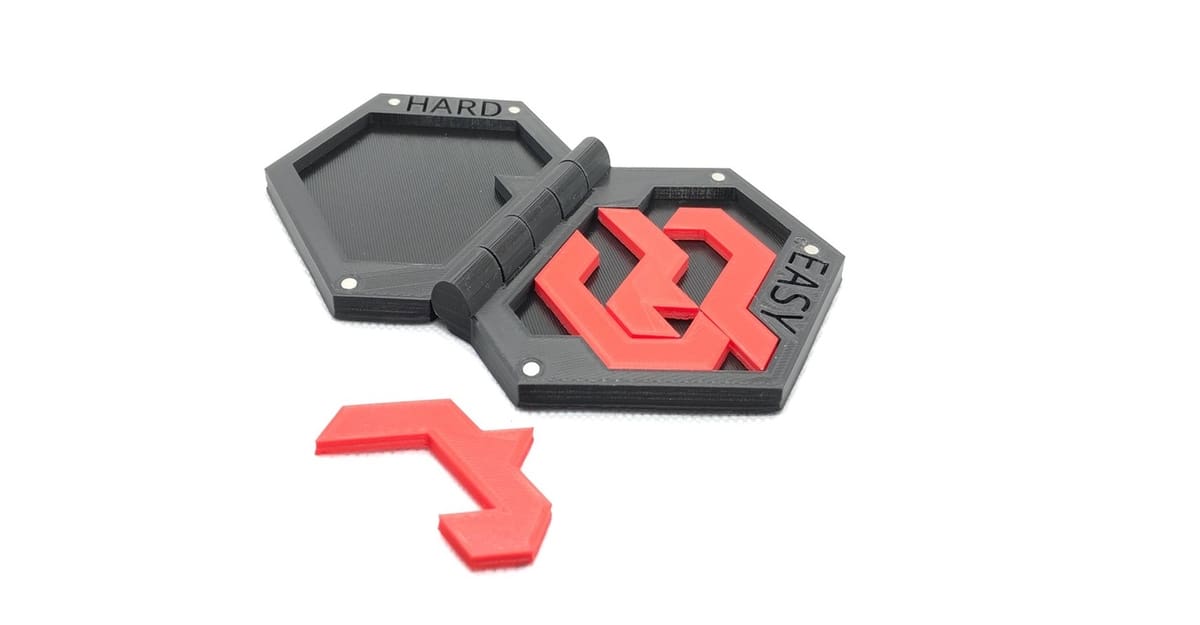
The premise for this model is that you have two options, an easy one and a hard one, but sometimes the easy one can be a little harder than you expected! The creator provided a version with holes for magnets and another without holes.
Printing with a brim is recommended to improve the accuracy and fit of the pieces.
With an interesting catch, this portable puzzle is a great option for you to carry around with you on the go. It’s very robust, and when closed all of the parts fit together compactly, even if not assembled. You should even be able to put it in your pocket without any problems!
- Who designed it? Priyank007
- How printable/popular is it? While it’s only got around 550 downloads, it’s a great model to consider – you can be the first to share your take on it!
- Where to find it? Cults
Flowsnake
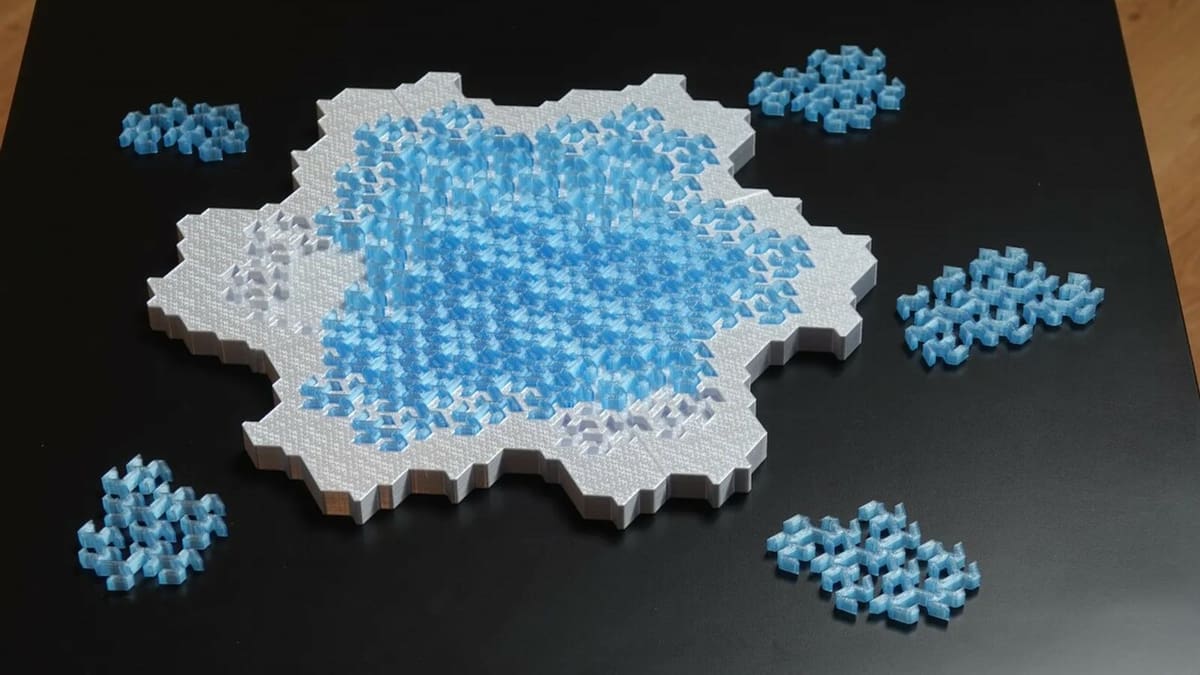
Even if you’re a super genius, this 12-piece puzzle will be a challenge to solve. Each part is a fractal and has an exact location where it belongs. Of course, you can print the pieces in color to try to make it a little easier, but even then, it still won’t be easy!
The reason for the complexity is the geometry itself, which allows the pieces to interlock in a more complicated way. The island’s edge is optional, and the pieces should fit together effortlessly or without pressure to form the “Flowsnake”. In addition to hints about key pieces and a solution provided via QR code, the author has also left many tips about print settings. For example, you’ll want to use a 0% infill density and print the pieces upside down.
- Who designed it? Svw
- How printable/popular is it? The 9 shared makes, 519 downloads, and 1 remix show that it takes nerves to solve, but it’s not impossible.
- Where to find it? Printables
Wave
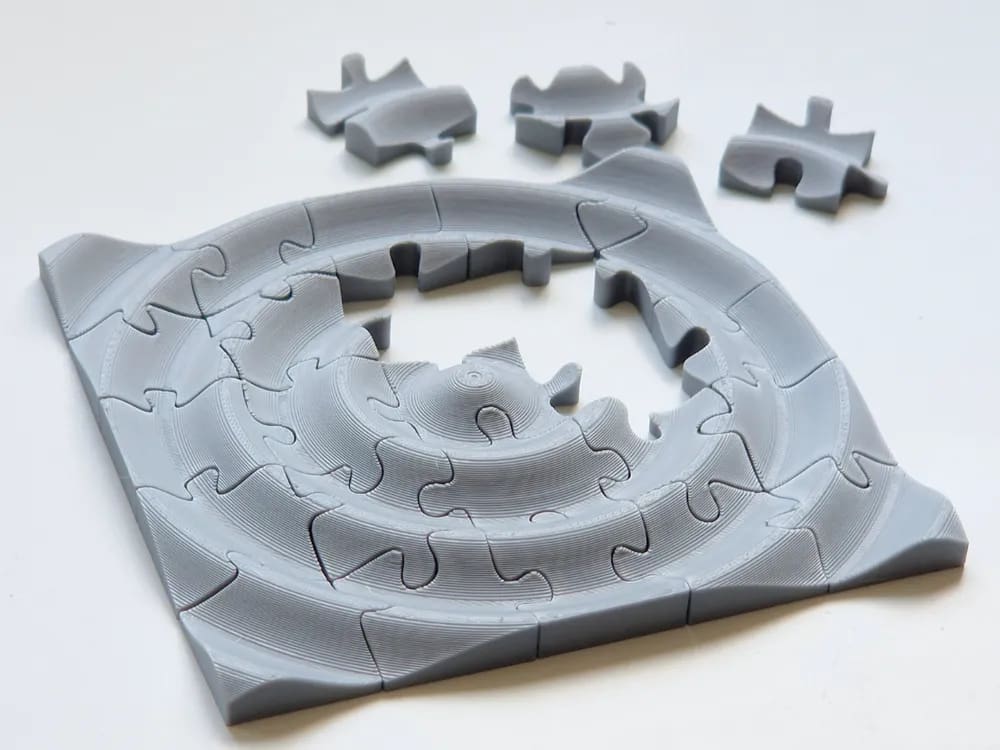
Looking for a puzzle to satisfy both the artist and the mathematician in you? This puzzle isn’t just fun to put together, it’s a decorative piece of art once you’re finished as well.
According to the designer, you can print this easy-to-print puzzle on one plate in less than two hours. It even makes a great gift.
- Who designed it? sidetag
- How printable/popular is it? This popular model has been made 7.7k times, and you’ll find loads of positive remarks in the comments.
- Where to find it? MakerWorld
Map
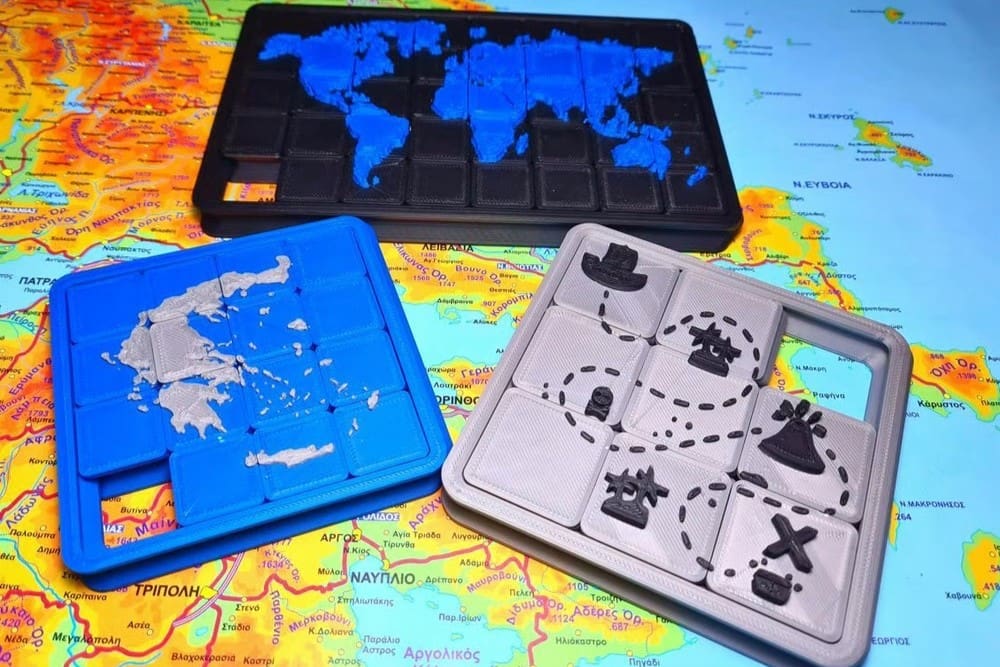
This map design is a print-in-place arrangement puzzle where you have to slide small squares around the frame to align them correctly. The project consists of a few versions, including a 3 x 3 (squares) treasure map, an 8 x 5 world map, a 4 x 5 map of Greece, and more. There are embossed features on each square of each puzzle so you can perform a mid-print filament change to use a different color to have the features stand out from the rest of the model.
While the designer didn’t list any of the printing specifications besides the fact that the puzzle prints in one piece, there are a few makers who have provided a few of the settings they used. One maker stated that they used a 0.2-mm layer height with a 15% infill density to successfully print one of these puzzles.
- Who designed it? NikolasBabetas
- How printable/popular is it? This map puzzle has 25 shared makes. You should be able to make this map just like so many others have!
- Where to find it? Printables
Four Fs
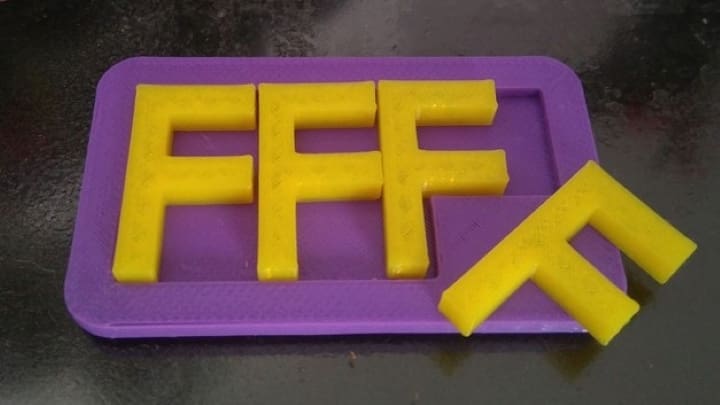
This four Fs puzzle is a fun one. Basically, you have to arrange four F-shaped pieces to all fit on one base part. In total, you need to print five parts (four Fs and one base) to complete the puzzle, and if you can’t solve it on your own, a solution image (spoiler alert!) is in the comments of the project page. A tip: don’t forget to try rotating the letters!
All the pieces are support-free and classified as a medium for their complexity. The only other information was provided by a community maker who listed that they printed the puzzle in PLA.
- Who designed it? FerJerez3D
- How printable/popular is it? This letter arrangement puzzle has a community print, over 13,500 views, and 1,900 downloads!
- Where to find it? MyMiniFactory
Pizza
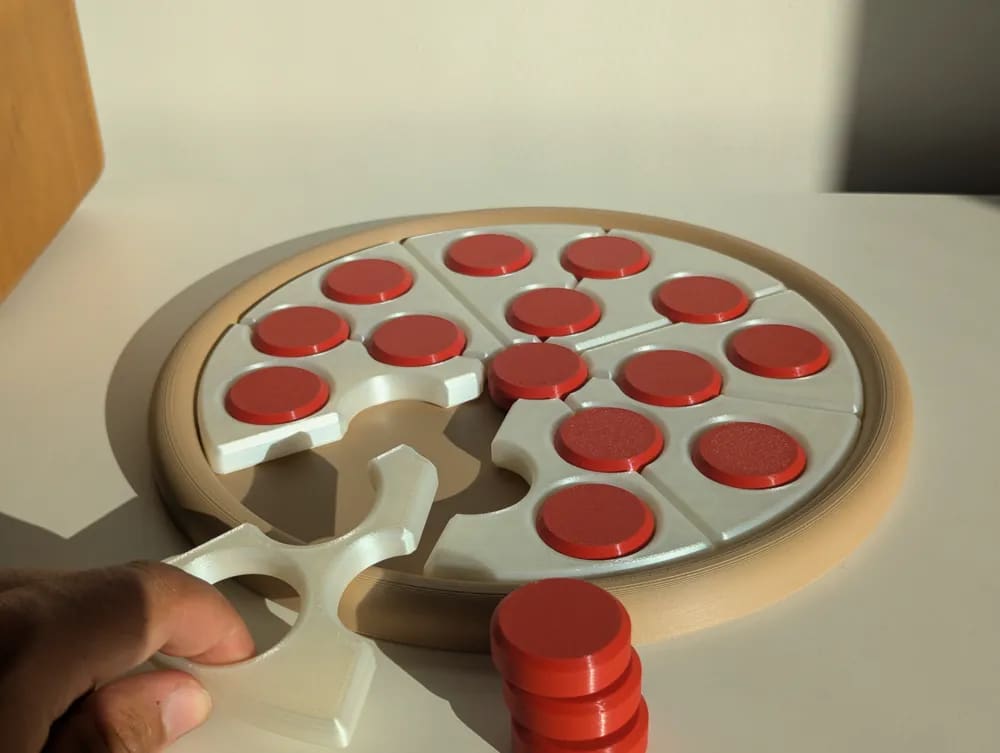
This puzzle is a fun way for little kids to practice their dexterity. The designer states being inspired by classic wooden pizza puzzles, where the challenge is to arrange the cheese and pepperoni slices so they fit on the dough.
The puzzle has 26 pieces in total including the “dough” base. Many makers agree this is easy to print and loved by all.
- Who designed it? ep.shapes
- How printable/popular is it? This food-related puzzle design has almost 600 recorded makes.
- Where to find it? MakerWorld
18 Animals
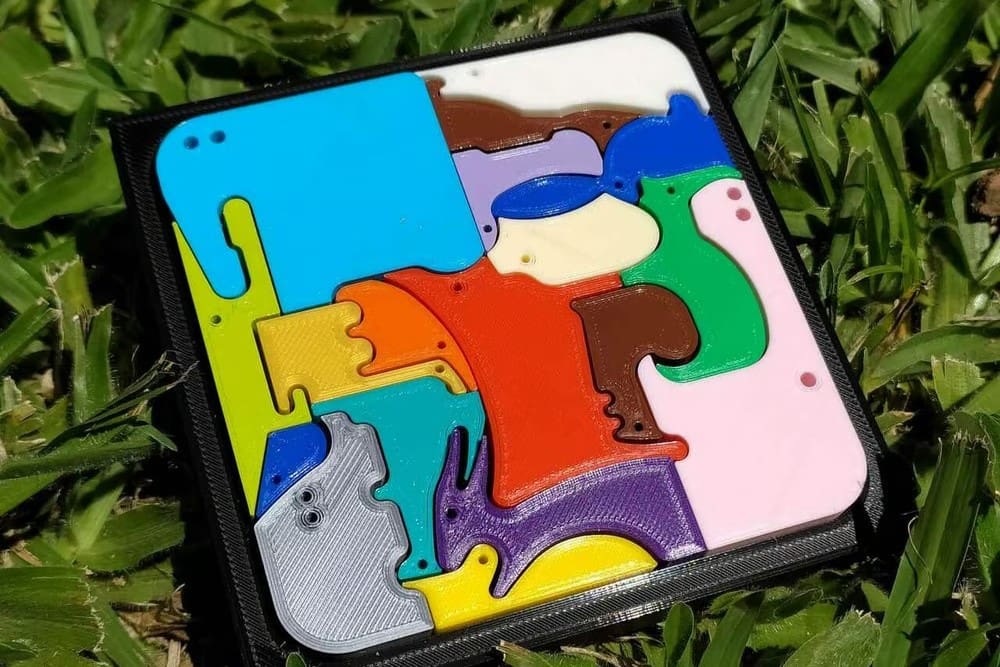
Don’t waste those end-of-the-spool leftovers! You can use filament pieces that aren’t long enough to make a large model in a creative way with this animal puzzle. The puzzle is composed of 18 pieces that will challenge your reasoning, and each piece is a precise fitting of an animal’s silhouette.
The designer included a separate ZIP file with individual parts so you can make adjustments to the size and other details. This is a great puzzle for the whole family to enjoy!
- Who designed it? onepointdiy
- How printable/popular is it? With 46 makes and a remix, you’ll want to make this cute puzzle for yourself.
- Where to find it? Thingiverse, Cults
Relax
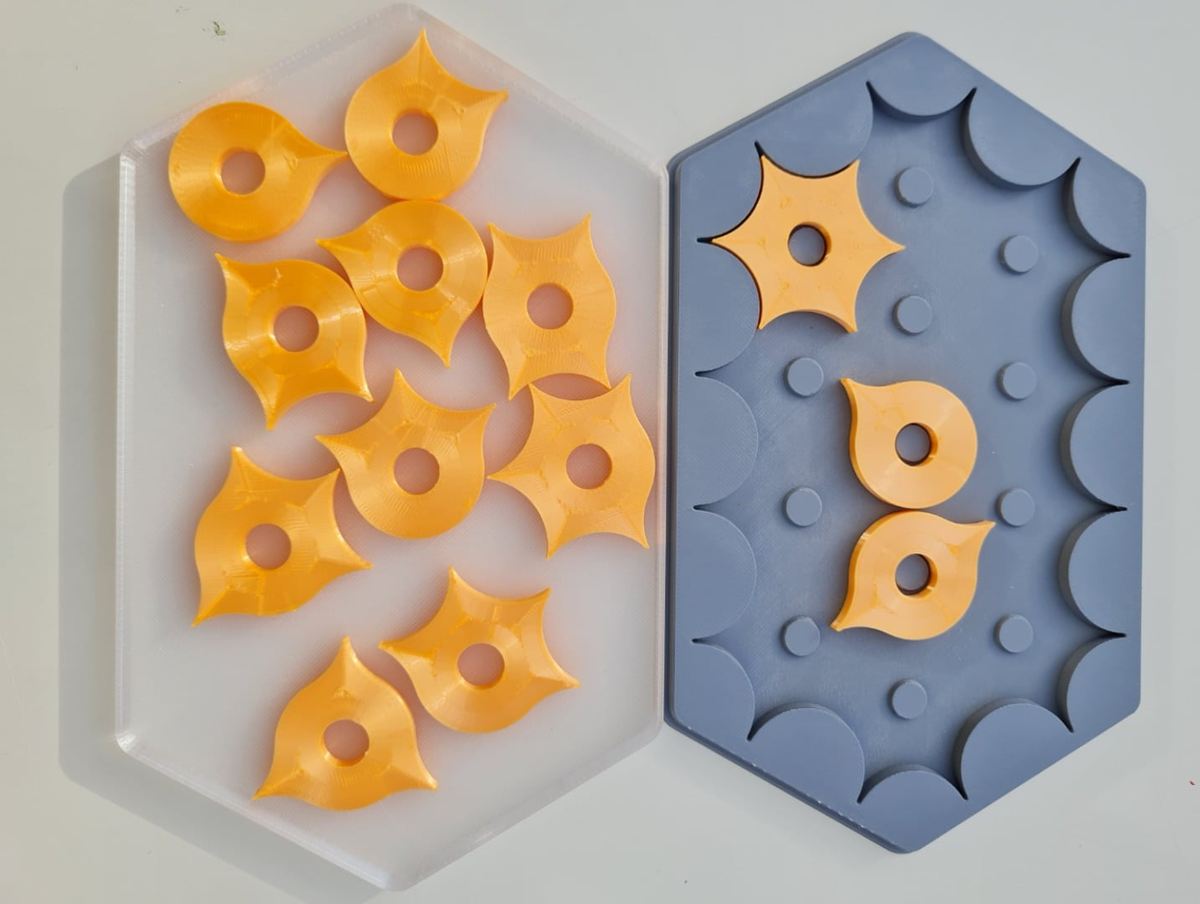
This puzzle is designed to help you wind down, get you to stop overthinking and just play for once. And the best thing about it? There’s more than one way to solve it. According to the designer, this puzzle can be solved 1,640 ways! Can you figure them all out?
The designer suggests using the ironing function for a smooth finish, but notes that turning that off can save you half the print time.The print file comes with a lid, although it’s not necessary for playing the puzzle itself. It does add that extra amount of charm, and helps keep all the pieces together when not in use.
- Who designed it? Sergii
- How printable/popular is it? This puzzles boast 1.5k prints and lots of love from the maker community.
- Where to find it? MakerWorld
Hex Path
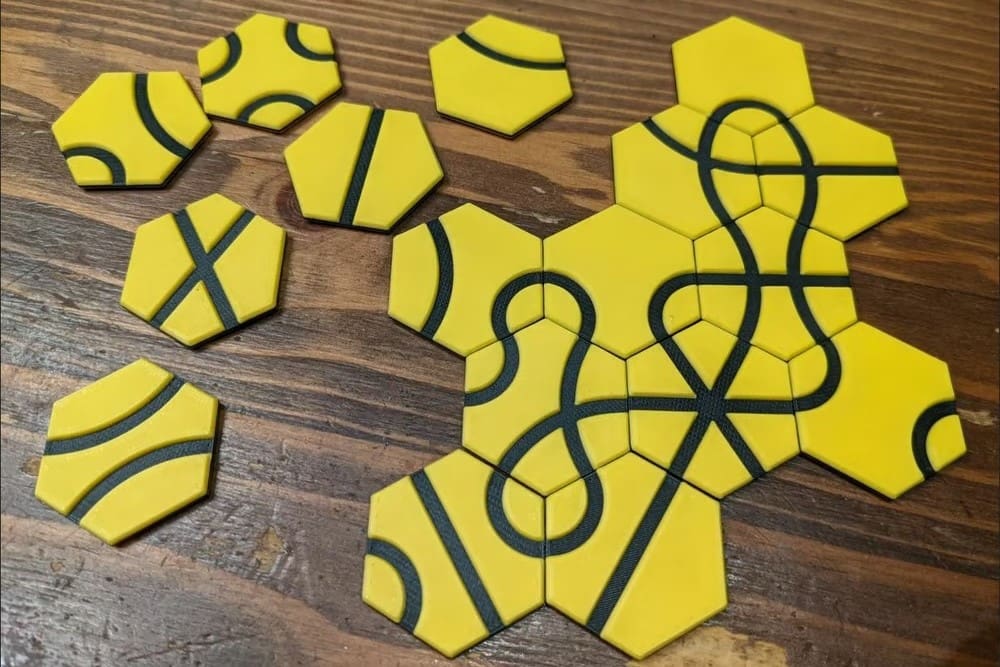
It’s amazing how a simple idea can become something interactive and fun with the help of a 3D printer. The objective of this puzzle is simple: Make the longest possible continuous path while ignoring the unconnected hexagons. The designer’s colleague created a program to test for solutions and found that the longest possible path is 32 pieces long. Are you up to the challenge?
If you’re tired of typical jigsaw puzzles and want something a little different, this one’s a good choice. Print it with PLA and a 0.2-mm layer height. You can combine it with spheres to make things even more fun!
- Who designed it? dworki
- How printable/popular is it? This labyrinth has 10 makes as well as a couple of remixes.
- Where to find it? Printables
Boxes & Cubes
The box is one of the most basic shapes, so why is it so difficult to put it back together!?
Print-in-Place Ghost
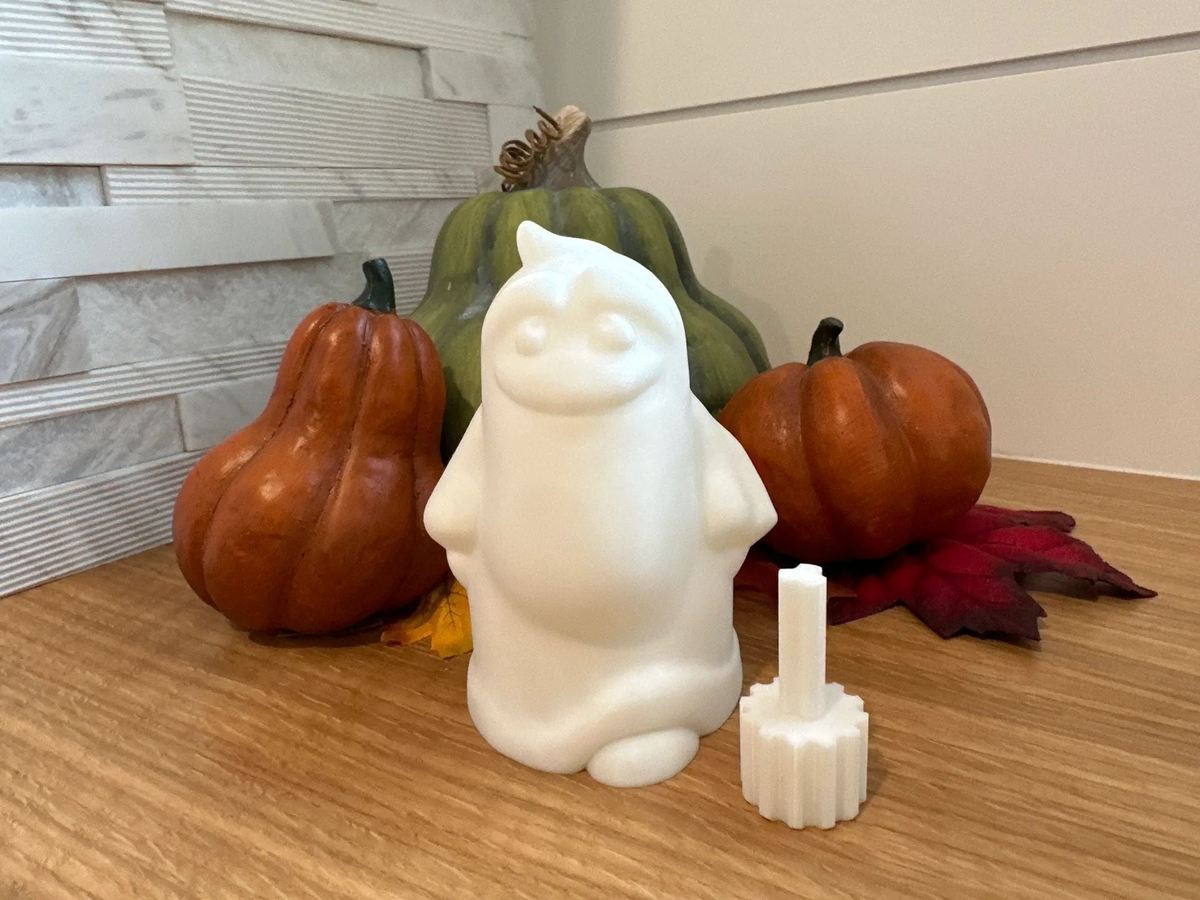
Want a puzzle box that’s ready to solve the minute it comes off the printer? This print-in-place ghost is perfect for you. It’s an easy print, but a difficult puzzle to solve. But don’t worry, if you get really stuck, the designer, 3DPrinty, includes a YouTube video how to solve it.
The designer says this print needs a fair amount of accuracy. The parts are printed in place and have a clearance of only 0.5mm. Your printer must also be able to print overhangs cleanly. Any stringing or other imperfections, the designer states, will make the puzzle impossible to solve.
- Who designed it? 3DPrinty
- How printable/popular is it? This box has 73 makes and comes in both an easy and a difficult version with no assembly required.
- Where to find it? Thingiverse, Printables
Japanese Box
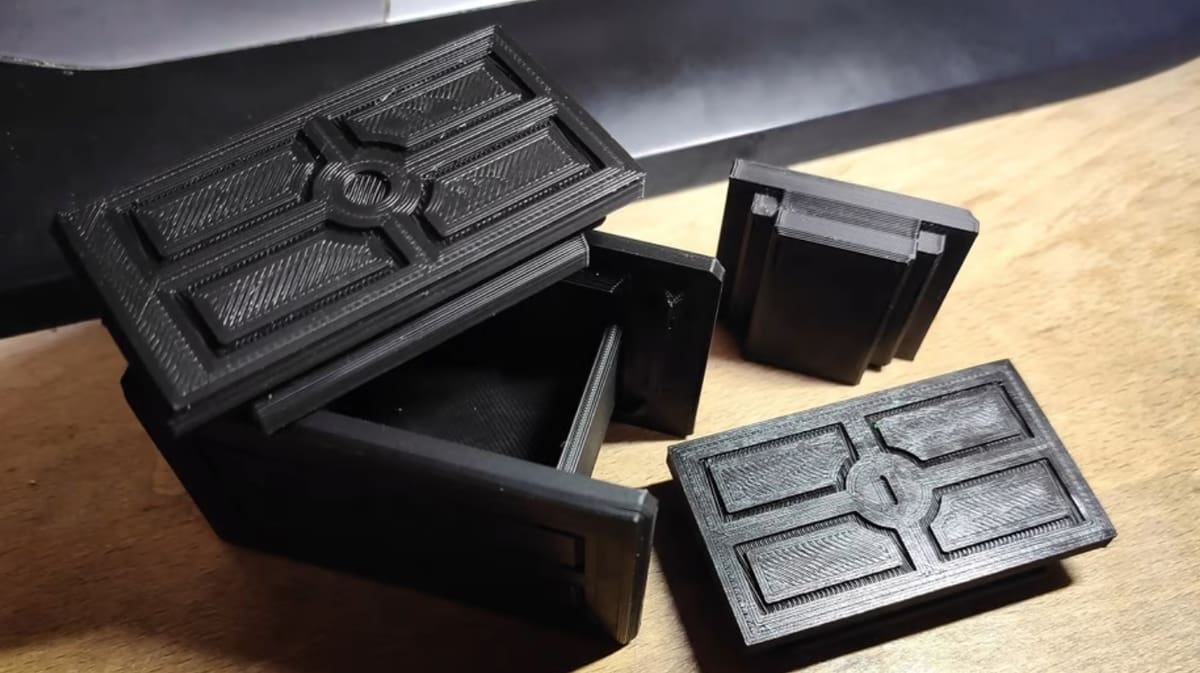
Many boxes exist that require some special procedure to open. This Japanese version is no exception, needing 10 steps to rearrange the pieces and free whatever’s inside. Printed to scale, it would be a good size to give a small gift, like a keychain or candy.
Users report that the model is hollow inside, probably to minimize material consumption. Just make sure to check your 3D printer settings to ensure that the bridging goes smoothly.
- Who designed it? dob71
- How printable/popular is it? There are 17 makes and a couple of remixes of this clever puzzle box.
- Where to find it? Thingiverse
The Launch
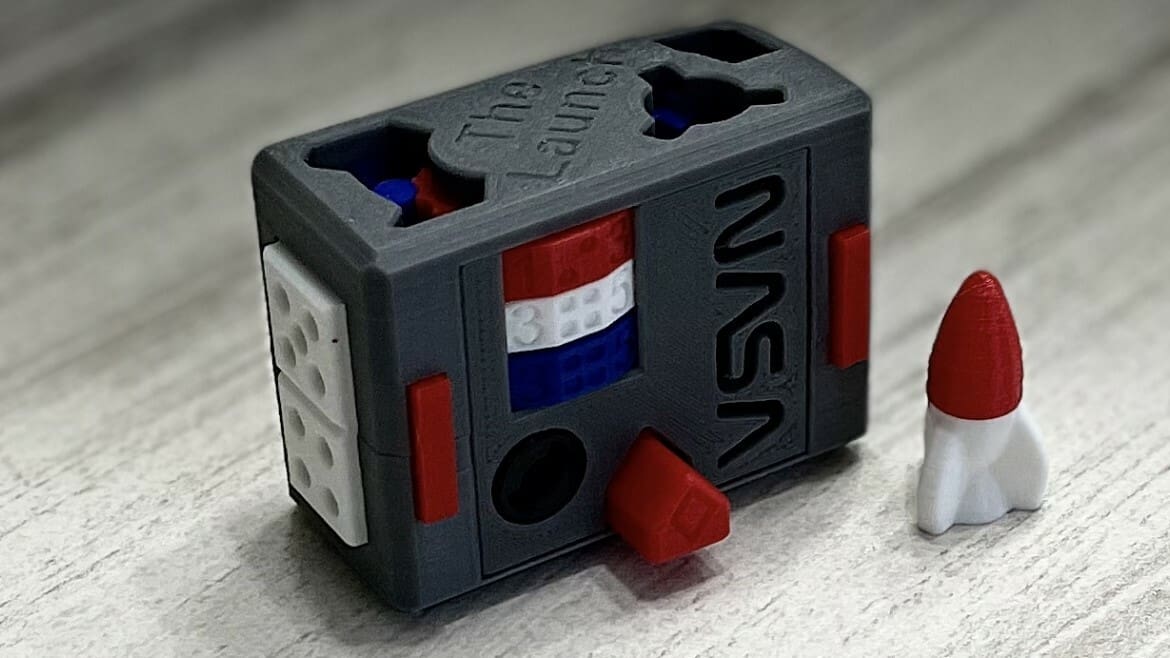
Ready to launch into orbit with this next thrilling puzzle box? This puzzle features rubber bands for greater durability, reduced wear, smoother touch, among other enhancements. In total, there are 22 pieces that promise to be super easy to print and assemble in your favorite colors.
The author provides a list of the colors used for each part and other setting tips, such as a layer height of 0.2 mm and 15% infill. To check out all the details, there are excellent videos about the remix updates and assembly instructions. There’s also a solution video, but it’s best to leave this one until after you solve the mystery so as not to spoil the fun.
- Who designed it? LeisureLuke
- How printable/popular is it? It’s easy to understand why more than 1,000 people have already downloaded this challenge. As 19 makers have already solved it, you can too!
- Where to find it? Thingiverse, Printables, Cults
Dowels & Box
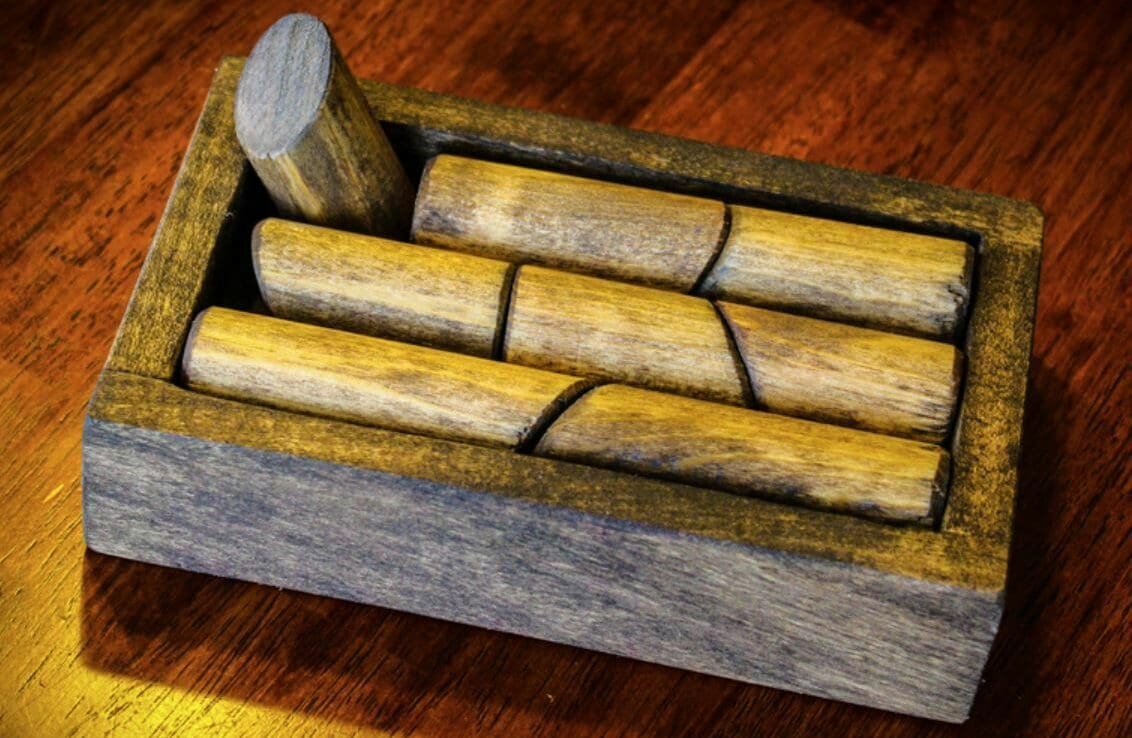
This puzzle consists of an open box with eight sliced rod segments (dowels). The goal is to arrange the rods so that they all fit inside the box. According to the designer, the puzzle is a 3D printable version of the original Lox in Box puzzle that was designed by Vesa Timonen.
As seen in the image above, getting seven of the dowels to fit is easy, but it’s the eighth that makes this puzzle a challenge. Need a hint? You can see the solution in the designer’s video.
Unfortunately, there are no printing tips for this puzzle. For this reason, you’ll have to come up with your own settings for the nine total pieces used for this design.
- Who designed it? mtairymd
- How printable/popular is it? This dowel and box puzzle set has over 7,200 views and more than 2,200 combined downloads.
- Where to find it? Cults, YouMagine
Gear Box
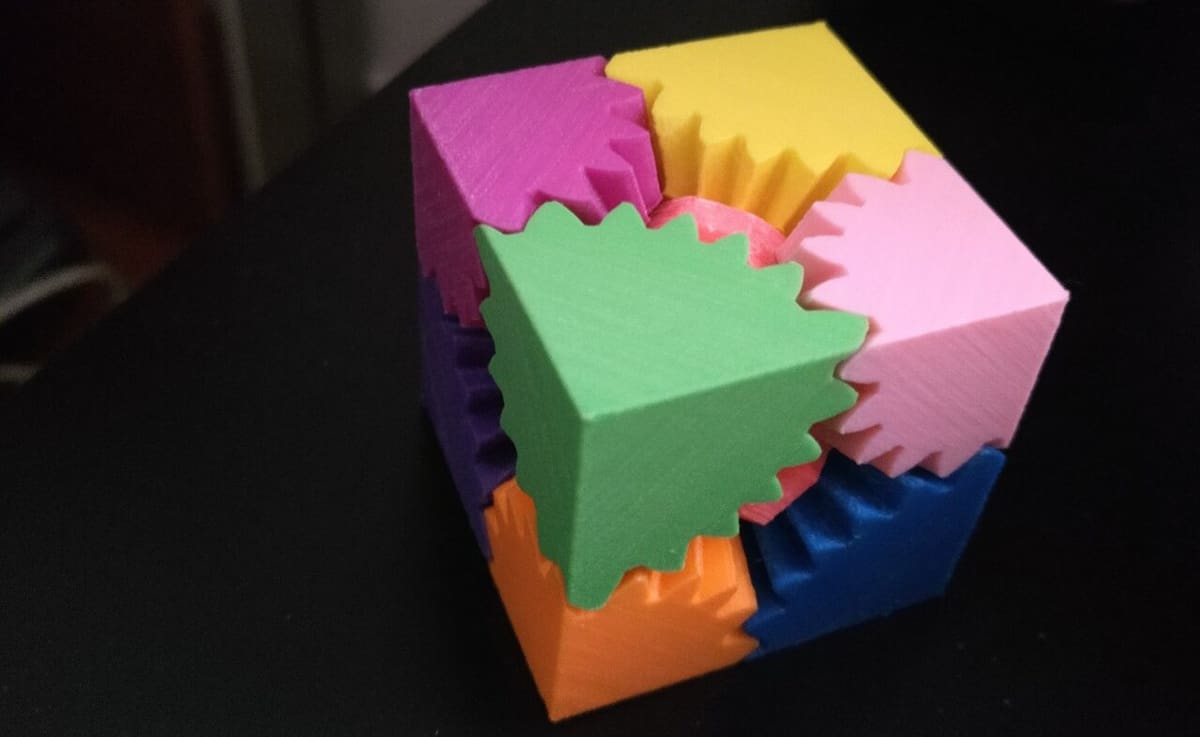
This model consists of multiple gears shaped in such a way that, when correctly assembled, form a cube. This is the second iteration of this design, with improved pins. The designer recommends snapping the pins into the center block before attaching the gears.
The model consists of one centerpiece, four large gears, four small gears, and eight pins. All of the components are easy to assemble and can be 3D printed without supports.
- Who designed it? emmett
- How printable/popular is it? There are an incredible 579 makes of this cube as well as over 1,000 remixes with makers adding names and symbols to the pieces.
- Where to find it? Thingiverse
Identical Twins
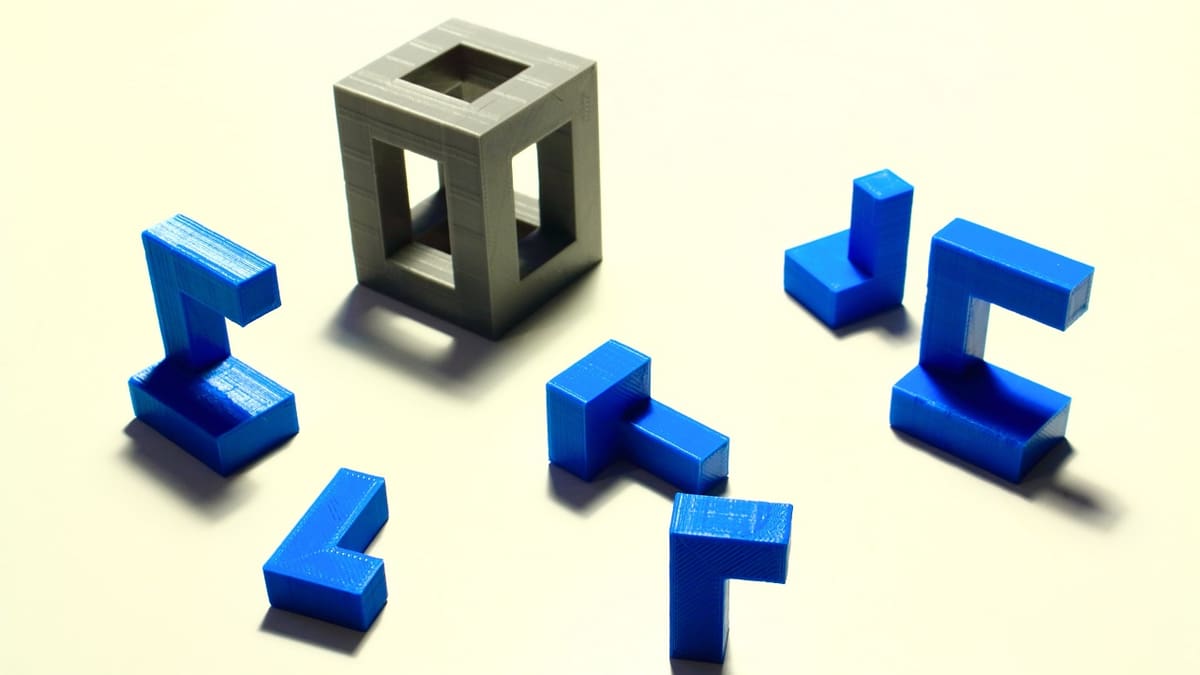
This 3D printable identical twins puzzle matches the puzzle that won the International Puzzle Party in 2017. The puzzle includes a hollowed-out rectangular box with rectangular holes and some smaller irregular-shaped pieces. The goal is to fit the smaller pieces into the box’s holes so that the surface of the box is smooth with no extruding parts.
The designer didn’t provide any printing tips, but other makers have stepped up to the plate and posted their settings. One maker listed that they opted for PLA and used a 15% infill to print the pieces, with supports activated.
- Who designed it? AndresMF
- How printable/popular is it? This identical twins puzzle has 29 recorded makes.
- Where to find it? Thingiverse
Multi-Part Cube
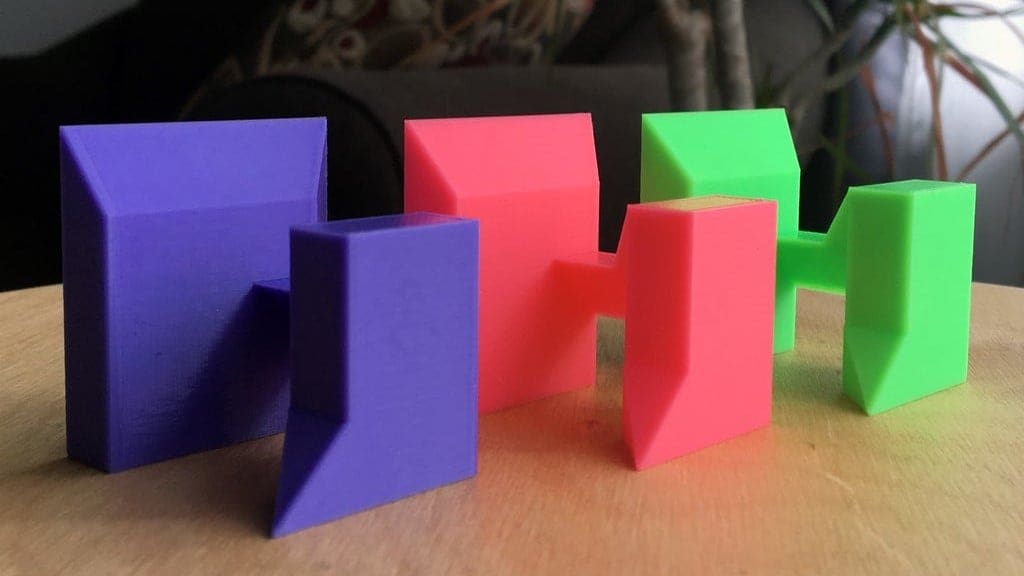
This puzzle is simple yet surprisingly difficult! It’s a set of three identical pieces that can be 3D printed without supports. Once printed, you (try to) slide the pieces together to form a perfect cube. This print can serve as a puzzle for kids or as a cool toy.
- Who designed it? WildRoseBuilds
- How printable/popular is it? 382 makes have been shared. This should be a simple print with mind-boggling results!
- Where to find it? Thingiverse
3D Arrangement
For those who have already flipped and broken all of their tables out of frustration, these puzzles assemble to create a compact 3D figure.
Elephant
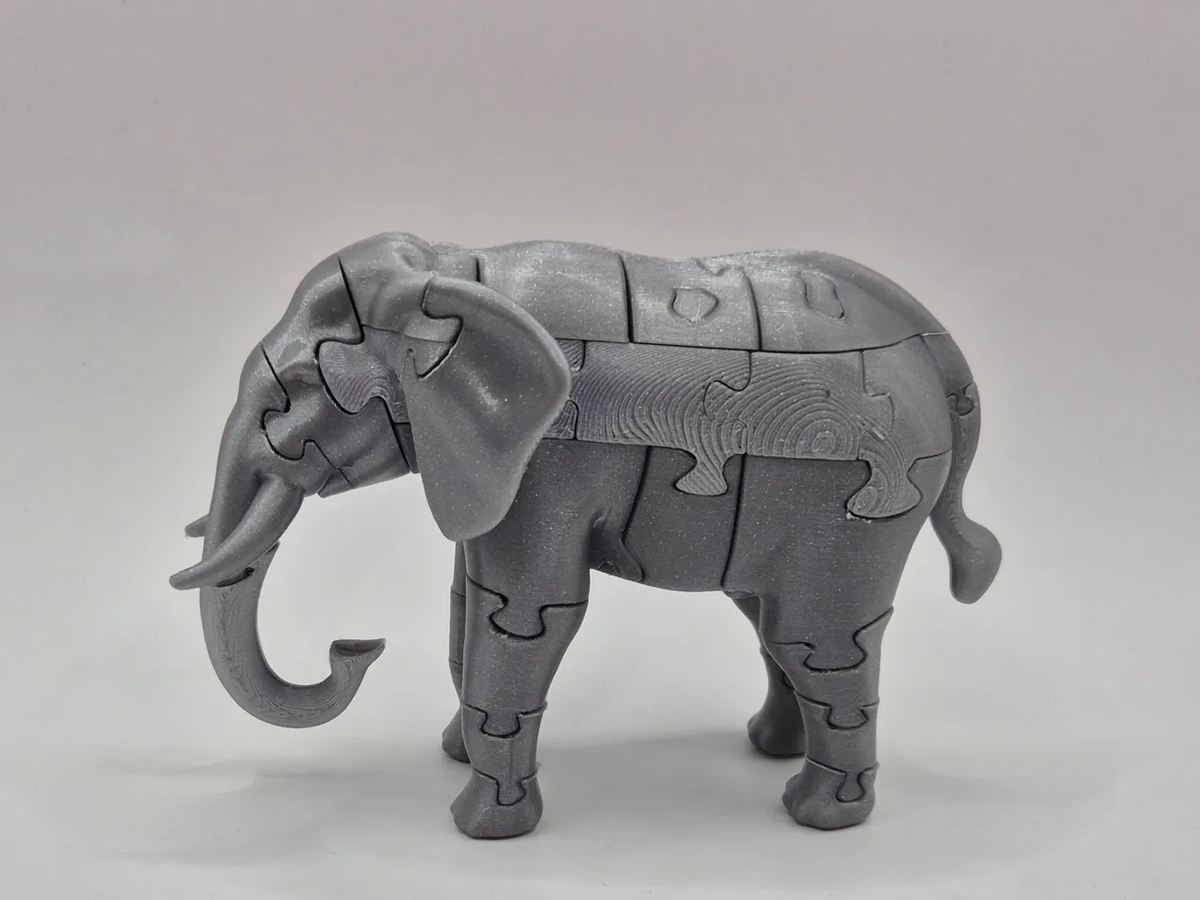
This 45-part puzzle is fun to put together, and at 14cm long and 10cm tall, ends up being a cute decorative piece when not in use.
The designer suggests printing with PLA, although makers using PETG didn’t have any complaints. A few of the puzzles pieces will need a brim, and the designer clearly indicates which ones these are. Some makers suggest sanding so the pieces fit together easier, but with so many makes, this print must be a fun one.
- Who designed it? Wilko_SLO
- How printable/popular is it? This elephant puzzle has over 14,600 downloads around 108 makes.
- Where to find it? Printables
Bee Kit
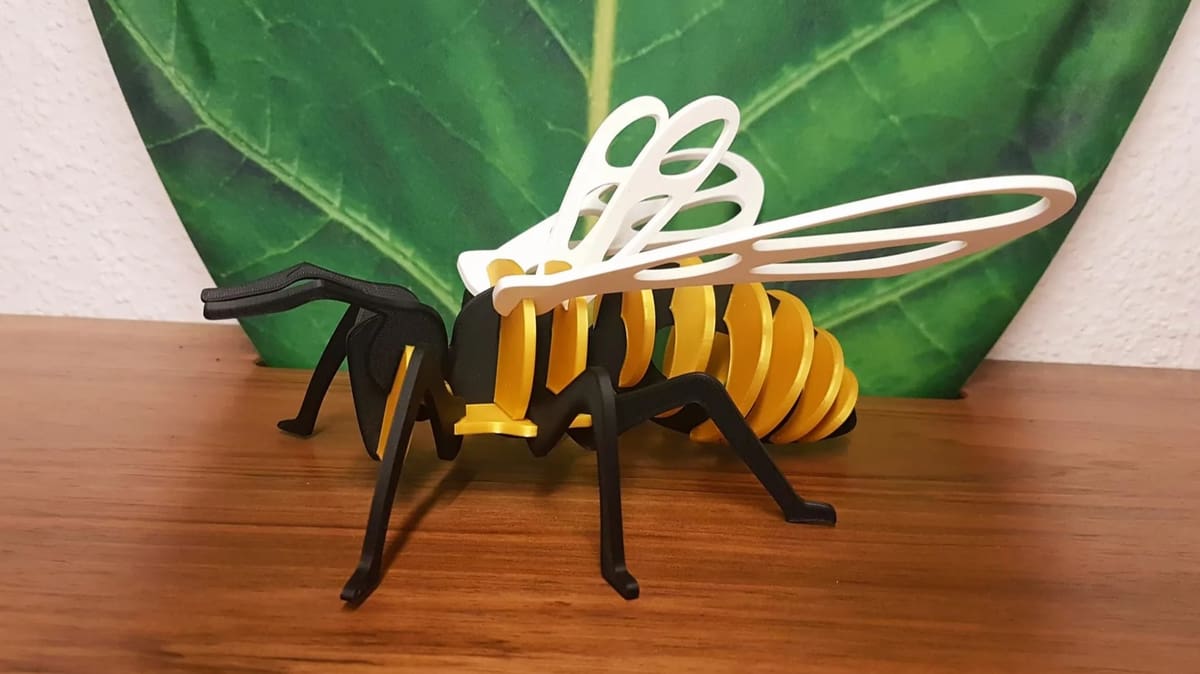
This bee model is challenging but well worth it! All the parts print separately, and fitting them together is your objective.
The designer recommends an infill of 15%. You can print the parts separately and assemble them as a puzzle, or print the fully assembled design to view the reference model and use it as a decorative piece. Honey not included.
- Who designed it? TomoDesign
- How printable/popular is it? Between both sites, 59 makes have been shared, showing that you can easily make it at home, too!
- Where to find it? Printables, Thingiverse
Third Stellation
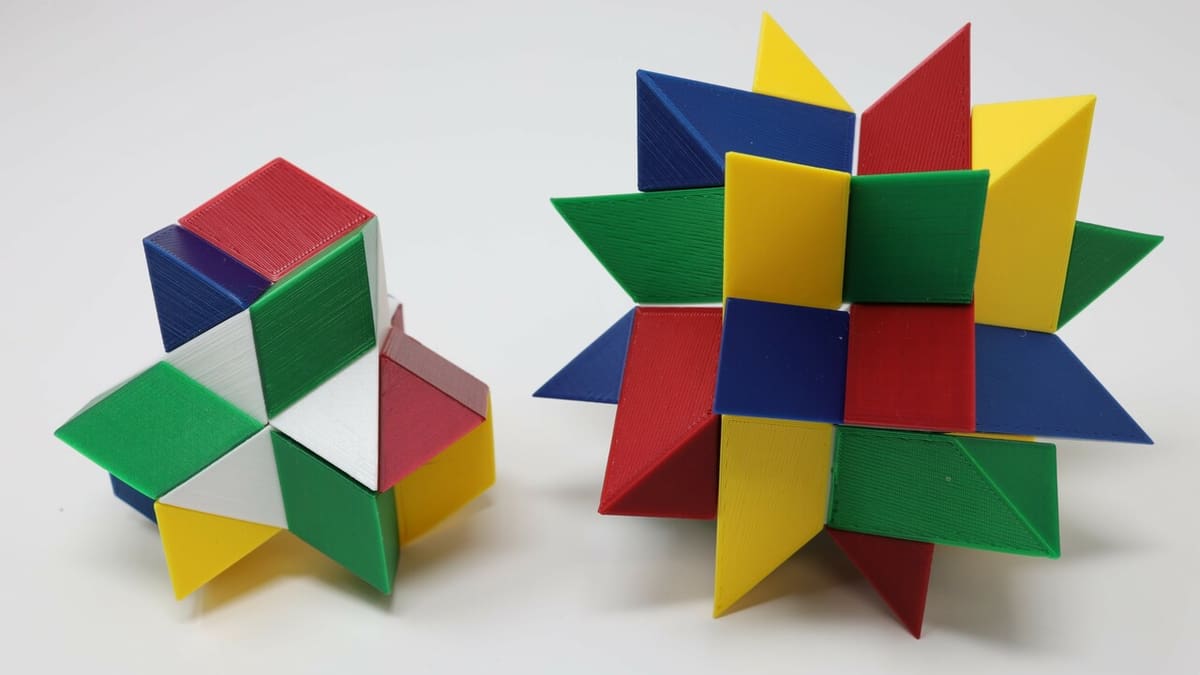
This is another brilliant creation from designer Stewart Coffin, who has earned the title of “the most outstanding designer and maker of interlocking puzzles that the world has ever seen.” This title is well-deserved, considering he has made over 400 different puzzle designs spanning a wide variety of genres. This puzzle is solved by successfully assembling all the pieces that interlock to form a star shape.
The six parts of the puzzle have subsections in different colors. When assembled, the puzzle creates the illusion of triangular sticks running the entire length of the puzzle, when in fact the individual pieces are entirely made up of half-stick segments. There are two versions: the monochromatic one known as “Superstar” and the colorful one known as “Third Stellation.” All parts use interlocking joints marked with letters, so make sure to correctly match them together.
- Who designed it? asiegel
- How printable/popular is it? Over 650 people have already downloaded this mathematical challenge, and there are two shared makes.
- Where to find it? Thingiverse
Eggy
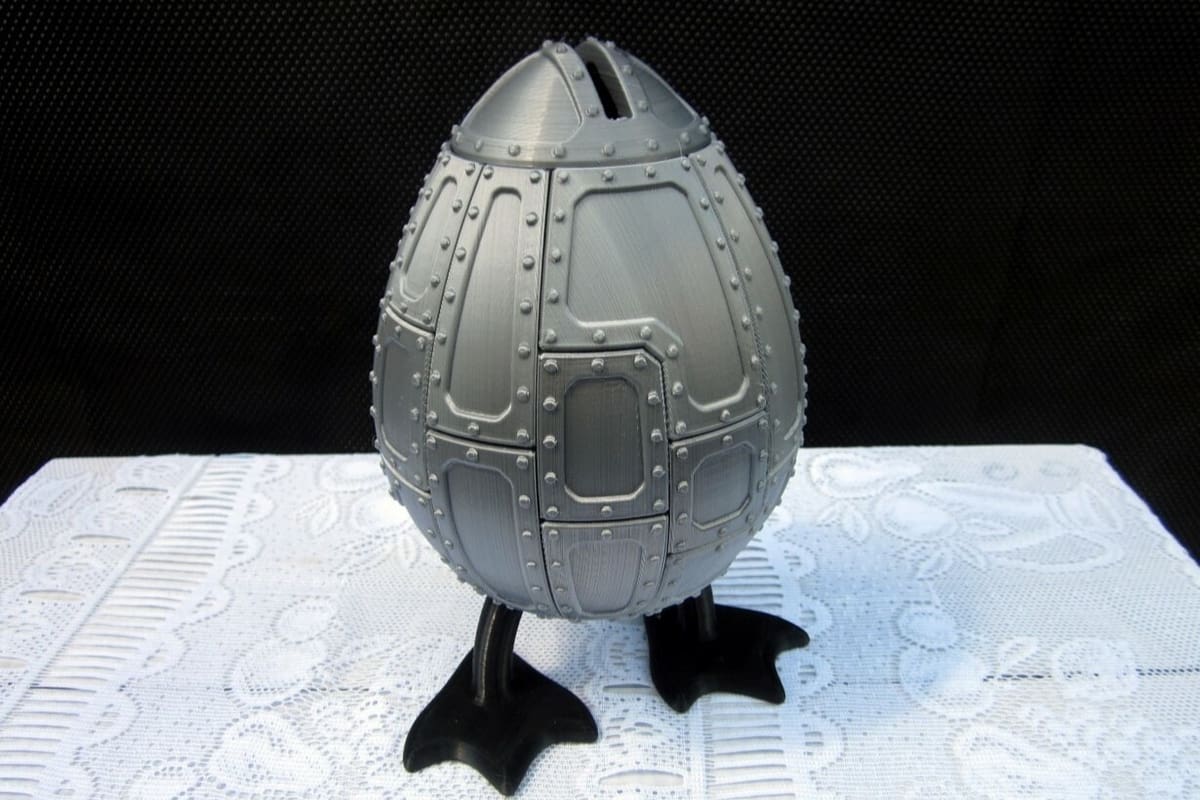
This eggy design can be a fun toy for puzzlers of all ages. The construction consists of 28 parts, which you need to assemble. The assembled model has dimensions of 195 mm height, 137 mm width, and 120 mm depth. The designer has also provided an assembled model for reference to make it easier for designers.
To make this model, use the designer’s suggested settings with a 0.2-mm layer height and 10% infill. You won’t need to worry about supports.
- Who designed it? Monogon_Lab
- How printable/popular is it? This project has 70 downloads and over 5,300 views. The author has also provided the reference model to make things easier.
- Where to find it? Cults
Martin's Rocket
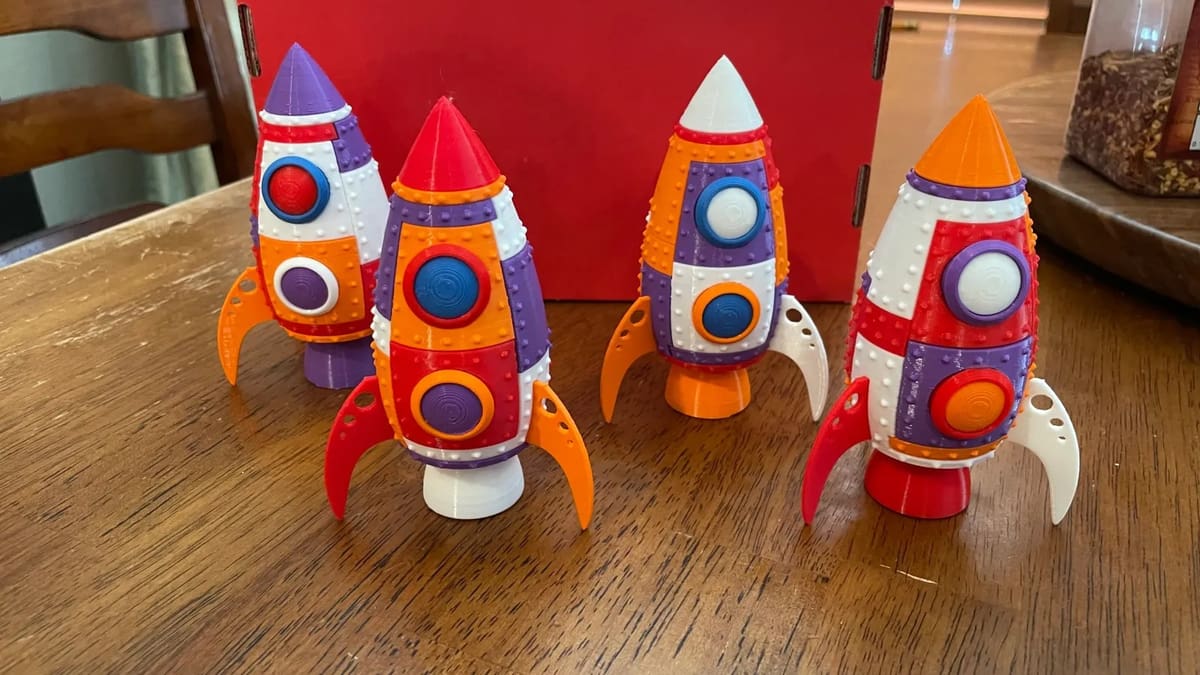
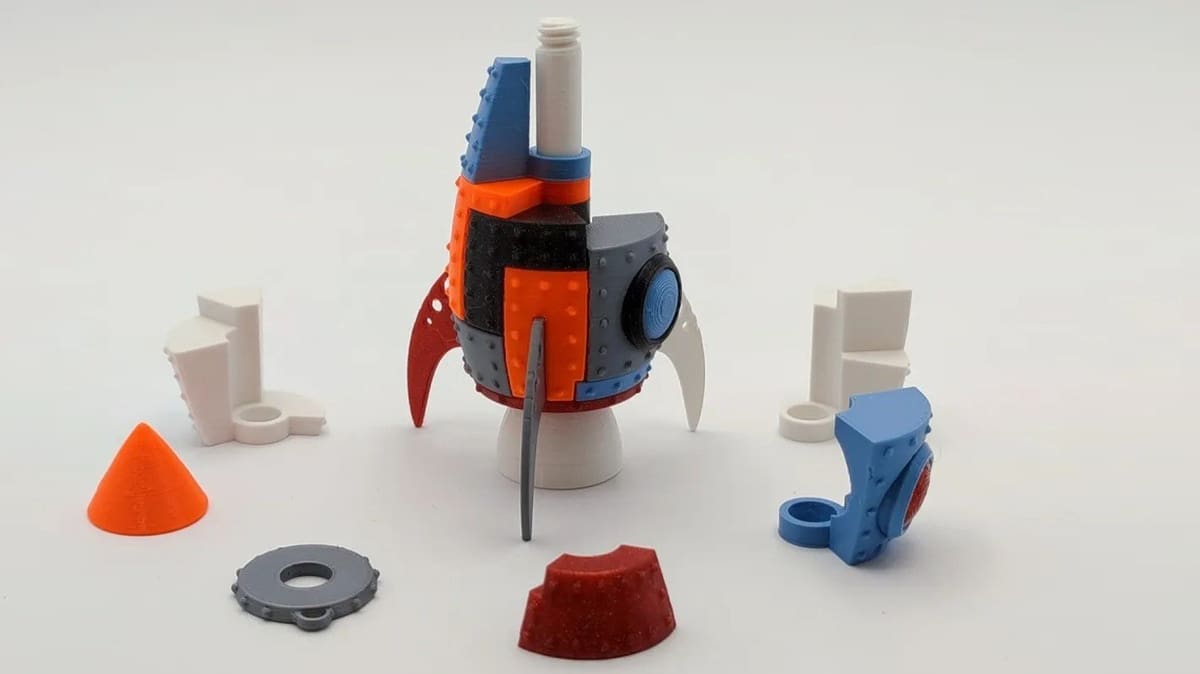
Are you ready to blast off to outer space? A dedicated uncle was inspired to make this rocket as a gift for his little nephew. He designed the parts using FreeCAD and Blender.
The puzzle consists of 24 pieces that are mounted on an axis. For best results, print using PLA or PETG at a layer height of 0.2 mm. To prevent the nozzle core piece from breaking, print with 100% infill. In total, the puzzle should take between 8 and 9 hours to print.
- Who designed it? McNumber
- How printable/popular is it? With 83 makes, this rocket has already taken off!
- Where to find it? Printables
Articulated Fish
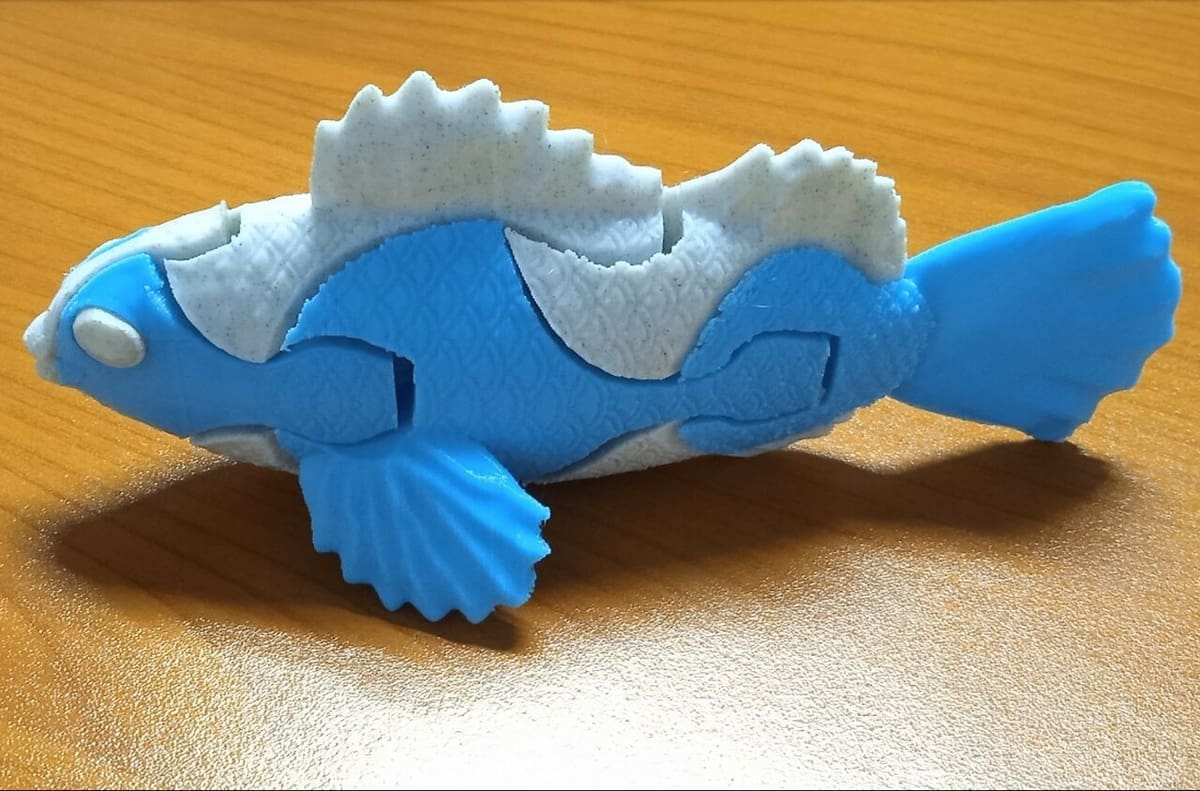
Here’s a puzzle that allows you to construct a 3D model of a fish with interlocking joints. The moveable joints allow it to realistically mimic the movement of a fish.
All the parts print separately. The designer notes that it’s similar to their viper puzzle, except this model needs supports for the fins. The recommended print settings for this model include a 0.2-mm layer height with 15% infill.
Millennium
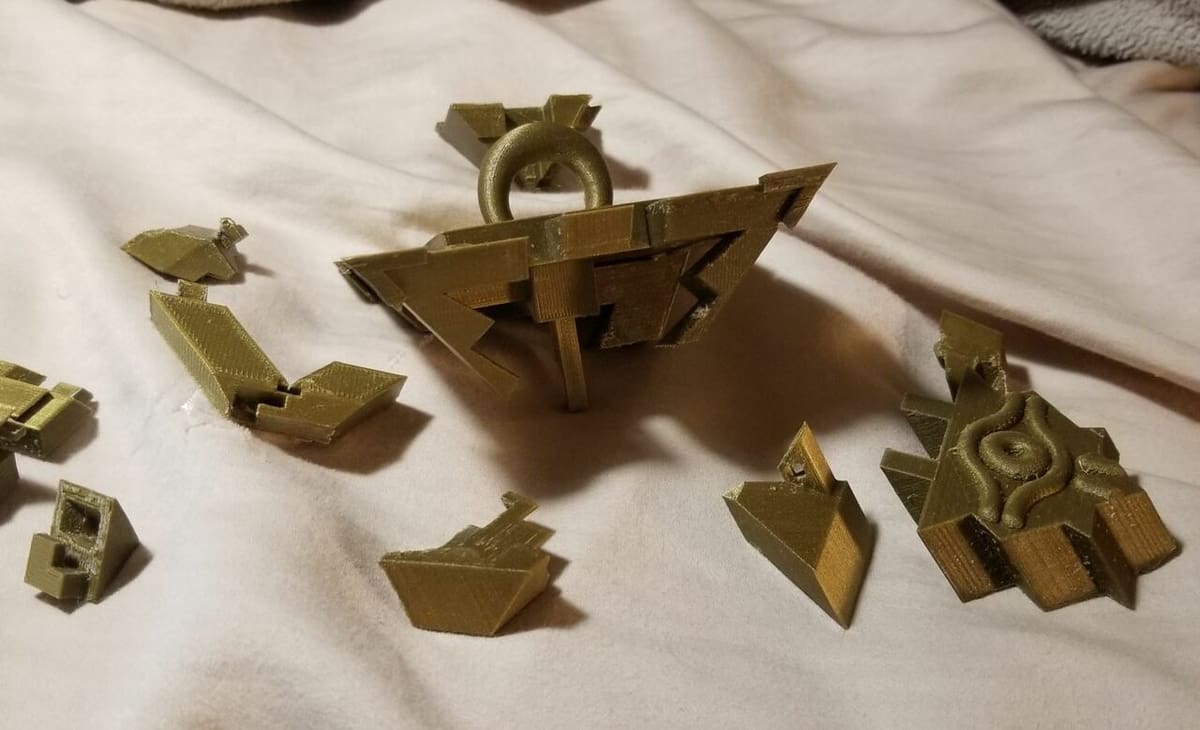
The Millennium Puzzle, from the Yu-Gi-Oh! franchise, is a popular but very complex puzzle design in the shape of a pyramid. It contains many smaller parts that make it difficult to solve. As legend has it, the puzzle is thousands of years old and meant to give great power to those who solve it.
The puzzle is comprised of 20 3D printable components, but a few have to be glued together before assembly, according to the designer. Given how many parts are used for the model, it’s not surprising that its printing complexity is listed as “difficult”. A community maker also listed that they printed the parts in PLA, but, sadly, no other printing advice was provided.
- Who designed it? ShadowofMagnus
- How printable/popular is it? The Millennium puzzle has over 93,800 views as well as 14,100 downloads. The project also has three posted community prints, indicating that you should be able to print it.
- Where to find it? MyMiniFactory
Mechanisms & Moving Puzzles
These puzzles have a bit more to them than meets the eye!
Coasters
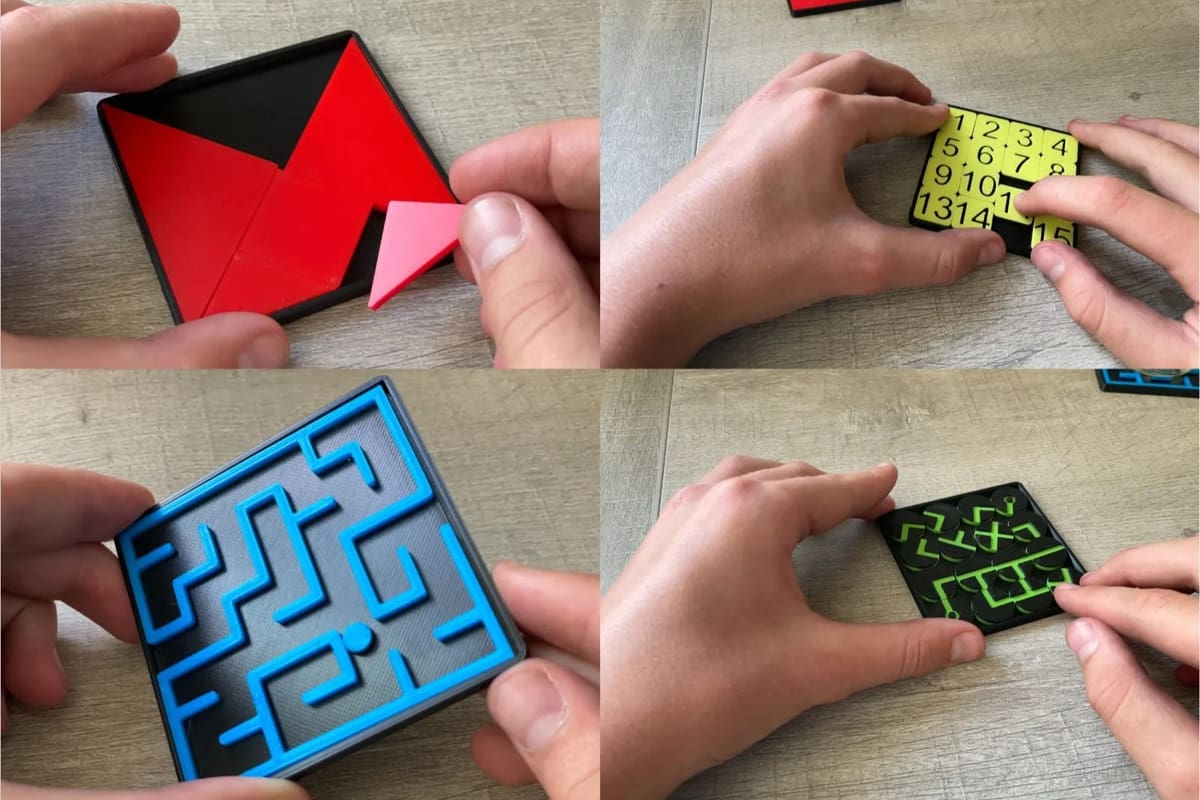
For those who love puzzles, here’s a small collection of four different challenges. These coaster puzzles will be a nice decoration for your home and protect furniture from liquid marks. The base is the same for all models, and there’s also a box to store them all together when not in use.
Each model has a distinct theme highlighted by vibrant and different colors. To print the colors, you’ll need to pause the print and change the filament. To learn more about how to do this, you can also refer to our article about pausing at height. In the comments, there’s also a very cool tip about using filaments that change color according to temperature.
- Who designed it? IMakeThings
- How printable/popular is it? 2 posted makes and over 160 downloads show that these coaster puzzles are printable able solvable!
- Where to find it? Printables
Labyrinth Box
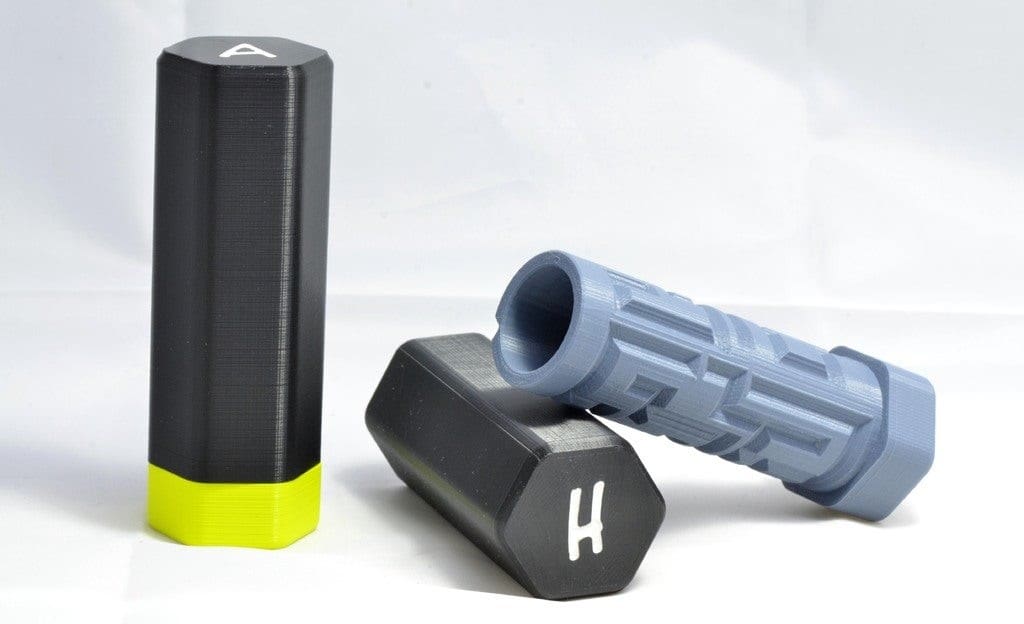
This is a two-part object. One part is a maze or labyrinth carved into the surface of a cylinder, and the other is a cap with a pin that goes on top of the labyrinth. When you start removing the cap, the pin is guided by the carvings. In order to separate the two pieces, you must feel the correct direction in which to move the cap. It’s a good way to make someone really work for whatever you’ve hidden inside!
- Who designed it? sneakypoo
- How printable/popular is it? This model has over 1,000 makes. There’s a long list of positive comments, so it should be a breeze to print – not so much to solve!
- Where to find it? Thingiverse
Lock
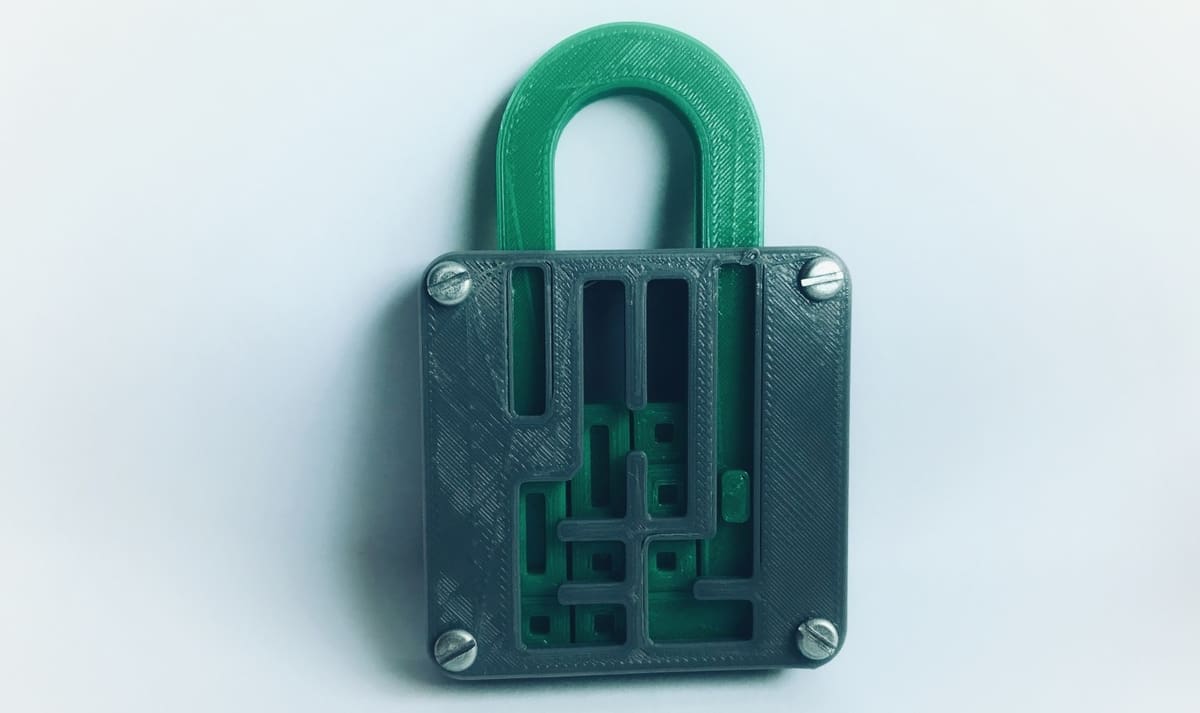
As the name suggests, this lock puzzle is just like a cam lock, and the goal is to open it. The puzzle was designed for a puzzle-making competition, and to open it, you have to rearrange the small pieces inside the lock using the matching key.
Assembling this mechanism involves using the 10 printable pieces, arranging them, and gluing the cover. There are also screw holes you can use to fasten the cover, but community makers have pointed out that screws will tear the holes up, leaving them unusable.
Great prints have been posted, and many have used PLA to print the puzzle. The model is listed as easy for its complexity.
- Who designed it? Anders644PI
- How printable/popular is it? This cam lock puzzle has quite a few community prints, over 32,300 views, and 3,400 downloads. So many people have printed this puzzle, and you can too!
- Where to find it? MyMiniFactory
Rubik's Bear
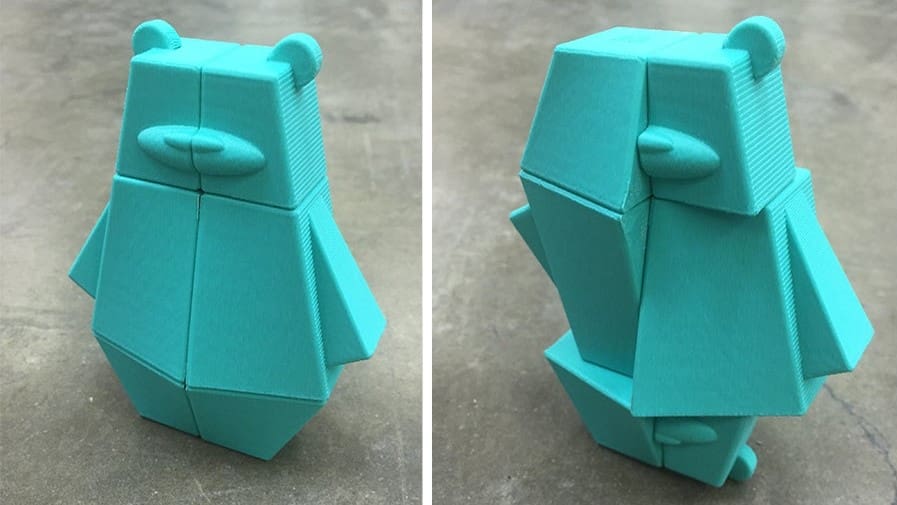
This 3D printable puzzle bear is an ideal present for small children. The goal is to assemble the bear from multiple separate pieces. The creator also included the template for stickers that can be glued to the bear pieces.
- Who designed it? emancarrillo
- How printable/popular is it? 37 users have also posted makes of this model, and among the eight remixes, there’s a fun robot!
- Where to find it? Thingiverse
Revolver
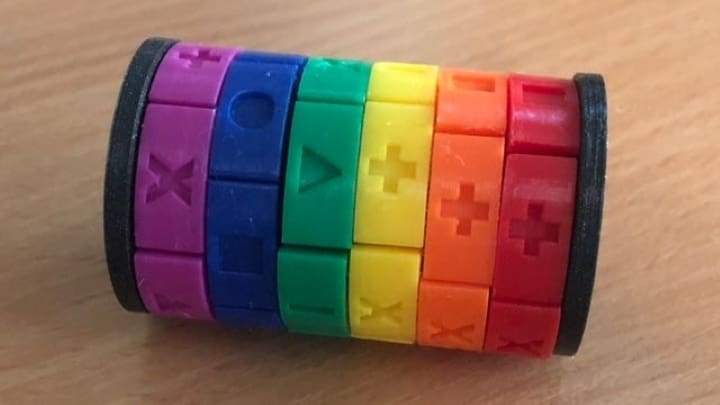
If you’re looking for a challenge, this 3D printable 41-piece puzzle is for you. It uses a mechanism similar to a Rubik’s cube but in the shape of a cryptex. The goal of the puzzle is to align colors or shapes in one line. The catch is that you have only one empty space, meaning that you need to plan ahead.
Unlike a Rubik’s cube, you won’t be able to cheat this one with memorized moves!
- Who designed it? muzz64
- How printable/popular is it? There are 48 makes of the shapes version and 51 makes of the colored one. A pretty even split!
- Where to find it? Thingiverse
Spin
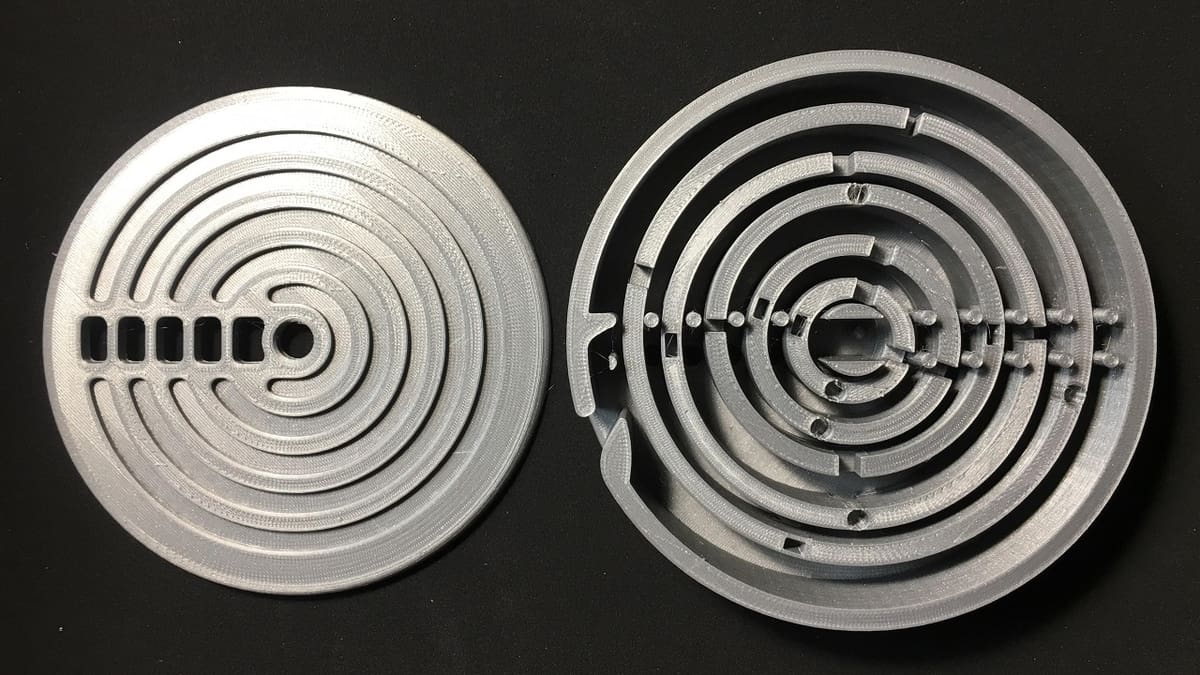
With this spin puzzle, you have to rotate and spin the parts to move the marble inside until you get it out of the exit point.
This maze-like puzzle is split into eight 3D printable parts, including the small ball (you could alternatively use a marble), and it contains five rings of pathways to create the maze.
The designer listed the model as easy for its complexity but provided no other printing tips. However, one community maker posted a well-printed model and shared that they used two perimeters, a 15% infill, and a decently fast print speed (60 mm/s) to print the model in PLA.
- Who designed it? mr.frogman99
- How printable/popular is it? This marble rotation puzzle has a community print and over 5,600 views, with over 500 downloads.
- Where to find it? MyMiniFactory
Pencil Trick
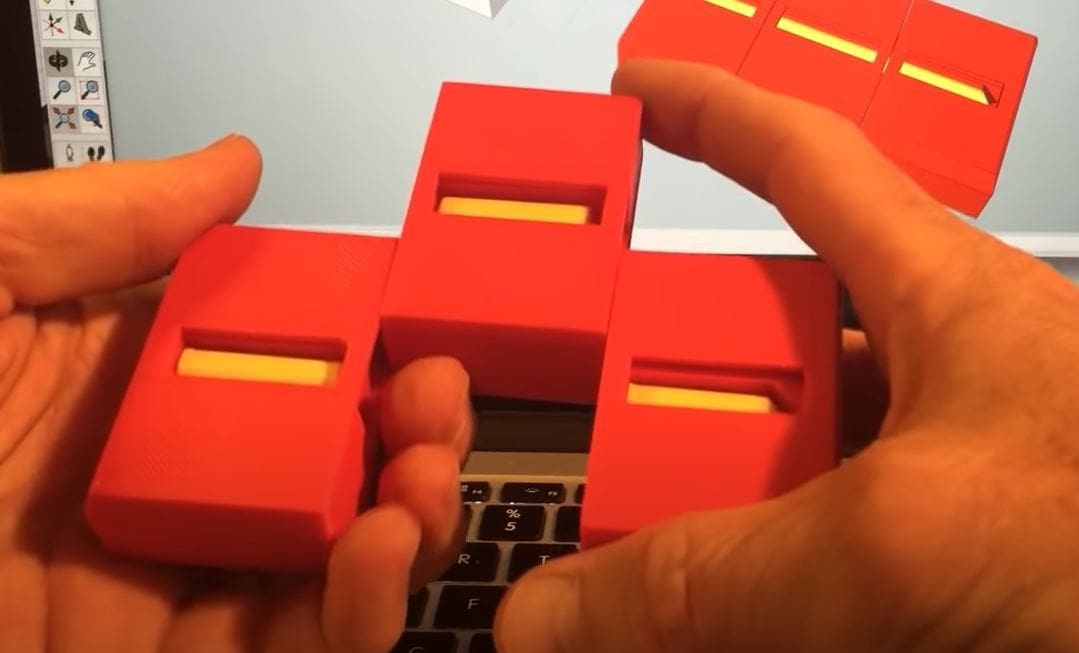
This magic trick isn’t exactly a puzzle, but it will certainly leave people puzzled! The idea is to slide a (3D printed) pencil into the three-piece model and remove the middle part to break the pencil into three. Then, when you push the middle part back into place, the pencil magically becomes whole again!
This design is slightly mechanical, consisting of eight printable parts. The creator of this design recommends taking a look at the complete STL file provided before printing to get a visual idea of how it fits together.
The designer indicated that some filing and sanding will be required to achieve a good fit. It’s probably best to print these parts with dimensional accuracy in mind in order to limit your post-processing.
- Who designed it? gzumwalt
- How printable/popular is it? This pencil puzzler design has over 15,100 views as well as almost 3,100 downloads.
- Where to find it? MyMiniFactory

License: The text of "30 “Impossible” Puzzles to Challenge Your Brain and Your Printer" by All3DP is licensed under a Creative Commons Attribution 4.0 International License.