No More Midnight Plate Swaps: This Kickstarter Kit Automates Your 3D Printer For Continuous Printing

While companies like FlyingBear race to automate the desktop FDM workflow, the industry is still searching for the 'gold standard' in reliable, lights-out production.
Have you ever called home from work to ask your spouse/teen/roommate to change the build plate on your printer? Or maybe you’ve stayed up late to swap build plates for an important project? You’re not alone. While complete remote control of your printer from your smartphone is a wonderful advancement, it can’t remove finished parts from the build plate.
So what if you start a print job in the evening, go to sleep, and wake up in the morning to find 15 finished parts without having to change the print plate even once.
Fortunately, there are a few gadgets on the market, mostly from start-ups or DIY kits, such as the 8-plate changer JobOx for select Prusa and Bambu Lab printers from the German start-up of the same name. There’s also the new Ottomat3D from a New Zealand-based startup that will work with almost any FDM printer. (Ottomat3D just closed its Kickstarter and doesn’t have units available to buy yet.) And check out the Swap Systems (for Bambu Lab), the AutoEjection kit from 3DQu, or the MatterHackers Autopilot.
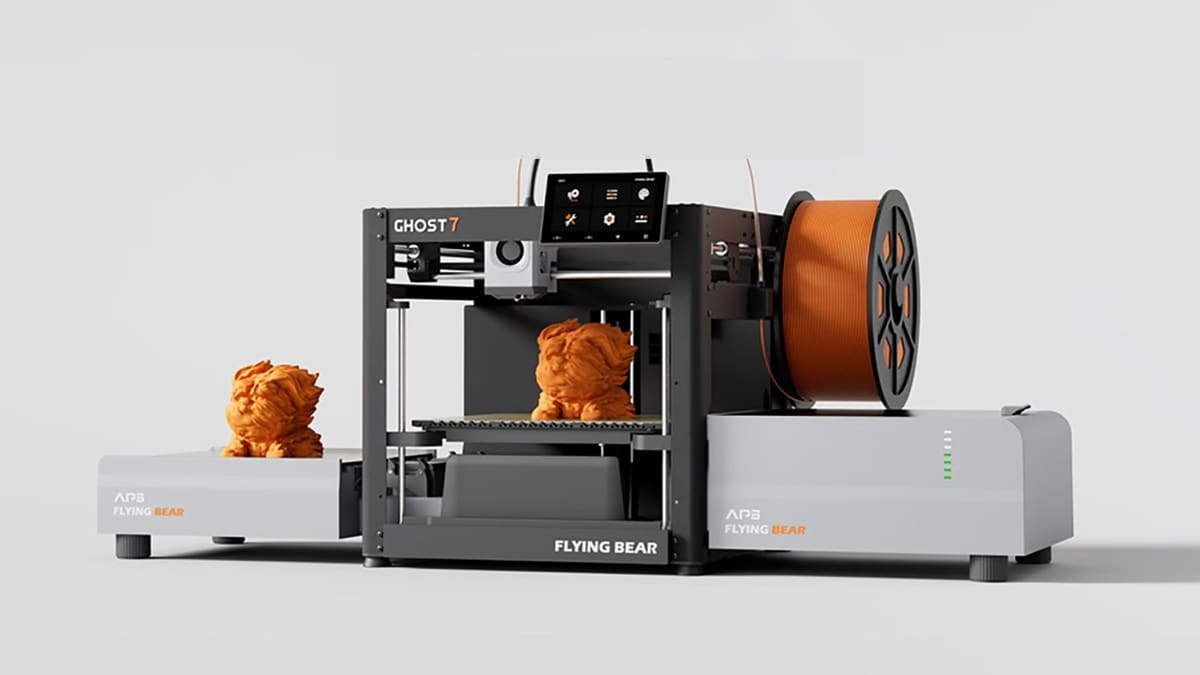
None of these, though, are from the 3D printer manufacturers themselves. But that trend could be changing. Take a look at how seamlessly this auto-build-plate exchanger from FlyingBear integrates with the company’s 3D printer.
Introducing the FlyingBear APS: A Universal Seven-Plate Carousel System
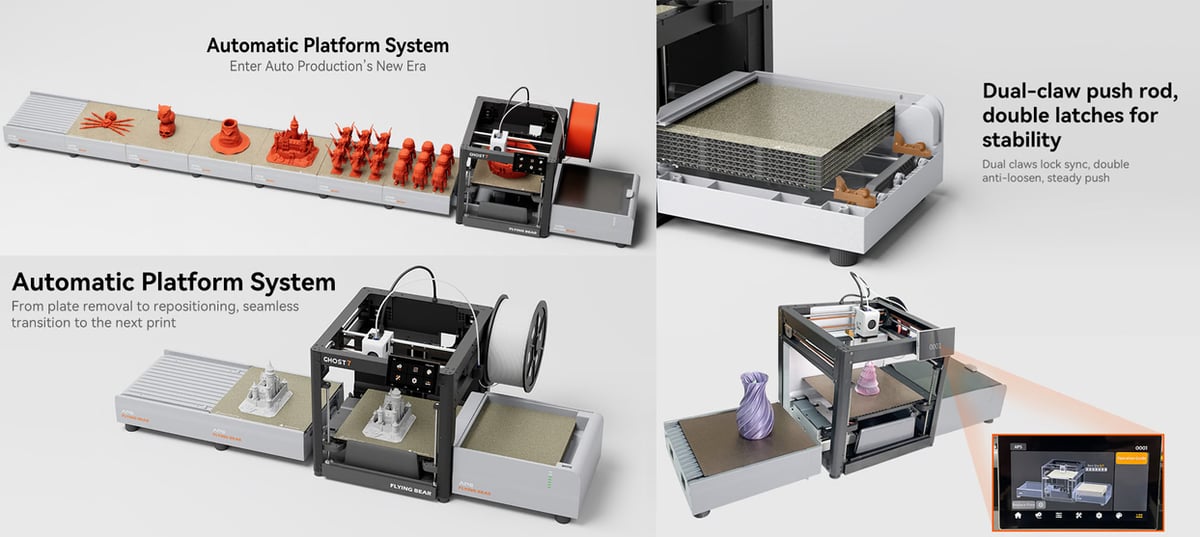
This Kickstarter product from FlyingBear is built to keep desktop FDM printers running without human intervention. The “APS (Automatic Platform System)” ($389 early bird) automatically ejects finished prints and swaps in a fresh plate on the company’s new Ghost7 3D printer ($349 early bird), allowing it to continue jobs overnight or across long production batches without sitting idle.
At the center of the platform is a seven-plate carousel that handles platform ejection, replacement, and print queue continuation. FlyingBear pairs this with real-time plate change monitoring, remaining plate count display, and synchronized progress information on the printer’s screen to create a workflow aimed at eliminating downtime and improving throughput.
According to the company, the APS concept grew out of a mixture of print farm visits, designer interviews, and DIY forum feedback. One farm operator described pulling two all-nighters with a pair of workers to pry off 20,000 parts using spatulas.
The APS targets three main user groups: printing farms that want unattended batch manufacturing, hobbyists who want to start prints before work and collect finished parts afterward, and creative studios that prefer overnight prototyping without alarms or manual interruptions. FlyingBear argues that automating plate changes can turn workloads that once depended on constant manual attention into fully automated jobs that are better suited for high-mix, small-batch fabrication.
There are compatibility constraints. For now, the APS works only with the FlyingBear Ghost7 and cannot be adapted to other brands without loss of warranty, and the company discourages enthusiasts from modifying protocols to force cross-brand compatibility. Buyers are free to purchase the 3D printer alone or the APS alone (if they already own a compatible model), as well as opt for bundle configurations.
Before You Get Too Excited
Founded in 2016, China-based FlyingBear offers budget-friendly desktop FDM 3D printers, with a smaller portfolio that includes resin printers, laser engravers, and accessories. While clear evidence of broad retail availability outside China is limited, the company says it has shipped more than 500,000 printers worldwide over nine years — a scale that, if accurate, suggests significant experience in supply chain management, mass production, and after-sales support.
With its APS Kickstarter launch, FlyingBear is pitching the platform as a step toward more accessible, distributed manufacturing. The goal is clear: tap into an audience of makers and small-scale producers who experience the daily headaches of build-plate swapping. Yet, at the time of publication, detailed technical specifications were still missing, and the campaign had attracted no backers with only days left to go. So why pay attention?
Because the desktop FDM space is arguably overdue for a serious, dependable automatic build plate changer. Multi-material systems are evolving fast — nearly every major consumer brand is experimenting with new ways to handle filament switching — but production automation remains the bigger, largely unsolved challenge. Material switching is one thing. Keeping machines printing continuously, reliably, and with minimal human intervention is another. And that’s where the real race may be heading next.
Editor's Note – This article highlights a Kickstarter crowdfunding campaign. Kickstarter is not a shop; campaigns are under no legal obligation to deliver on crowdfunding promises, nor offer refunds on unfulfilled campaign rewards. For more insight, read our article 8 Things to Watch for When Backing a 3D Printing Kickstarter.
You May Also Like:

Listen to All3DP’s News Podcast:
License: The text of "No More Midnight Plate Swaps: This Kickstarter Kit Automates Your 3D Printer For Continuous Printing" by All3DP is licensed under a Creative Commons Attribution 4.0 International License.