Did the Metal Filament Bubble Finally Burst? This Kickstarter Printer Project Aims to Restart the Trend

Startup Kare 3D just launched a Kickstarter campaign for a high-temp desktop 3D printer that it says can process almost any material.
The once enticing dream of extrusion-based metallurgy stalled out the moment makers realized the printer itself was just the tip of a massive, post-processing iceberg filled with harsh debinding chemicals or expensive outsourcing. But just as the wider industry seems to have thrown in the towel on consumer-level stainless steel filament 3D printing, a fresh high-heat Kickstarter campaign is attempting to revive the market slump.
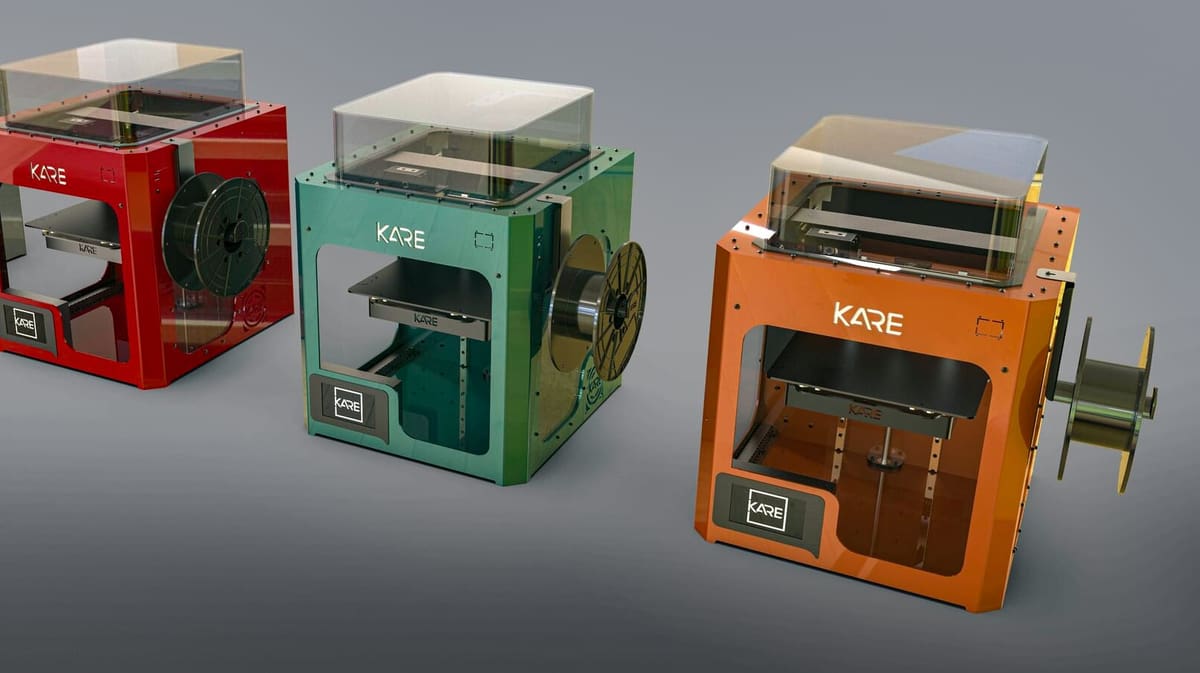
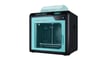
Ümit Coşkun was just an engineer with a dream five years ago. Today he’s pursuing an ambitious desktop printing proposition by launching the Kare S1 ($2,500) on Kickstarter. It’s an FDM he says has a 550 ºC hot end and can 3D print with engineering-grade materials including metal filament.
Kare 3D is the product of that long-running ambition: a desktop manufacturing platform intended to make advanced polymer and metal printing more accessible.
It is an appealing engineering vision, although the campaign arrives at a time when enthusiasm for desktop metal-filament printing appears to have cooled. Bound-metal extrusion remains technically interesting, but the need for debinding, sintering, shrinkage compensation, and costly post-processing equipment has limited its appeal beyond specialist users.
Coşkun hopes to secure Kickstarter funding to bring two printers to life: the Kare S1 has a build volume of 200 x 200 x 200 mm and is priced at $2,500, or $1,875 for early backers; the taller S1 Plus offers a 200 x 200 x 480 mm build volume. It is priced at $3,250, with an early-bird price of $2,500.
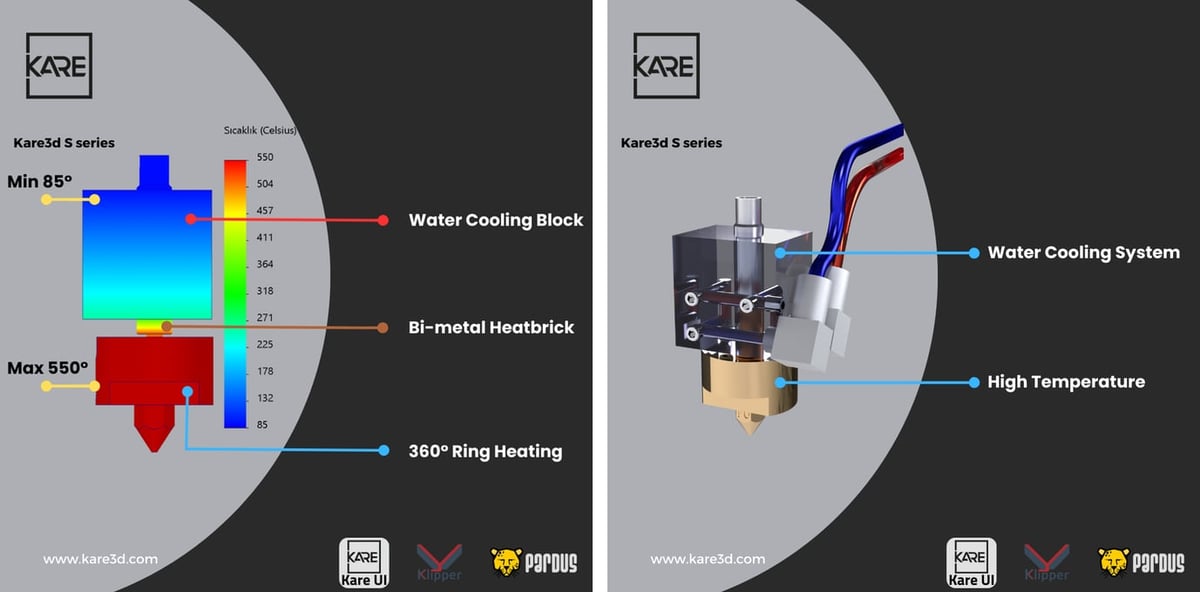
Kare 3D claims both machines feature a 150°C heated bed, and an actively heated enclosed chamber that can maintain temperatures of up to 150°C. The company also advertises print speeds of up to 500 mm/s.
The claimed 550°C hotend temperature is unusually high for a desktop FDM printer and exceeds the requirements of common bound-metal filaments and even most PEEK printing. It may provide headroom for future materials, although Kare 3D has not identified a currently supported filament that requires the full temperature range.
Other listed features include a direct-drive Orbiter extruder, a 4.3-inch touchscreen, Wi-Fi connectivity, remote monitoring, and support for Kare Slicer, Cura, and Simplify3D.
Kare 3D is offering an S1 Plus package with a third-party washing station and sintering furnace for $15,000, or $10,500 at the early-bird price, but note that the printer is not includes in this accessory package.
That price highlights the central challenge facing desktop metal extrusion. The printer itself may be relatively approachable, but the complete workflow is considerably more expensive and complex as companies like UltiMaker, Raise3D, and BCN3D have found. Users must account for material costs, furnace profiles, ventilation, process safety, and the possibility of failed parts during debinding or sintering. Alternatively, the added cost and time of sending parts to a third-party for post-processing.
The campaign does not yet identify the specific supported metal feedstocks or alloys although BASF (which is now Forward AM) and Zetamix are mentioned in a graphic. It also lacks data on final density, dimensional accuracy, mechanical properties, shrinkage compensation, and compatibility with third-party materials.
An Ambitious Project in a More Cautious Market
Kare 3D says it has completed the prototype phase and is raising funds to begin production and international distribution.
Coşkun’s goal is understandable: combine high-temperature polymer printing and bound-metal manufacturing in one desktop platform. A few years ago, that proposition may have attracted broader attention. Today, though, Kare 3D may face a harder task than simply proving that its printer works. It must also demonstrate that enough customers still want this workflow and that its system can make metal printing more reliable, economical, or convenient than existing alternatives, like outsourcing to 3D printing services that use industrial processes.
Editor's Note – This article highlights a Kickstarter crowdfunding campaign. Kickstarter is not a shop; campaigns are under no legal obligation to deliver on crowdfunding promises, nor offer refunds on unfulfilled campaign rewards. For more insight, read our article 8 Things to Watch for When Backing a 3D Printing Kickstarter.
You May Also Like:
License: The text of "Did the Metal Filament Bubble Finally Burst? This Kickstarter Printer Project Aims to Restart the Trend" by All3DP is licensed under a Creative Commons Attribution 4.0 International License.