Closer Look at the Creality K3, an Atomform Update, Next-Gen Lasers and the Bambu Lab-ification of CNC is Coming (Whether You Want It or Not)

IFA Berlin is a slog to walk, but worth it for a look at the hardware that’ll keep creative tech interesting over the next year. We found 3D printer debuts between a lot, and we mean a lot, of CNC machines, UV printers and innovative laser tech.
3D printing as consumer tech? The jury’s still out if the 2026 edition IFA Berlin, Europe’s largest consumer tech show, is anything to go by.
For a show with a dedicated hall to “Creators” teeming with laser cutters and desktop CNC machines there were surprisingly slim pickings on the 3D printing front. Perhaps the bleeding-edge tech crowd are not necessarily who printing manufacturers are out to woo right now. It’d take an article on it’s own to analyze that aspect, but what we can report from being on the ground is that while some new 3D printing tech there, it’s really the place to find all the tech you might consider running alongside your 3D printer.
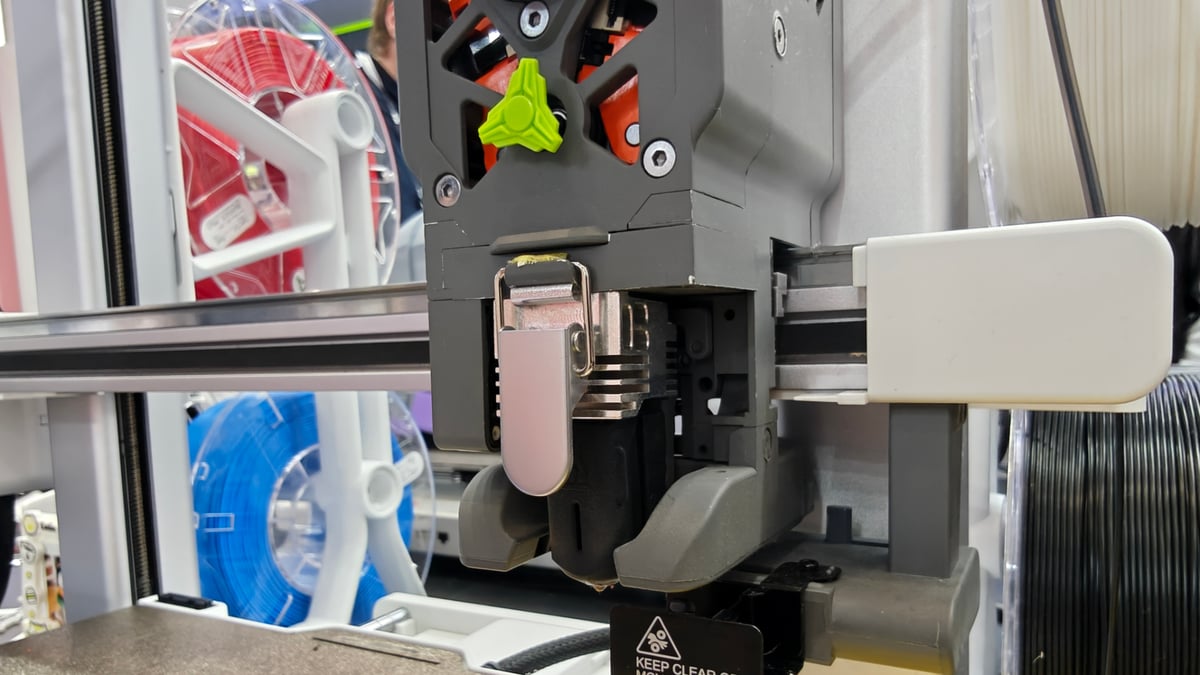
First, the familiar. Creality brought a strong collection of debuts to show the breadth of the company’s complete tech ecosystem. We got our first look at the Creality K3, the company’s flagship machine that leverages its KliTek toolchanging system in a package that, on the surface, looks like a simple Snapmaker rip off. Creality ditches the brushed-metal look of past K-series for a soft white shell more aligned with the SparkX series of beginner-friendly “appliance” grade printers, which doesn’t help its case, but there are strong differences worth noting.
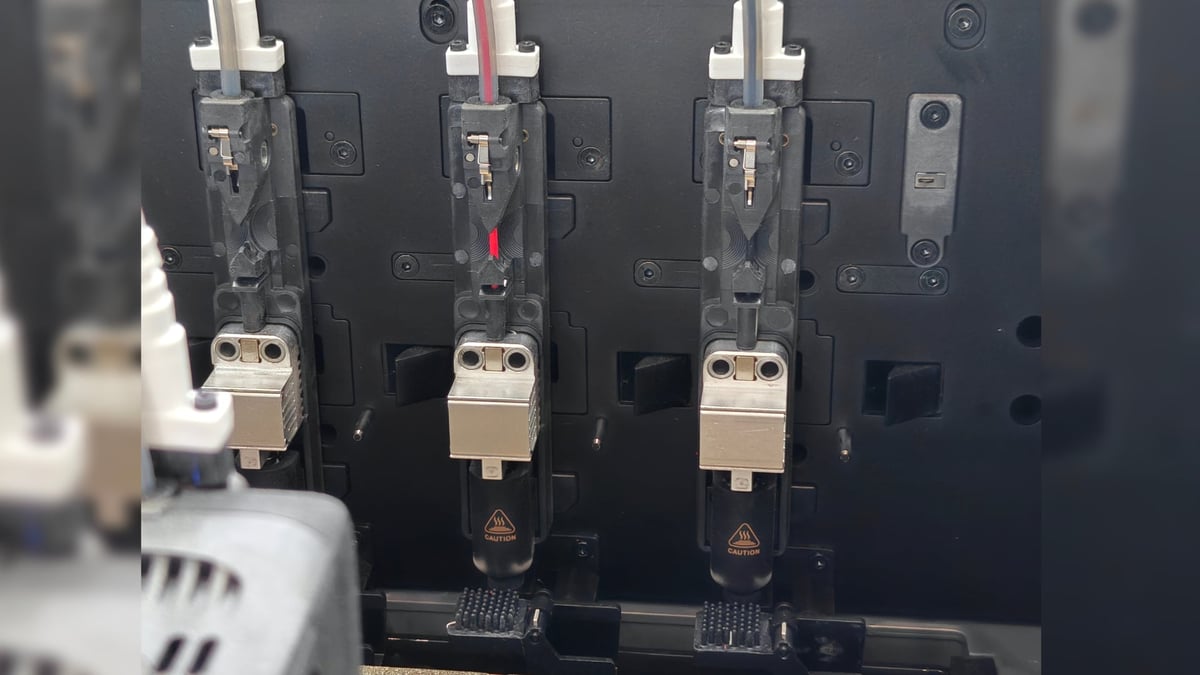
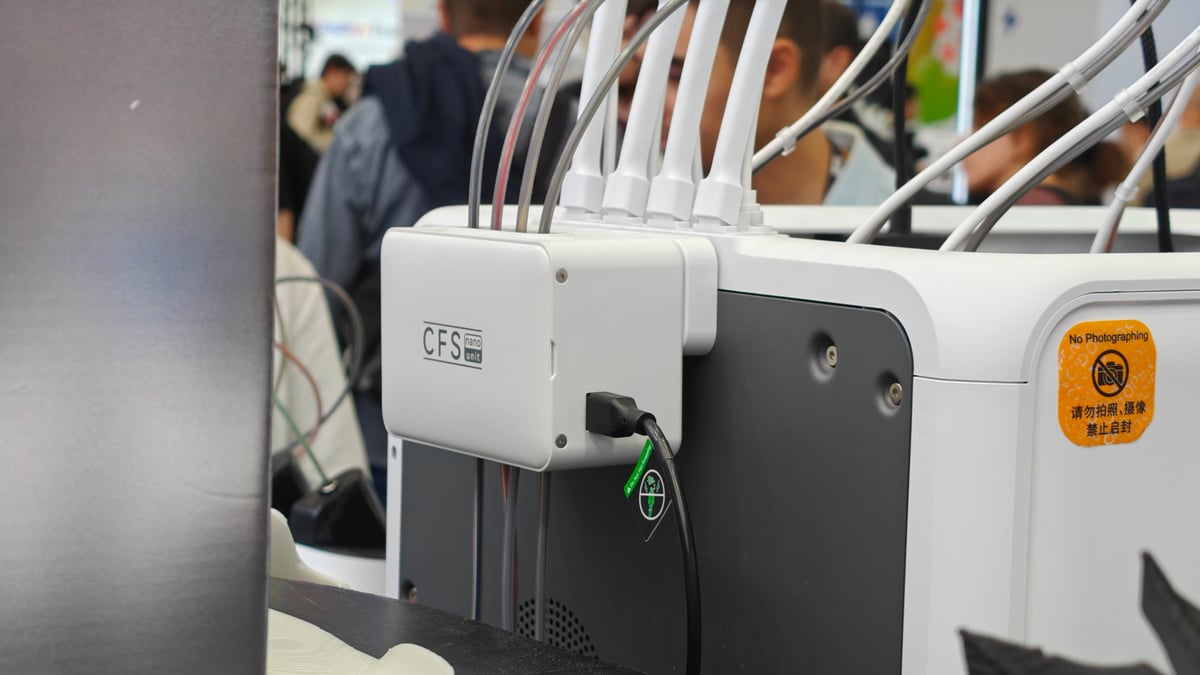
Optimized to print TPU, we’re told, the discrete tools the K3 swaps come as complete, umbilical units, connected via USB-C (like the U1). Filament is fed by a CFS Nano unit strapped to the back – the same CFS Nano that feeds the SparkX i7 Nano – which comes as standard. A lid will be available to enclose the volume, but it’s not included. Expect the price tag to punch down – around $850 – when it launches next month.
The K3 isn’t the only printer Creality is launching in October, with the curious, just-announced i8 SparkX landing then, too. Targeting the low-waste color printing crowd, it will launch at considerably less that the K3, we’re told. Under $400. We covered the main beats of that machine before.
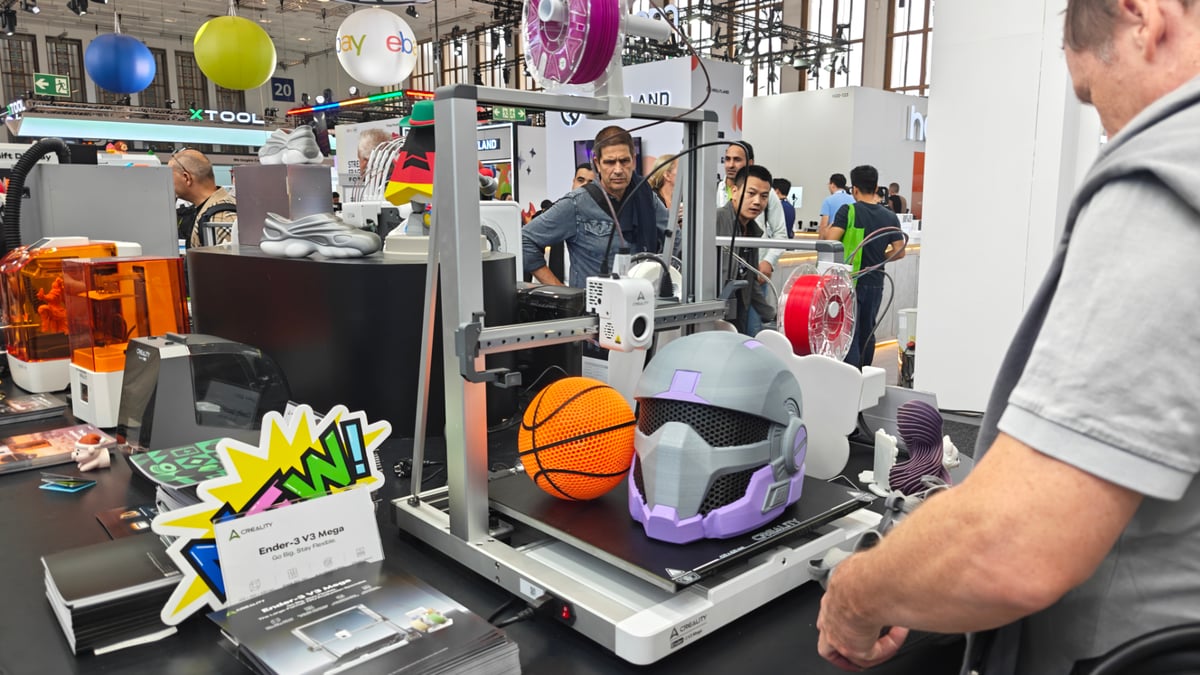
A surprise debut also came in the form of the Ender 3 V3 Mega, a new and very large bed slinger. I thought Creality was done with the Ender series, but the Mega is here to prove that theory wrong. Like the K3, Creality tells us the new Ender is optimized for TPU printing. Nifty multicolor helmets and multicolor soft shoes lying nearby evidently printed on this big new printer showed it’s ready-for-multicolor, as does the four-filament coupler atop the printhead. A 420 x 420 x 420 build volume puts it in territory truly deserving of the name. The price? Again, no exact figures, but expect “less than $600”. Nice.
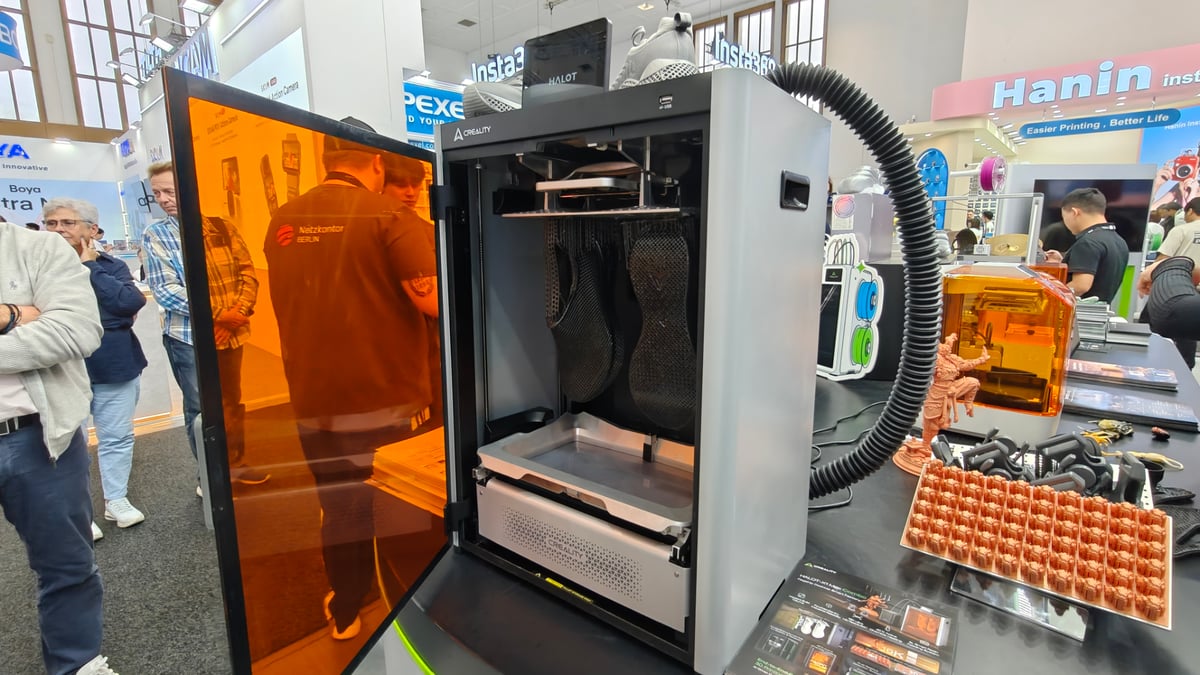
Creality’s show doesn’t end there, though (does it ever?) Also new are the Halot X1-Max Combo and Halot X1 Neo, at the two extremes of Creality’s resin 3D printing spectrum. The X1-Max Combo has a 302 x 162 x 350 mm build volume, and in keeping with the X1 before it, lifts the resin tank to the build plate rather than the other way round. A massive 5-liter capacity automatic resin station with pump comes as part of the package. It uses 405nm wavelength light, and features a 40°C heated chamber. At the other end of the spectrum the Neo has a 153 x 77 x 160 mm build volume, cutting a more conventional shape of printer but updated with the company’s modern ecosystem mod-cons of AI-model creation, printing via Creality Cloud, and camera-based print monitoring.
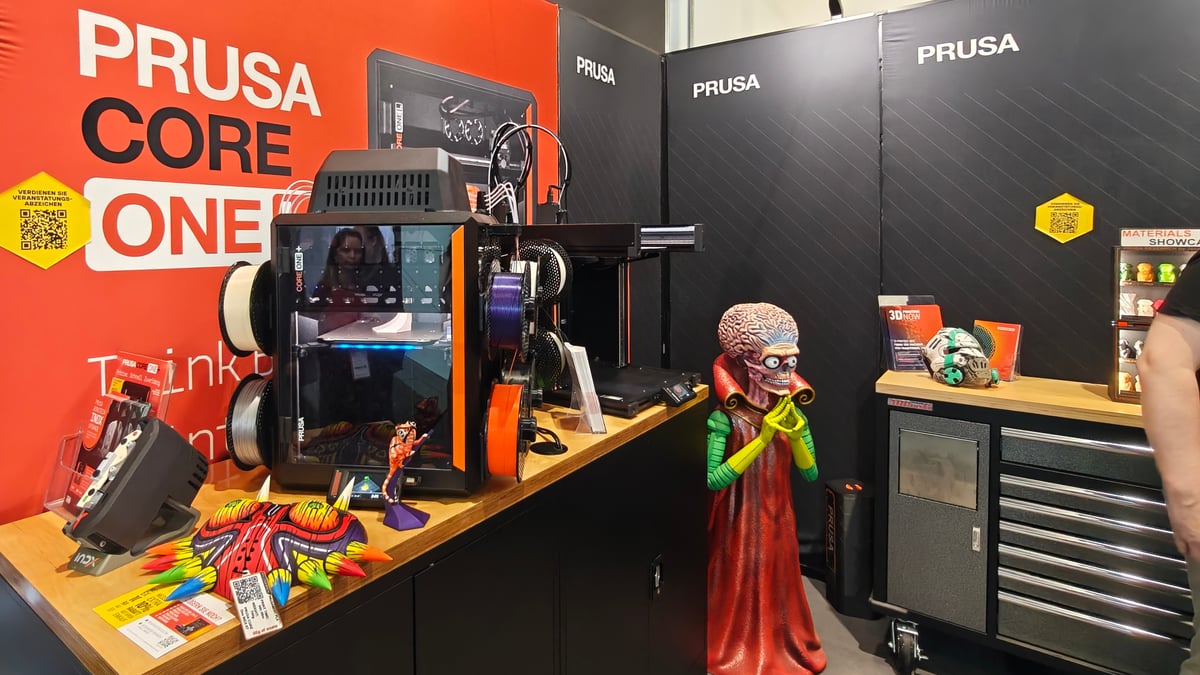
Prusa made its IFA debut with a small booth that let its new + (and Gen 2) machines do the talking, particularly the Core One+ (Gen 2) INDX. It was nice to see the Signature Oak custom 3D printer present, too. Most of the limited run of 250 units have been snapped up, we’ve been informed. I can see why, personally. I want one.
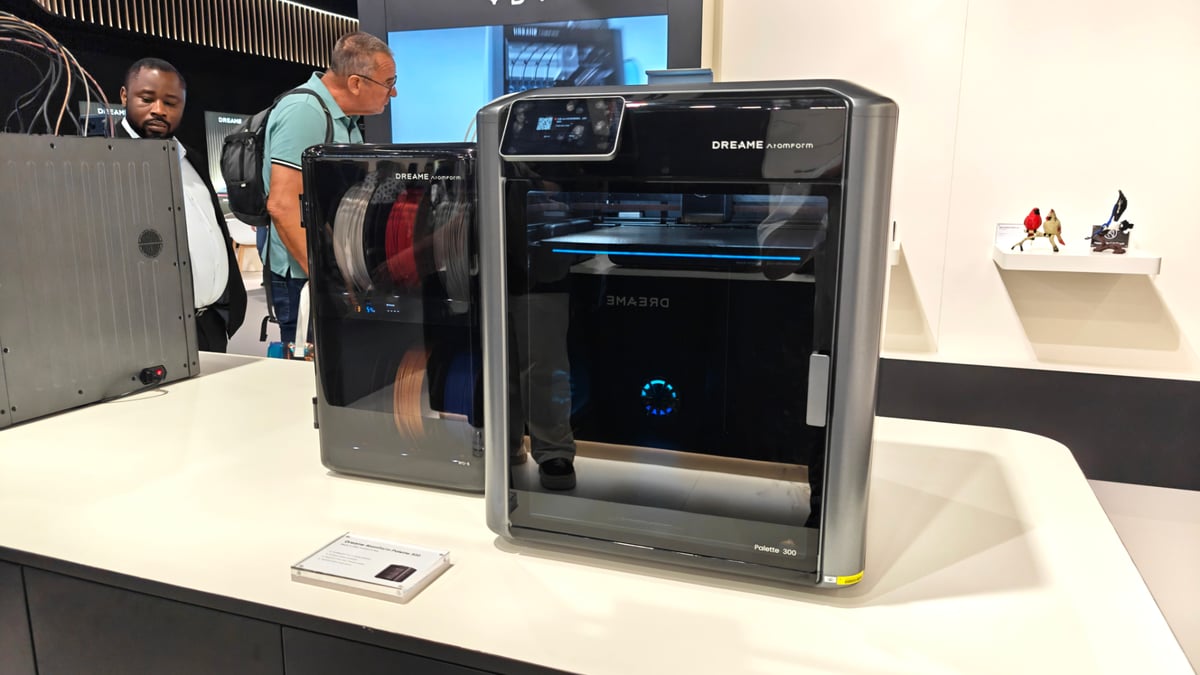
The ephemeral Mova Atomform put in an appearance in multiple ways, part rebranded as Dreame Atomform, part remaining Move Atomform. Yet to actually release a printer, Dreame’s creative tech effort spread two 3D printers, a UV printer, and desktop CNC machine across the two enormous Dreame and Mova booths. Among them, the troubled Palette 300, inauspiciously delayed due to engineering challenges with the reliability of its radial nozzle-changing system. But development continues, apparently.
Set for a 2027 launch, Dreame will have its work cut out convincing the 3D printing public that the Palette 300 is a worthwhile multi-thousand dollar investment in what will be a landscape transformed by the rule of the toolchanger.
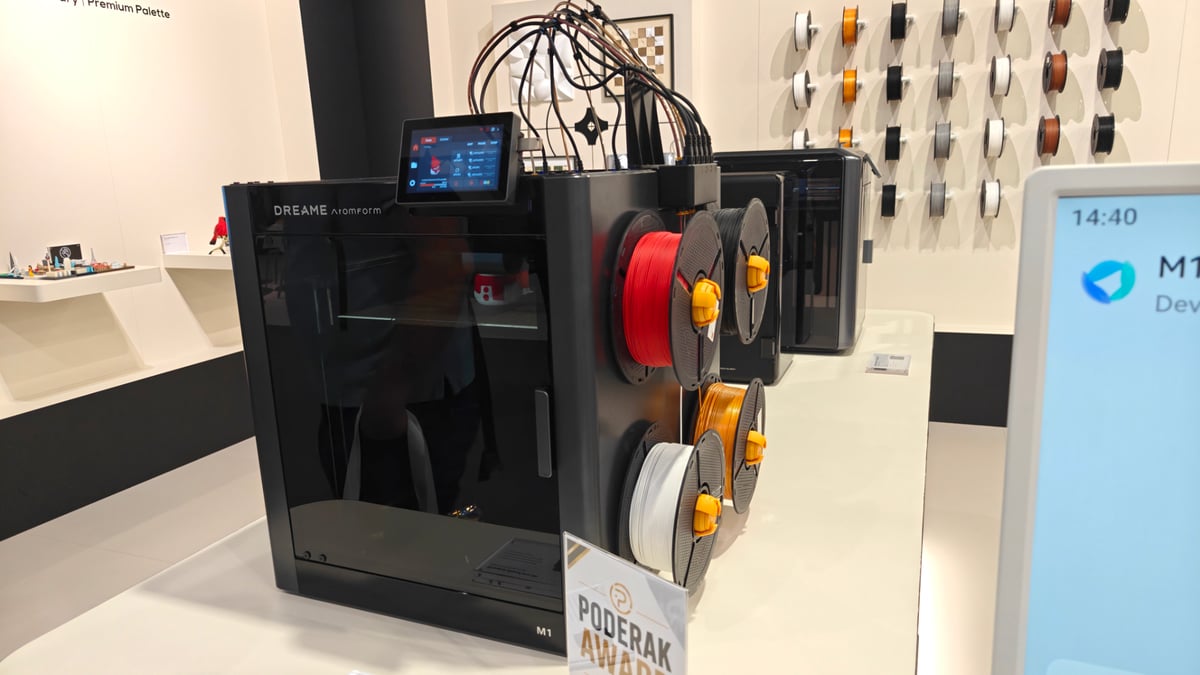
As if to prove my point, Dreame also debuted its own toolchanger 3D printer, the M1, at the show. It’s a four tool printer in the same mold as Snapmaker’s U1, albeit with subtle differences and Bambu Lab H-series-looks. It stands apart right now for its 300 x 270 x 290 mm build volume – but won’t launch until sometime next year.
It might sounds a little late compared to the competition, but it might not even matter to you and me – we’re more likely to see these landing in big-box stores than the household names we already know in 3D printing. Dreame is a consumer tech giant, and Mova is its affordable sub-brand – this is likely to count for something, if they ever get a machine in launchable shape that is.
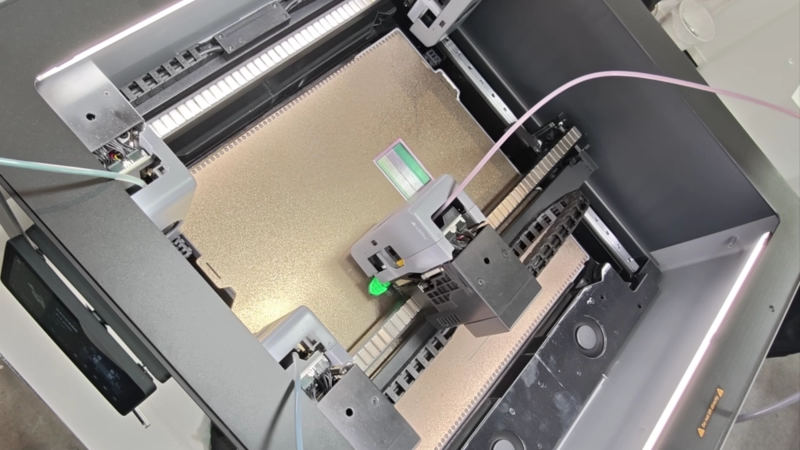
Kickstarter newcomer LightMake concludes the four notable 3D printing presences, with a prototype L4 on show beavering away at color prints. This linear-motor-packing productivity tool is very much pitched as a high-output efficiency machine – not your typical first printer, but a second or third printer for the industrious printerer monetizing their machines. Backing this theme up, LightMake also brought along a prototype of an automation station – a plate swapping unit that can be placed in front of the printer to remove prints as they finish overnight. It currently stands at a little over $2.5-million raised on its Kickstarter campaign.
In all, 3D printing was very much not the creative technological focus at IFA. This year, that particular accolade went to the half-dozen or so companies, some familiar, others less so, showing their visions of a simple desktop CNC machine revolution.
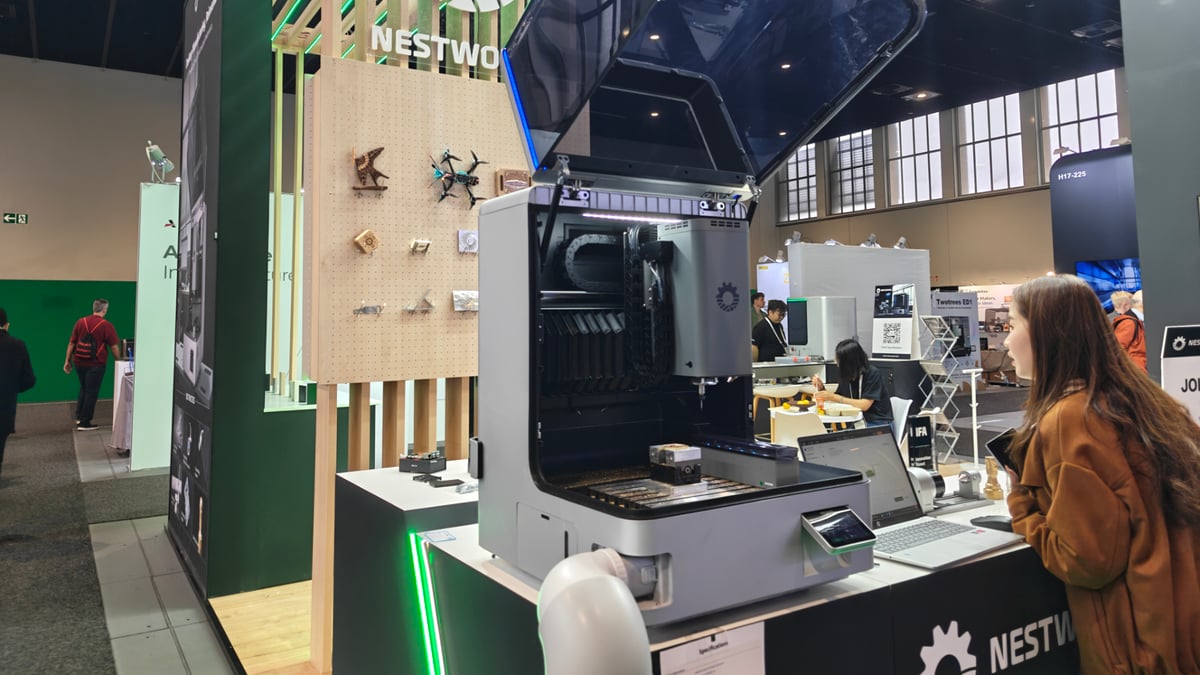
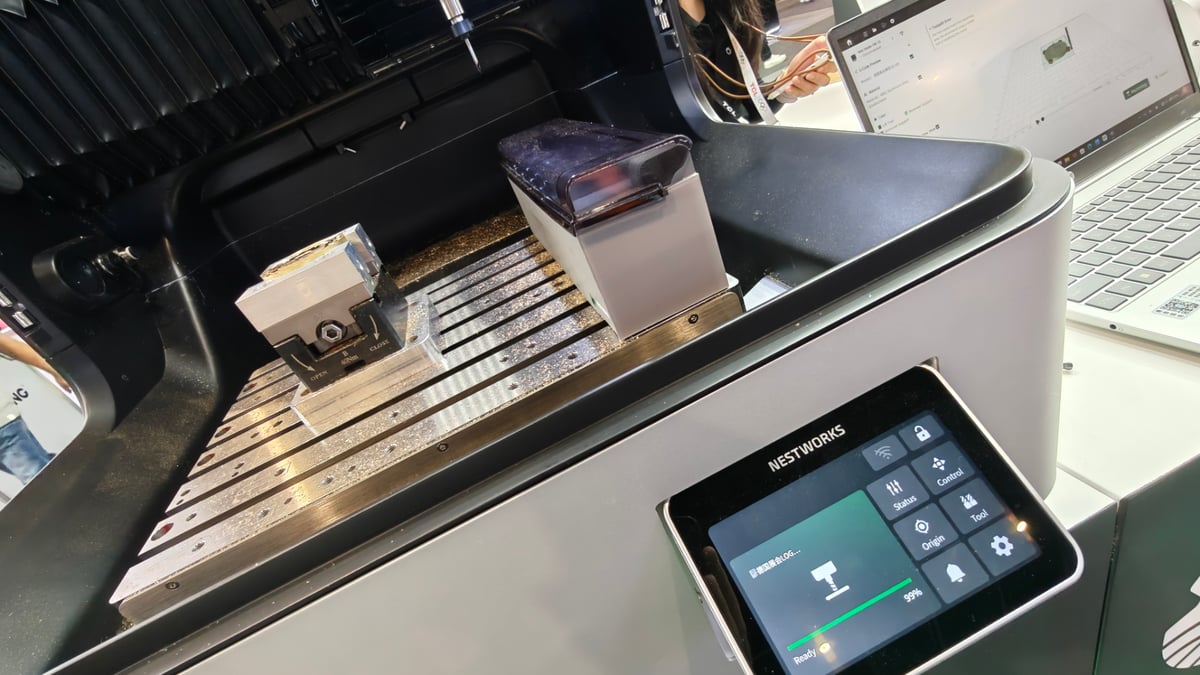
NestWorks was there with its late-2025-crowdfunded C500 machine on show. Intricate metal pieces were the key showing, with the C500’s 800W spindle up to the task of materials as tough as titanium. It’s equipped with an RFID-reading toolchanger, plus minimum-quantity lubrication mister to complement the machine’s air-cooling system. Also novel was a chip collection system – two screwlike augurs to push large chips and debris into the waste collection tray. Currently in post-campaign, we’re told preorders for the C500 will launch in October.
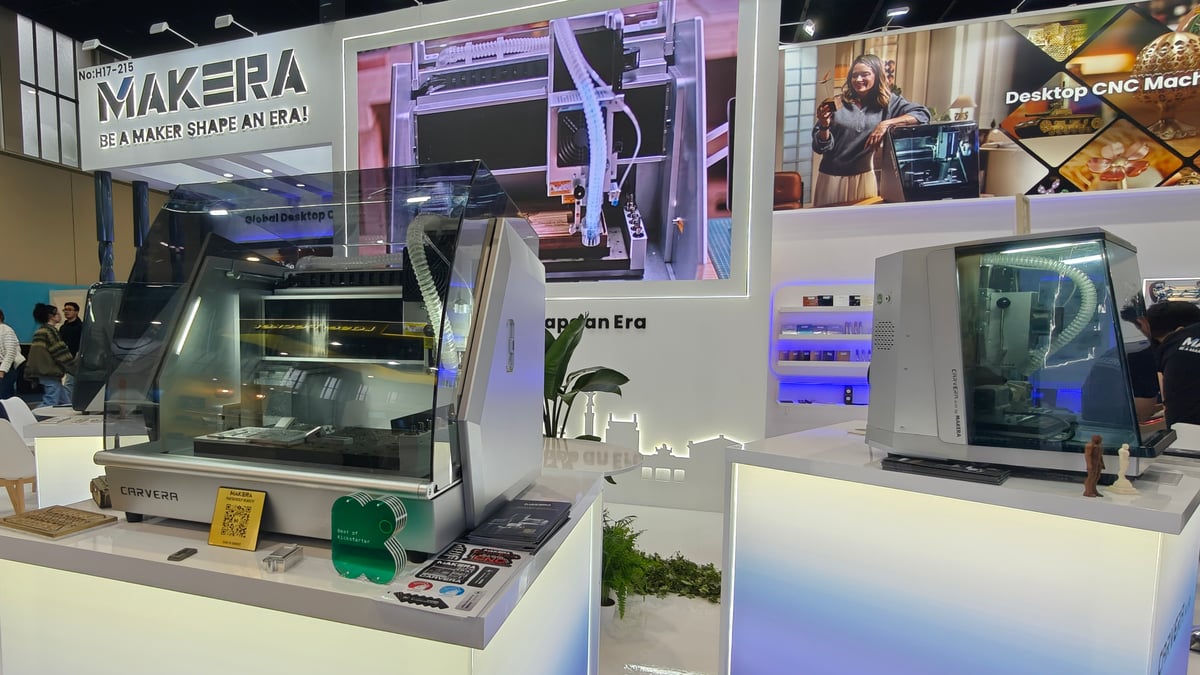
Makera’s space at the show grew to a larger open-air showroom, with all of its current line up – the Carvera, Air and Makera Z1, front and center. The brand recently revamped its software ecosystem, introducing Makerables, a project repository to help you find things to make on its machines.
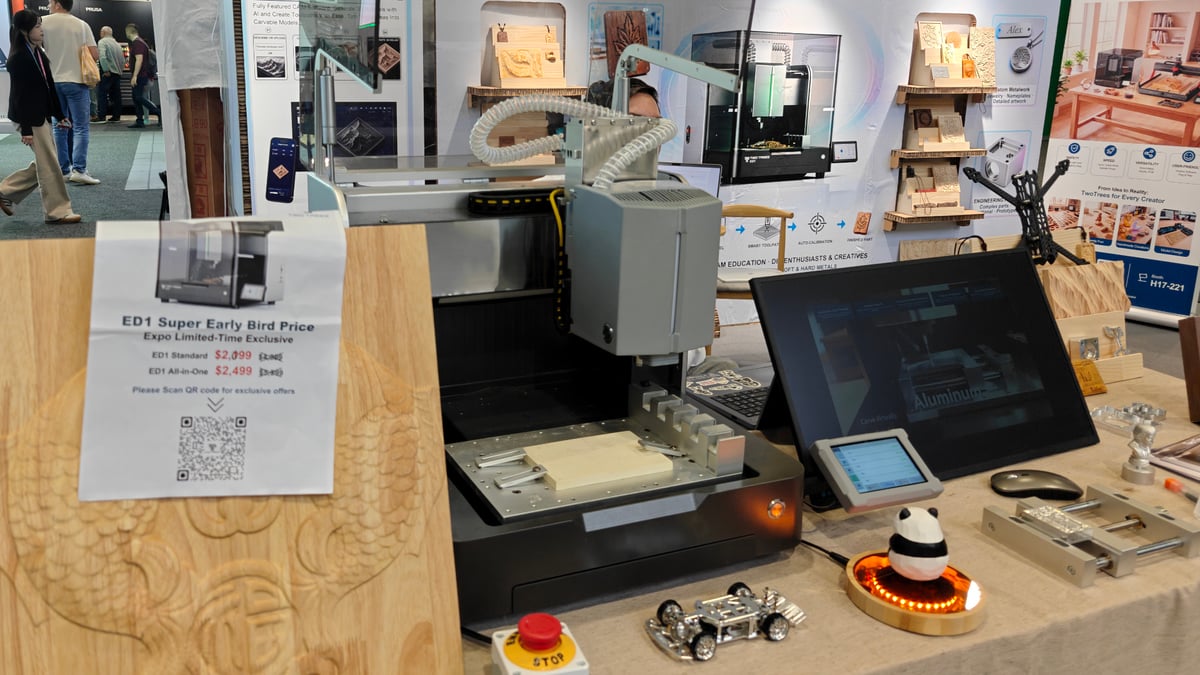
TwoTrees, which exited the 3D printing space not too long ago, showed us its new ED1 desktop CNC, a (comparatively, against everything else we saw) compact unit with a 600W spindle, air cooling (a liquid cooling system is in development) and five-tool automatic toolchanger. It’s expected to launch at around $2,700, but retailing directly – not though crowdfunding.
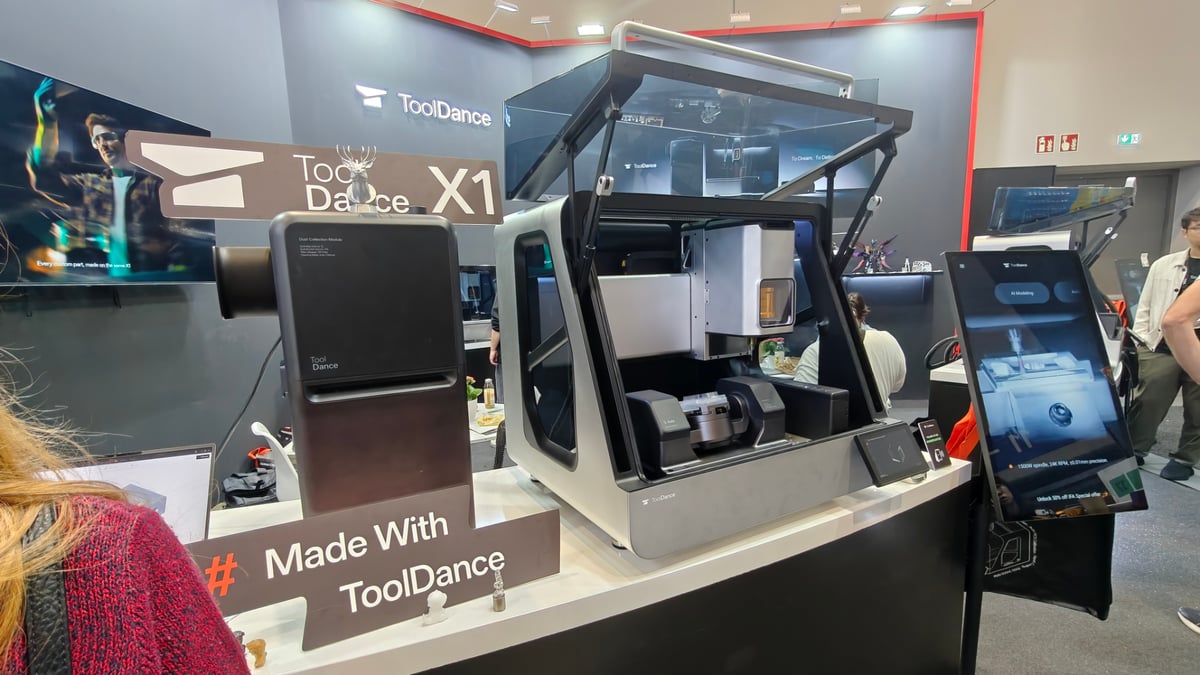
New startups, both independent works of DJI alumni (sounds familiar) were present in the form of InfiMaker and ToolDance, each bringing 1.5KW PMSM-toting mills that promises to put “pro” results on your desktop.
The ToolDance X1 is a stylish, 9-tool automatic toolchanger with modularity baked in. Four- and five-axis modules, sold separately, expand the types of work it can do. Standout features include near-full autonomy including lidar-based stock and tooling mapping for collision prevention, a large work area – 400 x 265 x 180 mm – and flood cooling for faster, more efficient processing. Coming to Kickstarter in October with super-early bird pledges starting at around $3,000. MRSP is expected to be around $6,000.
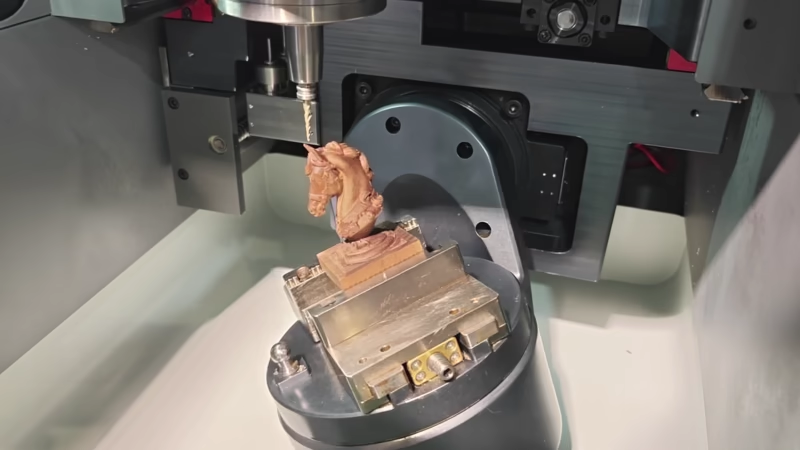
Across the hall, InfiMaker, a campaign that’s currently live on Kickstarter, showed off its natively 5-axis K1 desktop CNC machine. A common theme across all the CNC machines we saw was automation, through both the software and hardware. The K1 boasts a six-slot automatic tool changer, meaning the complete process through roughing to finishing can all be handled in a single continuous job. InfiMaker emphasizes the K1’s true 5-axis capabilities, showing inner geometries on a carved part to us that really only could be achieved with a proper 5-axis machine.
Another CNC debut came from Mova Atomform, which showed off its Forgix desktop CNC machine. More of a mock-up than a working prototype, Mova Atomform’s Forgix is yet another of the many, many attempts at making subtractive manufacturing as easy as 3D printing.
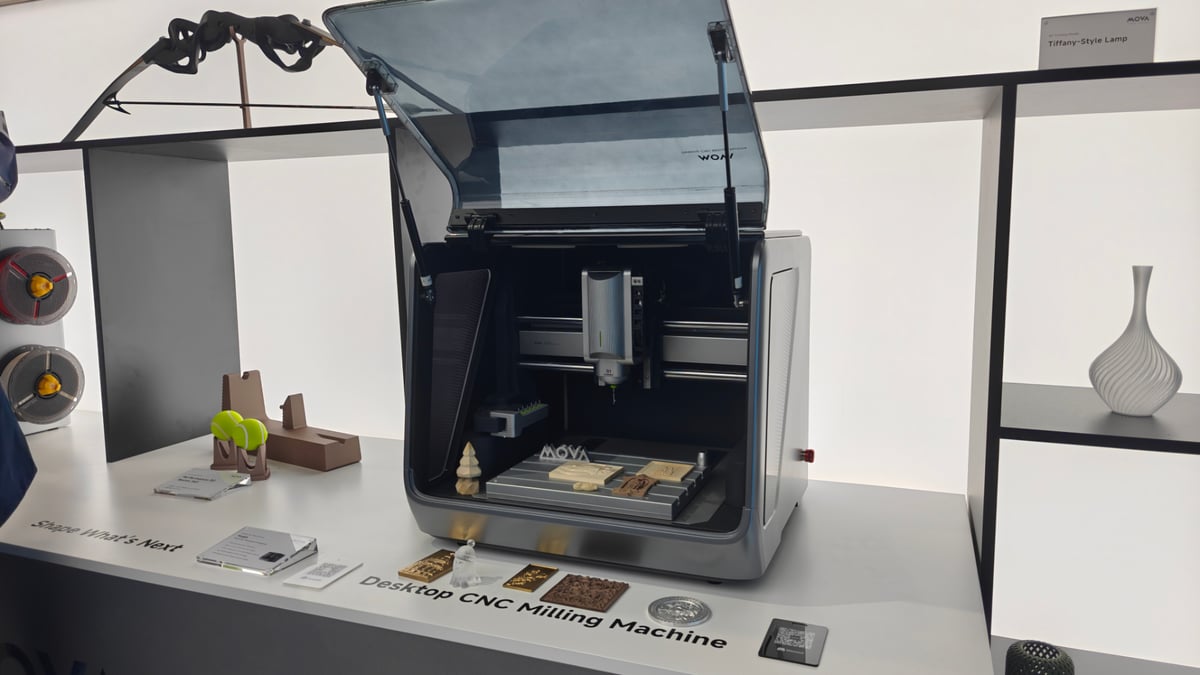
Key features on the Forgix will be its 500W spindle, automatic bit changer which allows up to 6 different bit types to be used in a job, and a structured light-based material detection, which will handle accurate positioning of jobs and adapt for contoured surfaces as well as, we hope, workholding avoidance. Like the Mova Atomform printers, don’t expect to see the Forgix until next year at the earliest – Q1 launch in China will be followed by other markets later in the year.
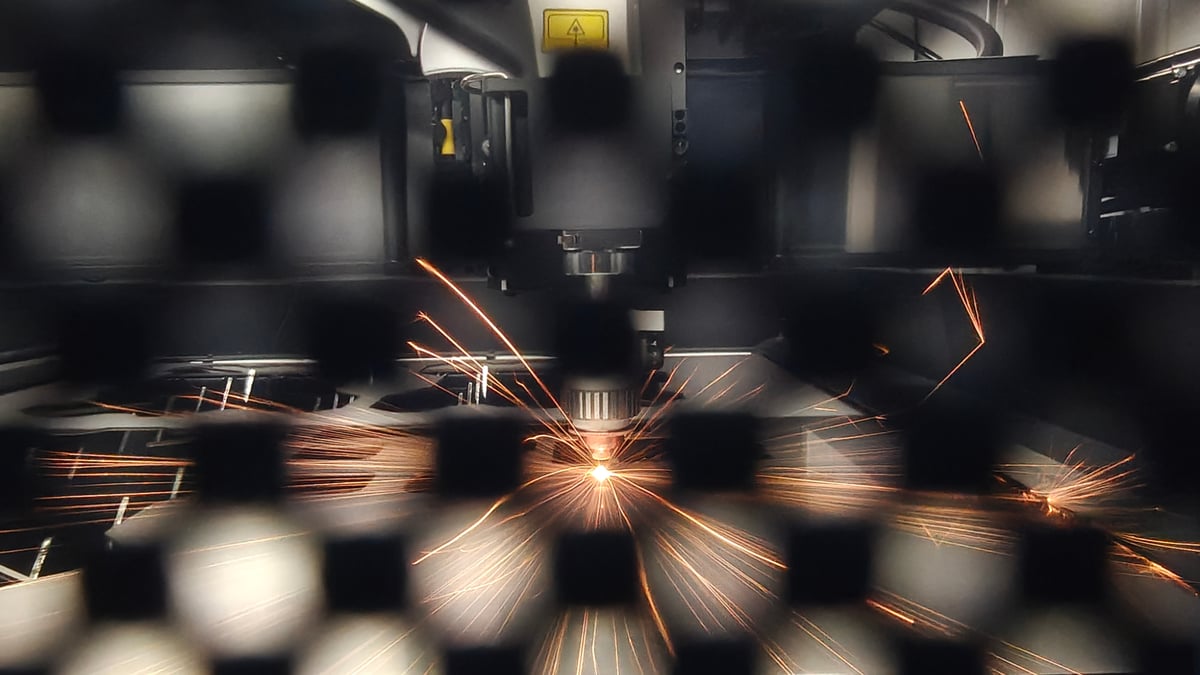
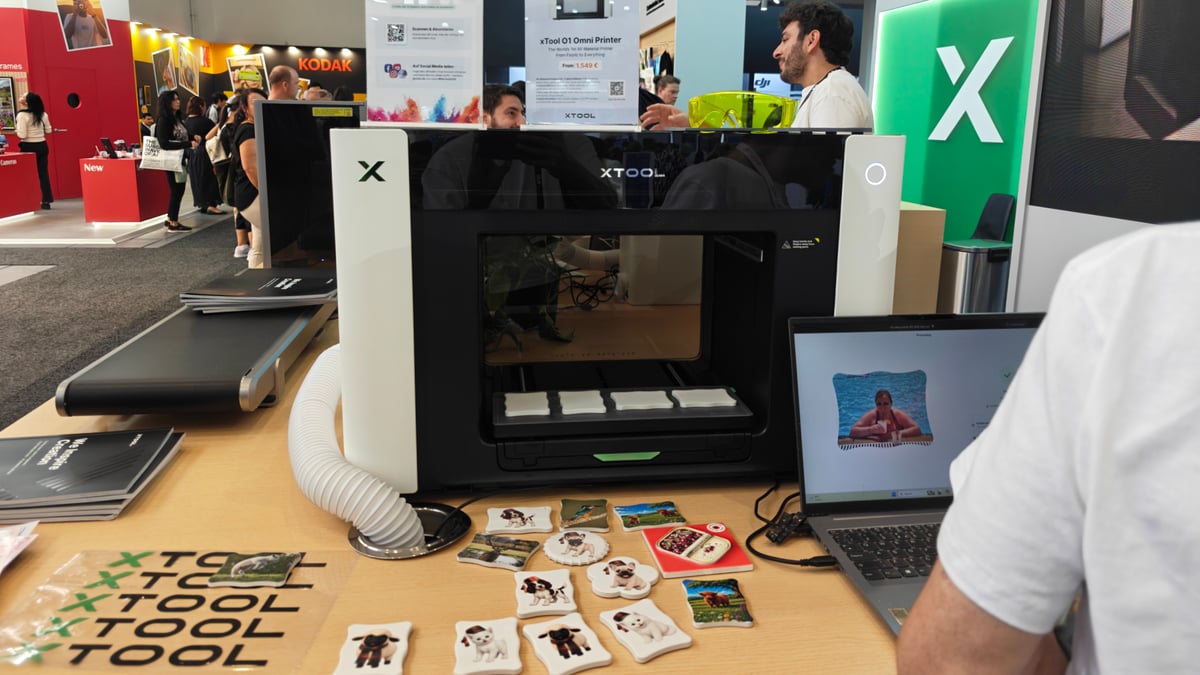
IFA Berlin is xTool’s show, going by booth presence and wow factor. Live demonstrations of the company’s 2025-launched MetalFab fizzed through several millimeters thick slabs of steel in seconds, while the recently revealed O1 Omni shows relief printing doesn’t belong to just EufyMake anymore, likewise the Apparel printer. A walk through that booth gives you a reality check on the how important ecosystem and a cohesive product lineup is – dozens of tools capable of printing textures, patterns, and graphics either directly or via transferal mediums, onto virtually any material you can imagine. Plus the tools to cut or prepare, all handled with the same singular piece of software, no matter the tool, process or material. Once you’re in and familiar with one, you have the knowhow to do any of it, and that goes from the most basic laser cutter all the way through to the MetalFab.
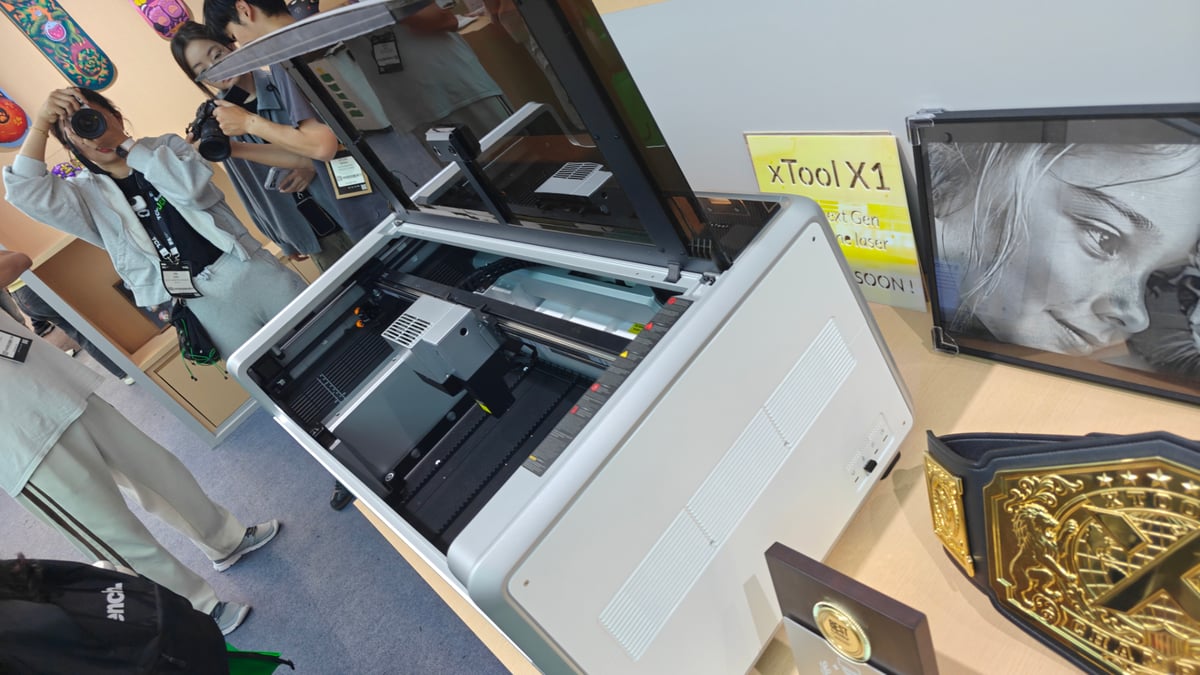
We got a glimpse of the company’s next-gen laser tech in the X1, a new pro-leaning machine that combines engraving and cutting into a single process with dual IR and diode lasers riding in parallel. Dual lasers isn’t a novelty, but having them both work on the same job simultaneously is. It’s a cavernous machine with a fixed are and volume – no pass-throughs. Attracting its own share of attention was the new xTool M2, too – an update to the company’s M1 multifunction machine, it’s a laser cutter and engraver first and foremost, with a CMYK color printing module for printing directly onto designs. It ditches the blade cutting of the M1, but adds a dual camera system that intelligently detects the material and position for accurate processing.
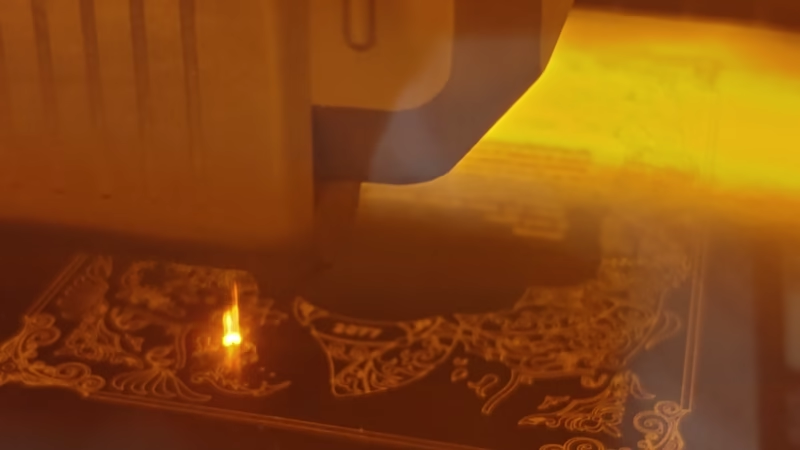
The laser innovation of the show doesn’t end there, though. At Accelaser, speed took center stage with its successfully Kickstarted HD1 “flying galvo” galvo laser taking overlapping passes to render massive, intricate engravings and etchings in much less time than a fixed-plane laser could. It’s commensurately pro, with Lightburn native out of the box. Pricing starts at $3,799 for the “standard” HD1 Pro, which features a 55W diode and 20W IR laser. For $6,299, the Ultra model has an 80W diode and 60W MOPA IR laser. Both models have the flying gantry, but the differentiator is the laser power and materials you’ll be able to cut and carve.
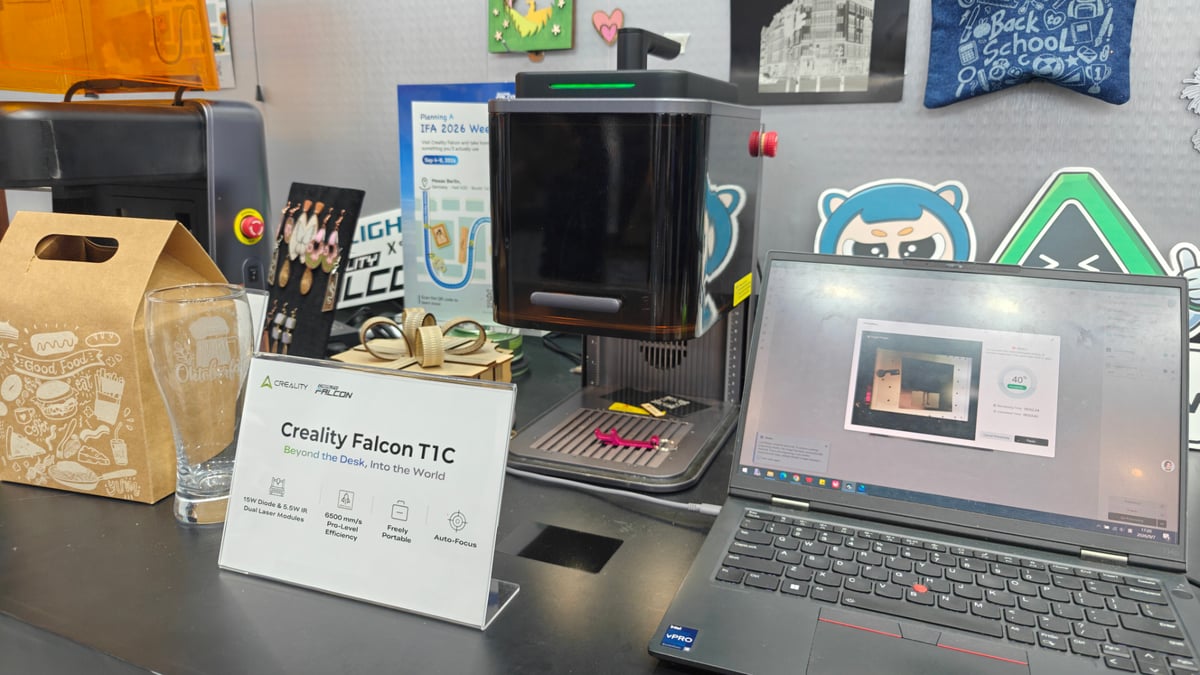
Creality’s laser sub-brand Creality Falcon also introduced a new laser, the T1C, a “baby” version of its flagship T1 dual IR diode laser. Like the bigger T1, the T1C also features dual diode and IR lasers, giving it wide material compatibility, including metals, and can use both to process multiple material types at the same time. It’s expected to launch for around $1,000.
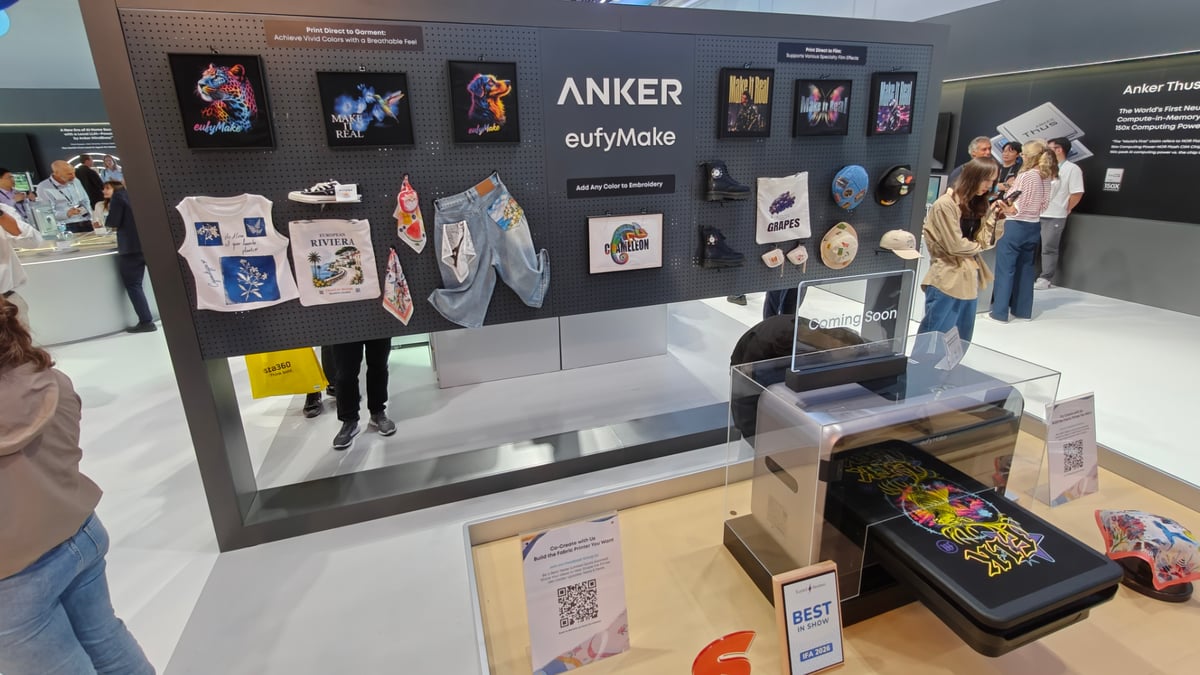
And in between, the versatility of DTF printers (and growing variety of them available today) was on show at Procolored and EufyMake, both showing new direct-to-fabric printing possibilities and the impressive results they can achieve.
You’ve Read That, Now Read These…