
Why Bambu Lab’s Sub‑$3K Printers Are Crushing Industrial FDMs

Industrial 3D printer sales dip as cheaper high-quality consumer brands flip the script on traditional buying habits, say two new industry reports.
Why spend $20K on an UltiMaker Factor 4 or $100K on a Markforged FX10 when you could buy a farm of 10 to 50 Bambu Lab H2Ds for less? We hear this a lot. And, although we have listed several reasons you might still want an industrial FDM in another guide, this remains a valid question.
In fact, professionals and small business owners are opting for lower-priced 3D printers at the expense of established professional and industrial 3D printers, according to two new market reports.
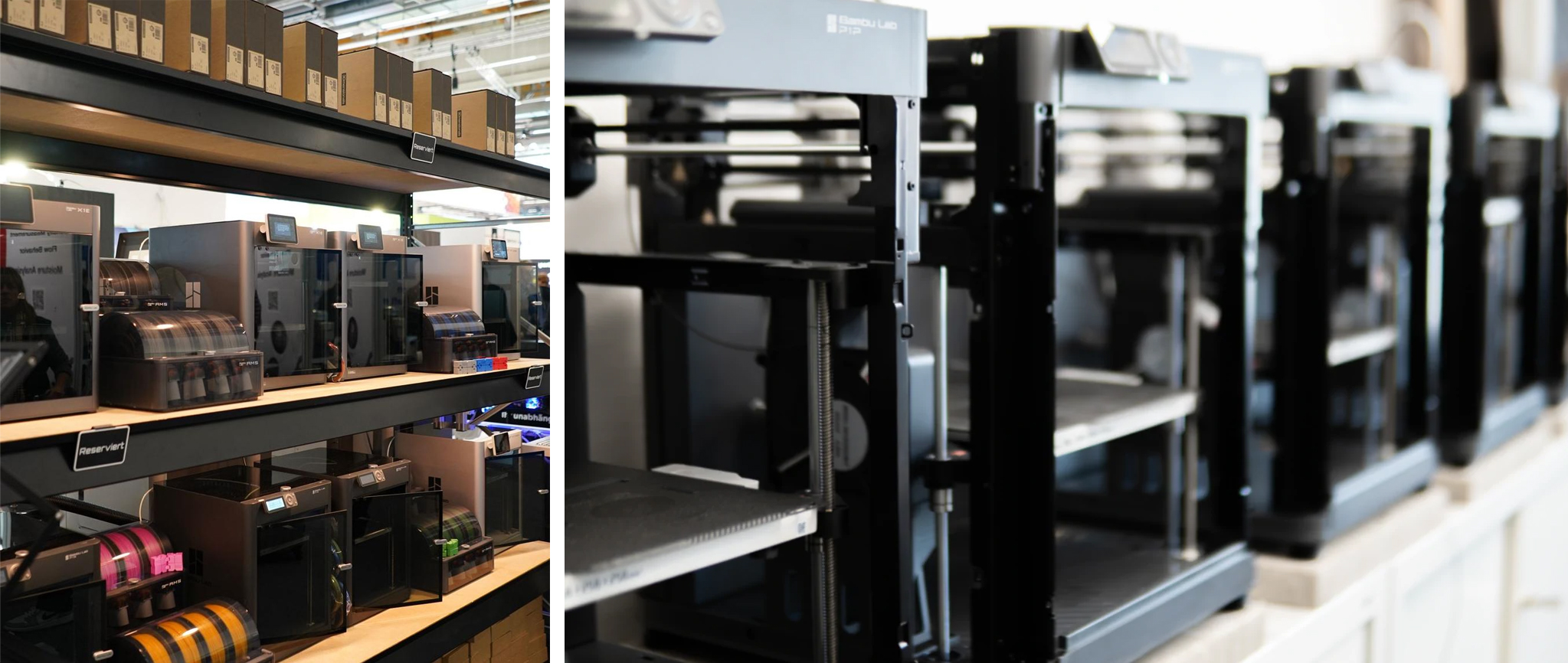
Today’s report by Wohlers Associates, the ASTM consulting group behind the famed annual additive manufacturing industry review, directly links the sales drop in industrial 3D printers to the rise in quality of what were strictly “consumer” 3D printers, specifically Bambu Lab, Creality, Prusa, and Flashforge.
"Over the last few years, we have seen a growing number of sub-$10k (and often sub-$1k) filament-based material extrusion and resin-based vat photopolymerization systems with print quality and part strength that approach, and in some cases even surpasses, parts produced by industrial systems." — Wohlers Specialty Report, Impact of Low-cost 3D Printers on the Additive Manufacturing Market
There’s no doubt that desktop FDMs in the $500 to $3K range have surged in quality. Much of the innovation in terms of print speed, print quality, and automation over the past few years has occurred in the “consumer” space, which should be renamed to the “under $5K desktop market” since consumers or hobbyists are no longer the sole target market.
Last week, another 3D printer market sales analysis from Context, a technology market analytics company, reached the same conclusion about the impact on industrial machine sales from high-quality, affordable options.
“The 4% fall in shipments of professional printers masks a significant technology shift,” the Context report states. “[Professional] material extrusion machines continued to lose momentum, with shipments dropping 31% [YoY in Q1 2025] … as buyers instead chose high-performance entry-level solutions from vendors like Bambu Lab.”
Wohlers goes even further saying that not only are the “new breed of low-cost printers” a “wake-up call” to the established desktop and industrial systems that have given customers only “minor incremental improvements”, but “these newer more agile companies have leap-frogged the competition in terms of providing intelligent low-cost systems that perform well beyond their price-point.”
Alongside quality and innovation, Wohlers points to new and better filaments for low-cost machines that are often up to 1/20th the price of their equivalent industrial materials. “The vast majority of filaments for industrial machines are now available in the same thermoplastics for low-cost desktop systems.”
Lowering the Financial Risk of Entry
Professionals opting for a Prusa instead of a Stratasys, for example, may actually be good for the additive manufacturing industry as a whole, the Wohlers report suggests: “This new trend may … see an increase in the number of companies adopting AM for production.”
More companies, unsure if 3D printing can even deliver the results they need, are willing to gamble $1,000 on an easy-to-use, versatile 3D printer, as opposed to $30,000 on a more complex professional or industrial machine. The experimentation is expanding the overall penetration of 3D printing into all types of manufacturing, especially small businesses.
The trend is noticeable in the numbers. For the Wohlers Report 2025, hundreds of service providers and end users were asked what polymer 3D printers they currently own and operate; Bambu Lab had the biggest piece of the pie at 13%, followed by 3D Systems, Stratasys, and Creality all tied at 11%. The Context report shows Bambu Lab’s printer shipments in the first quarter of 2025 were up 64% compared to the first quarter of last year.
Despite the good news for Bambu Lab here, both the new Wohlers report and Context suggest that there are other, underlying explanations for the drop in professional 3D printer sales that have more to do with the economy and how businesses procure equipment.
“Many of these companies may not consider their purchases of a $1,000 printer in the same way as requisitioning a $100,000 system,” the Wohlers report says. “One or multiple of the former may be within discretionary budgets and not necessarily in the financial planning phase.”
Most of the respondents to Wohlers’ investigation said they were considering an industrial 3D printer (62%) for purchase in 2025, compared to those saying they may buy a desktop 3D printer (17%).
The current economy, with its import/export uncertainties, is also a factor that favors lower-cost 3D printers, but it’s also fueling “strong underlying pent-up demand, particularly for Industrial systems,’ says Chris Connery, VP of global analysis at Context. “OEMs still report high levels of customer interest, and the industry is poised to rebound once macroeconomic conditions improve. We expect a gradual recovery [of industrial 3D printer sales] to begin in 2026 as interest rates fall and stimulate renewed capital spending, similar to the surge seen after the Covid lockdowns.”
In fact, much of the surge in entry-level 3D printer sales, up 15% in Q1 2025 compared to last year with over a million units shipped globally, “was almost entirely driven by shipment pull-in as vendors, channel partners, and end-users accelerated purchases in anticipation of U.S. tariffs on Chinese goods,” according to the Context report.
Looking to the future, Wohlers says, “We will see a continuing trend of greatly improving low-cost systems while, at the same time, seeing a decrease in prices of industrial machines (and industrial materials) which, in the past, may well have been overpriced in comparison to most other modern production technologies.”
You May Also Like:



License: The text of "Why Bambu Lab’s Sub‑$3K Printers Are Crushing Industrial FDMs" by All3DP Pro is licensed under a Creative Commons Attribution 4.0 International License.