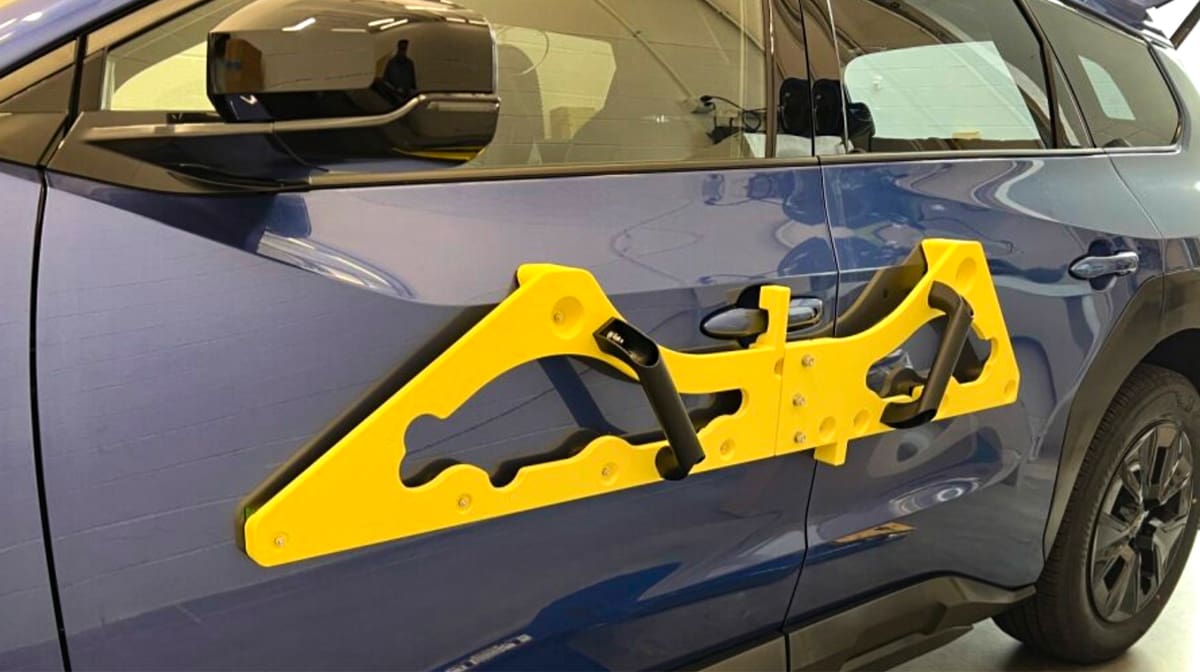
Subaru Slashes Tooling Time Over 50% with New Higher Speed Stratasys Print Head

A new Stratasys high-throughput T25 print head improves large-format FDM production, enabling Subaru to cut tooling development dramatically.
In an example of how additive manufacturing is reshaping automotive engineering that’s becoming more typical, Subaru of America says it has dramatically accelerated its tooling development workflows by leveraging large-format 3D printing technology in-house, cutting lead times by more than half. The recent results underline a broader trend: manufacturers are increasingly turning to rapid tooling on demand to streamline production and reduce dependency on traditional machining and outsourcing.
Subaru’s engineering teams are among the first users of Stratasys FDM 3D printers to implement the new Stratasys T25 High Speed Head on the F770 machine, which delivers up to 2.3 times faster print speeds.
“Being able to get the enhanced throughput with the F770 has made for a more reliable and robust operation,” says Matt Daroff, project engineering manager at Subaru of America, Inc. “Getting parts to our internal customers earlier gives them an opportunity to identify things we may not have caught in development. This enables us to make corrections sooner, minimizing waste of time and material on defective output before it’s produced.”
Tackling Automotive Tooling Challenges Head-On
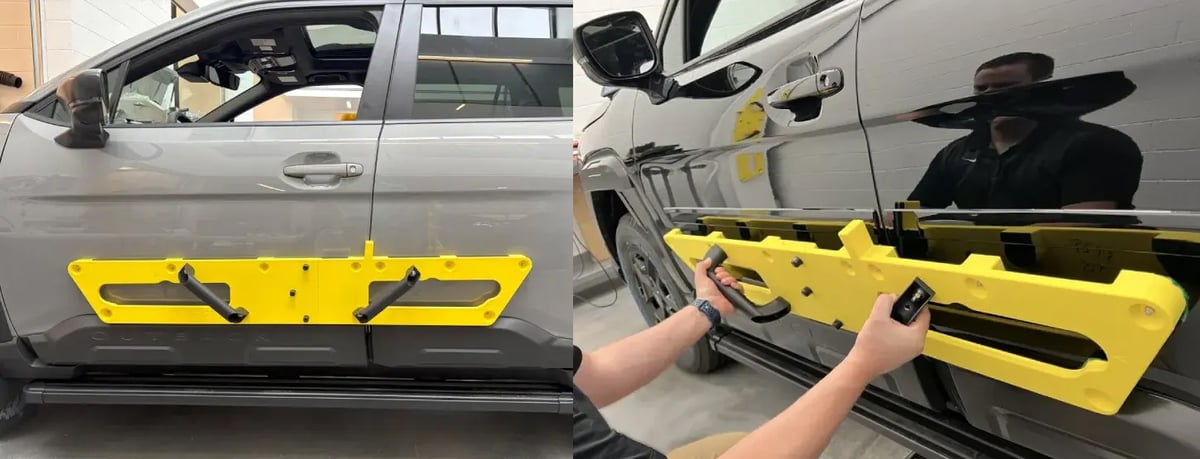
Automotive tooling, whether for accessories, installation jigs, or positioners, has historically been time- and cost-intensive. Traditional CNC machining often demands lead times of eight to twelve weeks combined with hefty tooling costs, creating bottlenecks for engineering teams that must iterate designs quickly. Subaru’s engineering group, responsible for accessories and installation tooling, faced precisely these constraints.
By bringing additive manufacturing onto the factory floor, Subaru has sidestepped many of these challenges. The company consolidated production of many tooling components onto a large-format FDM 3D printer, accelerating development cycles and improving responsiveness to urgent manufacturing needs.
Bigger Tools, Faster Prints, Better Results
Subaru’s breakthrough came through adopting a high-speed 3D printing approach that significantly boosts throughput for large tools — parts often tens of inches long. In practical terms, this meant a 36-inch tool printed nearly twice as fast compared to previous setups, enabling the team to deliver functional parts much earlier in the engineering process.
This rapid turnaround has yielded multiple tangible benefits for Subaru:
- Over 50 % reduction in tooling development time — shaving weeks off traditional workflows.
- Around 70 % reduction in overall prototyping and tooling costs — largely by cutting external machining and outsourcing.
- Improved design iteration — engineers can spot and correct issues earlier, reducing material waste and rework.
It’s not just about speed. By producing tooling in-house, Subaru’s teams have increased control over part quality and consistency while enhancing their ability to respond to shifting production demands. This agility is a compelling case for additive manufacturing’s role in modern industrial engineering.
What This Means for the Industry
Subaru’s results are emblematic of a wider shift in manufacturing strategy: use AM where speed, flexibility, and cost matter most. While traditional methods remain essential for many high-volume parts, in-house 3D printing is proving its worth for tooling, fixtures, and other bespoke components where rapid iteration is critical.
Increasingly, engineers across sectors are recognizing that fostering additive capabilities internally not only slashes development time, it also fosters innovation by enabling more design exploration and faster validation. Subaru’s success illustrates how AM can be more than a prototyping tool — it can be a strategic asset in heavy manufacturing environments.
As more OEMs follow this path, expect to see even greater integration of additive workflows on factory floors worldwide redefining what’s possible in tooling, fixtures, and on-demand parts production.
License: The text of "Subaru Slashes Tooling Time Over 50% with New Higher Speed Stratasys Print Head" by All3DP Pro is licensed under a Creative Commons Attribution 4.0 International License.