Rosa3D Launches Foaming PLA and TPU That Expand as They Print for Lighter Parts

Polish filament manufacturer Rosa3D has launched two new foaming filaments: PLA LW Aero and TPU Flex LW. Both rely on active foaming chemistry – a blowing agent embedded in the filament – to expand the extrusion at printing temperatures.
The new releases from Rosa3D, a brand launched in 2018 by Rosa Plast – a plastics operation dating back to 1979 in Hipolitow, Poland – both actively foam at extrusion, expanding the material to produce porous, lightweight prints. The PLA LW Aero starts foaming around 220 °C, peaking between 240–250 °C to expand 2.5 times it’s original size, while the TPU Flex LW kicks in hotter at around 260 °C.
Since the material expands, you can adjust the temperature and/or drop the flow to varying degrees to control the density of a print. The default recommendation is to drop to roughly 40% flow when aiming for maximum foaming to accommodate the expansion. At the time of writing no technical data sheet was available for the TPU Flex LW, but PLA LW Aero’s density ranges between 0.46–0.52 g/cm³ between 250–220°C.
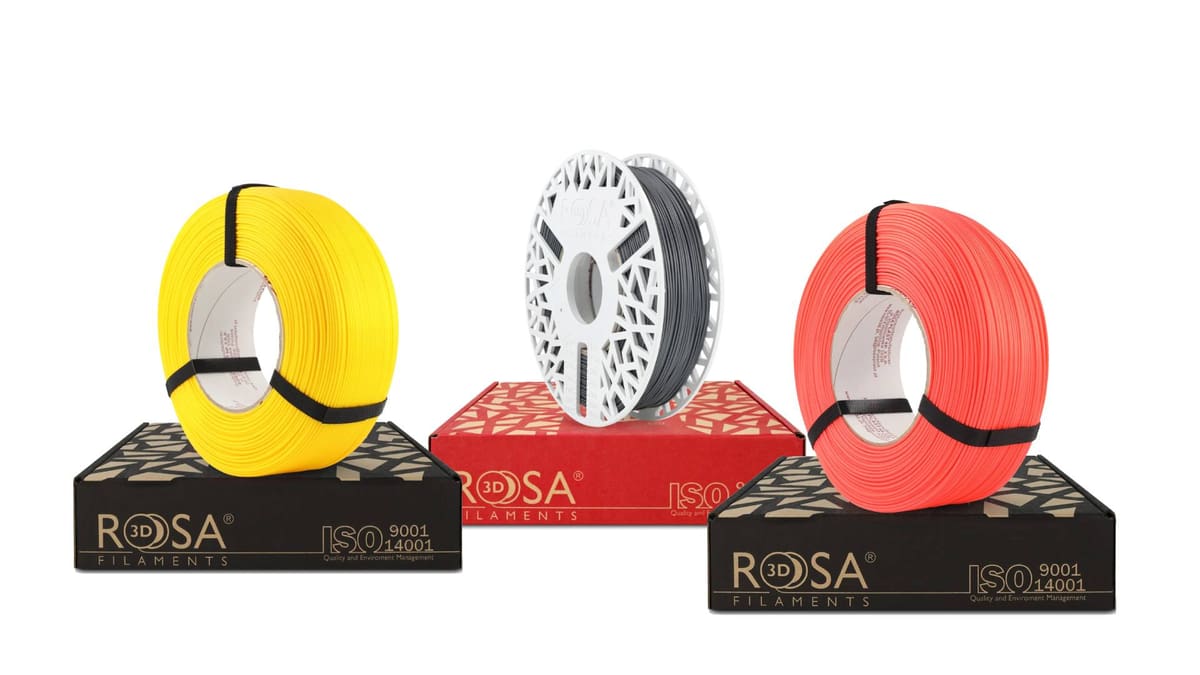
The PLA LW Aero arrives in five colors as 1-kg refills for Rosa3D’s “Masterspool” system, plus a 0.5-kg spooled version in white only. The TPU Flex LW ships in four colors on standard 0.7-kg spools. Pricing runs approximately €39/kg (~$45/kg) for the PLA refills and €36/kg (~$41/kg) for the TPU.
These new filaments join a growing market of specialty twists on everyday materials. Spectrum Filaments, also Polish, launched its LW-PLA UltraFoam late last year claiming densities as low as 0.40 g/cm³, and Siraya Tech’s Rebound PEBA Air foaming PEBA filament, also launched last year, explores the energy-return possibilities in addition to a low density range at 0.55–0.73 g/cm³. There’s a surprising diversity of options in 2026, with other brands offering foaming or prefoamed PLA variants including Polymaker, Creality, and Overture.
Foaming and Prefoamed? What’s the Difference?
Not all foaming filaments are created equal, with “active” and “passive” versions – foaming and prefoamed – dividing them into two camps.
Prefoamed filaments come, as the name suggests, already activated. They’re the most porous, expanded version of themselves, making them predictable and easy to print since you’re not contending with the extrusion profile reacting to the printing process. Polymaker’s PolyLite PLA LW is one such example.
The inverse of this, of course, is actively foaming filaments – materials that react to the conditions of printing to expand. Rosa3D’s LW-PLA AERO is an actively foaming filament. There are advantages to active foaming, not least that you get more printed material from the spool. Through a combination of flow rate, print speed, and printing temperature, you can control how much the filament expands, and ultimately, how dense the print is.
Practical limits apply here as they do across the category. Foaming filaments demand slow print speeds – Rosa3D recommends 5–60 mm/s – because consistent expansion requires controlled extrusion. That will seem painfully slow to anyone used to the print speeds modern machines typically run at, but it’s a physical limitation that you can’t really escape. Foaming PLA also suffers from heat sensitivity; thin-walled remote control (RC) parts – a common use case for lightweight materials – left in direct sunlight can warp.
Choosing one over the other will be a matter of your expected use case and comfort with experimentation and difficulty printing. Prefoamed materials are easier to print and will give more predictable, repeatable results. Actively foaming materials, such as Rosa3D’s PLA LW Aero and TPU Flex LW, introduce more variables to the printing process, but the benefit of being able to achieve specific (or variable) densities and weights out of your prints is why you’d bother.
Rosa3D PLA LW Aero and TPU Flex LW are both available now from the Rosa3D webstore.
Read more recent news:
- AI-Generated 3D Models Are Here – And Only One Platform Has Banned Them
- Icon’s $899K Titan Construction Printer Puts Multistory Construction in Your Hands, Shipping 2027
- Creality Estimates $5 Homemade Spools From Its New Filament Maker
Tired of Reading? Try Listening
License: The text of "Rosa3D Launches Foaming PLA and TPU That Expand as They Print for Lighter Parts" by All3DP is licensed under a Creative Commons Attribution 4.0 International License.