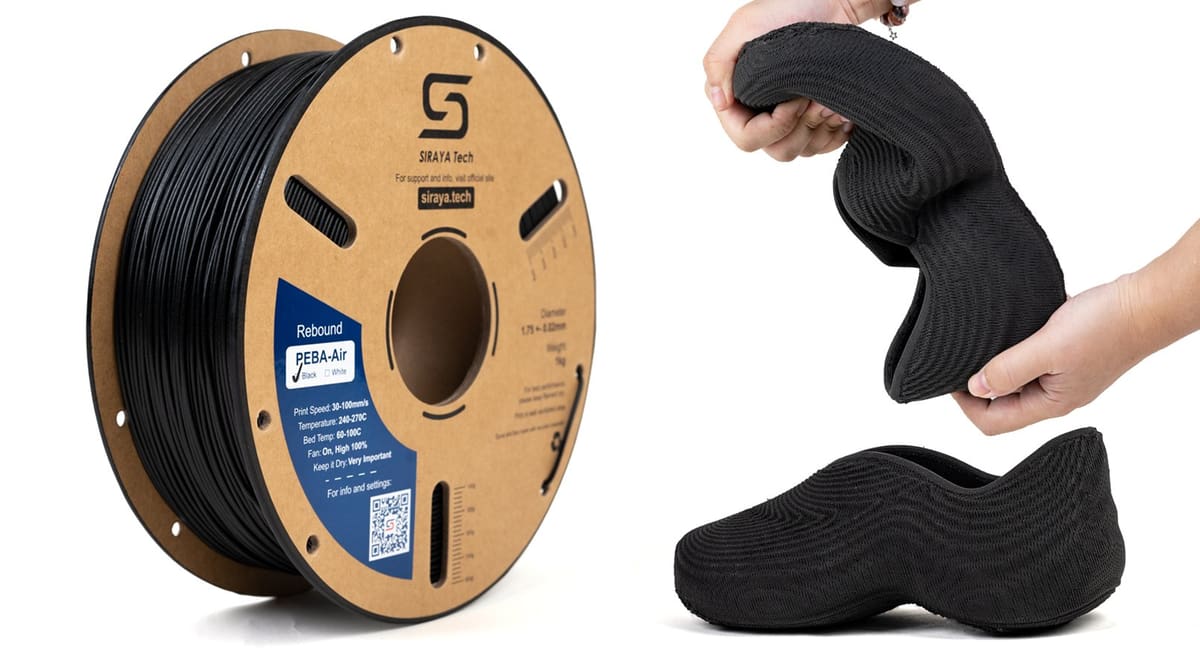
3D Print Lighter, Stronger, Springier Parts With Nylon-Based, Foaming Rebound PEBA Air

By adjusting print temperature, you can customize firmness, rebound, and weight — no new hardware required.
Dial in the perfect bounce and even shed up to half of your print’s weight without changing hardware. A new filament from California-based Siraya Tech makes it possible to adjust how soft or firm your 3D printed parts should be, just by changing your printer’s temperature.
Rebound PEBA Air ($69.99/0.8kg), however, is not just another active foaming filament, the company says; it features high-energy rebound, making it ideal for everything from custom shoe midsoles to ultra-light drone parts that are still tough enough to take a beating.
Compared to TPU, PEBA (polyether block amide) is lighter, bouncier, and recovers its shape faster when bent or stretched. It’s often used in high-performance applications like running shoe midsoles, sports gear, and parts where rebound speed, weight savings, and chemical resistance are important.
Last month, Siraya Tech launched its Rebound PEBA 95A, and now, we have a foaming version that enables you to cut down on weight.
Unlike conventional filaments, Rebound PEBA Air responds to print temperature. Run it cooler and the material firms up. Crank up the heat, and it softens, expands, and even sheds weight — in some cases up to 50% lighter than a solid print. Think midsoles that can be customized for bounce, or drone landing gear that stays strong without dragging extra grams through the air.
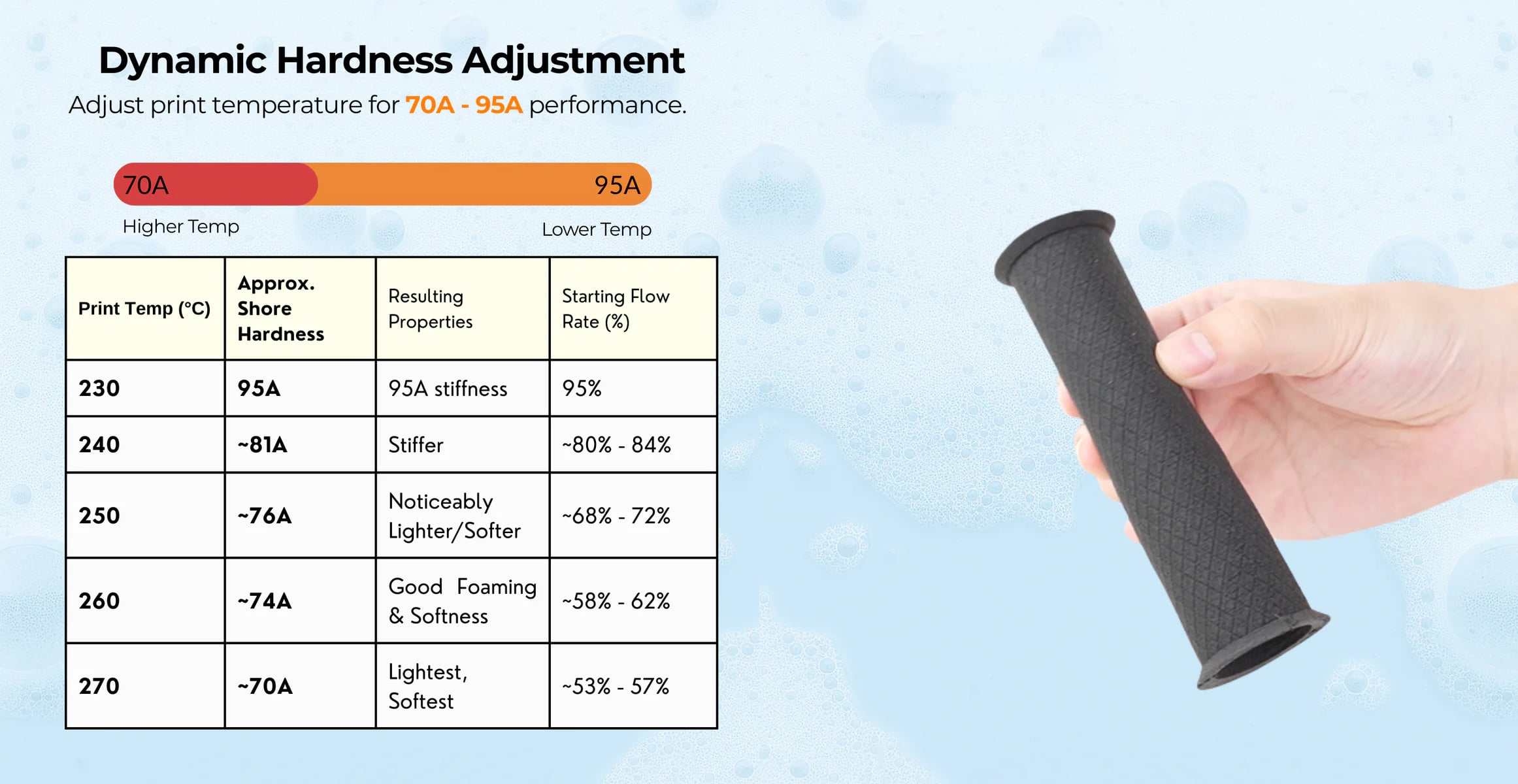
Underneath the innovation is a mix of nylon (PA) and soft TPE blocks, giving it both mechanical strength and elasticity, the company says. That means the parts aren’t just light and squishy; they’re also durable, chemical-resistant, and able to take a beating from fatigue and impact. The foaming process even leaves prints with a soft-touch matte finish, an aesthetic upgrade over the glossy, sometimes plasticky look of standard filaments.
For designers, engineers, and makers, the applications could be broad:
- Sports gear like custom orthotics or lightweight padding
- Robotics and drones that need shock-absorbing bumpers
- Automotive parts such as vibration dampeners
- Wearables and ergonomic enclosures
This isn’t Siraya Tech’s first experiment with foaming filaments. Its earlier TPU Air introduced the idea of lightweight flexible printing, but PEBA Air is the evolution — bringing higher rebound, stronger structural integrity, and a wider performance envelope.
And the best part? It works on most FDM printers, no exotic hardware required.
How Do Siraya Tech’s “Airs” Compare
The main differences between Siraya Tech’s Flex TPU Air and PEBA Air flexible filaments lies in their chemical makeup. One is a thermoplastic polyurethane (TPU) while the other is a PA12 copolymer elastomer, also known as PEBA (Polyether Block Amide). PEBA is noted for its high energy return. Both materials are designed to be lightweight and have tunable hardness by adjusting the print temperature, but they offer different ranges.
Both filaments use active foaming technology to reduce weight, but each caters to a different softness range.
PEBA Air has a 60% Bayshore rebound across different print temperatures, while Flex TPU Air’s datasheet does not specify a value for energy return or rebound.
Both materials are hygroscopic (absorb moisture) and must be kept dry for optimal print quality. Both recommend drying at 70-80°C if the filament becomes damp.
Rebound PEBA Air is available now through Amazon and later this year at Siraya Tech’s website.
You May Also Like:

License: The text of "3D Print Lighter, Stronger, Springier Parts With Nylon-Based, Foaming Rebound PEBA Air" by All3DP Pro is licensed under a Creative Commons Attribution 4.0 International License.
CERTAIN CONTENT THAT APPEARS ON THIS SITE COMES FROM AMAZON. THIS CONTENT IS PROVIDED ‘AS IS’ AND IS SUBJECT TO CHANGE OR REMOVAL AT ANY TIME.