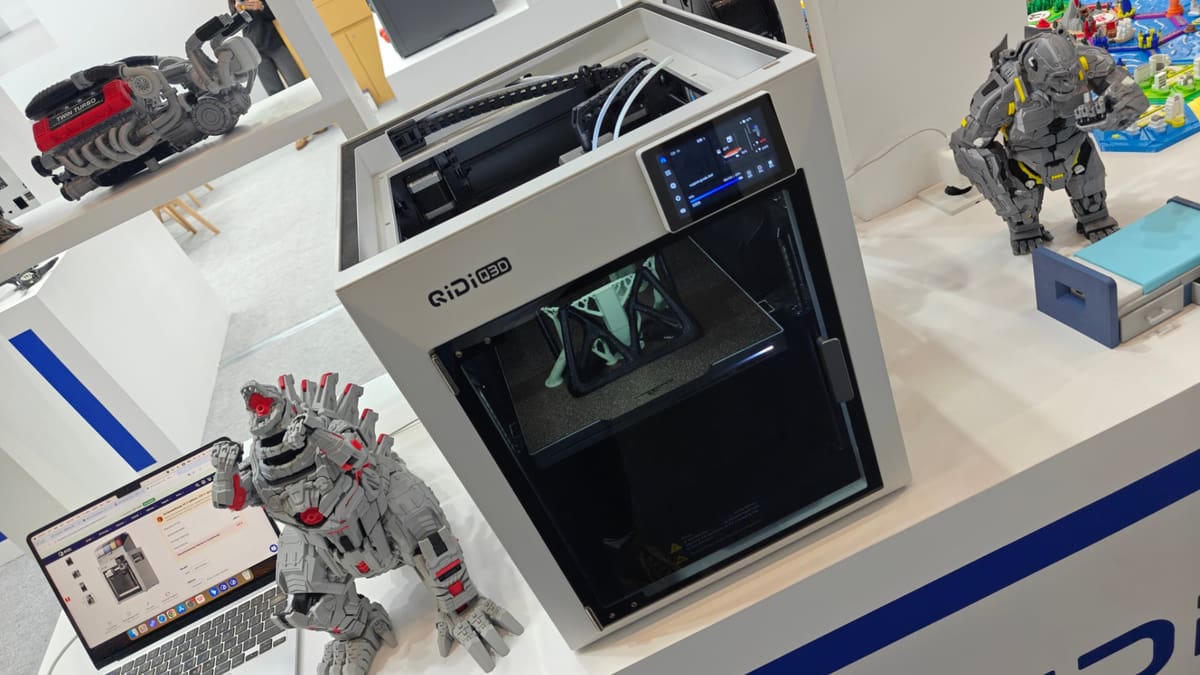
Qidi’s Dual-Nozzle Q3D Lands at Formnext, Has 70°C Chamber & 350° Hotend – $529 in Presale

Qidi's dual-nozzle printer is up for preorder at $529 and claims higher hotend and chamber temperature limits than the printer it bears a strong resemblance to: Bambu Lab's machine X2D. Qidi aims to ship it early next year.
At Formnext, Qidi debuted its answer to Bambu Lab’s X2D. Called the Qidi Q3D, it’s a dual-extrusion 3D printer that prints with two independent nozzles, each fed by its own extruder.
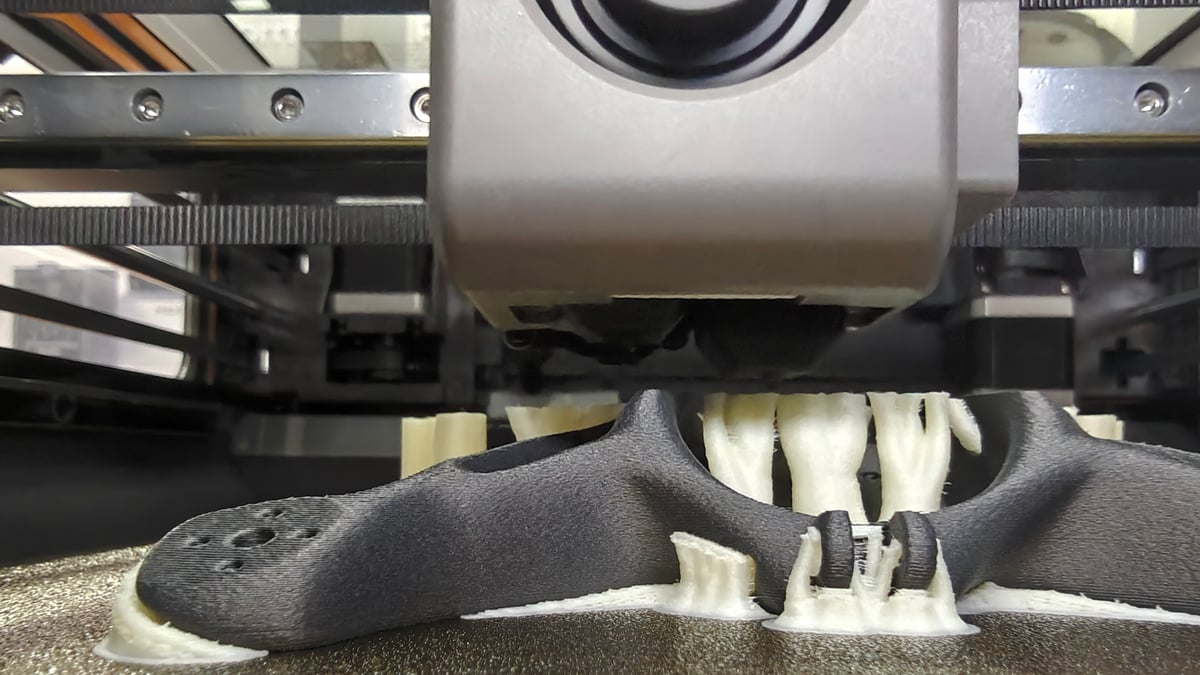
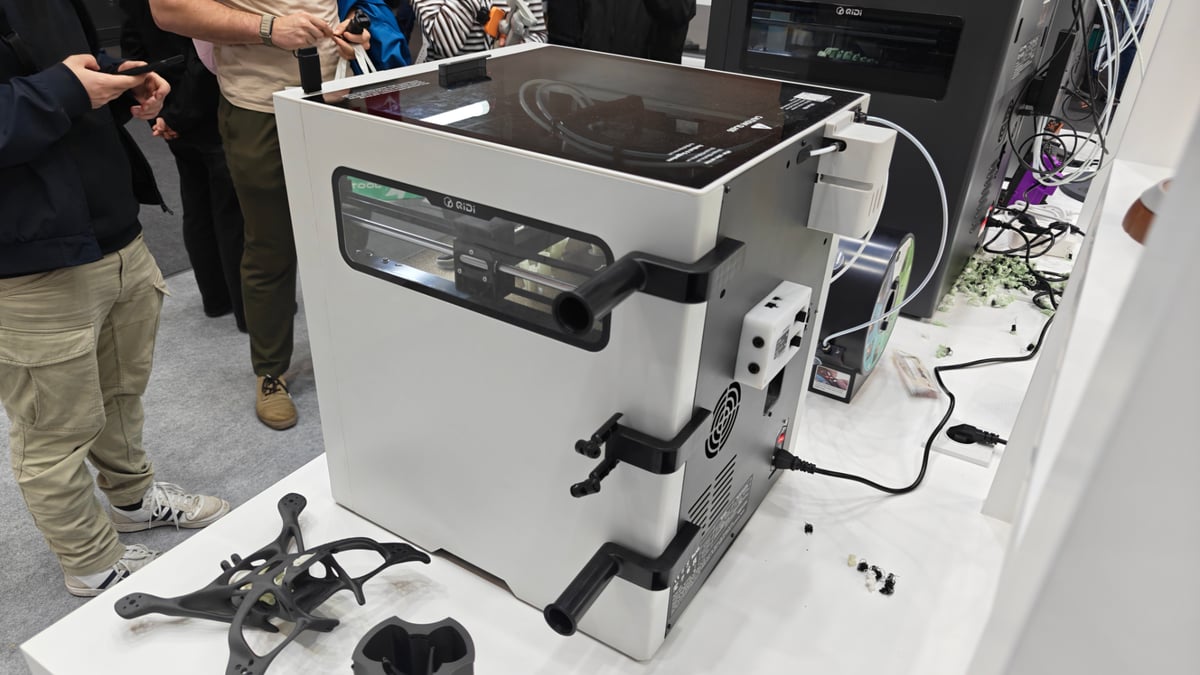
A mechanical switcher engages whichever nozzle is needed. The main nozzle is fed by a direct-drive extruder. The right-hand “secondary” or “auxiliary” nozzle gets its filament from an external Bowden-type extruder at the rear of the printer. It’s a hybrid setup. Unusual, and familiar.
Looking closer, though, there are clear differences between the Q3D and its almost-namesake, starting with price. Available to preorder now, the Q3D can be secured for $529 with a $30 deposit, against a $599 launch price. The X2D launched at $649 and is currently $589 in Bambu Lab’s Black Friday sale, which runs through December 1.
In shape and capability, there’s only one other printer on the market that’s close to the Q3D looks like it will offer, so here’s a brief comparison between the Q3D and that printer, Bambu Lab’s X2D, showing how they stack up on paper:
The other big difference, and one of the reasons to choose Qidi’s machine, is its Klipper-based firmware and the openness that generally comes with it. Integrating the printer into advanced setups, with finer control over its behavior and your access to it, is something power users can’t simply so easily from the likes of Bambu Lab.
Qidi rates the Q3D’s “lightweight” printhead at up to 600 mm/s, pulled by 7 mm 1.5GT belts. The hotend is updated over the Q2’s, with new cage-secured tool-free quick-swap nozzles.
Airflow and temperature are a particular focus for the Q3D. Dual intakes pull fresh air in from outside the printer to blow at the print, and Qidi’s “Gen-4” system actively heats the chamber. The Q3D is also compatible with Qidi’s Polar Cooler accessory ($~220), which sits beside the printer and pushes a high volume of air through a tube at the hotends. Qidi recommends it for large models and for high-temperature and fiber-reinforced materials on long prints. We haven’t tested one.
An eddy current sensor at the printhead handles bed leveling, with Qidi “guaranteeing a flawless first layer.” Emissions are handled in part by an integrated three-stage filter: a G3 pre-filter, an H12 HEPA filter, and a coconut-shell activated carbon filter.
Qidi lists material support for each nozzle separately. The main hotend covers PLA, ABS, ASA, PETG, TPU, PA, PC, and carbon- and glass-fiber-reinforced filaments. The secondary nozzle handles PLA (except PLA Aero, a material Qidi doesn’t even make), PETG, ABS, ASA, TPU 64D, PA, PC, and PVA, plus dedicated support filaments. For best results, Qidi recommends running PLA Silk, PETG-CF, ASA-CF, PA6-CF, TPU 64D, and PA/PET support through the main nozzle.
What $30 Buys
For now, the Q3D can only be reserved with a $30 deposit. Pay it, and the balance due later on the standalone printer drops to $499 for $529 in total – $70 off the $599 launch price.
It’s a little convoluted, and easily confused considering the store page says “shipping now”, though shipping won’t actually follow till later. It’s a saving nevertheless for those keen to jump in on new tech from the company. The deposit scheme also covers the full spread of Q3D bundles: the printer alone, the printer plus Polar Cooler, in Combo with the Qidi Box filament feeder, or all three together.
According to the fine print, Qidi emails a payment link when the balance is due, and buyers are requested to pay the balance within seven days. Qidi estimates shipping at about three months after full payment but doesn’t guarantee it, and shipping fees are set at final payment. The deposit is refundable at any time, with no fee.
The Qidi Q3D is available to preorder now via the Qidi webstore.
You’ve Read That; Now Read These…


License: The text of "Qidi’s Dual-Nozzle Q3D Lands at Formnext, Has 70°C Chamber & 350° Hotend – $529 in Presale" by All3DP is licensed under a Creative Commons Attribution 4.0 International License.