Polymaker’s New G-Flex ‘Unbreakable*’ PETG Is Designed to Be Abused

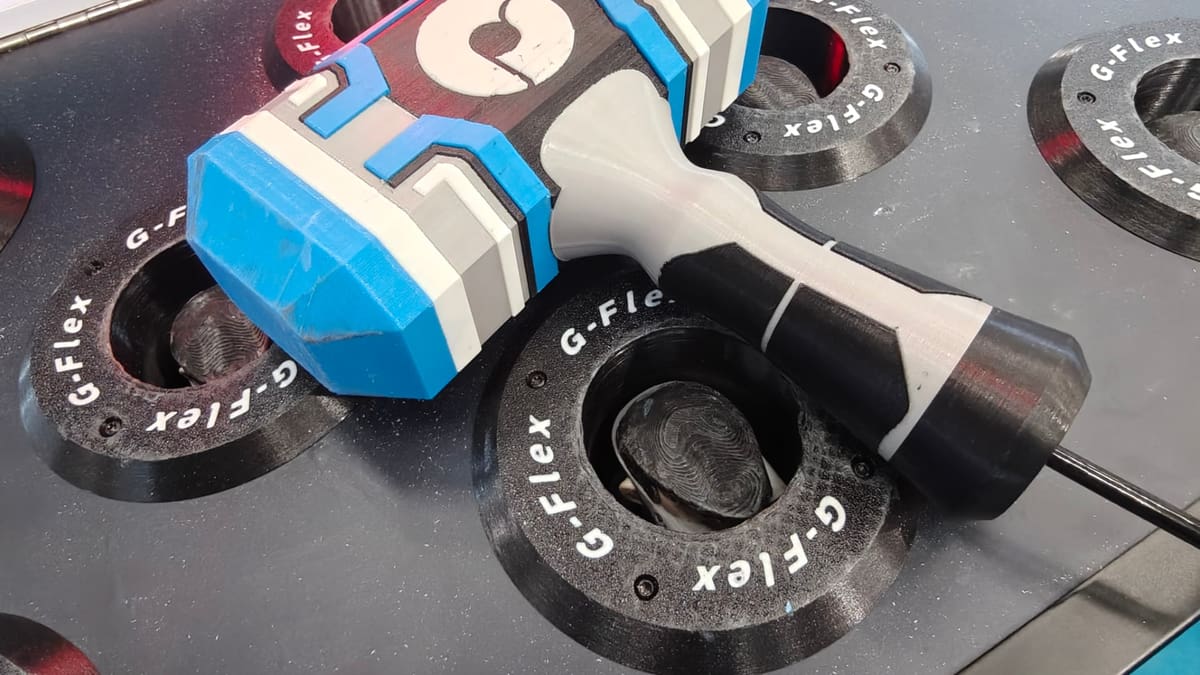
Okay, so it's not actually unbreakable, but it tough enough to resist a lot of abuse, as evidenced by booth staff stomping, hurling and generally mistreating the G-Flex props at Formnext in a way that can only be described as confident and concerning.
Polymaker’s presence at Formnext is a typically fun showing, and this year’s headliner release is right on form. G-Flex is the company’s solution to brittle, breakable PLA and PETG prints of the type characterized by market stall flexi toys.
Due to release in six colors – black, white, grey, yellow, blue, and red – a 1 kg spool costs $21.99. Or it would if you could get some. General availability is expected in December, there is limited availability in some regions (and even preorders). Two demo carnival games at the stand – whack-a-materials scientist, and high-striker show of strength – were printed with components exclusively from G-Flex, and have withstood the collective force of the public at Formnext this week.
It’s a bold move to plaster the word “unbreakable” all bold across the front of the material for a filament, but there is an asterisk to cover their backs. Of course it’s not really unbreakable, but the purposes and intended usage of the filament, it’s pretty near to it. When it does break, tearing is perhaps a more accurate description of the mechanical destruction happening. Extremely strong layer adhesion and a resistant bend to it that returns to the original form gave us the feeling of a tough rigid polyurethane more than the material we know as PETG. Yet PETG it is, the company tells us.
Looking closer at the Material Data Sheet (MDS), which usually includes complete or partial lists of the component materials of a filament, we can see that TPU is a component of G-Flex, but to what extent is not fully disclosed: between 20 and 60%.
Polymaker pitches G-Flex as the ideal filament for toys, acquiring a couple of certifications and conformity checks in this direction. TUV low-VOC emissions, plus ISO 179-1 unnotched Charpy impact testing recorded “no break” in both XY and Z orientations, they say, while EN-71 3 toy safety compliance against the migration of certain chemical out of the material (say, when licked, chewed or ingested, as young kids might be inclined to do) cover part of the broad safety implications of printing toys to sell and pass on to the general public. These don’t in isolation or combination, mean a printed toy is safe. They’re both agnostic of the shape of the print, which is as important a factor if that’s what you’re aiming for with your prints.
Polymaker G-Flex: At a Glance
Printability wise, while it’s a PETG and general practice for this material applies, Polymaker does recommend a few specifics. Use a PEI-coated type bed, avoid cold Cryo-type plates, with print speed and flow set together at 300 mm/s and up to 24 mm³/s.
In other news, the brand debuted new variants of transparent PETG and TPU. Translucent PETG is a formulation of clear or subtly colored PETG designed for use in lighting projects, such as lamp shades. A 1 kg spool of that runs at $19.99.
Polymaker TPU 95A Matte is a new surface finish for the company’s TPU that trades the typically glossy look for a duller, softer matte feel. A 1 kg spool of that is available for $25.99.
You’ve Read That; Now Read These…


License: The text of "Polymaker’s New G-Flex ‘Unbreakable*’ PETG Is Designed to Be Abused" by All3DP is licensed under a Creative Commons Attribution 4.0 International License.