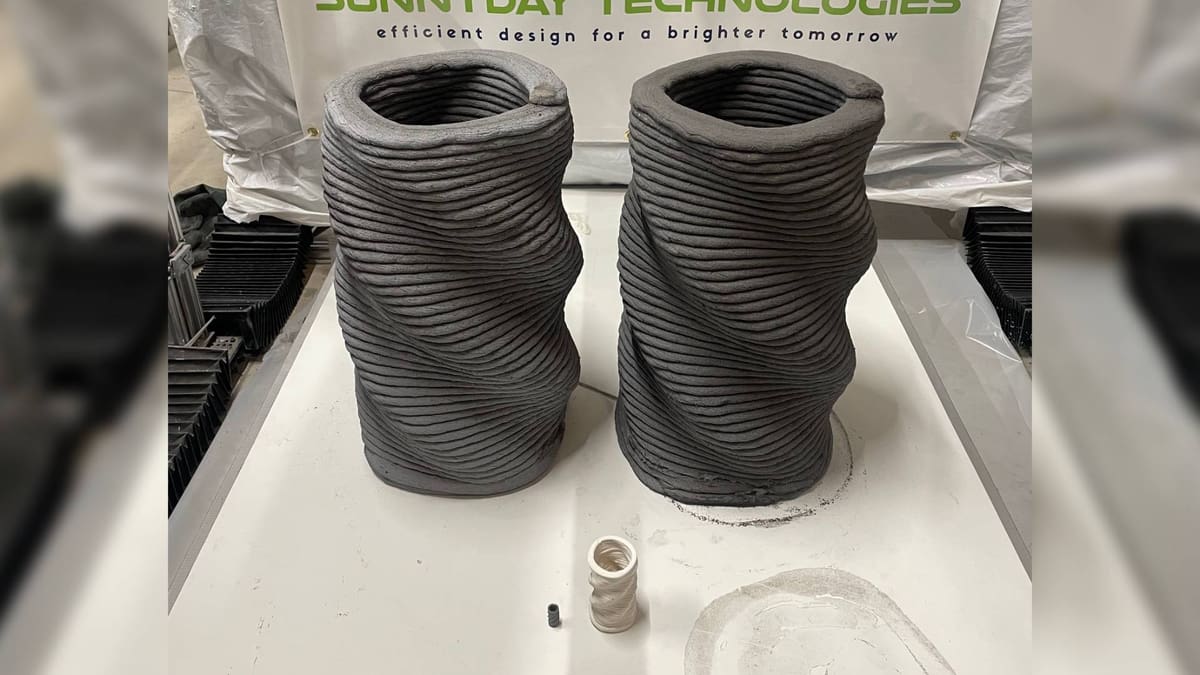
New DIY Concrete 3D Printer from Off-the-Shelf Parts

Forget proprietary hardware—this open-source project from Sunnyday Technologies uses standard NEMA motors and generative design to bring pallet-scale concrete printing to your workshop.
The new M3-Crete is a DIY, open-source, medium-sized concrete printer aimed at researchers, universities, and contractors so they can build, modify, and improve on a validated baseline, but anyone why wants to print their own garden walls and concrete furniture can also join in.
The project, recently uploaded to GitHub, follows the logic of a scaled-up desktop gantry, stretching a 1 m³ workspace over an open-frame architecture. Rather than proprietary rail systems or custom industrial castings, the M3-Crete aims to use standard, off-the-shelf components like NEMA 23 motors, paired with generatively designed printable parts for efficiency and rigidity.
The printing of concrete is not your typical use case for a machine of this type, but the M3-Crete makes sense when you consider that Sunnyday Technologies (Sunn3D) is also responsible for Cemforge, a printable concrete development platform. Being open source, you could, of course, customize the M3-Crete to your own ends, but the core purpose of it as is as an efficient validation platform for custom concretes.
The design makes “heavy use of generative design for printed parts to compensate for the stiffness differences compared to machined aluminum,” says Sunn3D founder Nick Sonnentag. “I’ve been waiting years to apply generative design at this scale, and I’m genuinely interested to see how the community reacts to the carriage and bracket design.”
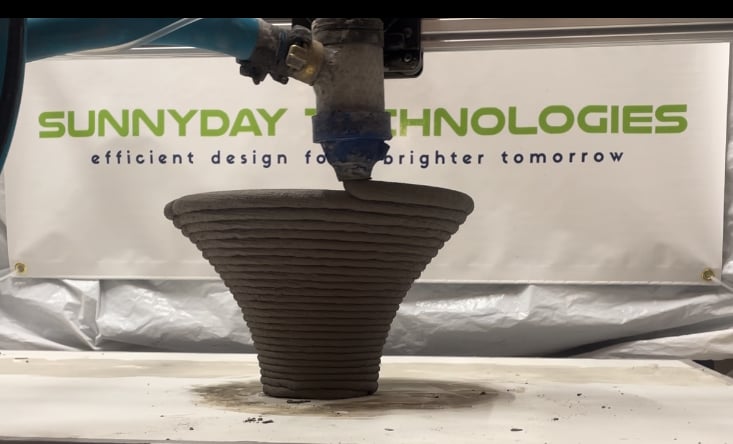
To deliver the material, the machine uses a progressive cavity pump (PCP). Unlike the geared dual-drive extruders we’re used to in FDM printing, a PCP uses a helical rotor turning to move material. This creates a sequence of small, discrete cavities that “progress” from the intake to the nozzle. In the context of a thick or lumpy material like concrete, it provides a pulse-free, volumetric flow that can handle the high viscosity and abrasive nature of printable cements without the clogging or inconsistent pressure that can come with in auger or piston-driven setups.
“Our modular scaling approach is grounded in concrete physics: past 4-6 feet, residual stresses from shrinkage quickly exceed the tensile strength of hydraulic cement, especially early-age when it’s still a dense crystal matrix rather than a hardened mass” Sonnentag adds. “Some cement printers use 2K accelerator-dosing nozzles – similar to shotcrete – where material deposited a layer or two below actively hardens rapidly while printing continues above it. That active reaction front changes how you manage stiffness, shrinkage stress, and dimensional stability as you scale up.”
The documentation and publication of files is ongoing, with files appearing as they are validated. Sonnentag tells us the project is committed to the principles of RepRap and the open source community ethos. For now, software side points to “upstream” versions of Marlin and Klipper for use as the printer’s firmware. As for what and how to print, Cemforge’s website claims it will offer some 8,000+ material formulations optimizable for the local conditions and printability – powered, naturally for 2026, by AI.
The M3-Crete is released under an MIT License (CERN-OHL-W). As we wrote late last year, concrete printing is the big bet for construction, and like every aspect of “real world” uses of additive, there’s a class of machine and layer of prototyping and validation beneath – the M3-Crete seems like it very much could fit that bill.
Read more recent news:
- The Labubu Purge: Why Pop Mart is Taking Bambu Lab to Court
- Creality's New K2 SE Might Be a Smarter Buy Than the K1C
- Cool Things to 3D Print in October 2026
Tired of Reading? Try Listening
License: The text of "New DIY Concrete 3D Printer from Off-the-Shelf Parts" by All3DP Pro is licensed under a Creative Commons Attribution 4.0 International License.