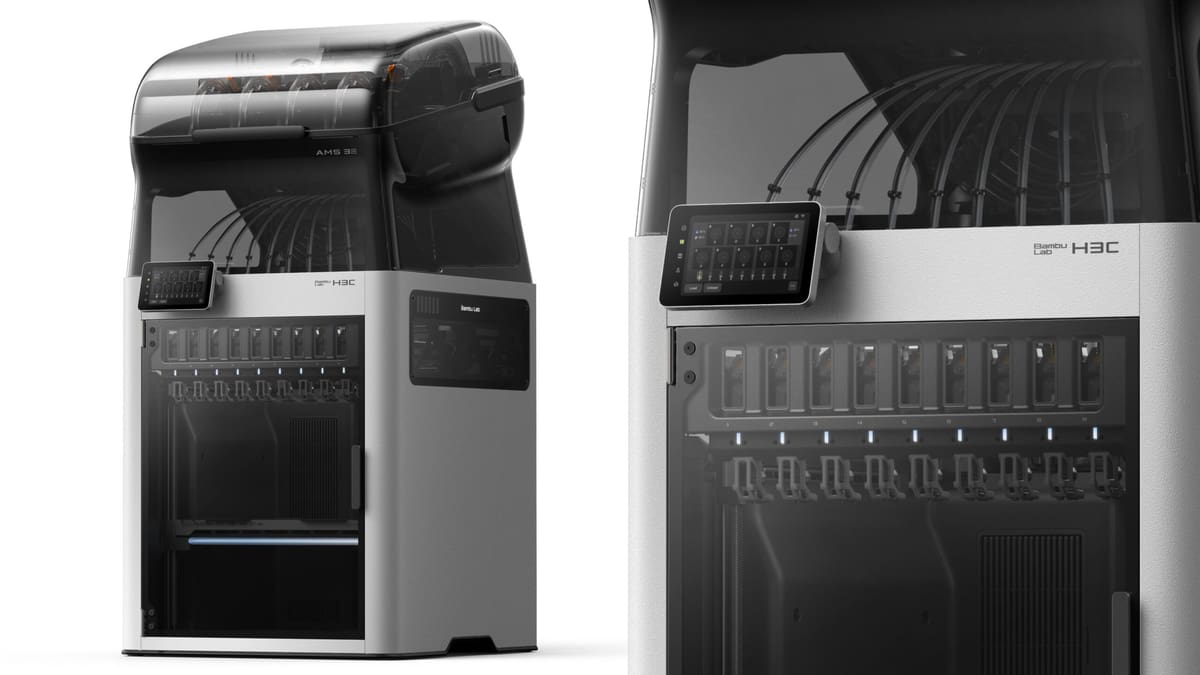
First Look at the Bambu Lab H3C: The Last 3D Printer You’ll Ever Need?

Bambu Lab's H3C combines nine swappable PrintTools, an integrated filament management system, and support for ultra-soft TPU.
Bambu Lab is going all-in on tool changing, and it’s not doing things by halves. Its new H3C ($2,499), the first in what the company calls its third-generation printer, packs nine swappable “PrintTools”, a dedicated system for printing ultra-soft flexible materials, and continues the H2-series’ ability to switch between 3D printing and other fabrication processes.
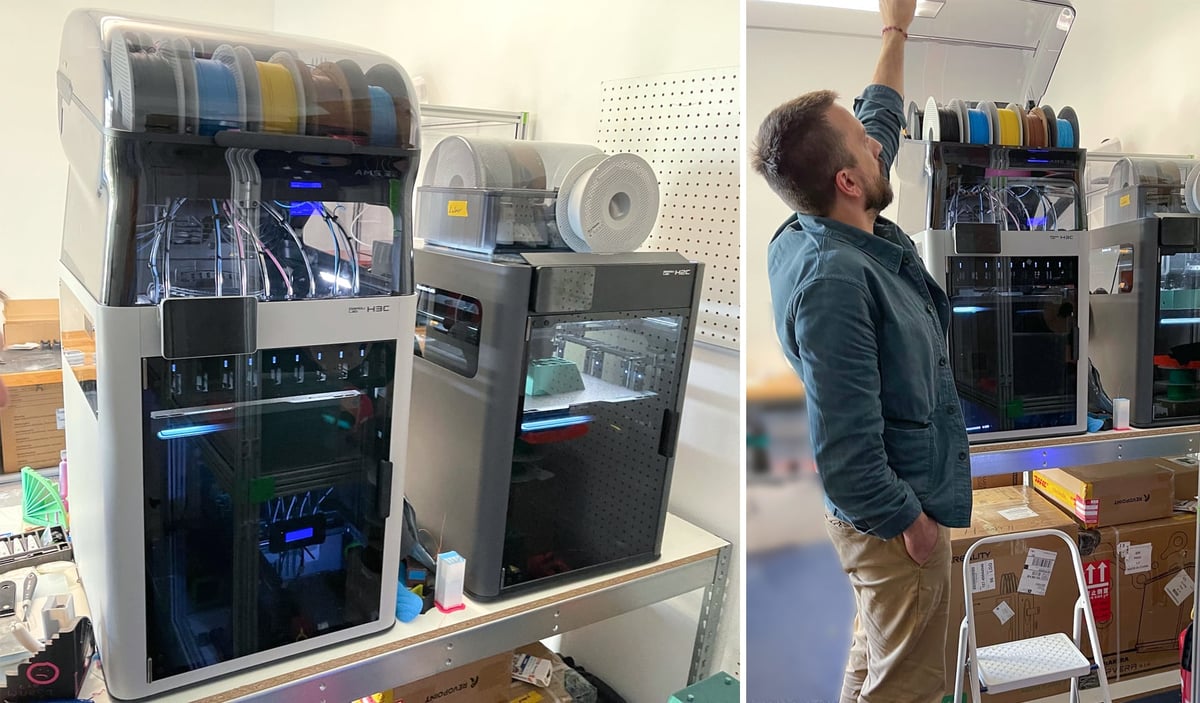
We’ve had our hands on the H3C for weeks now, and while tool-changing 3D printers are nothing new, with Prusa, Snapmaker, and Flashforge having already demonstrated the advantages of keeping materials in separate toolheads, Bambu Lab’s take is a tightly integrated system that makes more complex multi-material and multi-process projects easier to tackle.
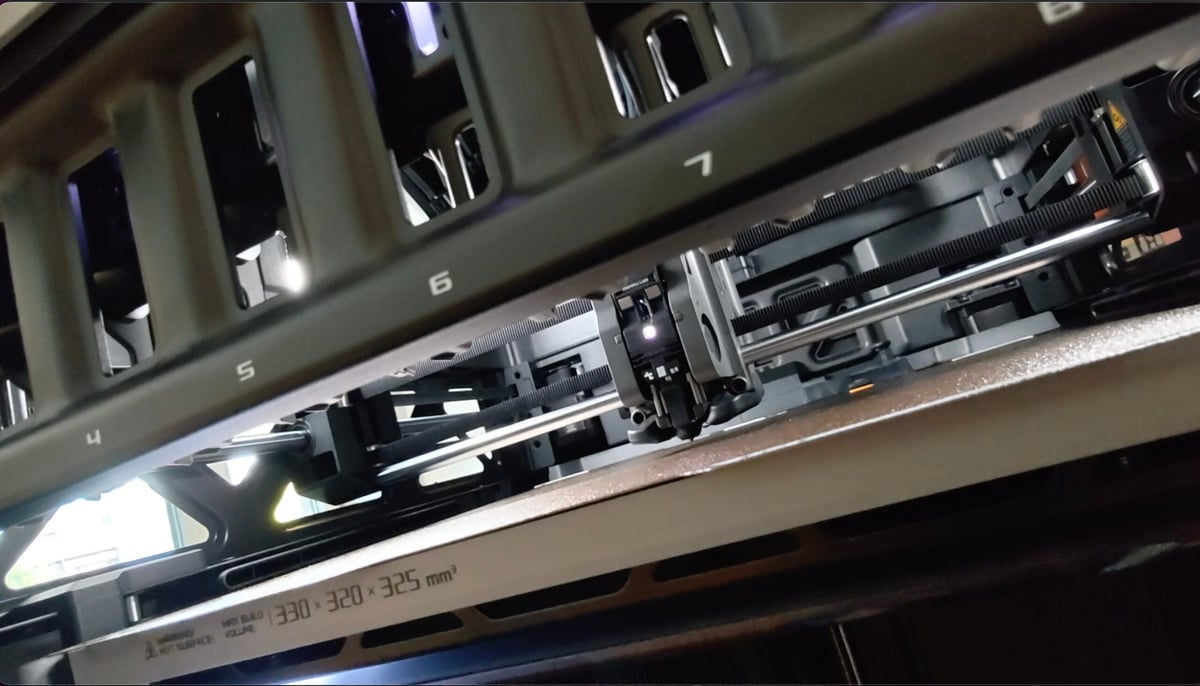
At the center of the H3C is Swaptek, a tool-changing system that gives each PrintTool its own filament path, heating element, and electrical connection. The machine anticipates upcoming tool changes and pre-heats the next nozzle while the current one is still printing, allowing it to resume extrusion with a different material in under six seconds, according to Bambu Lab.
Although that may be true of the time to park and pick up a new tool, the H3C prints a prime tower besides multicolor and multi-material models, increasing that total change time up over ten seconds. We clocked changes on average around 14 seconds for a multicolor print of the same material type. It’s marginally faster than the likes of Snapmaker and Flashforge’s toolchangers, but slower to change than either of Prusa’s XL or the INDX-equipped Core One.
But don’t let that bend you into thinking the H3C isn’t fast. It’s blazing fast. Bambu Lab claims a reduction in the motion system’s mass has allowed it to crank the travel and top printing speeds to 25,000 mm/s and 1,400 mm/s. The H3C’s travel moves are faster than the eye can register. If it weren’t for the ramping acceleration and deceleration, it’d look like the printhead teleports between points. It’s quick.
Bambu Lab’s Take on Tool Changing is Deliberate
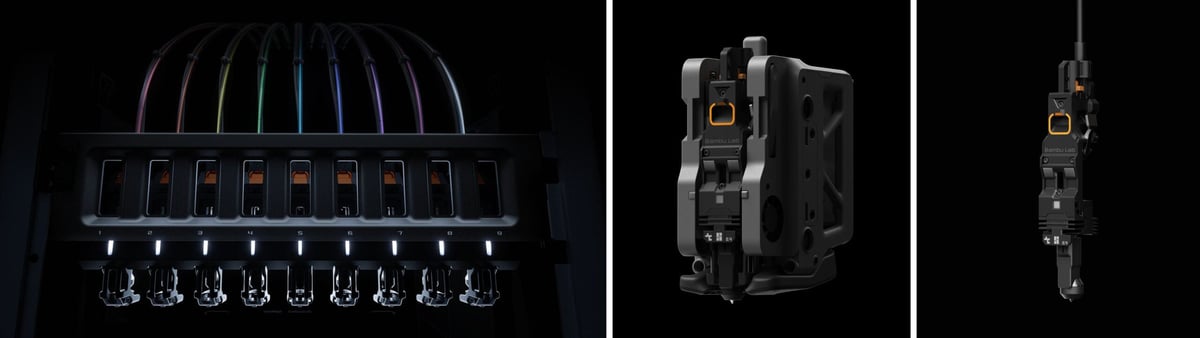
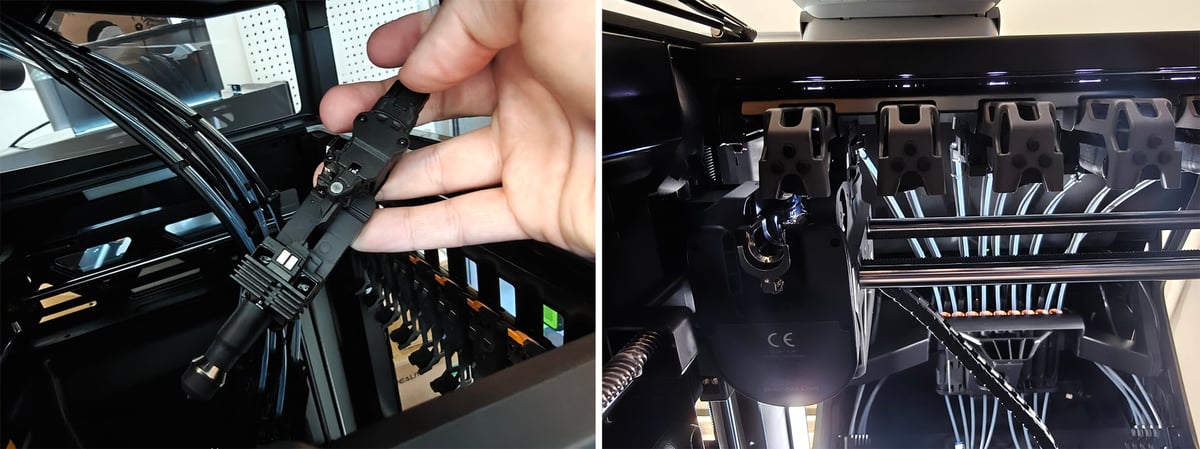
Instead of the fixed rack for the toolheads that you’ll find on Prusa’s implementation of the INDX on its Core One printer, Swaptek uses a retractable rack that adjusts its vertical position during tool pickup. According to Bambu, this improves tool alignment and consistency while moving filament tubes away from the active printing area, reducing potential vibration and interference. It also provides a clearer view of the print.
With Swaptek, you can also combine different nozzle diameters in a single job, using finer nozzles for detailed features and larger ones elsewhere. For anyone holding out on the prospect up upwards compatibility between the H2C and H3C, unfortunately that is not the case.
The H3C uses a(nother) new nozzle type – it’s not inductive, like the H2C – and unlike almost everything the company has released since the A1 Mini, is not quick-swappable. The nozzles themselves are distinct units from the tool stack itself, and can be swapped out. Three small screws hold them in place.
Clearly Bambu Lab is thinking that having nine nozzles on call is more than enough to cover most situations you may have for printing, so changing the hardware will be rare.
Under the Hood of the AMS 3H
Unlike the H2C, which relied on feeding all but one of its seven possible nozzles in a job via a single filament path connected to AMS devices, the H3C can accommodate all nine spools in the new AMS 3H. This brings with it a switch to dedicated filament paths per tool, but offers less flexibility when a material needs to be printed through different nozzle sizes. Bambu Lab says the H2C will remain available for users who prioritize that versatility over switching speed.
In fact, half of the story for this release lives in the bulging AMS 3H that permanently mounts to the top of the H3C. All nine spools feeding the H3C’s toolheads can sit snug in the hermetically sealed AMS 3H. It’s a major evolution on the box-style generations of AMS prior.
Only two spools can be actively dried simultaneously inside the 3H, which is a choice made to balance drying performance, safety, hardware cost, and everyday usability, Bambu Lab says. If you need to print with more than nine spools, H3C supports external AMS expansion via an optional Buffer connected to PrintTool No.5. All external AMS units route through this single PrintTool, and up to four AMS units can be connected, enabling up to 24-color printing.
For the launch, Bambu Lab is offering a single H3C AMS Combo configuration. It includes eight 0.4 mm PrintTools for 1.75 mm filament and a ninth 0.4 mm tool with a dedicated 2.85 mm filament path. All come with hardened-steel nozzles. The 2.85 mm filament has to use a bypass feed from within the AMS 3H, rather than the AMS’s normal feeding system. Likewise other flexibles can be dropped directly into the chamber through dedicated bypass ports on seven of the nine filament slots.
More Thought-out Flexible Filament Printing
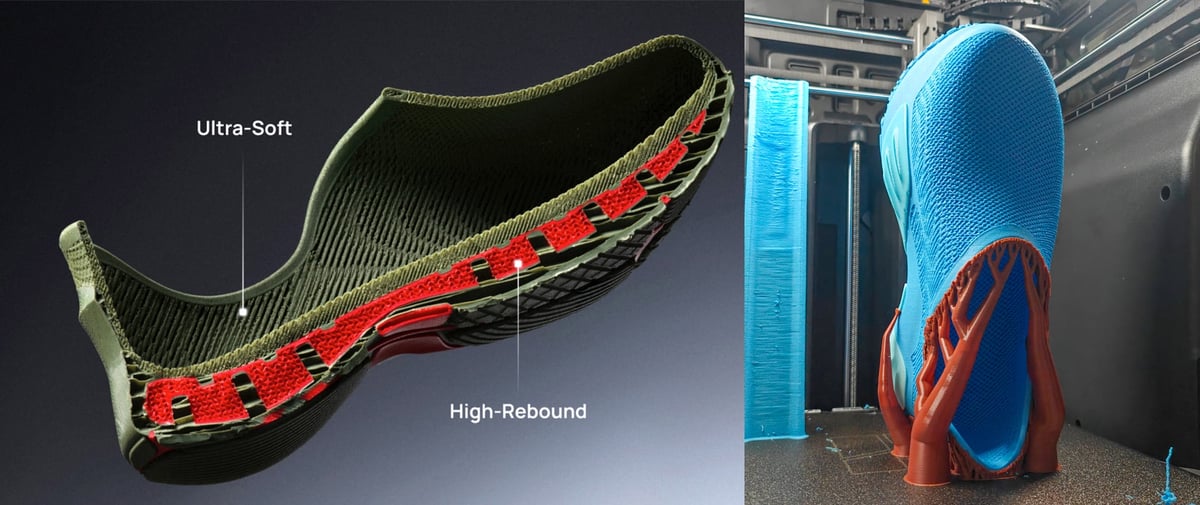
Rather than finagling elaborate placement of soft flexibles somewhere near the printer like for the H2-series machines, the H3C seems designed around the accommodating the situation. For flexible filaments, including the new, soft 70A in 2.85mm size, there are bypass ports that drop the filament directly into the chamber beneath.
Indeed the toolheads are even designed to make this experience better, with guide loops for you to keep the flexibles out of the way from tangling, and a spot to fix the unneeded guide tube for 1.75mm filaments out of the way.
A lot of attention has clearly gone into strengthening the printer’s ability to deal with flexibles, but rather than simply making it possible, they’ve tackled the issue head on and looped in a solution that has been in plain sight all along – using a larger filament size.
“Printing flexible materials is no longer something you have to struggle with,” says Bambu Lab. That’s potentially significant for applications such as footwear, wearable products, and objects combining soft and rigid sections.
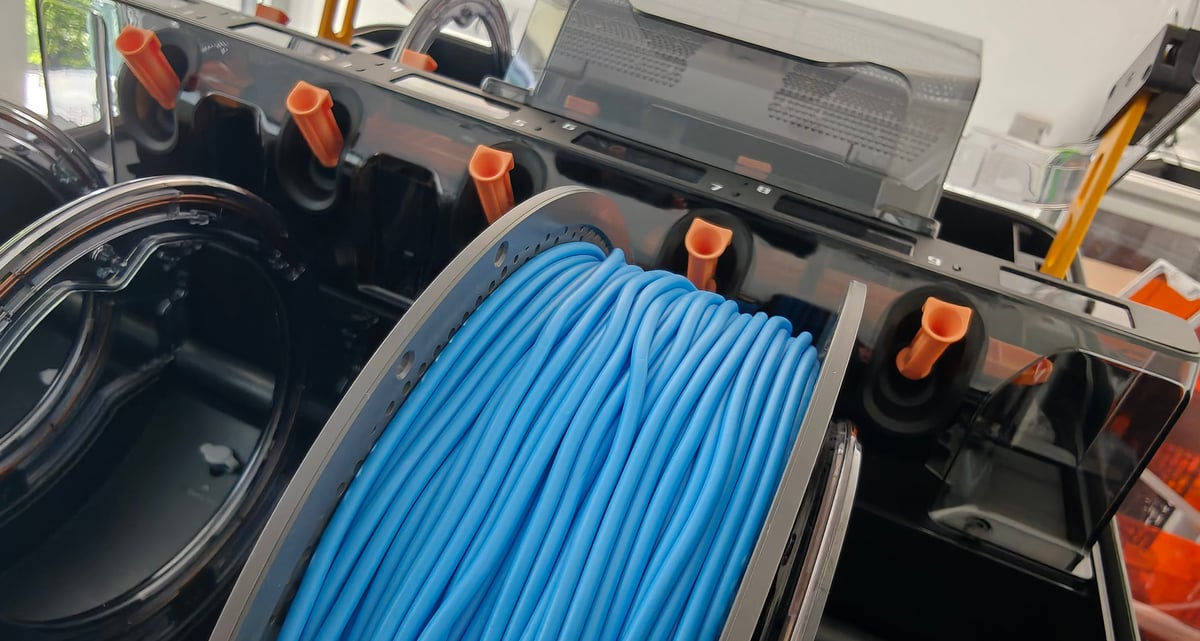
There have been initiatives to try and establish new sizes, but the mostly defunct 2.85mm size fits the bill and is poised to make a comeback. I’m calling it now – others will follow Bambu Lab on this. Larger diameter filament means less pushing is needed to feed more plastic into the hotend for melting. It’s a smart solution that sets Bambu Lab’s new machine apart, and having seen it put flexible prints on the plate at alarming speed, we know it works.
Part of the reason flexibles print so well is that Swaptek takes a different approach to gripping filament. Its FlexFeed extruder, which supports both the standard 1.75 mm filament and thicker 2.85 mm filament, uses a dedicated motor to actively adjust how tightly it holds the material.
In the lead up to the launch, Bambu Lab has pointedly spelled out the differences from Bondtech’s INDX system – an attempting to get ahead of any criticism of ripping them off, perhaps. Despite the shape of the tools and the exposed filament in path, what the tools can do and how they work certainly seem distinctive enough that such criticism would be misplaced. The INDX smartly uses a single extruder motor to tackle both tool locking and filament extrusion, dynamically adjusting its tension against resistance in the filament, Bambu Lab’s FlexFeed appears to be simpler. The similarities are clear on the surface, certainly. An exposed filament path with the extruder sliding in sideways to grab the materials can only look a given way.
More Filaments, Infinite Colors
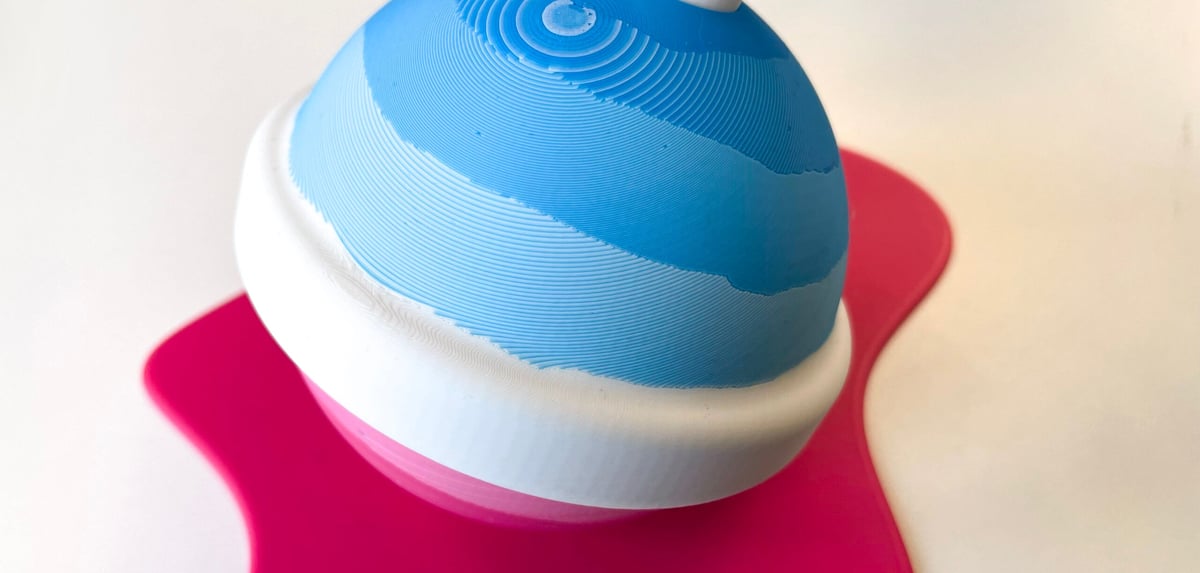
Bambu Lab emphasizes the H3C’s qualification to achieve color mixing in prints – a slicer feature added back in April with the launch of the X2D. The company’s new PLA Palette filament is exactly the kind of semi-translucent material you need, and having printed some, the results are pretty spectacular. The H3C’s nine filament capability more than adequately covers the CMYKW (cyan, magenta, yellow, black, and white) spectrum to let you print with a massive number of virtual colors in your prints.
“Because Swaptek reduces color-change time to a fraction of what it once required, color mixing becomes something you can use freely rather than something you have to plan around,” the company says.
The company’s ambitions go beyond extrusion. Optional CraftTools use the same swapping mechanism to automate operations such as blade cutting, drawing, and debossing. As with the H2-series before it, this kind of cross-craft compatibility positions the H3C well for projects that would otherwise require multiple machines or separate finishing steps.
Printer Specs & Surprises
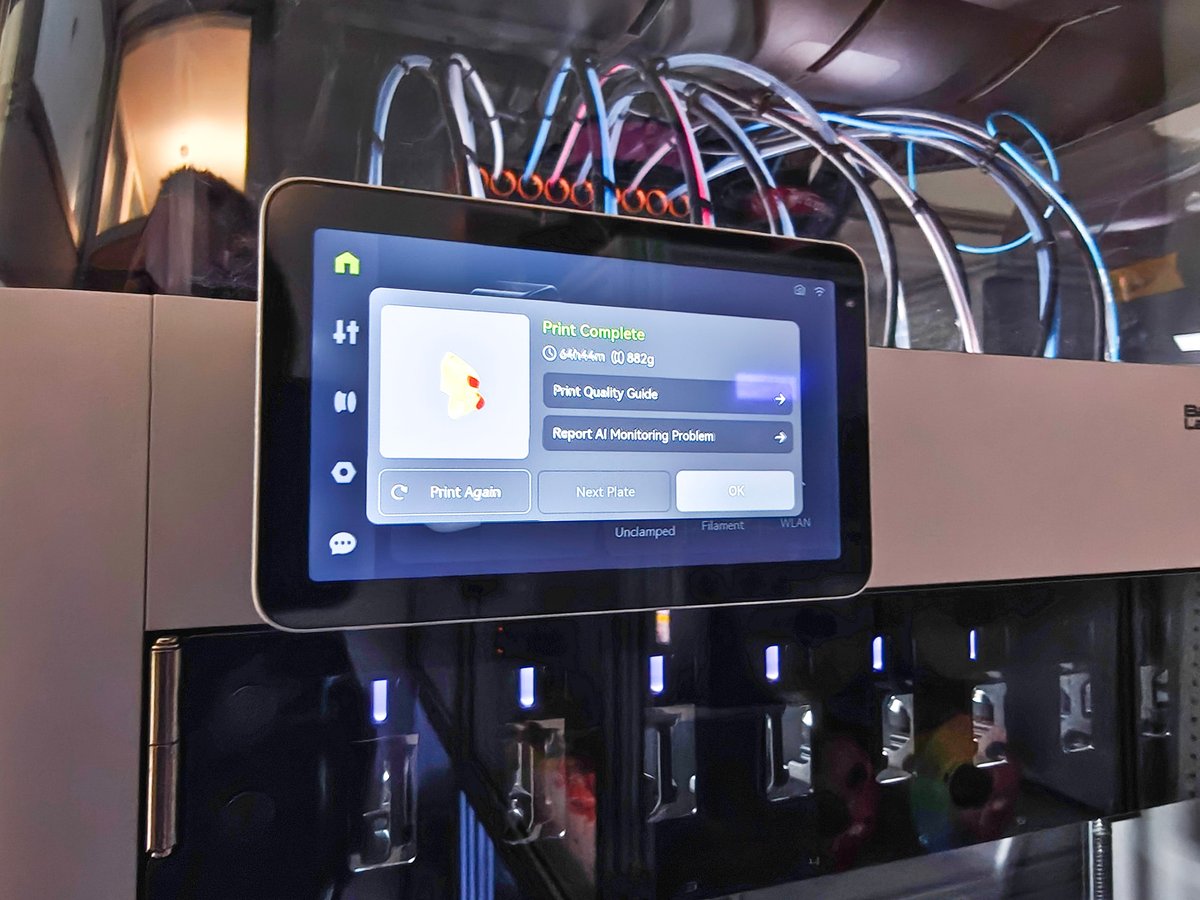
As for the printer itself, there’s a sizeable 330 × 320 × 325 mm build volume – your H2S and H2D plates fit – a maximum nozzle temperature of 350 °C, a 120 °C heated bed (all the same as the H2C), and an actively heated chamber reaching 65 °C. On paper, that makes it a capable platform for engineering filaments as well as everyday materials.
Bambu Lab is also releasing an optional, stand-stand alone air filtration system called the E1 Air Purifier that sits next to your printer and, presumably, attaches to the exhaust vent on the back of the AMS. There aren’t a lot of details on this accessory but it is in addition to the printers existing H11 HEPA filter and activated carbon filter.
Bundles for the printer can also stretch to include a new Bambu Station wheeled base unit. The H3C is tall, so the possibility to lower it onto a transportable storage cart makes sense.
The H3C looks like Bambu Lab’s attempt to take tool changing beyond straightforward multicolor printing, combining material flexibility and automated fabrication processes in one machine.
Based on our initial weeks with the printer, it more than lives up to the hype. In the coming weeks, we’ll present a more thorough review of this machine and it’s capabilities.
The Bambu Lab H3C ($2,499) is available now from the Bambu Lab webstore.
Bambu Lab H3C specifications
AMS 3H specifications
You Might Also Like:



License: The text of "First Look at the Bambu Lab H3C: The Last 3D Printer You’ll Ever Need?" by All3DP is licensed under a Creative Commons Attribution 4.0 International License.