Cutting Support Material From 3D Prints Is Getting Easier, Choosing an Ultrasonic Cutter to Do It Isn’t

A new Kickstarter campaign for an ultrasonic cutter pitches effortless 3D print support removal, shows us how vast the scene has gotten recently, and teaches a moment of caution to actually look a little closer before backing on Kickstarter.
Follow along with All3DP’s coverage of the printing space over the years, and you’ll know that a lot of printing stuff gets its start on Kickstarter. Things like the 3D printers themselves, software, enclosures and, increasingly, accessories like ultrasonic knives.
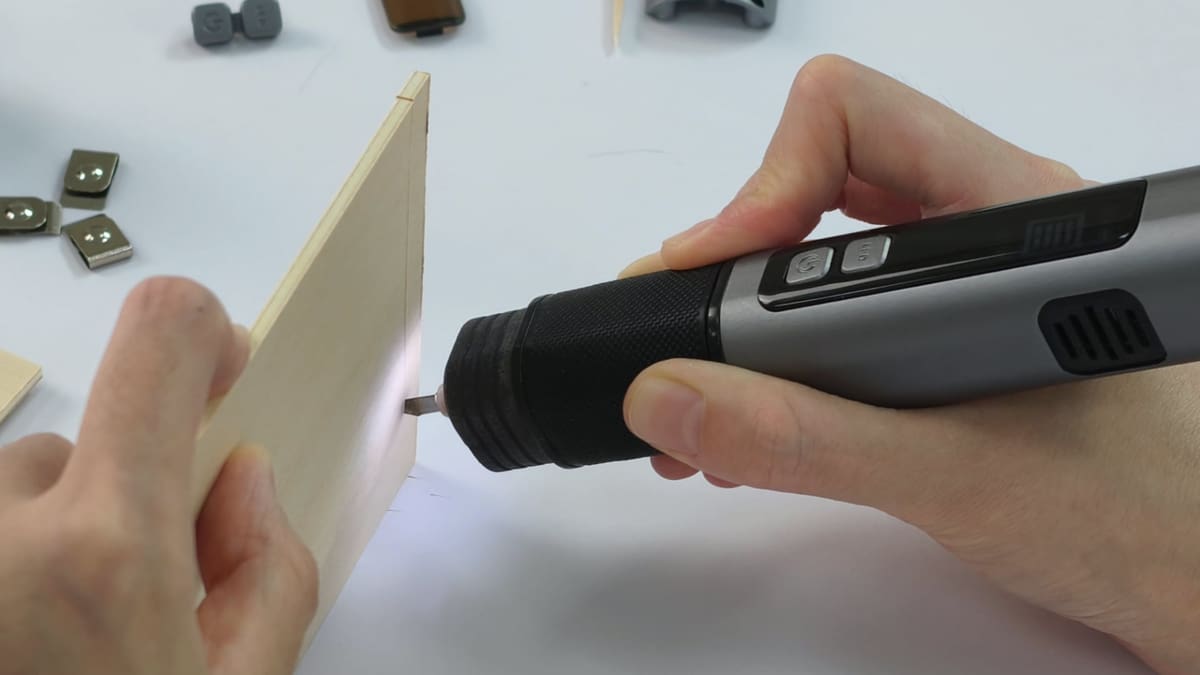
Right now, there are a handful of ultrasonic blades available for pledging toward on Kickstarter, including the SonicMax Slice 10. Among other loosely crafty use-cases like slicing through leather, wood, and acrylic, the SonicMax’s cordless, battery-powered 40 kHz ultrasonic cutter is one of a growing number of such tools particularly suited for nipping supports off prints and general clean-up of 3D printed parts.
There’s clearly an interest in such tools. Despite being one of several available to back right now, the Slice 10 has raised over $100,000 from 866 backers since going live earlier this month. It is the newest entrant in a category of 3D printing-aligned accessories based on old tech that’s gone from curiosity to persistent thing-on-our-radar in about two years.
In practise I rather like the idea of a magical knife that slips through supports like they’re made of butter. That is, effectively, what an ultrasonic knife does. The blade is vibrated tens of thousands of times a second, and consequently able to pass through solid materials with the gentlest application of pressure from you.
As far as a category of tool goes, they’ve existed for many years – there are kitchen knives that do it, costing in the hundreds of dollars – more as a luxury, rather than what seems like an obvious accessibility benefit. The underlying technology – ultrasonic transducers, this slips of material that vibrate under current – are responsible for common household products like diffusors, where they vibrate water so much it vaporizes into a cold mist. Ultrasonic blades stack transducers to concentrate vibrations and power into a blade, letting it achieve a sawing motion that’s barely perceptible to the human eye. This motion can generate heat, but also chips away at the material, effectively cutting through it as fast as the vibrations go and the material gives way.
Corded industrial ultrasonic cutters have sold for hundreds of dollars for years – the WonderCutter turned up at mainstream retail including Home Depot. Hackaday even documented a DIY build back in 2019.
The last couple of years has seen the market fill with inexpensive cordless models, including many crowdfunded versions aimed squarely at 3D printer owners. Czechia-based 369Sonic raised roughly $60,897 from about 215 backers in 2024, with the Hanboost C1, and Hozo’s NeoBlade following, both earning considerably more at over $700K each. Established 3D printing companies also released corded units, including Phrozen’s Sonic Saber, and Twotrees’ U1. The appeal is pretty clear, particularly in resin printing where support structures can be a dense forest of points contacting the model – being able to part delicate supports, brims, and stray extrusions without deforming fine features is a real post-processing hassle that a hobby knife or flush cutters can handle poorly.
Across the space, the specs are usually pretty similar for the cordless models – 40 kHz, roughly 200–240 grams, USB-C, and replaceable battery cells, all in the region of $99–150 – the Slice 10 very much fits to type here, though its eventual MSRP will skew a little higher at $215. It does attempt to stand out with a couple nods to long-term usability that sound welcome though, chiefly a larger battery promising some four hours of intermittent use. According to SonicMax Inc., the company behind the Slice 10, the device makes use of “a high-efficiency transducer” that they say is more efficient than typical designs in the industry. Other headline features SonicMax point out include “lift-to-activate auto sensing that primes the device for use, an OLED status display, and built-in LED cut-line illumination.”
The Slice 10 is, almost certainly, a real product that does a job. It might even be good at it – we don’t know. But we can’t let it pass without comment that things aren’t quite as they seem. The company’s website advertises being “As Seen In” CNET – we can find zero such mention – as well as outlets named TechGear Review, CraftPro Magazine, and Industrial Tool Digest – none of which appear to actually exist. Dig a little deeper and you find the company’s contact detail address and telephone number are identical to that of a smartwatch and audio company called Tranya, both listing a suite shared with a law firm that renders cross border services for China-U.S. entities. Two FCC listings exist for SonicMax Inc. – covering two audio products under Tranya and Nutshell brands. Hm.
None of this points to anything necessarily nefarious – well, the false endorsements is pretty bad but, being generous, could be chalked up to blind text someone simply forgot to change – but the narrative as a fresh-faced company launching its first product looks less certain under this modest amount of scrutiny. On the flip side of things, Tranya has shipped several products in recent years, so that probably bodes well for the backers of the Slice 10.
The SonicMax Slice 10 is available to back on Kickstarter, with current early bird pledges starting at $119 for the basic Slice 10 cutter.
Editor's Note – This article highlights a Kickstarter crowdfunding campaign. Kickstarter is not a shop; campaigns are under no legal obligation to deliver on crowdfunding promises, nor offer refunds on unfulfilled campaign rewards. For more insight, read our article 8 Things to Watch for When Backing a 3D Printing Kickstarter.
Other recent news



License: The text of "Cutting Support Material From 3D Prints Is Getting Easier, Choosing an Ultrasonic Cutter to Do It Isn’t" by All3DP is licensed under a Creative Commons Attribution 4.0 International License.