Biqu’s Upcoming Board Lets You Swap Your Bambu Lab P-Series ‘Brains’ for Klipper

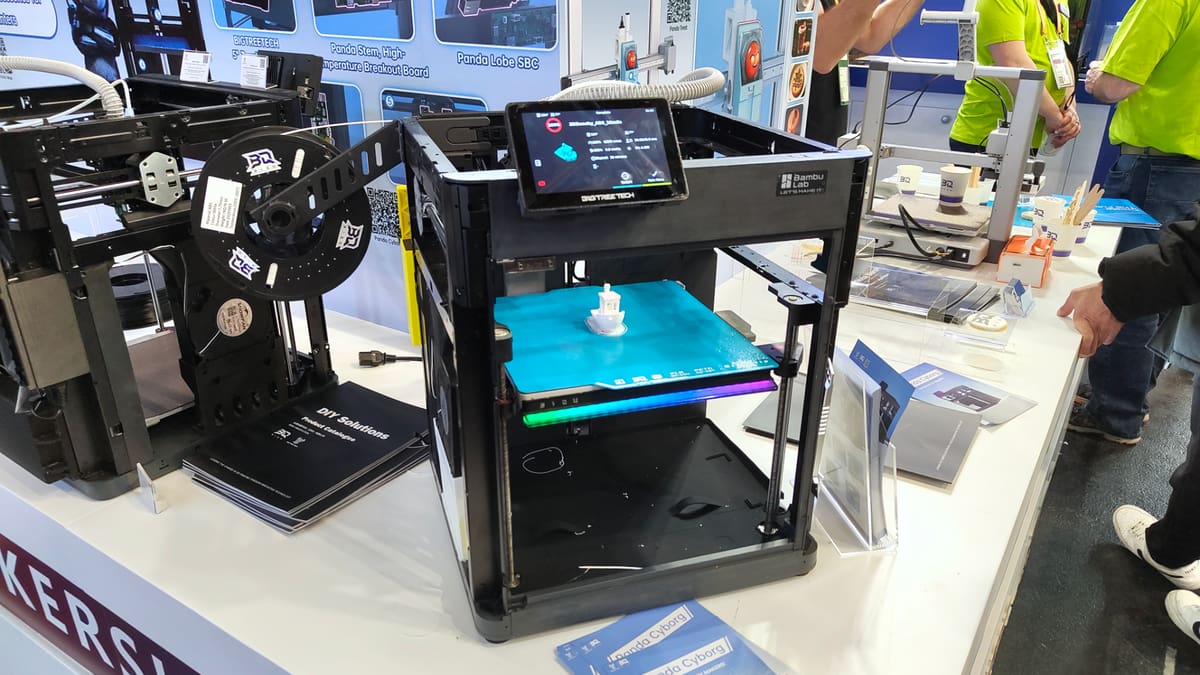
Biqu will release the Panda Cyborg kit for the Bambu Lab P1S and P1P soon, transforming the printers into a Klipper-powered playground. That, and an unexpected sweet treat were the highlights of a colorful year at Formnext for the company.
Biqu is slowly becoming my personal highlight at Formnext. Year on year, you find useful, unexpected, and sometimes funny products that show the brains behind the brand not only have a sense of humour, but want to inject that into your 3D printing. This year has been no different.
In the trade halls of Frankfurt, between the deployable printers redefining the battlefield, industrial debuts, no-waste toolchangers and politics, Biqu is colorfully forcing users’ freedom of choice on Bambu Lab’s famously closed ecosystem with an upcoming kit for older Bambu Lab P-series machines called Panda Cyborg.
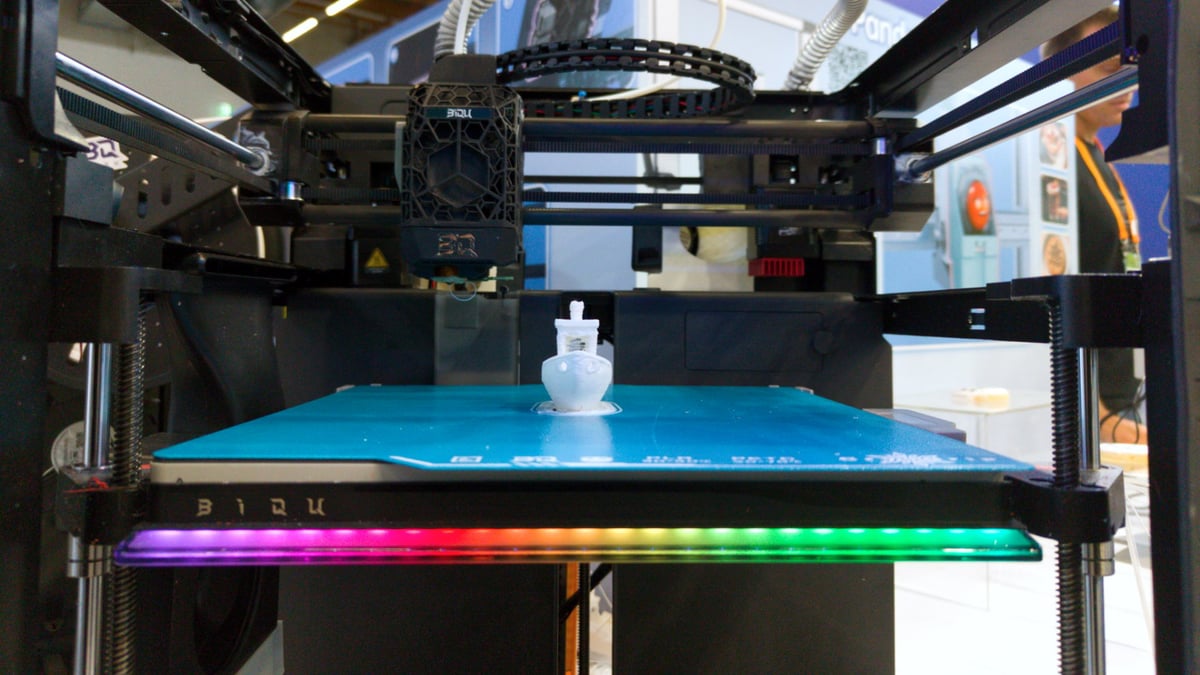
Cyborg comprises two main parts: the Panda Lobe and Panda Stem, serving as direct replacements for the P-series’ mainboard and AP board. They use all of Bambu Lab’s original cabling and ports, making the switch a relatively straightforward procedure.
We’ve covered the company’s growing Pandaverse of Bambu Lab compatible accessories and upgrades closely, knowing that there are a lot of Bambu Lab owners out there. The law of averages mean there are also a lot of folks interested in tinkering and toying with their machines. That will only increase as the hours tick by on those machines’ supported service lives: the Bambu Lab P1P, for example, will stop receiving bug fix updates at the end of 2027, with security patches ending in 2029.
The Panda Lobe has an integrated 5.5 inch touchscreen display, giving it a similar form to the Panda Touch, and enables high fps camera streaming. The Panda Stem drops inside the chassis in place of the printer’s AP board, letting the “brains” talk to the body, and using heat-resistant connections for accessories, opening the possibility for experimenting with higher chamber temperatures with the printers.
And what else do you get besides those fixed features? Full Klipper.
This takes your P1S or P1P completely outside of Bambu Lab’s guard rails, leveraging the decent hardware platform but customizing the behaviour and performance to your liking. A demonstrator Panda Cyborg on display at the show was cranking out 10 minute Benchys, albeit messy ones, but the wider point is that option takes you right back to a point in time where Mainboard replacements and tinkering were commonplace.
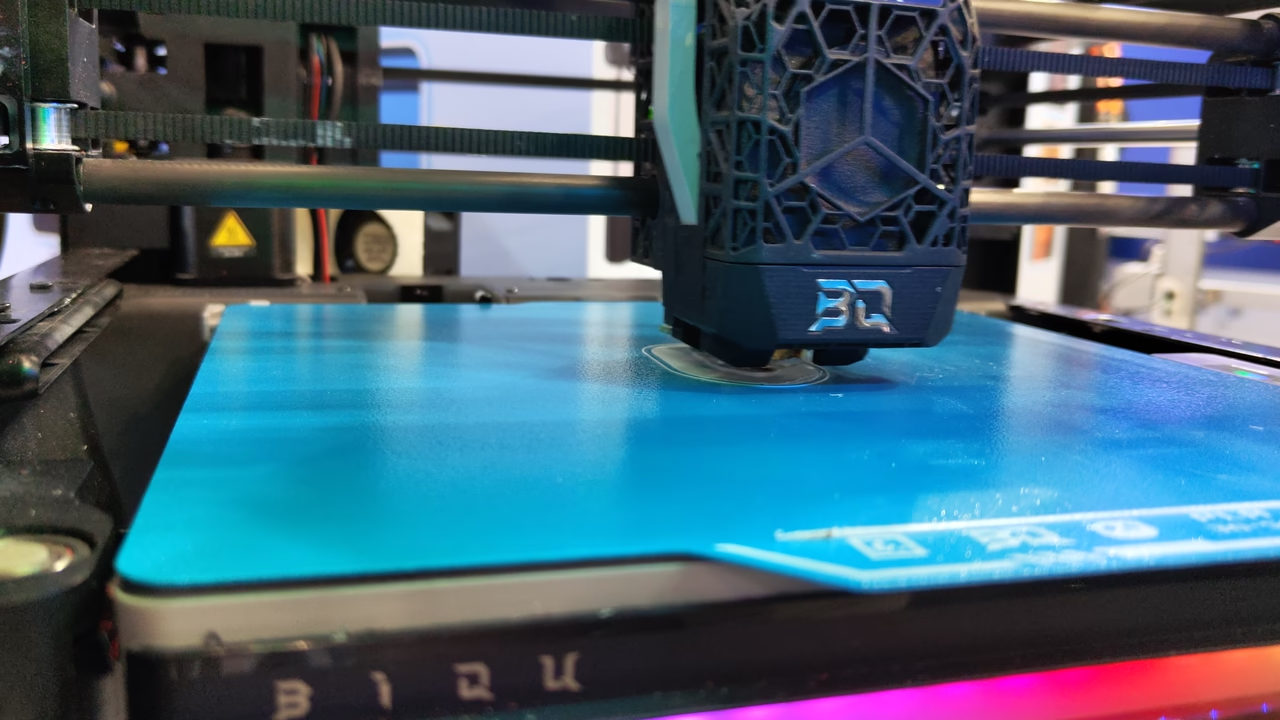
BigTreeTech’s SKR boards were the gold standard in affordable upgrades for the Creality Ender 3 when it was the dominant budget 3D printer (imagine) so to see Biqu come full circle and bring that level of flexibility to a famously inflexible system is fascinating.
Due to launch in the coming months, the Biqu Panda Cyborg will let you lobotomize your Bambu Lab machine, turning it into an educational platform to tinker with things. But that’s not even the wildest or weirdest thing the company had to show.
BigTreeTech technical director Luke Harrison was on hand to demonstrate an upcoming printhead add-on the company has cooked up that brings new capability to Bambu Lab printers.
Imagine you hack a standard inkjet cartridge from a 2D printer, fill it with FDA approved edible ink, and then use the fan connection of the printhead to control the printer and spray edible 2D images onto coffee, beer, cookies, cakes… the works.
That’s the Panda Treat.
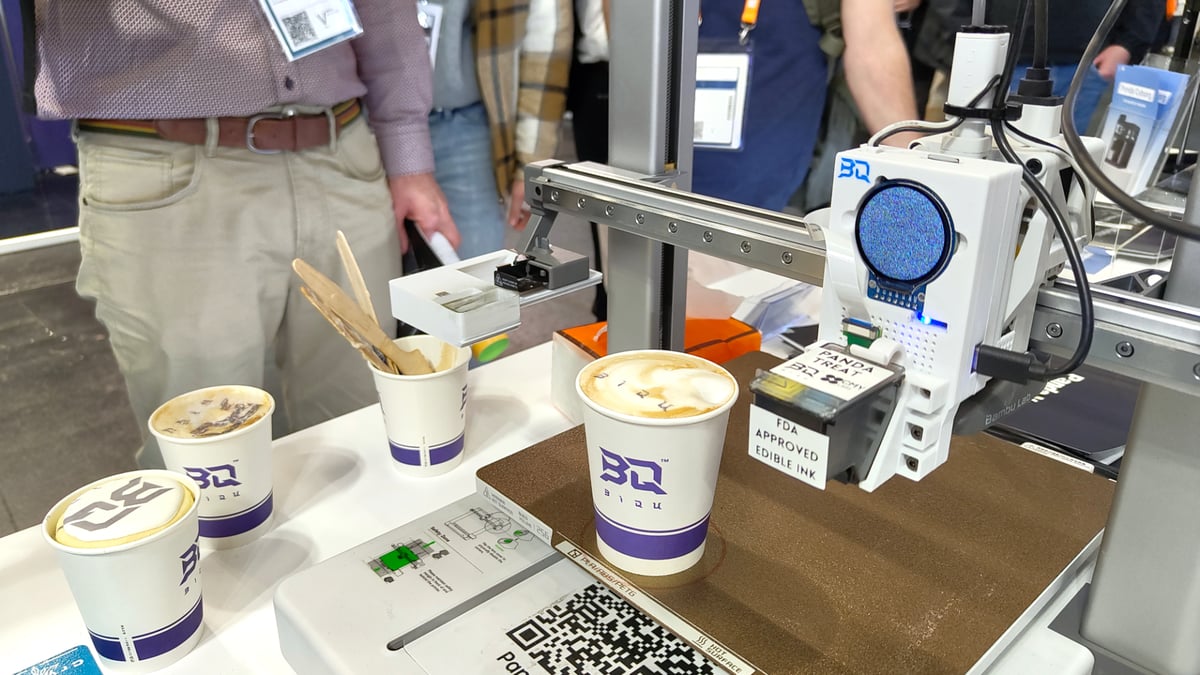
And more than that, the possibility is there for the Treat to actually print regular ink onto a 3D printed layer. The device simply snaps onto the front of the printhead – in the example shown at Formnext, a Bambu Lab A1 – connects to the printer via the printer’s fan port, your phone via LAN, and delivers a printable file that when initiated, has the printer scan back and forth, one overlapping line at a time, depositing the ink onto the object.
It could theoretically colour a regular plastic print too. What we saw in action at the show was not too far removed from the kind of color printing tech XYZprinting tried to get off the ground with its da Vinci Color printer nearly a decade ago. Coloring just the outer walls of a neutral plastic print, you could take a cheap, mono-material print and make it colorful. It never caught on as a dedicated multi-thousand dollar printer, but as a fun accessory for your Bambu Lab machine? Why not.
Read more recent news:
- Flashforge at Formnext: Budget Multicolor Focus & the Elusive CJ270 May Cost Less Than Initially Expected
- Anycubic Shows off Three New Printers, Plus A New ACE 2 Pro Filament Changer at Formnext
- Prusa’s Purgeless Nozzle Swapper is (Almost) Here, and It’s Powered By Bondtech
Tired of Reading? Try Listening
License: The text of "Biqu’s Upcoming Board Lets You Swap Your Bambu Lab P-Series ‘Brains’ for Klipper" by All3DP is licensed under a Creative Commons Attribution 4.0 International License.