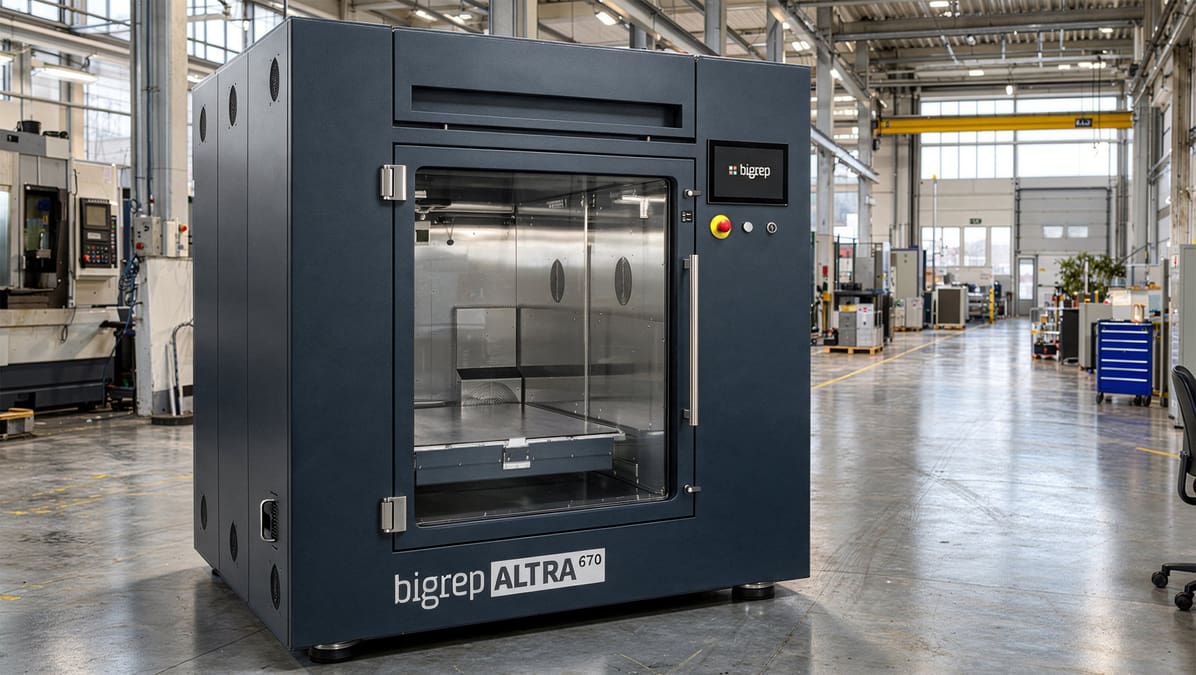
BigRep’s New Altra 670 Takes on Stratasys’ F870 With a Bigger, Hotter Build Chamber

The new industrial 3D printer combines a 140°C heated chamber, dual 450°C extruders, and automated features for manufacturing large parts from engineering-grade polymers.
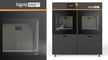
Just weeks after Stratasys introduced its F870 industrial FDM 3D printer, German manufacturer BigRep is launching the Altra 670, another large-format machine aimed at producing functional parts, tooling, manufacturing aids, and — in today’s market — drone bodies and parts. Both printers target industrial production environments, but BigRep is taking a different approach, prioritizing a larger build volume, higher processing temperatures, and an open material filament system.
The Altra 670 offers a 700 × 1,200 × 800 mm build volume compared with the Stratasys F870’s 1,000 × 610 × 610 mm — 80% more build volume. But perhaps more importantly, BigRep’s fully heated chamber reaches 140°C, compared with 95°C on the F870. This give the Altra 670 an advantage when printing large parts from thermally demanding polymers, such as PEKK, carbon-fiber-reinforced PEKK, and PPSU, since keeping deposited material hotter throughout a build can reduce warping and internal stresses of large parts while improving interlayer bonding.
Stratasys, though, isn’t necessarily aiming for a broad material range, instead designing the F870 with a 95°C chamber specifically for the established materials used in factory-floor tooling: Nylon 12CF, ABS, and ASA. Still, high-temperature material flexibility is a bonus in the Altra 670’s material line, which also includes ABS, ASA, polycarbonate, polypropylene, and a variety of carbon-fiber-reinforced materials.
Both printers target industrial manufacturing, with the F870 focusing particularly on fixtures, jigs, and production tooling, while BigRep presents the Altra 670 as a more broadly applicable system for large prototypes, manufacturing aids, and end-use parts in sectors including aerospace and defense.
The Altra 670 also has a 140°C print bed and two water-cooled Direct Synchronized Extruders (DSX) capable of reaching 450°C.
Different Approaches to Continuous Printing
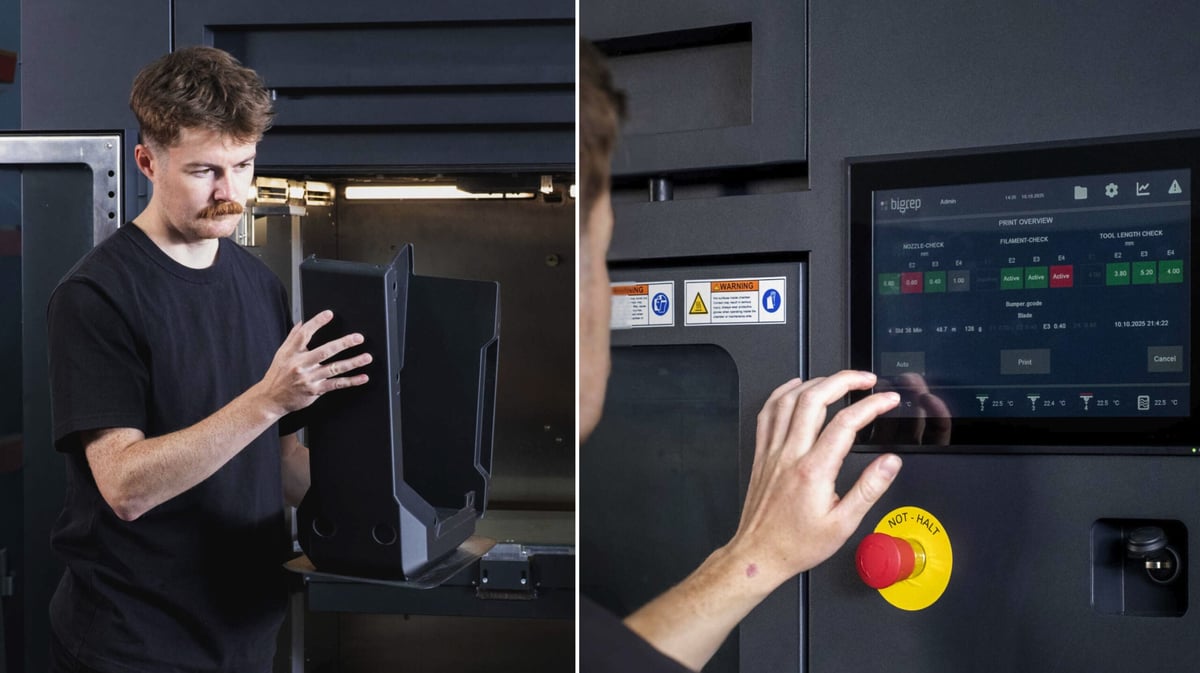
Both machines are designed to handle lengthy print jobs with minimal intervention.
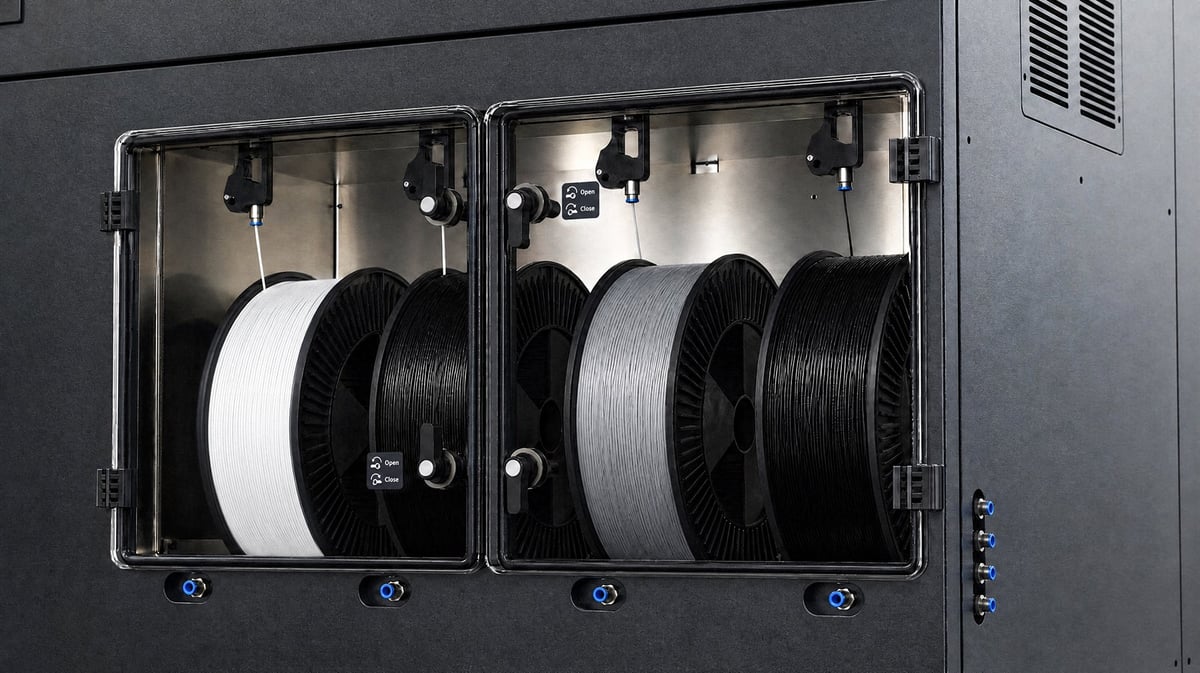
BigRep’s two DSX extruders feature multiple sensors for filament continuous monitoring. Its Relay Mode automatically switches to the second extruder when the first runs out of filament, allowing a job to continue without stopping for a spool change.
The Altra 670 accommodates four 8-kg spools, giving it up to 32 kg of onboard material capacity. The Stratasys F870, meanwhile, accommodates four 4,100-cm³ material spools, equivalent to approximately 17 kg of ABS or 17.5 kg of ASA in total. That gives BigRep nearly twice the onboard capacity by weight, although the F870 has an integrated regenerative drying system, whereas BigRep specifies only sealed dry storage.
A checkmark is the plus column for BigRep though is its open filament system that supports third-party materials. The F870 is limited to Stratasys’ own material portfolio and does not support the company’s OpenAM software.
The Altra 670 features automatic calibration, adaptive mesh bed leveling, filament runout detection, and an HD camera for remote monitoring.’s heated switchplate print surface is removable and designed to distribute heat evenly across large builds, while airflow-control technology helps maintain uniform temperatures throughout the chamber.
BigRep says the machine’s welded frame, ball screw drives, and servo motors contribute to accuracy during long print jobs. The company specifies positioning accuracy below 0.05 mm and a maximum XY movement speed of 400 mm/s. Its extruders offer a maximum material throughput of 250 g/h, although this figure alone doesn’t establish how quickly the machine will complete a given part.
Bigger Printers, Different Trade-Offs
BigRep’s Altra 670 doesn’t redefine high-temp, large-format extrusion printing, but it brings together capabilities that are difficult to find in a single industrial filament printer. Its 670-liter build volume, 140°C chamber and open material system give manufacturers the flexibility to produce large parts from a wider variety of engineering polymers than the Stratasys F870 supports. Larger and hotter machines exist, particularly among pellet extrusion systems, but those involve different trade-offs in throughput, process control, and part detail.
CreatBot’s D1000 Pro HS and 3D Systems’ Ext 1070 Titan Pellet, for example, are both substantially larger 1,050 × 1,050 × 1,050 mm build envelope, but are actively heated to just 80°C. Roboze’s Argo 1000 Hypermelt could be the biggest challenger with a build volume of up to 1,000 × 1,000 × 1,000 mm, alongside a chamber temperature reaching 180°C. It prints with pellet materials, which are generally more affordable, and has an extrusion rate up to 2 kg/h.
The Stratasys F870 has a dedicated range of print heads, imbedded material dryer, and Stratasys’ qualified material ecosystem.
Ultimately, one of the biggest differentiators may be price (including materials), which has not been released.
The Altra 670 is available to order worldwide, with BigRep expecting initial deliveries by the end of the first quarter of 2027.
Its introduction also coincides with BigRep’s return to private ownership following its stock-market delisting.
“Our initial public offering two years ago was based on the expectation of rapid market acceleration in additive manufacturing, an assumption that proved more optimistic than the market ultimately allowed,” says Thomas Janics-Jakomini, CEO of BigRep GmbH. “Returning to private ownership allows us to refocus our resources on product development and growth.”
The company reports revenue growth of approximately 45% over the preceding twelve months.
You May Also Like:

License: The text of "BigRep’s New Altra 670 Takes on Stratasys’ F870 With a Bigger, Hotter Build Chamber" by All3DP Pro is licensed under a Creative Commons Attribution 4.0 International License.