Stratasys’ New F870 Industrial FDM Is Huge, but Is Anything About It Actually New?

Stratasys' new F870 combines a meter-long heated build chamber, carbon-fiber material support, integrated drying, and enough filament for days-long factory tooling jobs.
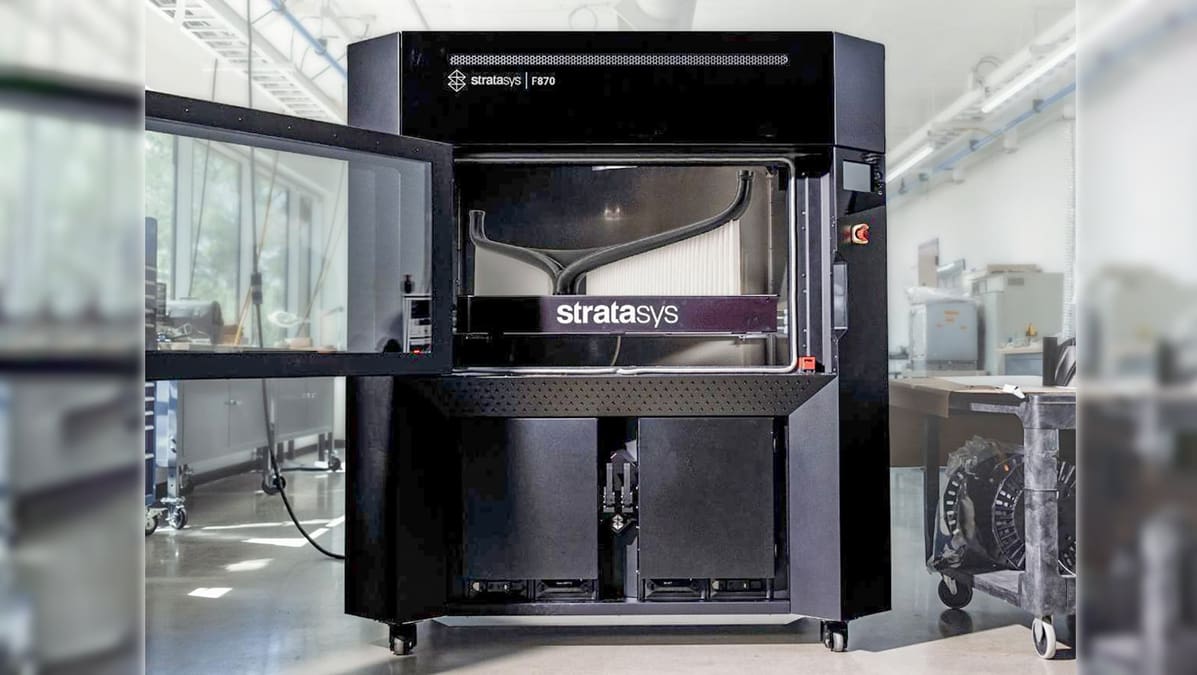
Stratasys just announced its new industrial FDM, the F870, a printer built primarily for factory-floor tooling, jigs, fixtures, manufacturing aids, and functional parts, which is nothing new for Stratasys. Its printers have been plugging away at companies like Ford, Toyota, and General Motors for years.
The machine offers a 1,000 x 610 x 610 mm build volume, a 95 °C fully heated chamber, integrated regenerative material drying, four large material spools with automatic changeover, and compatibility with Nylon 12CF, ASA, ABS-M30, and a new ABS Draft material. Stratasys claims the material capacity is sufficient for as much as “two weeks of continuous unattended printing,” and a one-meter tool genuinely could take two weeks considering the relatively slow deposition rate of 21 cm³/h for Nylon 12CF.
These are all certainly industrial specifications. What’s less obvious is what, if anything, the F870 brings to industrial extrusion printing that hasn’t already appeared elsewhere.
Large heated chambers? Roboze goes bigger and hotter. High-temperature printing? AON3D, MiniFactory, and Markforged go considerably hotter. Carbon-fiber composites? Commonplace. Integrated material drying and automated loading? Also available elsewhere. Process monitoring, simulation, and quality assurance? Some rivals actually go substantially further.
Even at the other end of the market, comparatively inexpensive professional printers such as Bambu Lab’s H2D Pro now offer active chamber heating, engineering-grade composites, automatic material handling, extensive sensing, and enterprise networking for just a few thousand dollars — compared to what is likely a unit closer to six-figures, but Stratasys hasn’t released the price.
What the F870 appears to offer, then, isn’t a unique piece of technology so much as a particular combination of established industrial FDM features wrapped around one especially useful asset: a very large build area designed specifically for making factory tooling reliably and with minimal intervention.
A Familiar Meter-Long Build Area
The F870’s closest relative is Stratasys’ own F770, and the resemblance is particularly striking. Both machines have exactly the same 1,000 x 610 x 610 mm build volume and even the same external dimensions. Introduced in 2021 for less than $100,000, the F770 was itself promoted as having the longest fully heated build chamber on the market. It offered soluble supports, GrabCAD integration, MTConnect connectivity, remote monitoring, and up to 140 hours of unattended printing.
The F870 essentially upgrades everything surrounding that build envelope.
Stratasys says it adds integrated material drying, automatic material changeover, larger 4,100 cm³ material spools shared with the F3300, Nylon 12CF capability, and a new family of N-series print heads. Four spools provide 16,400 cm³ of loaded material capacity, giving Stratasys the basis for its claim of up to two weeks of unattended operation.
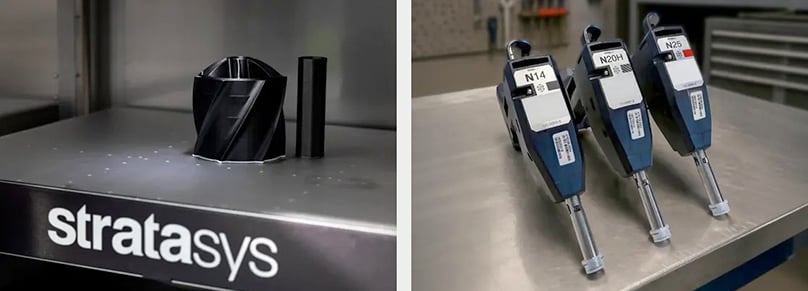
Three print heads target different use cases. The N14 prints ABS-M30 and ASA at layer heights down to 0.178 mm; a hardened N20H handles Nylon 12CF; and the higher-flow N25 prints ASA at 0.33 mm with a stated maximum throughput of 66 cm³ per hour.
So, compared with the F770, there is plenty that’s improved. But those improvements don’t necessarily make the F870 technologically unusual compared with the wider industrial market.
About That “Longest Fully Heated Chamber” Claim
Stratasys calls the F870’s chamber the “longest fully heated build chamber on the market” and “the longest fully heated chamber available in industrial FDM.”
That claim needs some qualification.
Roboze’s Argo 1000 Hypermelt offers a 1,000 x 1,000 x 1,000 mm build space – a full cubic meter – with its chamber heated to 180 °C. That’s far more heated build volume than the F870’s 1,000 x 610 x 610 mm chamber, while matching its one-meter principal dimension. Yet, the Argo 1000 uses far more economical pellet-based material extrusion, rather than proprietary filament FDM. If Stratasys is defining “industrial FDM” narrowly as filament-fed FDM, its claim may hold within that category. Pellet extrusion and filament extrusion bring different compromises in resolution, workflow, material handling, support strategy, and finishing. But it does undermine the idea that a very large heated chamber is itself a new industrial capability.
The F870 gets Stratasys’ GrabCAD and Insight software, MTConnect connectivity, mobile monitoring, and an industrial service and workflow ecosystem, but the new machine isn’t being pitched around a comparably new sensing, inspection, or simulation architecture. Its automation is instead concentrated on something more basic but potentially very valuable: making sure a giant print has dry material and enough of it to keep going. Stratasys’ own F3300 looks substantially more sophisticated mechanically. It has four extruders and an automatic tool changer, linear motors and encoders, automatic calibration, four independently controlled material dryers, and redundant extrusion capability intended to reduce downtime. It also supports ULTEM 9085 and PC alongside ASA and Nylon 12CF.
At the opposite end of the comparison is a question that would have sounded absurd not very long ago: for factory tooling, why not simply buy a fleet of much cheaper printers?
The F870 absolutely has advantages over something like a Bambu Lab H2D Pro. A part approaching a meter in length simply cannot be produced as one piece on an H2D Pro. Its 95 °C chamber provides substantially more thermal headroom, and Stratasys’ large dried material reserves, soluble-support workflow, MTConnect compatibility, industrial lifecycle, and established factory support operation are designed around a different class of deployment for major auto makers.
But for a factory producing hundreds of small jigs, brackets, guards, gauges, and assembly aids, the choice is more complicated.
A printer farm of Markforged, Bambu Lab, UltiMaker, or Intamsys, offers parallelism. Multiple independent jobs can run simultaneously; a failed machine takes only a fraction of the available capacity offline; and additional capacity can be installed incrementally rather than concentrated in a single large piece of equipment.
Farms have drawbacks, of course. Large components need to be divided and joined. Every machine adds another build plate, extruder, filament path, maintenance schedule, and potential failure point. Managing ten or twenty printers isn’t necessarily equivalent to managing one industrial machine designed for unattended manufacturing.
That difference – rather than extrusion itself – is increasingly where industrial manufacturers have to justify their premium.
And without an F870 price, that economic argument can’t yet be tested. Stratasys has not publicly listed pricing for the new machine and instead asks prospective customers to request a quote. Its predecessor, the F770, launched below $100,000 in 2021, but that doesn’t tell us where the substantially upgraded F870 will land.
A Very Specific Tool for Very Large Tools
While the F870 is not a technological revolution, it doesn’t necessarily need to be one. It makes most sense when its purpose is narrowed to exactly what Stratasys says it is for: large factory-floor tooling.
A manufacturer printing a 900 mm assembly fixture may care little that a Hylo can print PEEK at 500 °C in a 250 °C chamber. It may not need continuous carbon fiber from an FX20. And a rack of Bambu Labs isn’t particularly useful if the part needs to emerge from the machine as a single dimensionally stable piece rather than six sections waiting to be bonded together.
For that customer, the F870’s defining specification isn’t any exotic new technology. It’s having a big enough chamber, adequate materials, soluble supports, enough dry filament to finish an enormous job, and a production workflow trusted to do so repeatedly.
Stratasys isn’t pushing FDM’s technical limits with the F870. It is packaging mature industrial FDM technology around a very large build envelope and trying to make large tooling production simpler, less labor-intensive, and more predictable.
F870 Tech Specs
You May Also Like:


License: The text of "Stratasys’ New F870 Industrial FDM Is Huge, but Is Anything About It Actually New?" by All3DP Pro is licensed under a Creative Commons Attribution 4.0 International License.