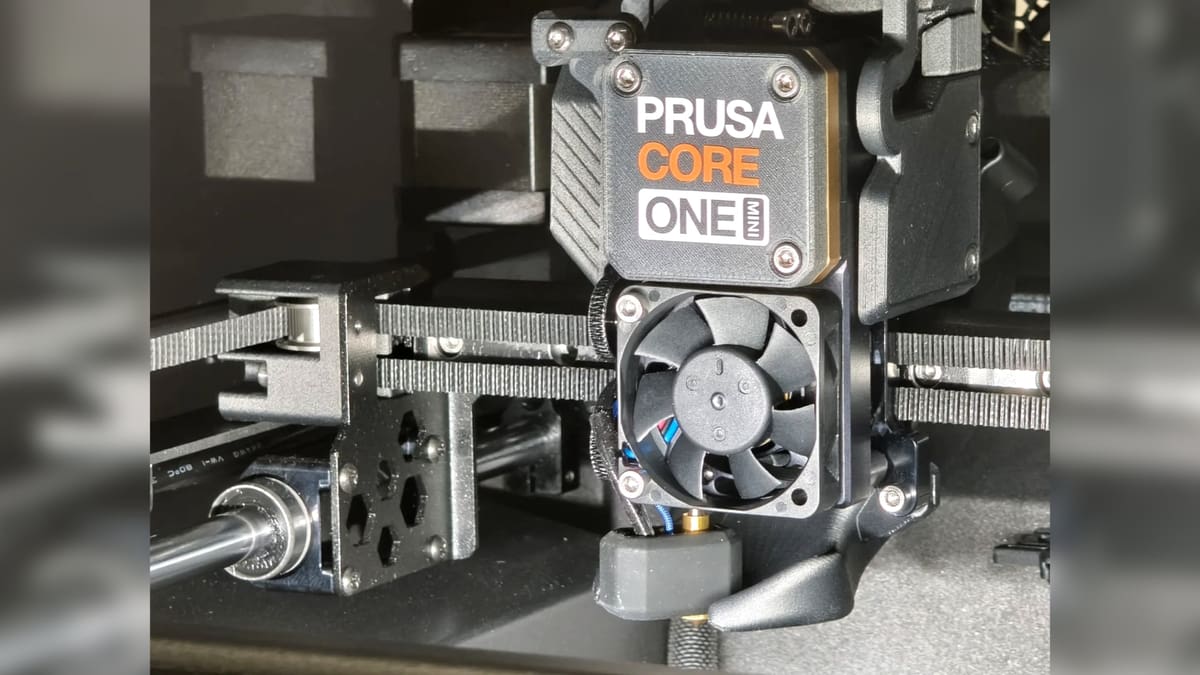
A Maker Spent Nine Months Building the Core One Mini Prusa Won’t Make

Normally an upgrade in the universe of Prusa means upcycling parts from your printer into a newer, more capable (or bigger) printer. An industrious maker has flipped this concept on its head and repurposed a Core One kit into an on-brand-looking Core One Mini. Why? To prove they could.
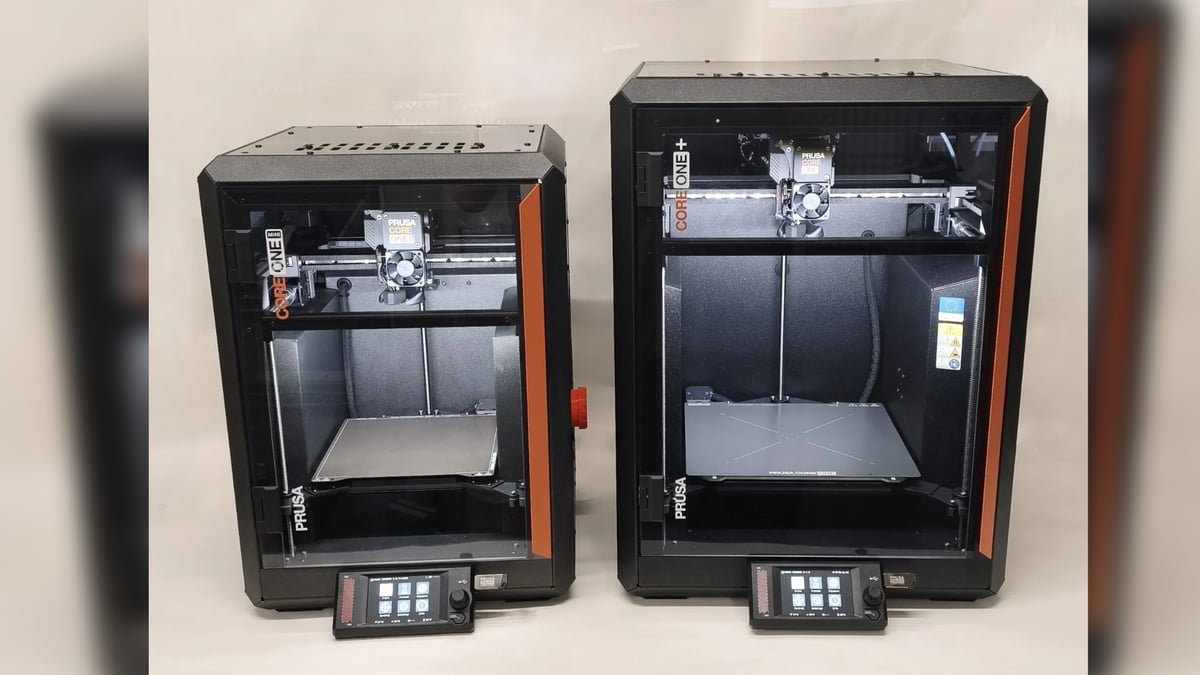
A fully enclosed CoreXY printer with a 180 x 180 x 200 mm build volume, built around the heatbed of the Original Prusa Mini and a lot of the Core One, now exists as a finished, fully functional machine. While it may look like an official Prusa 3D printer, it’s not. Existing as a project on Printables, the Core One Mini (Community Edition) was built over nine months by a single Printables user, suit, who has documented the journey across a 15-part blog series on Printables. It makes for fascinating reading, digging into the ins-and-outs, judgements and challenges such a task can throw up.
Judging by the complexity involved, it’s not a project for the faint of heart. And between the total cost to arrive at a prototype, plus the resulting machine not really being all that space-efficient compared to its larger siblings, perhaps it’s one to read about, rather than replicate.
Since the Original Prusa Mini+ arrived in 2020, Prusa has released several MK-series updates, plus two entirely new platforms in the Prusa XL and Core One, which most recently saw the Core One L arrive late last year. That’s half a dozen or so machines with no whisper of a new Mini anywhere among them. Whatever the economics that keeps a new Mini away, the question of whether there will ever be one often returns. Suit’s project provides an unofficial answer.
The build merges the design paradigms of the Core One and the Core One L, using the official CAD assemblies Prusa published in December 2025 as its dimensional source. The frame profiles are stock Core One extrusions shortened by exactly 70 mm, cut with a 3D printed jig so the existing hole patterns still line up and nothing needs drilling.
The build reuses the Mini’s original 24V heated bed – this is the sole component that actually crosses over on this unofficial upgrade path. You could even start from scratch and pick up the bed as a spare from the Prusa. Parts not included in the released file set are either identical to their Core One+ counterparts, or lightly modified Core One ones.
For their part, Prusa Research sponsored a Core One kit that the prototype was built on, according to a post by the designer. Received in December 2025, this donor kit constitutes the single largest line item in the Core One Mini’s budget. According to the designer, Prusa has had no other involvement in the project.
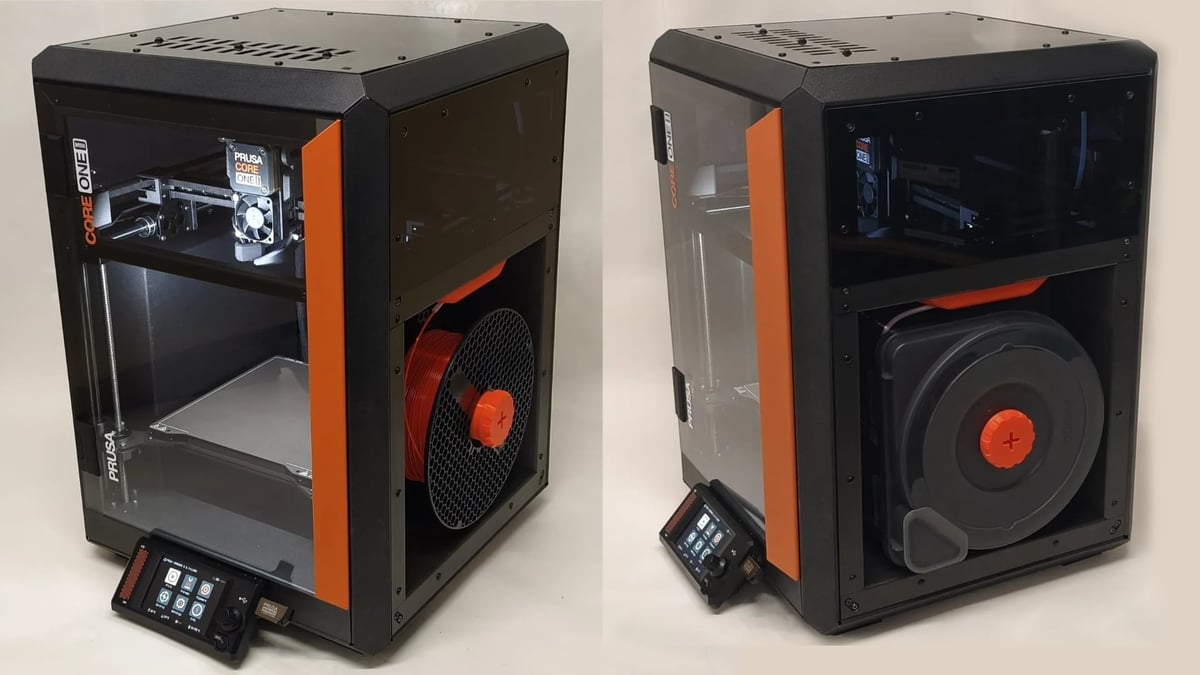
The project went through three major revisions. The first design scaled down a reverse-engineered Core One and fitted on paper, leaving nowhere to plug in a power cord. The second died at Formnext 2025, when the Core One+ and USS Drybox appeared – two worthwhile updates to accommodate in the design. The third only became possible once Prusa published the official CAD for the printers shortly after. The designs that eventually comprised the Core One Mini (Community Edition) are largely remixed from those official STEP files, which is also what cracked the machine’s tightest fit: the filament sensor, here sunk into the printer’s handle grip.
The Original Prusa Mini introduced 32-bit mainboard architecture and a shared firmware core that persists today in all of Prusa’s latest releases. Suit’s Core One Mini runs a fork of the Core One firmware, with changes confined to what the geometry forces: new global motion limits, revised parking and homing positions, a resized bed-mesh probing grid, an adapted automatic vent routine, and a retuned thermal model and PID for the smaller 24 V bed. Like any custom firmware install on Prusa’s newer printers, installing it means physically breaking the appendix on the board.
How the printer handles printing and printing profiles is a smart, forward-looking move – there are no plug-and-play slicer profiles available to go with the Core One Mini, with suit reasoning that anyone able to build the machine can duplicate the Core One profile and change a handful of settings for themselves – an approach that means the profiles survive PrusaSlicer updates and changes they bring.
The file package includes a matching bed texture for your slicer’s viewport, plus tested start and end G-code for PrusaSlicer and OrcaSlicer. These were rewritten to address the front bed geometry and reduced overtravel, which broke the stock priming routine.
They report it prints as reliably as the original Core One, with a 13.5-hour, 200 mm-tall Aero Engine in PLA among the test pieces. An ASA test in a draft shield needed roughly 30 minutes of heat soak to reach a 45 °C chamber from the heatbed alone – the same way the Core One+ heats its chamber, but slower here, because the smaller 24V Mini bed has less heating power to push around than the MK52 it replaces.
By their own accounting, the prototype Core One Mini (Community Edition) came to around €1,750, before shipping and before laser cutting, sheet bending and painting. That figure covers a first build with test pieces and leftovers, including a spare heatbed. They expect to bring it down, in time with revisions. At this moment in time, there’s no BOM yet and no assembly instructions. In the absence of official parts from Prusa directly, you need access to sheet-metal fabrication.
The Core One Mini (Community Edition) also takes up roughly 56–60% of a Core One+’s enclosure volume to deliver under 44% of its build space, inverting the space efficiency upgrade a MK4 to Core One conversion was sold on. This was a known limitation for the project, predicted before the build started.
The prototype is invariably pricier than production units, but even if such a Core One Mini commercially existed, it wouldn’t really stand up well against the Core One+, nor something like a Voron 0.2, which comes in at $400–600 by Voron’s own documentation for a 120 mm³ build volume. And not forgetting of course that the Original Prusa Mini+ still exists, and now ships in a bundle with an enclosure for $549. It’s a fine and capable, if a little dated, tiny printer.
But the point was never to build the cheapest possible printer, or even one that’s decent value – it was to create a fully featured miniature Core One.
Given the Core One Mini (Community Edition) is derived from Prusa’s own CAD, released under the company’s Open Community License, that licence bars selling complete machines or remixes of them without a separate agreement with Prusa. A direct sale of the printer is unlikely, but the creator is asking for community support in approaching Prusa to allow a component bundle – a glimmer of hope for die-hard enthusiasts to more conveniently build their own irrational, excellent Core One Mini (Community Edition) printer. Support can be shown via donations to the project’s GoFundMe, or with likes, downloads, and shares on the project’s Printables page.
You May Also Like


License: The text of "A Maker Spent Nine Months Building the Core One Mini Prusa Won’t Make" by All3DP is licensed under a Creative Commons Attribution 4.0 International License.