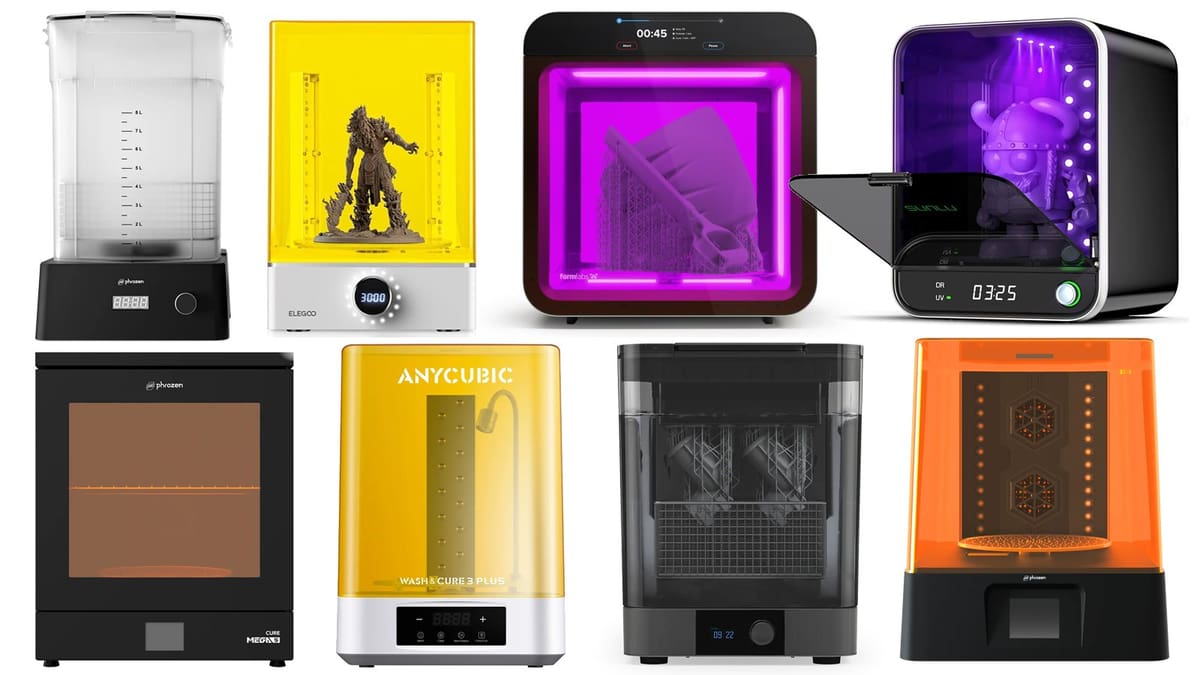
Resin 3D Printing Made Clean & Easy: Buyers’ Guide to Washing & Curing Machines

Say goodbye to sticky buckets and hazardous fumes. We break down the best post-processing stations from budget-friendly Anycubic and Elegoo units to pro-grade gear from Formlabs.
If you love the incredible detail of resin 3D printing but dread the sticky, hazardous (yet required) post-processing, you aren’t alone. For years, the “washing and curing” phase was the huddle of the hobby—messy, time-consuming, and inconsistent.
Fortunately, the days of improvised pickle buckets and DIY UV lamps are over. Manufacturers like Anycubic, Elegoo, and Phrozen offer reliable dedicated stations that promise to make post-processing safe and seamless.
But with dozens of new models to pick from, ranging from compact $100 hobbyist units to industrial-grade automated systems, finding the right fit for your workspace can be overwhelming.
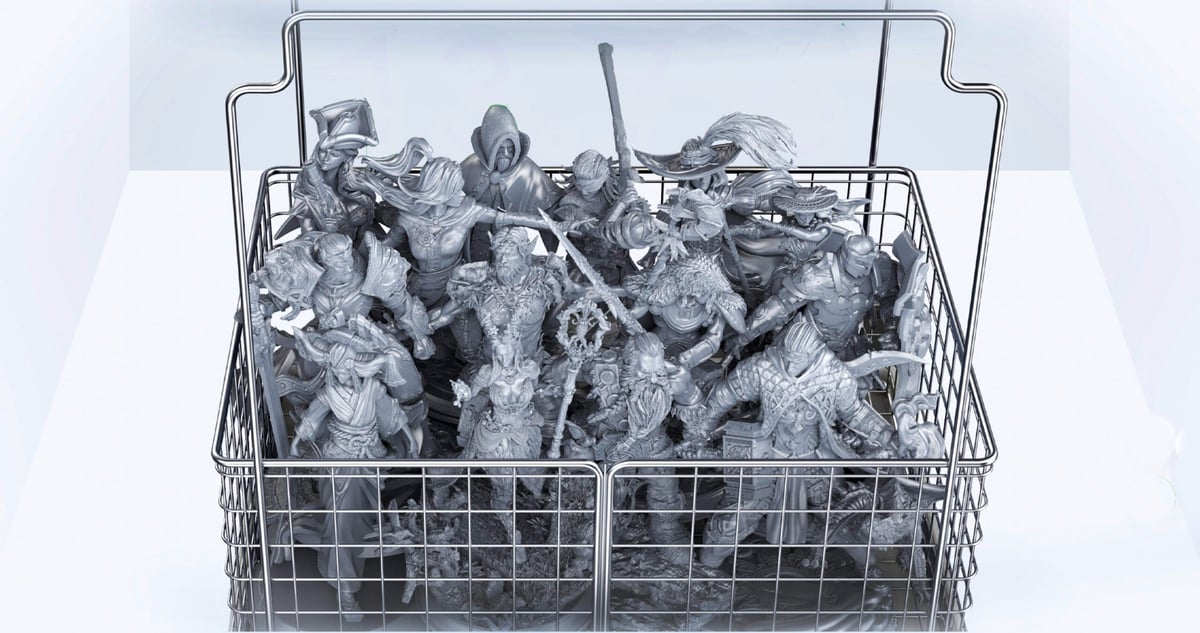
This guide presents the most capable and reliable options currently available, helping you choose a system that enhances both safety and print outcomes.
The Best Washing & Curing Stations (2-in-1)
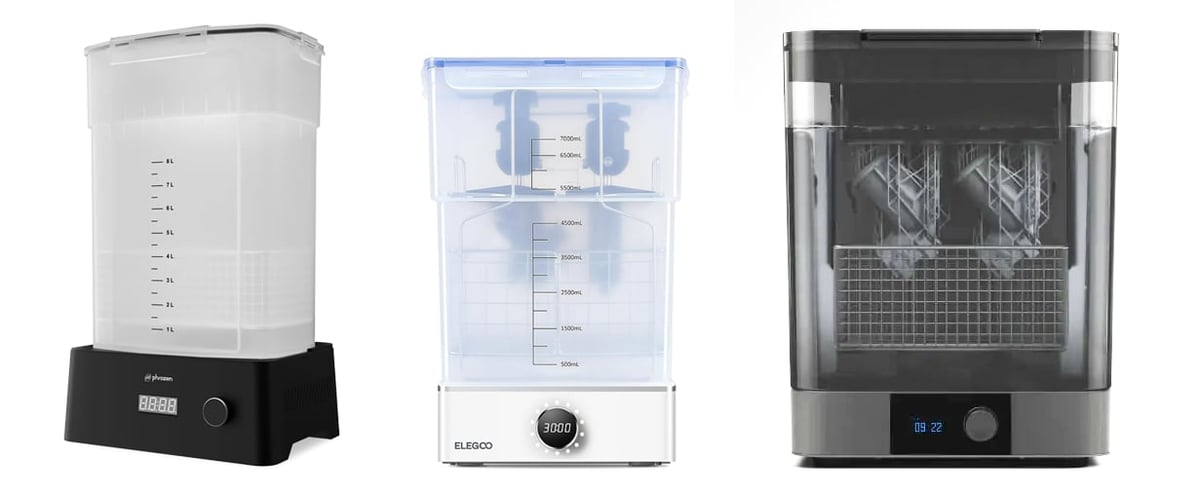
The Best Wash & Cure Stations (2 units)
2-in-1 Wash and Cure Units
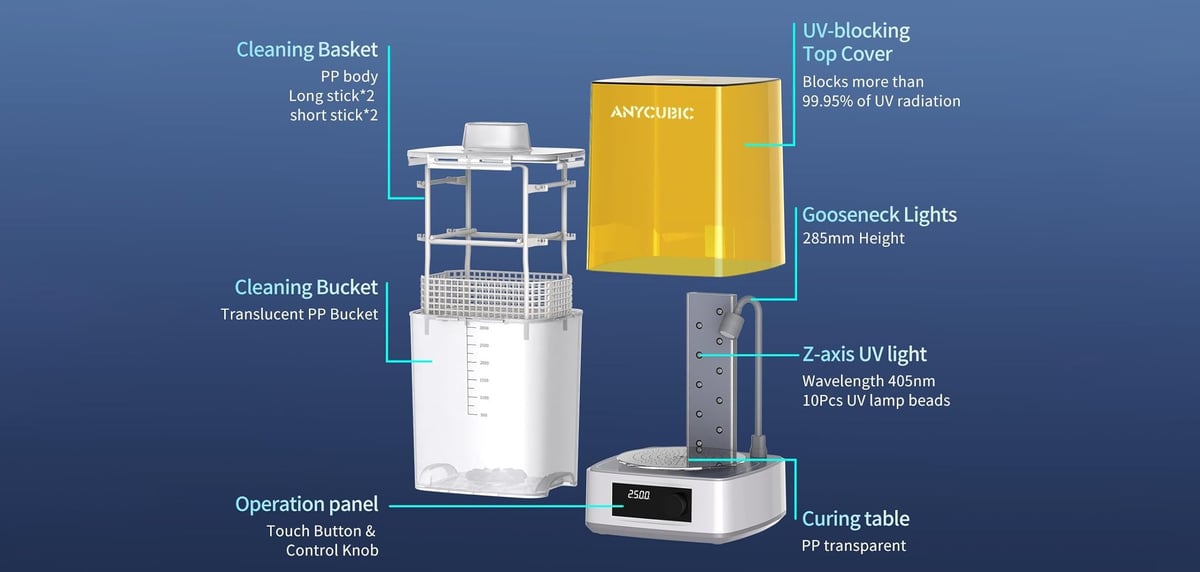
These machines combine both washing and curing functions in a single base unit. You swap out the top lid and change components to switch between modes. Like most washing and curing units, these work with LCD, DLP, and laser-based SLA technology and virtually any type of consumer-grade resin.
Pros:
- Space-efficient and well-suited for casual printing frequency
- More affordable (typically $100-300)
- Single power source and footprint
- Simpler setup for beginners
- No need to monitor weather conditions compared to sunlight curing
Cons:
- Requires slight rearrangement every time you switch from washing to curing, including setting up and removing the turntable so the cleaning solution tank can fit
- Can only perform one operation at a time (either washing OR curing)
- Less efficient if you’re working with multiple prints or running continuous production
Anycubic Wash & Cure 3 Plus
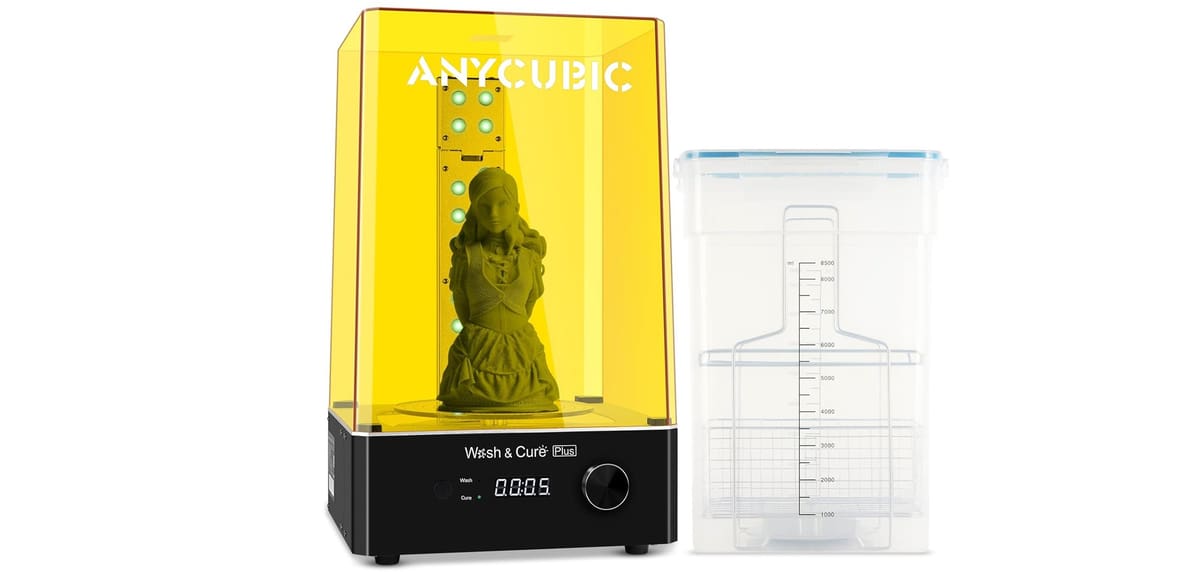
The Anycubic Wash & Cure 3 Plus is a compact all-in-one post-processing unit designed for small- to medium-size resin prints. Its wash compartment accommodates a modest volume, and the integrated curing chamber uses 405 nm UV LEDs and a turntable to deliver fairly even curing across small batches of models. Because it combines washing and curing in a single housing, it conserves workspace and simplifies post-processing for users working with miniatures, prototypes, or modest-scale prints. The unit is best suited for hobbyists or small studios that value simplicity and minimal footprint over large capacity.
Anycubic Wash & Cure 3 Max
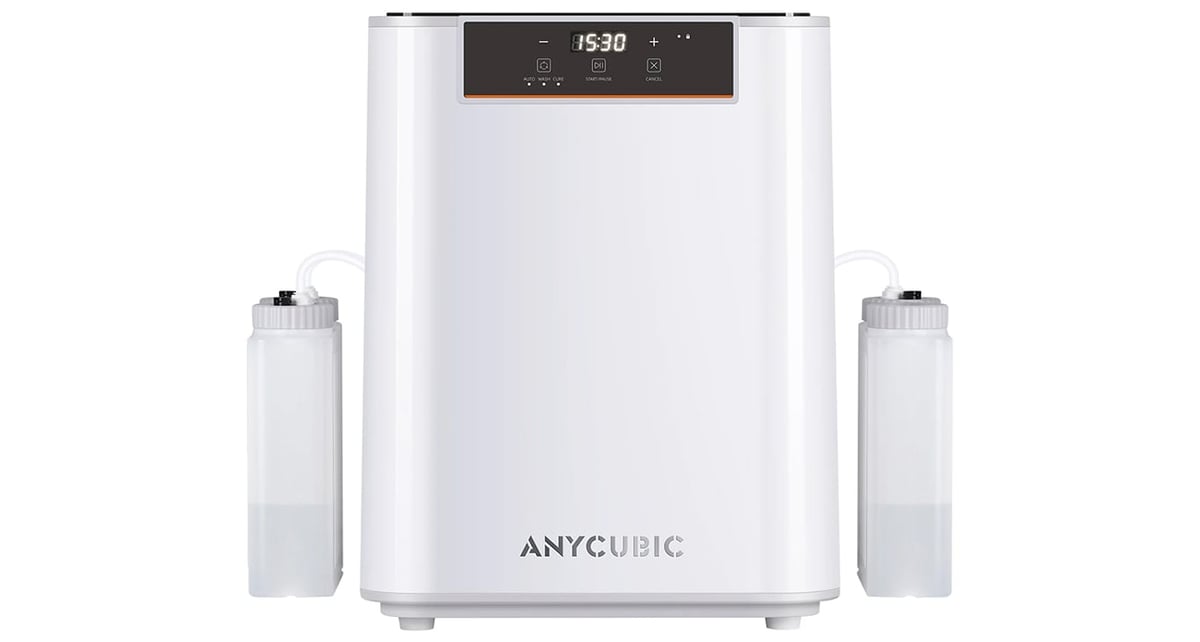
The Anycubic Wash & Cure 3 Max is a larger, more capacious all-in-one unit aimed at users printing larger models or sizable batches. Its wash tank and basket are dimensioned to fit bigger prints than typical desktop resin printers produce, and the built-in spray-and-immersion cleaning method reduces manual handling of uncured resin compared with manual IPA baths. The curing chamber is also sized to handle larger items, making it a solid choice for users working on full-plate prints, larger prototypes, or functional parts. It is appropriate for makers needing a balance of capacity and convenience without moving into industrial-scale post-processing.
Elegoo Mercury Plus V3.0
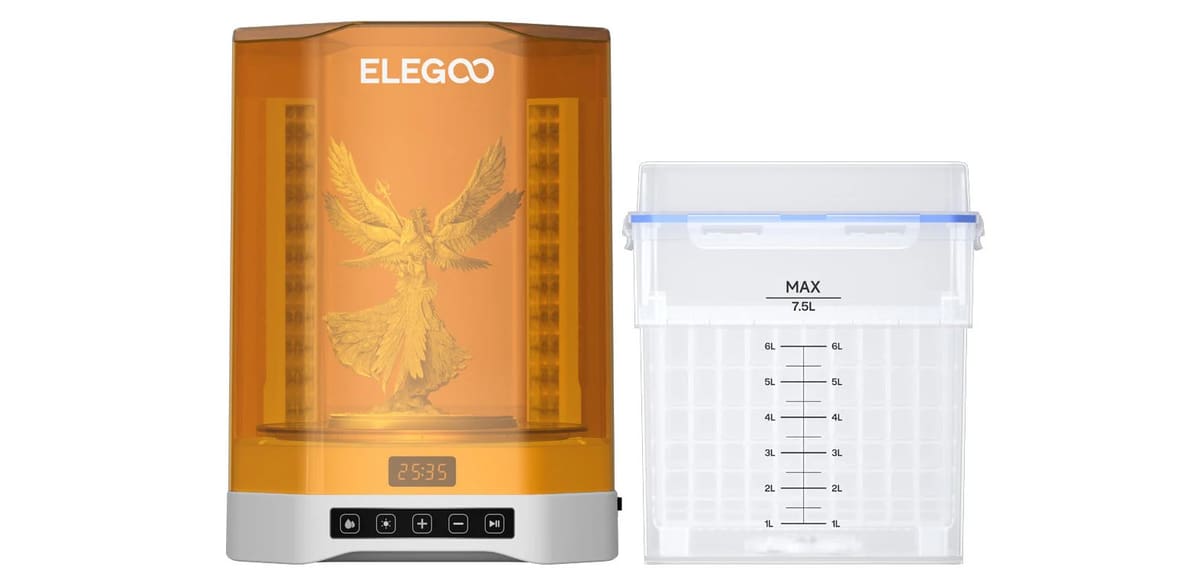
The Elegoo Mercury Plus V3.0 is a combined washing and curing unit intended to simplify post-processing for resin 3D prints. The system offers a larger wash volume than earlier versions, allowing it to handle bigger models or multiple smaller pieces at once. It supports both basket cleaning and build-plate–mounted cleaning, and the updated agitation system circulates cleaning fluid more evenly to help remove uncured resin from detailed parts.
For curing, the machine uses a rotating platform and an array of 405 nm LEDs to provide consistent exposure from all directions. Controls are straightforward, with preset time options for both stages, and the UV-blocking cover includes a shutoff mechanism that stops curing when lifted. While not drastically different in operation from previous Mercury models, the V3.0 focuses on incremental improvements in capacity, stability and ease of use aimed at users who want a single device to handle the full post-processing workflow.
Creality UW-03 Washing & Curing Machine
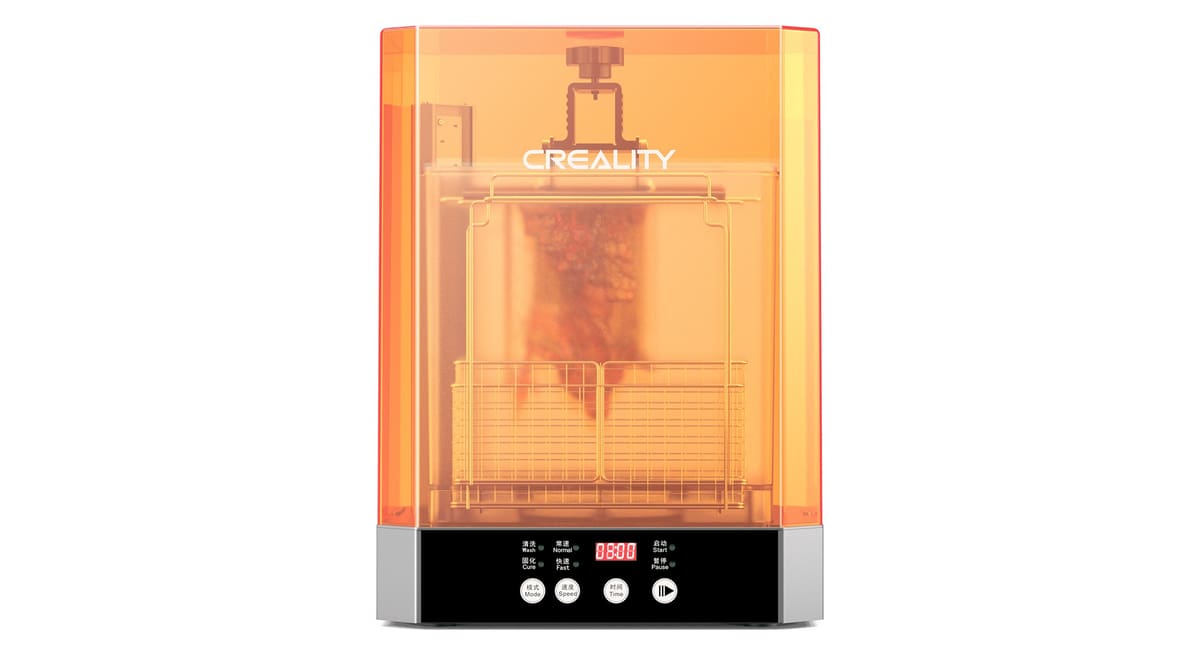
The Creality UW-03 Washing & Curing Machine offers a budget-conscious, entry-level wash-and-cure solution that handles most small- to mid-sized resin prints. Its wash compartment supports typical desktop printer bed sizes, and its integrated curing unit offers 360-degree UV exposure via a rotating turntable, which is sufficient for standard post-processing needs. Control is simple, with manual or timed wash/curing cycles that make it straightforward for beginners or occasional resin printers. While its capacity and features are modest compared with larger machines, it provides a functional and space-efficient option for hobbyists and small workshop setups.
Separate Wash and Cure Units
These come as two distinct machines: one dedicated to washing, one dedicated to curing.
Pros:
- Washing and curing can be done simultaneously, which is handy when working with several printers
- No reassembling of the turntable base is involved
- More efficient workflow for higher-volume printing
- Allows you to employ two jobs simultaneously instead of just one
Cons:
- Takes up extra space with an additional device, which may be a concern for users with limited workshop space
- Higher cost (typically $400-600+ for the bundle)
- Requires two power outlets
Elegoo Mercury X Bundle
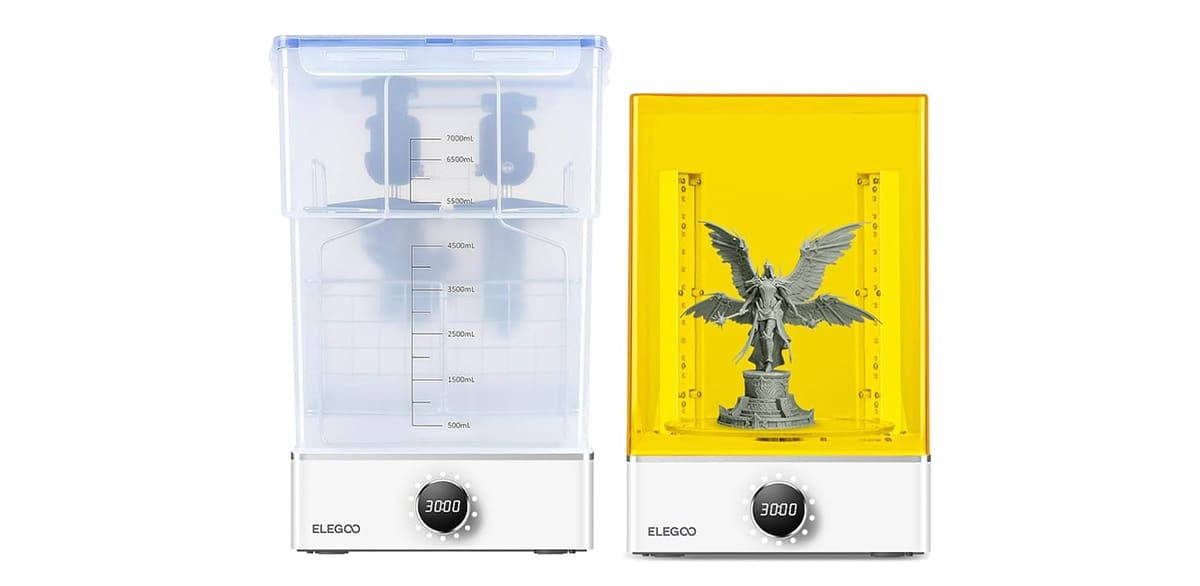
The Elegoo Mercury X Bundle consists of separate wash and cure units, providing a straightforward post-processing setup well-suited for small to mid-size resin printers.
The wash station can clean models directly on the build plate, while the curing chamber uses multi-directional UV LEDs and a rotating platform to ensure even exposure. Because the units operate independently, users can wash one print while curing another, which improves workflow efficiency compared to 2-in-1 systems. The overall capacity is appropriate for most hobbyist-scale prints, though it may be limiting for large-format machines.
Phrozen Mega S Washing Station & Mega S Curing Station
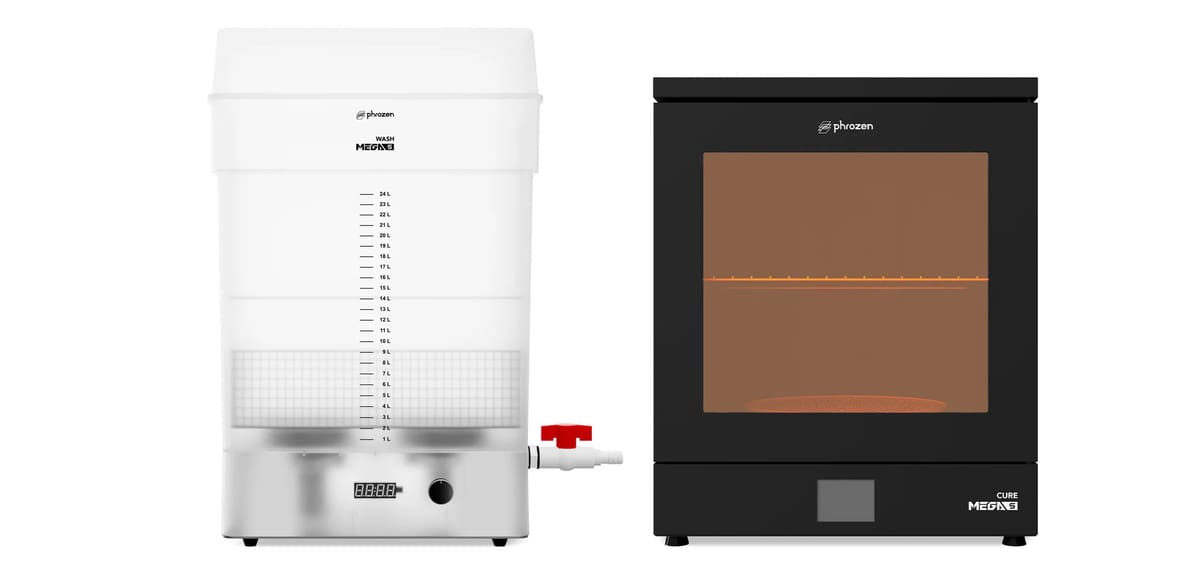
Phrozen’s Mega S Washing Station paired with the company’s Mega S Curing Station offers a more robust setup for medium to large resin prints.
The Phrozen Wash Mega S is a large-format washing station built for handling oversized resin prints or multiple parts at once. It uses a 25-liter container and a double-vortex wash system that alternates rotation to improve cleaning efficiency, aided by adjustable speeds for different print types. The washing chamber measures about 33 × 19 × 30 cm and supports a wide range of large build plates.
The unit includes a side drainage valve for easier solvent disposal and has an overall footprint of roughly 41 × 26 × 62 cm, keeping it manageable for its size. Weighing around 8 kg, it is designed for users who need reliable, high-capacity cleaning for large-format resin printers.
The Cure Mega S provides uniform, high-intensity UV exposure across a larger chamber than typical consumer curing boxes, allowing consistent post-curing of bigger components. This combination is suitable for users producing frequent or larger-scale prints but does require adequate workspace due to the size of both units.
Phrozen Wash & Cure Kit
For smaller prints and a tighter budget, Phrozen also offers the very capable Wash & Cure Kit.
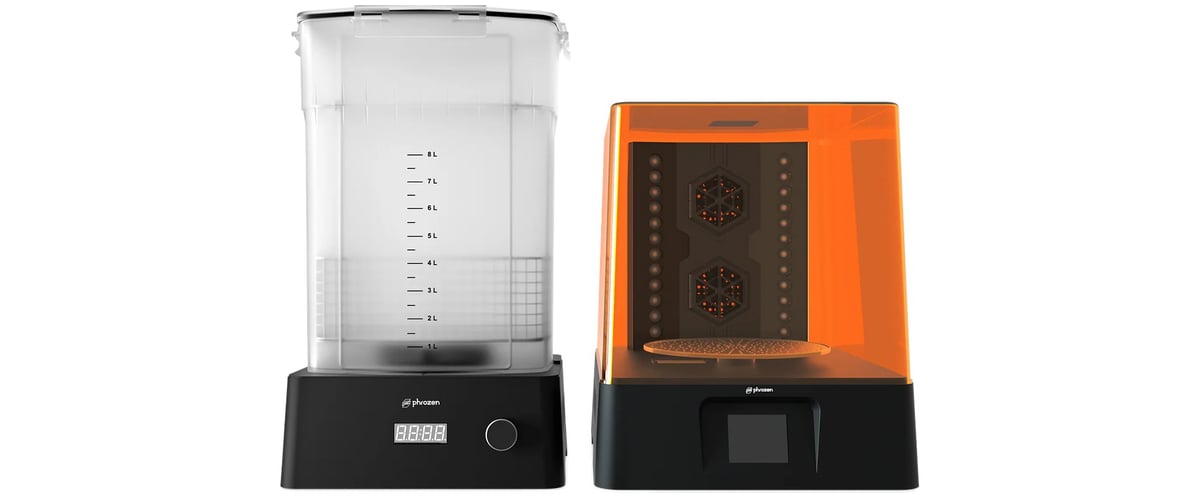
This combined washing and curing station designed to streamline post-processing of resin 3D prints. It features a large 8 L washing bucket that can accommodate 10-inch build plates — ideal for larger prints — where a bottom propeller generates a powerful vortex to gently but thoroughly clean away excess resin without damaging fine detail.
Once the wash is done, models can be moved directly into the curing unit, which uses 405 nm UV light (from both beneath and around the object) plus a dual-fan drying system to dry and fully cure prints in a single workflow.
This all-in-one approach to post-printing — wash, dry, cure — significantly reduces the time, mess, and manual effort compared with traditional resin cleanup (buckets of alcohol + UV lamps), and helps ensure prints emerge clean, solid, and uniformly cured.
Sunlu Ultrasonic Cleaner & RC-2 Curing Box
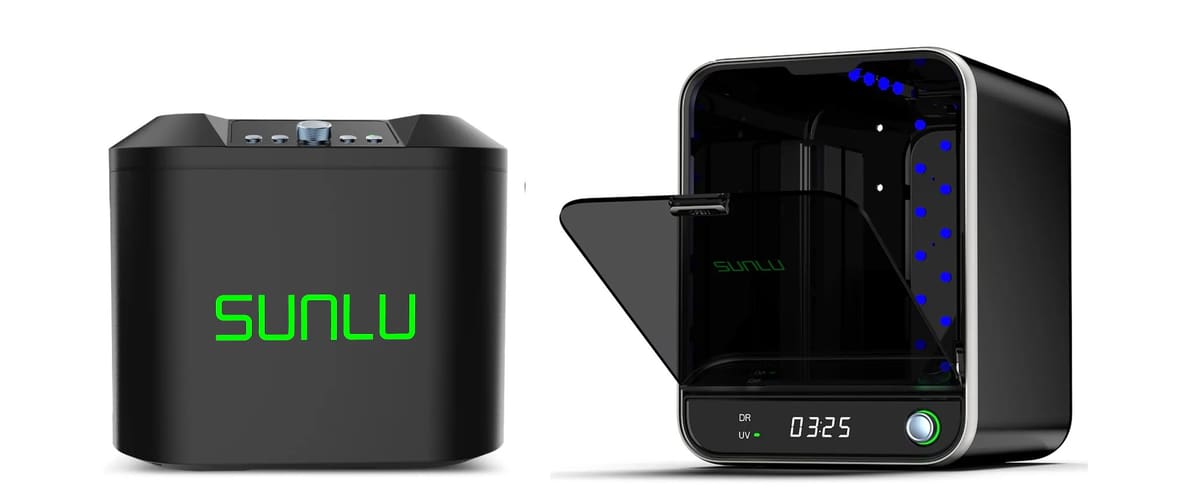
The Sunlu Ultrasonic Cleaner and RC-2 Curing Box form a compact post-processing setup aimed at users working with small or highly detailed prints. Ultrasonic cleaning can reach recessed features more effectively than manual agitation, making it useful for miniatures, jewelry, and other fine parts. The RC-2 curing box provides 360-degree UV illumination with a rotating platform to improve curing uniformity. While this combination offers precise cleaning and reliable curing for smaller prints, its limited capacity makes it less suitable for larger models.
Formlabs Form Wash V2 & Form Cure L V2
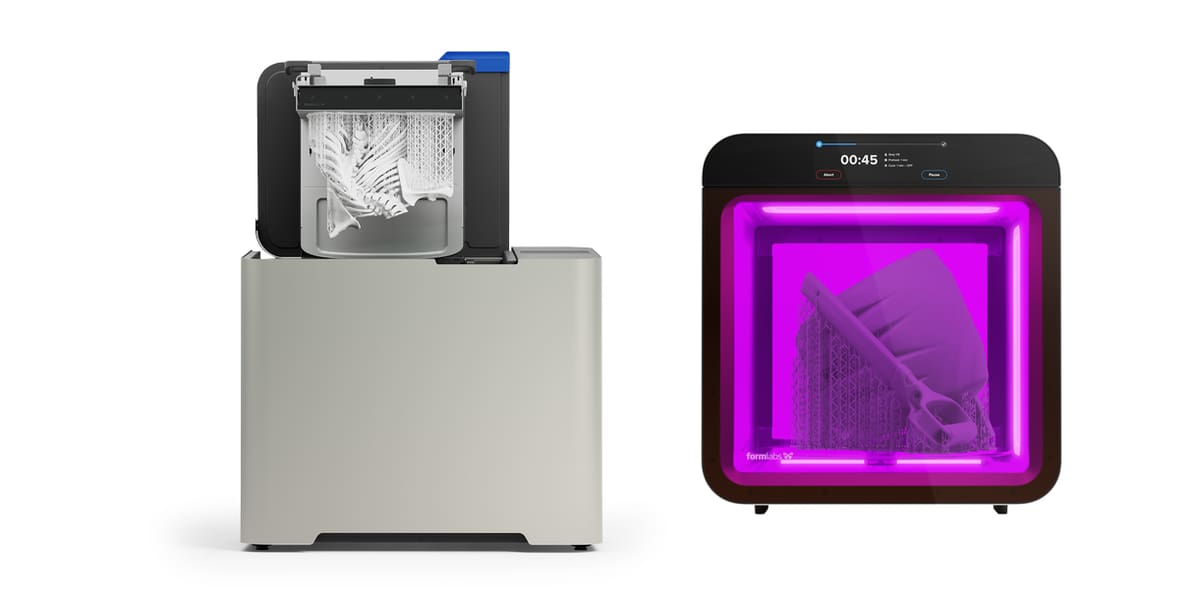
The Formlabs Form Wash L V2 and the new Form Cure L V2 are large-format post-processing systems designed to deliver consistently high-quality results for users working with Formlabs’ bigger resin printers. Together, they streamline the often time-consuming steps of washing and curing by automating each stage with precision and repeatability. The Form Wash L V2 provides a powerful, hands-off cleaning process that uses an agitated solvent bath to remove uncured resin from even the most complex prints. Its spacious chamber accommodates large parts or multiple smaller models in a single cycle, while features like automated lift-out and timed wash programs ensure that parts are cleaned thoroughly without risk of overwashing or warping.
The Form Cure L V2 complements the washing process with an equally advanced curing system. It uses a combination of high-intensity LEDs, controlled heat, and rotating turntable motion to cure parts uniformly, strengthening the material and improving dimensional accuracy. Its chamber is engineered to handle the largest prints the Formlabs ecosystem can produce, offering optimal UV exposure and temperature control for demanding engineering resins. Together, the Form Wash L V2 and Form Cure L V2 create a reliable, professional-grade workflow that reduces manual labor, improves consistency, and ensures every printed part reaches its full performance potential.
Formlabs’ More Compact Option
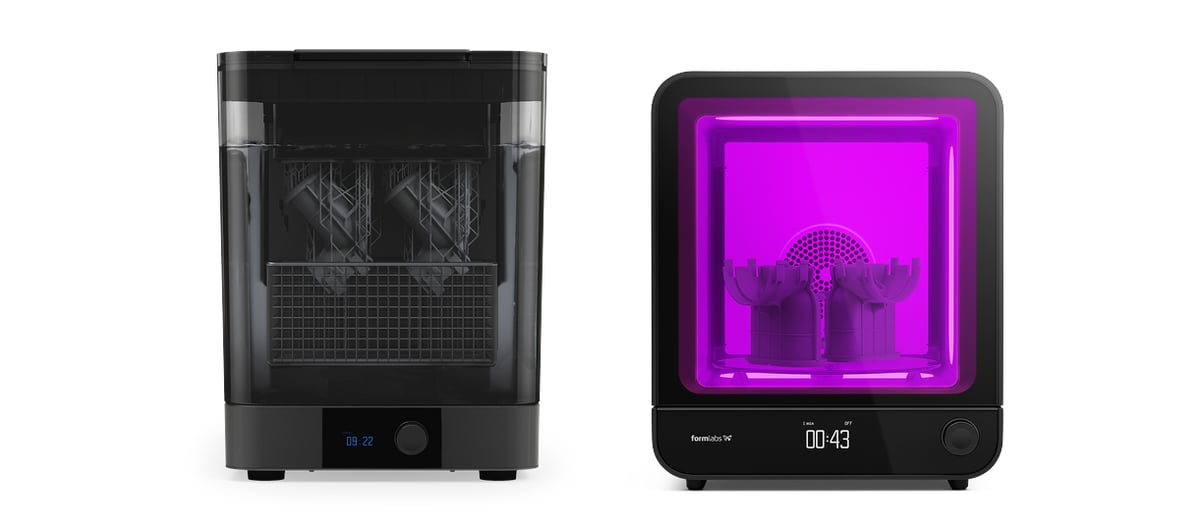
If this is more room that you need, the Formlabs Form Wash V2 and Form Cure V2 (120 V) are compact, efficient solutions for post-processing resin prints. The Form Wash V2 automatically cleans parts in an agitated solvent bath, removing uncured resin without manual scrubbing. Following washing, the Form Cure V2 provides uniform UV light exposure and controlled heat to properly cure parts, enhancing strength and dimensional stability. Together they offer a streamlined, reliable workflow for small to medium-size resin prints.
Industrial Wash & Cure Options
The wash-and-cure market includes a range of options, and capacity is one of the main factors that separates them, but that’s not all. Although this guide focuses on small to mid-format systems, such as the Elegoo Mercury X Bundle and Anycubic Wash & Cure 3 Plus, which are generally suitable for working with desktop resin printers, once you boost your volume or part size or shift into more industrial materials, you may need a different bread of washing and curing machine.
But what do the pros and 3D printing services use?
Hobby curing machines are designed for general consumers and prosumers who print miniatures, props, and standard 405 nm resin parts. Their goal is convenience and affordability, so they rely on simple UV LED strips usually at a single wavelength and basic timers set manually.
Professional using resin 3D printer from, 3D Systems, Stratasys, or Photocentric, for example, have different washing and curing needs. The industrial grade resins need specific post-processing to ensure the mechnical properties of the materials, which typically include more powerful UV light and heat.
Heating is rarely included, as a result, the curing results depend heavily on user judgment, the resin type, and the positioning of parts in the chamber.
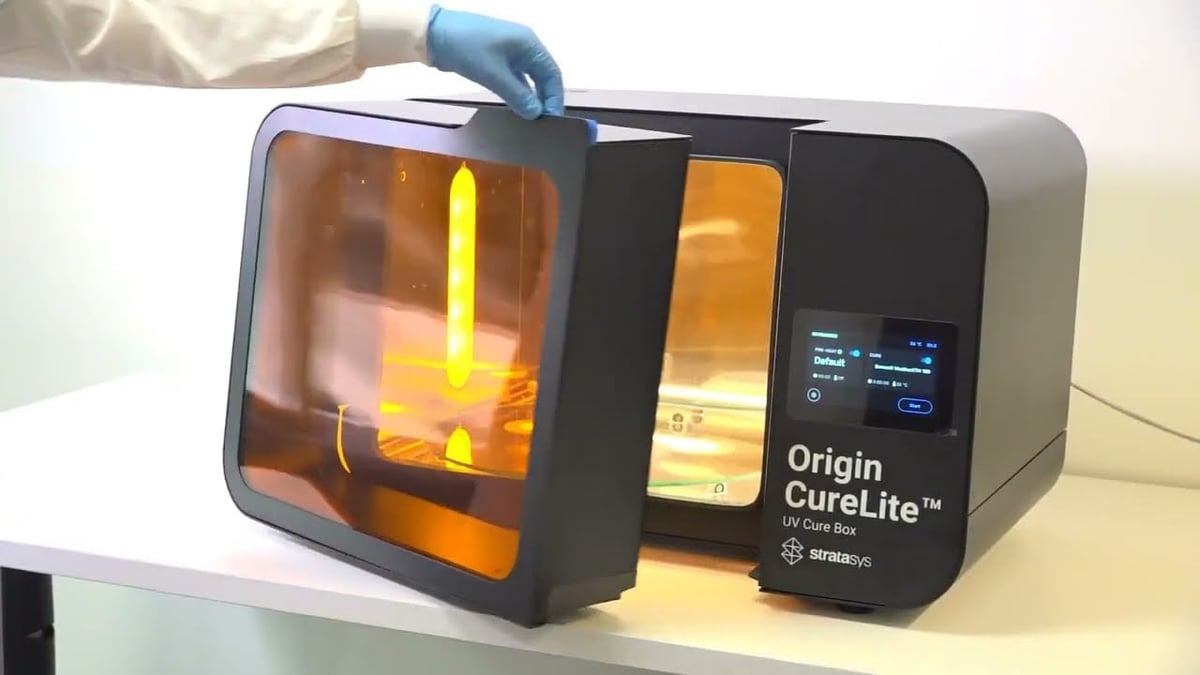
The Stratasys Origin CureLite, for example (pictured above), is engineered for manufacturing environments where repeatability, mechanical performance, and material certification are essential. It uses dual-wavelength UV LEDs at 365 nm and 395 nm and provides 360-degree uniform exposure. The CureLite integrates active thermal control and can heat parts up to 80°C, allowing it to complete the polymerization needed for engineering-grade photopolymers. This combination of controlled heating and dual-wavelength UV enables it to achieve consistent dimensional accuracy, surface finish, and mechanical properties suitable for end-use production.
Automation is a major separator as well. Hobby machines require users to set times manually and monitor curing progress. Most industrial curing machines are fully automated, “Click & Go” station with preset curing profiles for each validated material. Industrial machine can wash and cure faster, too. The SprintRay Pro Wash/Dry, for example, is a fully-automated two-stage wash and dry system that promises finished parts in 10 minutes. Thanks to a suite of automatic features, the only time you have to touch IPA is when you pour it into the reservoirs. The unit comes with pre-calibrated hydrometers that sink in clean IPA and float when it’s dirty. So you always know when it’s time to refresh your IPA.
Even the physical construction and regulatory footprint differ significantly. Hobby units are consumer appliances with basic safety standards. The CureLite carries a full suite of industrial certifications including CE, FCC, RoHS, and REACH compliance, as well as detailed specifications for sound emission, connectivity, and power requirements
In practice, a hobby curing machine is sufficient for visual models and everyday resins, while industrial versions exists to ensure that engineering-grade materials reach their validated mechanical, thermal, and dimensional properties. The two grades serve fundamentally different roles: one prioritizes affordability and convenience, and the other ensures manufacturing-level consistency, certification, and material performance.
You May Also Like:



License: The text of "Resin 3D Printing Made Clean & Easy: Buyers’ Guide to Washing & Curing Machines" by All3DP is licensed under a Creative Commons Attribution 4.0 International License.