Xenia Puts Carbon Fiber in PEBA Filament for Tougher Protective Gear & Flexible Parts

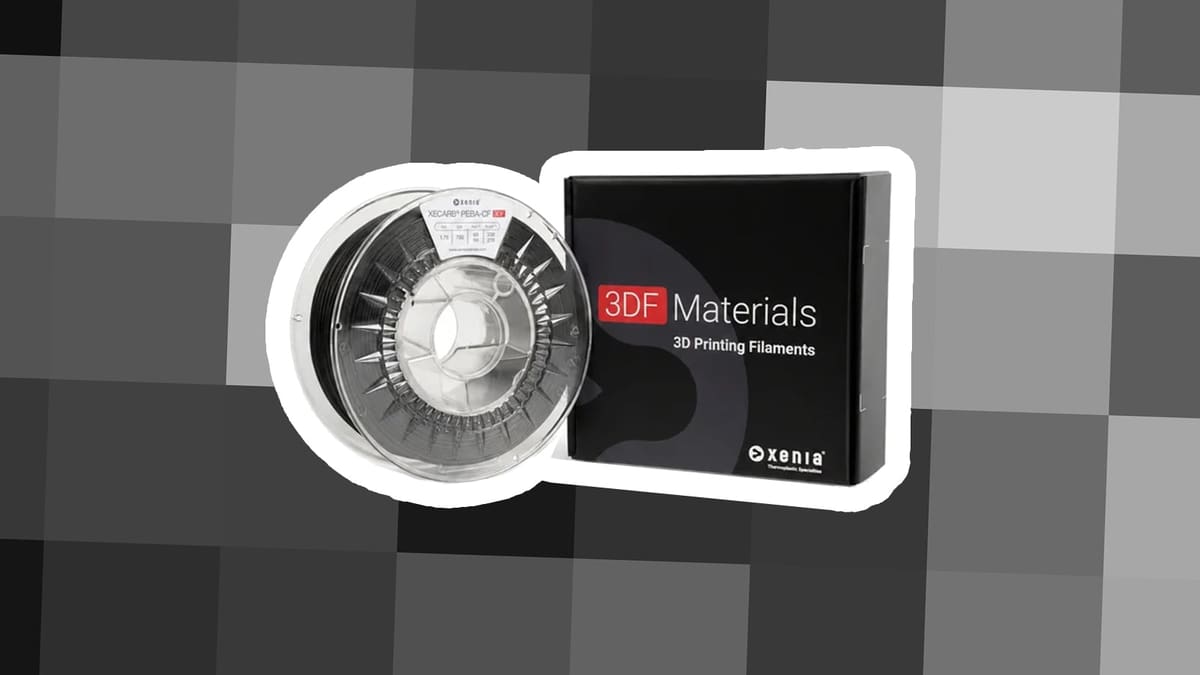
The new Xecarb PEBA-CF filament combines an elastomeric base with 15% carbon fiber, targeting functional parts that need stiffness and impact resistance.
PEBA has been gaining ground as a lighter, springier alternative to TPU, with 3D printing filament manufacturers promoting its impressive rebound and resistance to permanent deformation. As we explored in our guide to 3D printing with PEBA, the material is particularly appealing for footwear, cushioning, and flexible parts subjected to repeated mechanical stress.
But now, Italian materials manufacturer Xenia is taking PEBA in a different direction with Xecarb PEBA-CF, a new FDM filament that combines a polyether block amide matrix with 15% carbon fiber reinforcement. Rather than maximizing flexibility, the aim is to limit deformation under load while retaining some of the toughness and elastic recovery associated with PEBA.
The material could fill an interesting gap between soft, high-rebound PEBA filaments and conventional rigid carbon fiber composites. Robotic gripper fingers are one potential application, where maintaining shape under load while tolerating impacts and repeated mechanical stress is important. Lightweight protective housings and drone components could also benefit from this combination of properties.
It’s a potentially useful formulation, and one not widely represented among currently marketed PEBA filaments. Yet, without published tensile modulus, elongation-at-break, or quantitative energy-return data, which hasn’t been release yet, it’s difficult to establish how much flexibility survives the reinforcement or how Xenia’s filament compares with existing alternatives.
What Xecarb PEBA-CF Offers
According to what Xenia has released, the filament has a density of 1.08 g/cm³, a Shore D hardness of 64, and a melting point of 160 °C. Its technical datasheet also specifies a heat deflection temperature (HDT) of 105 °C at 1.8 MPa.
For comparison, Xenia’s existing Xelight PEBA filament, which prioritizes flexibility and weight reduction, has a lower density of just 0.87 g/cm³. The new composite is therefore not the company’s lightest PEBA offering, but it targets a different balance of mechanical properties.
Printing Xecarb PEBA-CF
The filament comes in a 1.75 mm diameter, with Xenia recommending nozzle temperatures between 230 and 270 °C and bed temperatures between 60 and 90 °C.
Its carbon fiber content calls for a hardened-steel nozzle with a diameter of at least 0.4 mm. The manufacturer recommends a glass or PEI build surface and suggests using an adhesive and enclosed chamber.
Xenia also recommends drying the filament for six to eight hours before printing, although its product webpage specifies 85 °C while its October 2026 technical datasheet specifies 75 °C.
Xecarb PEBA-CF expands Xenia’s 3DF Materials portfolio, which already includes carbon fiber-reinforced PA11, PA12, PPA, and PVDF filaments.
Xenia will exhibit at Formnext 2026 in Frankfurt, Germany, November 17–20, at Hall 12.1, Booth B69. Pricing and commercial availability details for the new filament have not yet been released.
Material Properties
Recommended Print Settings
Recommended Drying
You Might Also Like:


License: The text of "Xenia Puts Carbon Fiber in PEBA Filament for Tougher Protective Gear & Flexible Parts" by All3DP Pro is licensed under a Creative Commons Attribution 4.0 International License.