Tripo at Formnext Previews Detail-Focused AI Agent Aimed at 3D Printed Part Accuracy

The upcoming generative model promises 3D assets that need little editing before printing, while a new AI agent called Polipop aims to automate the journey from an idea to a practical part for real-world fabrication.
The first question we had for Tripo, the AI model-generator platform, when we sat down with them at Formnext was: Why are you here?
After all, Formnext is the world’s largest expo for additive manufacturing while Tripo is a platform for generating figurines. Ah, but not for long, they said. The company has its sights set on engineering with the hope of becoming the go-to tool for producing accurate, measurable parts for manufacturing without CAD.
At Formnext, Tripo AI offered a first look at Polipop, an AI agent still in Beta testing tailor-made for additive manufacturing designed to “bridge the gap between AI-generated 3D content and physical 3D printers,” the company says. What does that mean? For Tripo, its a workflow offering that handles the journey from an initial concept to 3D modeling, accurate representation, print preparation, and transmission to a 3D printer.

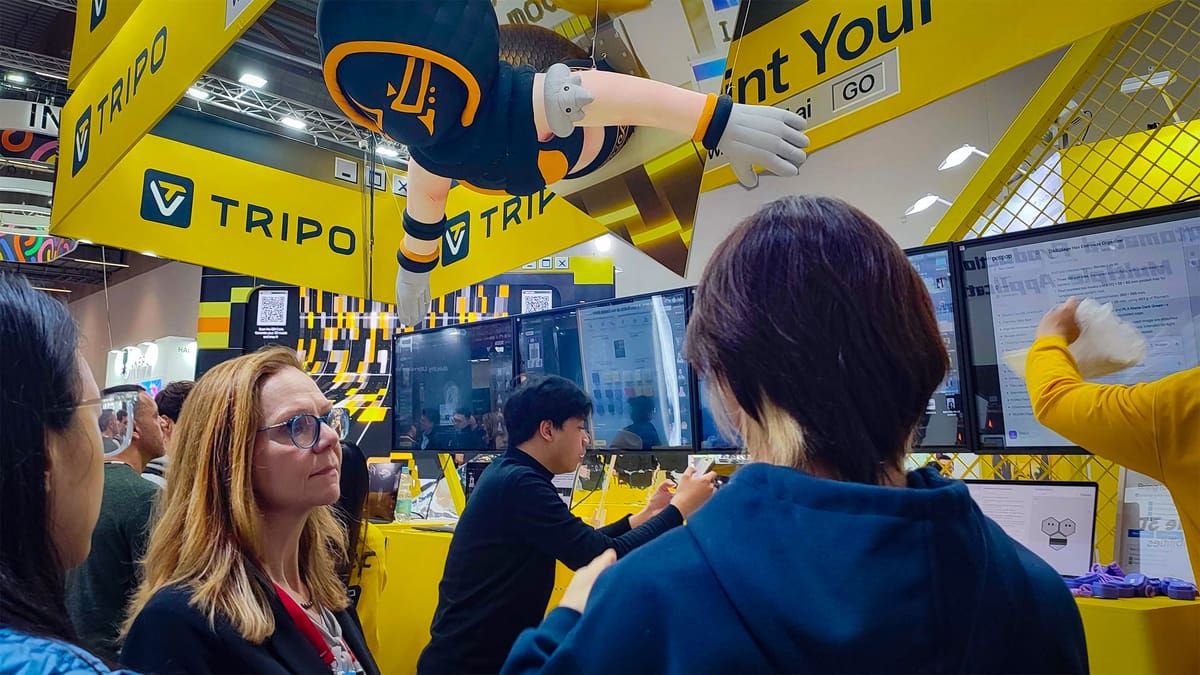
All3DP meet one-on-one with Tripo AI Research Lead Benny Yuan-Chen Guo (pictured above, right), who framed the developments as part of the company’s broader push to extend generative 3D technology beyond purely virtual environments and creative modeling and directly into physical fabrication of parts that have more demanding specifications.
Polipop: Merging Organic AI with Functional CAD
While creators have increasingly adopted generative AI for decorative figurines, Guo noted that practical mechanical components remain a significant blind spot across the current 3D AI landscape.
To overcome that gap, Polipop combines generative organic styling with parametric CAD techniques. “There are some parts that are generated using 3D AI which is more organic, and there is another part [that’s] more for the mechanics or functionality that’s modeled in different skills,” Guo said. “We are trying to build the two worlds together to make parts that are really functional.”
In practice, this means Polipop is “using organic models from Tripo and do all these kind of CAD skills on this generative model so that it can function well.”
Everyday Customization with Exact Measurements
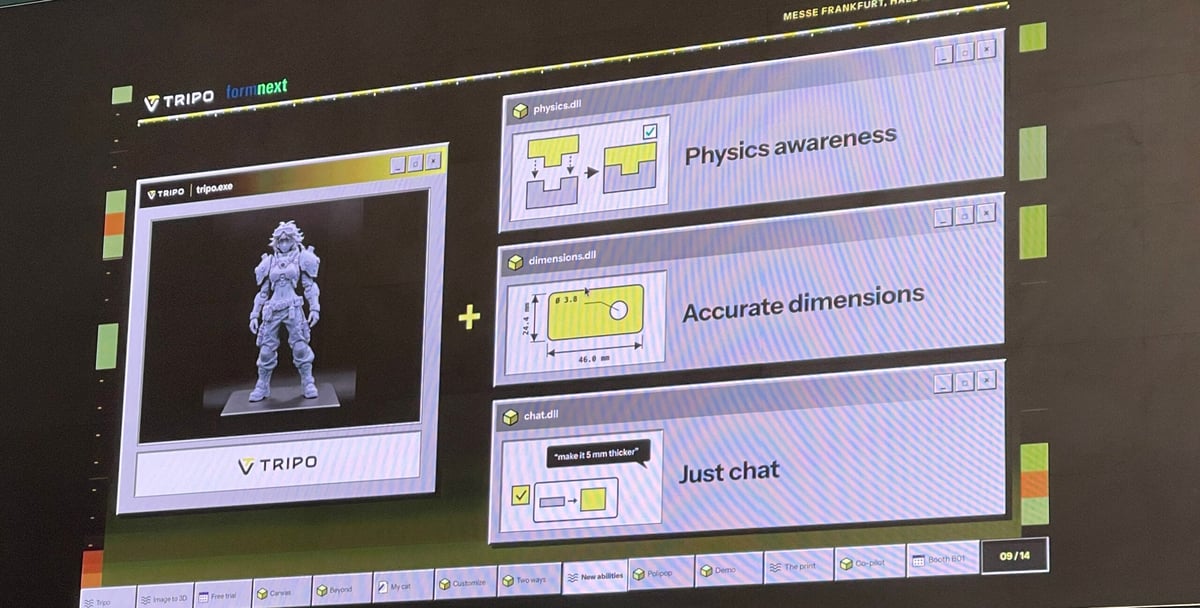
For functional everyday objects, such as custom drawer dividers, containers, or fitted adapters, users without professional CAD training are often forced to take crude shortcuts or use a limited parametric tool on MakerWorld.
Polipop bypasses that friction by generating objects around specific real-world dimensions provided by the user. “You can measure the length and width of your drawer and depth and you put that Polipop, and maybe you also have a reference image,” Guo explained. “And it will build up your part for you with very exact measurements.”
While we saw a demo at Formnext, All3DP is registered for the Beta testing and will report back on its accuracy claims.
Slicer Feedback, “Spaghetti” Prevention, and Print Simulation
Apart from focusing on accuracy, another persistent issue with AI-generated meshes Tripo is working on is that digital integrity does not always guarantee physical success on the build plate. As Guo acknowledged, superficial checks do not ensure a model will actually print.
“Water tightness or thin wall, they’re just a basic guarantee for whether something can print,” Guo noted, explaining that standard checks overlook crucial factors like unsupported geometry, weak structural elements, or difficult overhangs.
To intercept failures before material is wasted, Polipop sends models to slicing software and analyzes the toolpaths directly. “In Polipop, we are sending these 3D models actually to the slicer software to get the slicer results,” Guo explained. “First we’ll see whether it slices, and second we will analyze the sliced G-code to find out whether there is an overhang that could lose detail after you print, or whether this kind of structure is not stable enough so that when you print it could fall.”
Even with G-code inspection, Guo emphasized that a divide remains between computer files and real-world extrusion, leading Tripo to invest in virtual printing simulation.
“Still there is a gap between the digital version and the real print, and we are investigating this new technique that allows us to simulate the printing process to see whether it actually prints well,” Guo said. “It’s a long way to go, but I think that’s the future, because you need to simulate first, then you get the simulated result to make sure it actually prints as you want.”
Guo highlighted the practical cost of skipping this step: “Without simulation, I think most of the time you only get to trial and error in real printers. That’s a cost of real time and money.”
Consumer Adoption Now, Broader Manufacturing Ahead
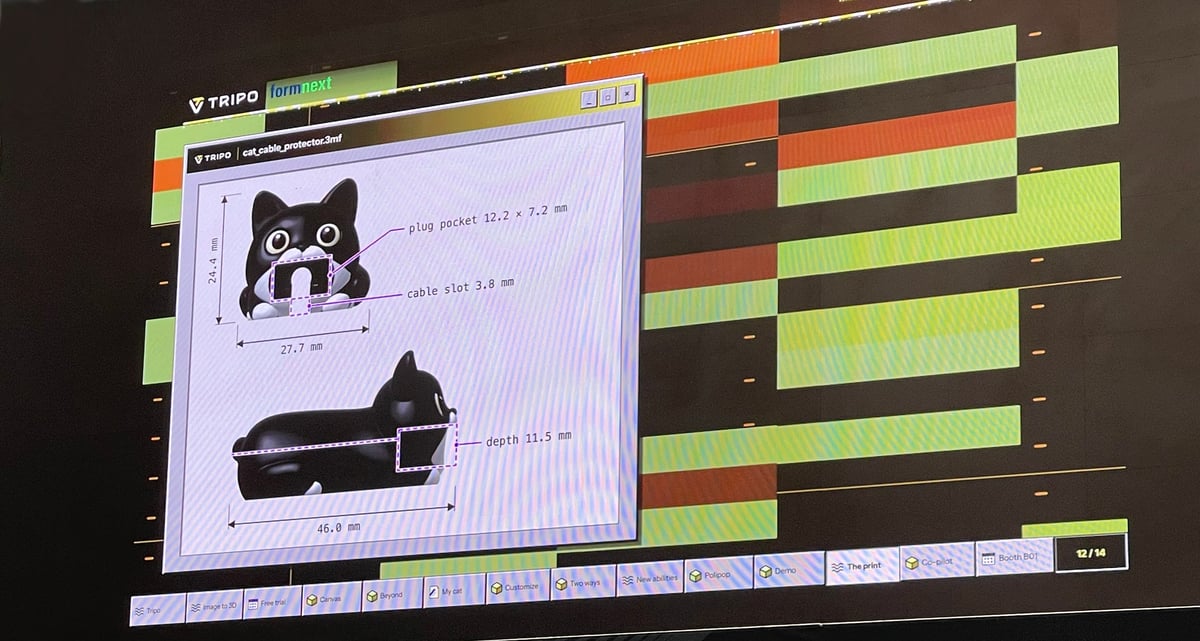
Although parts for heavy industrial environments, such as factory-floor jigs, fixtures, or automotive components, demand strict mechanical tolerances, Guo indicated that factory deployment remains a longer-term objective.
“I think it’s probably a little bit far to get into the real industry, the manufacturing,” Guo explained. Currently, Tripo’s focus is on more “home-level 3D printing precision” that functions but does not guarantee the millimeter tolerances required for something like car parts.
Instead, Guo sees immediate potential in daily, consumer-driven personalization. “I think the customer grade 3D printing is a huge market, because you can see a surge of how people want to customize all kinds of daily products building on their own needs,” he noted, citing demand for custom pet models, tailored bike accessories, and bespoke device cases produced by independent merchants.
Guo believes that eliminating design barriers could expand the 3D printer hardware market itself. “If we have this kind of tool, for example Polipop, everyone can make all kinds of customized products easily.”
While Tripo does not currently partner with third-party print-on-demand services like CraftCloud or Xometry, Guo indicated that on-demand manufacturing integration is an avenue they may explore down the road so that users without 3D printers can also go from idea to part.
Looking further ahead, Tripo aims to adapt its algorithms across fabrication methods beyond additive manufacturing, including subtractive processes. While 3D printing requires understanding how molten filament adheres layer by layer, Guo pointed out that “for CNC you care about how you can accurately crop out the unneeded region of your materials,” making multi-process manufacturing a core area of ongoing research.
H3.5: Powering Intricate, Print-Ready Assets
Alongside the agent, Tripo offered a preview of H3.5, its upcoming 3D-native foundation model that, it says, can reproduce intricate features and subtle visual details better than the previous iteration.
Serving as the underlying generative engine is Tripo’s H3.5 introduces “substantial improvements in capturing fine details, reproducing visual nuances, and maintaining visual exactness,” the company says.
Crucially for additive manufacturing, the Tripo says the model is engineered to produce print-ready 3D assets that require minimal editing, significantly reducing the tedious manual cleanup traditionally needed to prep AI meshes for slicing. In our own tests, Tripo has demonstrated that its H-series technology can take a concept and turn it into a 3D printed object within minutes. While the company describes H3.5 as a major upgrade scheduled for release soon, a firm launch date has not yet been announced.
You Might Also Like:



License: The text of "Tripo at Formnext Previews Detail-Focused AI Agent Aimed at 3D Printed Part Accuracy" by All3DP Pro is licensed under a Creative Commons Attribution 4.0 International License.