Raise3D’s New T450 and T700 Go Big & Fast With TwinFlow Extrusion

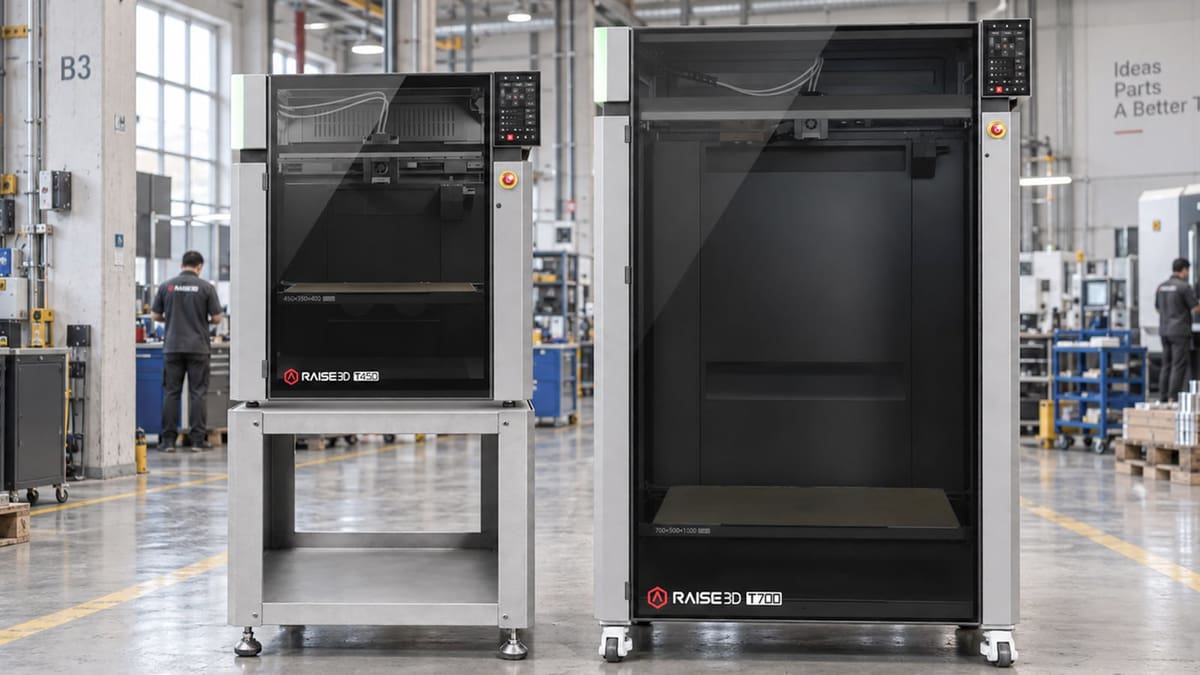
With the T450 and T700, Raise3D is moving beyond its roots in professional desktop 3D printing toward large-format industrial production, betting on high-speed, high-flow extrusion to compete for manufacturing applications.
Raise3D is joining a growing field of industrial FDM 3D printer makers betting on bigger, faster polymer production. It’s two new machines with an interesting TwinFlow extruder present a potentially interesting differentiator in an increasingly competitive field for faster, more economical production of large engineering-polymer parts.
Raise3D’s new T450 and T700 have a novel extrusion system that feeds two filaments into a single nozzle. The machines are the first in Raise3D’s new industrial T Series, which the company is teasing ahead of a Nov. 10 unveiling for Formnext, but they both appeared at the Next-Generation 3D Printer Expo in Tokyo in July, where Raise3D’s Japanese distributor opened preorders for the smaller T450.
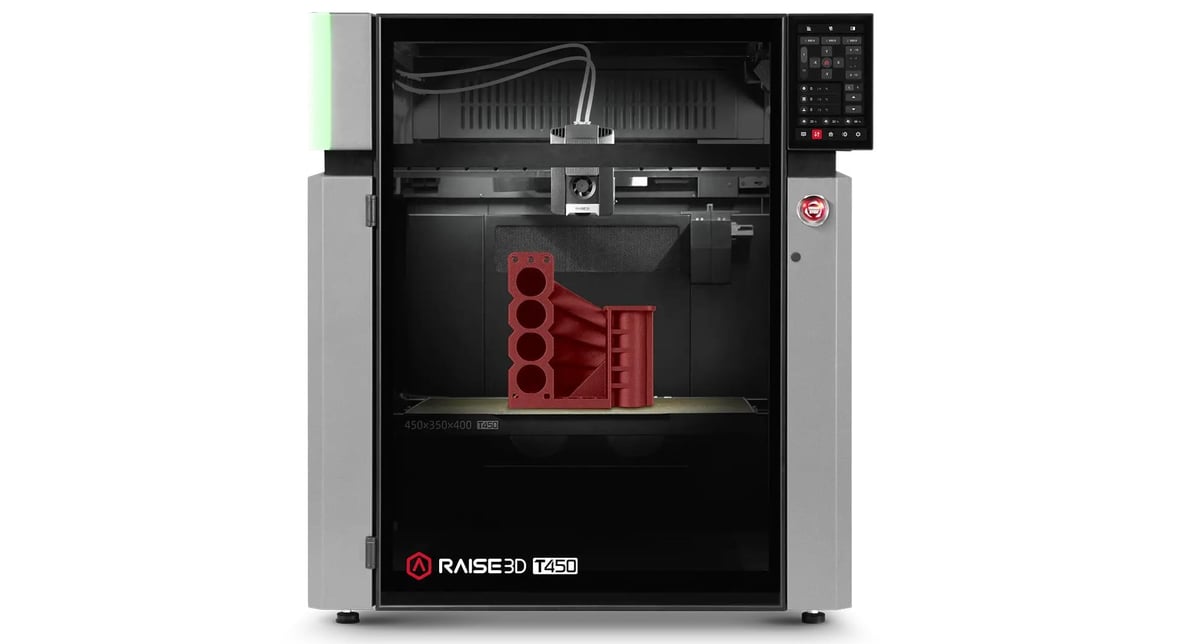
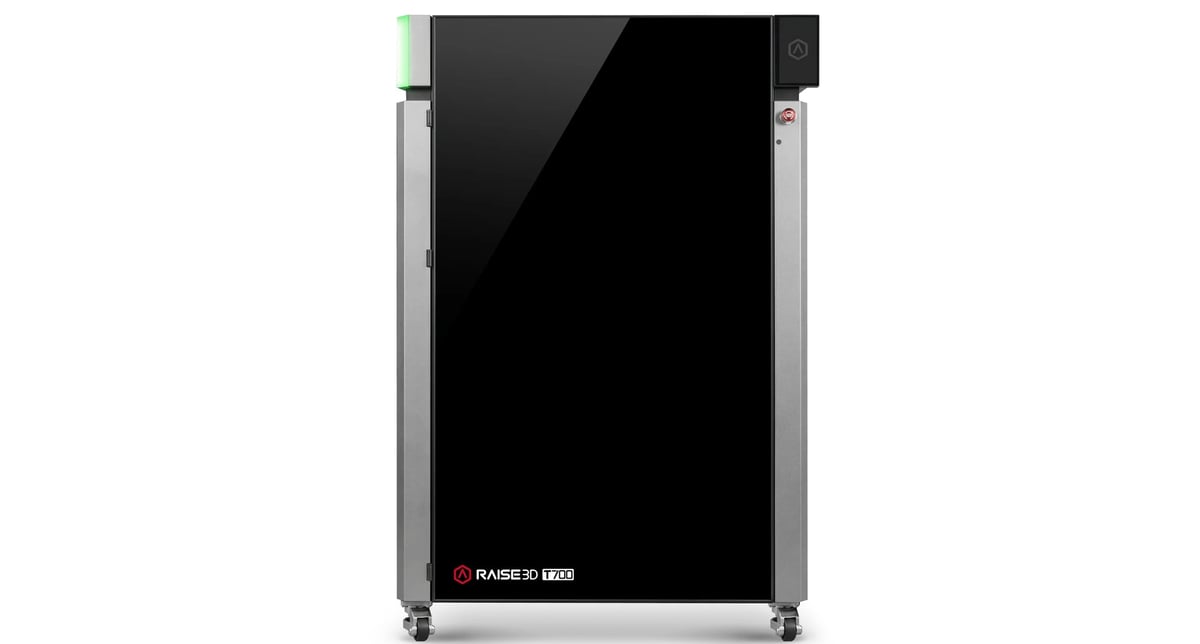
The T450 offers a 450 × 350 × 400 mm build volume, while the considerably taller T700 stretches to 700 × 500 × 1,000 mm, providing 350 liters of printing capacity. Both feature an actively heated chamber, high-temperature extrusion, and a four-motor CoreXY motion system designed to sustain high print speeds.
Raise3D is advertising speeds up to 700 mm/s and volumetric extrusion rates reaching 80 mm³/s. Those are impressive numbers for machines of this size, although, as always, maximum print speed and actual part-production throughput are two different things.
Two Filaments, One Nozzle?
Perhaps the most interesting feature is Raise3D’s TwinFlow extrusion technology.
Rather than using two separate printheads, TwinFlow routes two 1.75-mm filament feeds through a Y-shaped manifold into a single nozzle. In high-flow mode, both feeds contribute material to increase extrusion throughput. The system can also operate with two colors or compatible materials without the nozzle-offset calibration required by conventional dual-head systems.
It’s an interesting approach to a familiar problem: a printer can only move as fast as its hotend can reliably melt and deposit plastic. Particularly when producing large components with thick walls and substantial infill, volumetric flow becomes a more meaningful bottleneck than maximum travel speed.
Raise3D specifies an extrusion rate of up to 80 mm³/s, tested using its Hyper Speed ABS V2 filament at 250°C with a 0.4-mm nozzle and a smooth, single-wall test geometry. That qualifier matters. Performance with carbon-fiber-reinforced engineering polymers, larger nozzles, and more complex parts remains to be demonstrated.
TwinFlow could also raises questions about material switching. With both materials sharing the same melt path, purging and cross-contamination could complicate multi-material printing. Raise3D has yet to publish much detail on how it handles transitions or which material combinations are practical.
Still, combining dual-material flexibility with high-flow extrusion in one printhead is an intriguing proposition, especially for a large-format machine where every hour of printing matters.
Built for Engineering Materials
Both machines combine a nozzle temperature of up to 420°C, a 120°C heated bed, and an actively heated chamber reaching 70°C.
According to the Raise3D’s Japanese site listing the T450 specifications, the nozzle features a silicon-carbide tip and a copper-alloy body designed for efficient heat transfer. Supported materials include ABS, ASA, PETG, TPU, and fiber-reinforced polymers such as PET-CF, PPA-CF, and PPS-CF.
A four-motor CoreXY motion system works alongside pressure advance to maintain extrusion consistency during acceleration and deceleration. Raise3D also specifies acceleration of up to 30,000 mm/s².
Other production-oriented features include an automated top vent for managing chamber temperatures, filtration, an electronic door lock, and more than 20 sensors. The T450 has both a live-view camera and a nozzle-monitoring camera, with AI-based spaghetti and nozzle-clog detection features as forthcoming rather than fully available.
The 70°C chamber is useful for many engineering plastics, but it is not in the same high-temperature category as some significantly more expensive industrial FDM systems. Printing large, dimensionally stable parts in demanding polymers will require more than a hot nozzle.
Into a Crowded Big-Printer Market
Raise3D’s arrival comes as several manufacturers are pushing large-format filament printing further into industrial production.
BigRep recently introduced its Altra 670, offering a 700 × 1,200 × 800 mm build volume, dual extruders reaching 450°C, and a chamber heated to 140°C. The German manufacturer also launched the One.5X earlier this year, updating its roughly one-cubic-meter platform with automated calibration, improved extrusion, and continuous-printing features.
Stratasys, meanwhile, is bringing its new F870 to Europe at Formnext. With a 1,000 × 610 × 610 mm build volume, a 95°C heated chamber, integrated material drying, and support for carbon-fiber-filled nylon, it targets large production tooling, fixtures, and functional parts. Stratasys also emphasizes extended unattended operation, claiming up to two weeks of printing with its high-capacity material system.
These aren’t necessarily direct competitors, however. BigRep’s Altra 670 offers substantially more build volume and higher chamber temperatures, while Stratasys places considerable emphasis on validated materials, process consistency, and integrated production workflows.
Raise3D appears to be approaching the market from a different direction: bringing high-speed CoreXY technology, a potentially high-throughput extrusion system, and substantial build volumes into a more compact industrial package.
The T700’s one-meter Z axis is particularly noteworthy. It could accommodate tall ducts, housings, structural prototypes, and tooling that would otherwise need to be assembled from smaller prints.
Whether Raise3D can compete on production reliability and total cost per part, rather than simply headline speed, remains to be seen.
Raise3D’s initial T Series material points to broader automotive, aerospace, and industrial manufacturing applications.
The more general trend is toward printing larger, stronger polymer components quickly enough, and consistently enough, to make additive manufacturing a practical production process rather than primarily a prototyping technology. Drone manufacturing may be an increasingly attractive customer segment, but it is hardly the only one.
Already Appearing at Resellers
Raise3D Japan says T450 preorders should hit a shipment target of October 2026. It indicated that the T700 was expected to reach the Japanese market in 2027.
The T450 is also listed by Japanese industrial equipment supplier Ricoh. In Germany, retailer 3D-Drucker-Experte advertises the T450 with pricing available on request. A reseller listing is not, however, confirmation of stock or immediate delivery.
Official European and US pricing for the new machines has yet to be established.
Check out the T450 and T700 at Formnext in Frankfurt, Nov. 17–20, in Hall 12.1, Booth D21.
Note: Specifications are based on pre-launch information published by Raise3D’s Japanese distributor and may change.
License: The text of "Raise3D’s New T450 and T700 Go Big & Fast With TwinFlow Extrusion" by All3DP Pro is licensed under a Creative Commons Attribution 4.0 International License.