New Artec Neo Takes Aim at One of 3D Scanning’s Most Tedious Jobs

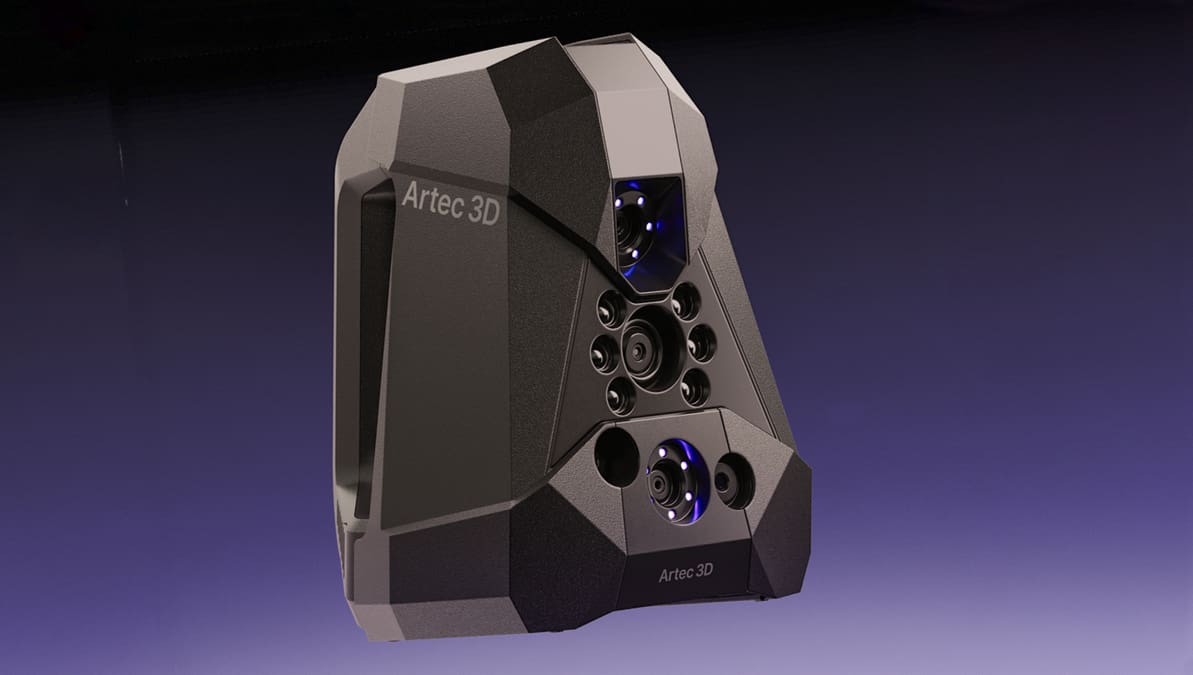
Artec 3D new Neo, a handheld 3D scanner designed to reduce one of the more mundane parts of precision 3D scanning: covering a workpiece with tracking markers before measurement can begin.
Reflective markers are commonly used by handheld metrology scanners to help the scanner establish its position as it moves around an object. The approach works well, but preparing a large component can take considerable time, particularly when only a handful of features actually need highly accurate measurement.
With Neo, Artec is proposing a different compromise. Instead of putting markers across the entire object, users place them primarily around the areas where dimensional accuracy matters most. The scanner can then use the object’s shape, texture and color to keep track of the rest of the surface.
Artec calls the approach “tolerance-driven 3D scanning.” That isn’t an established category of 3D scanning so much as a description of the workflow the company is trying to create: spend measurement effort where it is needed rather than treating every square centimeter of a part as equally important.
For example, an engineer reverse engineering a large casting might need accurate dimensions around bearing bores, mounting holes and machined faces, while the rough cast surfaces connecting them only need to be captured well enough to reproduce the overall shape. Neo is intended to capture both in a single scanning session without requiring markers over the entire casting.
When markers are applied, Neo achieves accuracy of up to 0.025 mm or 0.025 + 0.035 mm per meter scanned. Without markers, the device captures using the same blue-light technology as Artec’s Spider II. This method tracks surfaces based on texture and geometry instead of targets, achieving a 3D point accuracy of up to 0.05 mm.
Different Ways to Ditch the Dots
The problem Artec is addressing is real, but it isn’t unique to the company. Other scanner manufacturers have taken a different route to reducing marker preparation.
Revopoint’s Trackit, which we did a full hands-on review of back in June, pairs a handheld laser scanner with a separate optical tracking station. Rather than relying on markers attached to the workpiece, the tracking station watches the scanner and determines where it is in space. Within the tracked area, this allows the system to scan objects without covering them in positioning dots. Revopoint describes Trackit as providing marker-free scanning, including on objects without useful surface features.
Shining 3D uses a similar principle with its FreeScan Trak range. The FreeScan Trak Nova combines a handheld scanner with an external tracking unit, allowing marker-free measurement through real-time optical tracking. For particularly large measurements, the system can also use photogrammetry to maintain accuracy over longer distances. Shining 3D notes that markers may still be recommended on very large surfaces.
The trade-off with these systems is straightforward. They largely eliminate the need to prepare the object, but they introduce another piece of equipment that has to be positioned with a clear view of the scanner.
Neo appears to approach the same problem from the opposite direction. There is no separate tracking station. Instead, some markers remain part of the workflow, but potentially far fewer of them.
Where Neo Could Make Sense
That could make the scanner particularly attractive for jobs where setting up an external tracker would be awkward. Maintenance and repair work on installed machinery is one example. Large castings, automotive body components, molds and tooling are others. It could also be useful when scanning delicate, painted or historically important objects where users would prefer not to attach large numbers of adhesive markers to the surface.
Another promising use case is reverse engineering. A technician may need accurate dimensions for interfaces such as bolt patterns and bearing locations while also wanting a complete model of the surrounding object. Being able to gather both types of information in one scan could be more convenient than switching between a precision measurement workflow and a separate general-purpose scanner.
Neo’s headline accuracy figures are competitive with existing metrology scanners, but they are not the main reason the product is interesting. Revopoint, Shining 3D and others already offer scanners capable of high-accuracy industrial measurement.
The more significant promise is workflow.
If Neo can provide reliable measurements around critical features while allowing the majority of a component to be scanned without markers or an external tracking station, it could remove a surprisingly large amount of preparation from everyday inspection and reverse-engineering jobs.
In that sense, Artec isn’t solving a new problem. It is proposing a potentially more convenient way of solving one that scanner manufacturers have been wrestling with for years.
Price & Availability
Artec told All3DP that the price will vary a bit by region but “is comparable to the Artec Leo,” which retails for about $38,000 – $40,000.
You May Also Like:


License: The text of "New Artec Neo Takes Aim at One of 3D Scanning’s Most Tedious Jobs" by All3DP is licensed under a Creative Commons Attribution 4.0 International License.