Kentstrapper’s New Mille FDM Prints a Cubic Meter in One Piece, Without the Six-Figure Price Tag

Priced from ~$46,000, this Florence-based manufacturer's new machine packs a full cubic meter of actively heated build space
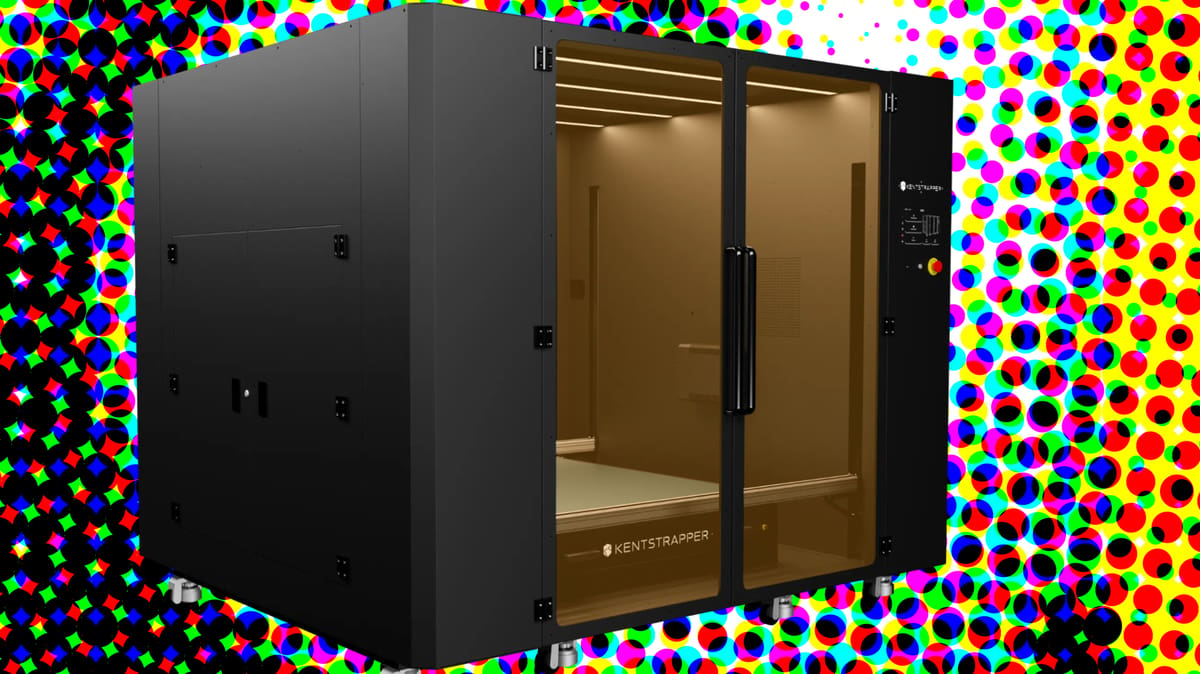
Kentstrapper, an Italian manufacturer that’s spent 15 years building industrial FDM printers out of its workshop in Florence, has launched its new flagship: the Mille. As the name suggests (mille is Italian for “thousand”), the headline feature is scale; a 1,000 x 1,000 x 1,000 mm build volume. That’s enough room to print structural jigs and full-scale prototypes as a single monolithic piece with no assembly seams. This all for a starting price of ~$46,000.
Scale alone isn’t the pitch, though. The Mille’s steel cartesian frame houses an active 60°C heated chamber, meant to keep meter-scale parts from warping as they cool, and a 1 m² bed split into six independently controlled silicone-heated zones running up to 120°C. Its standard extruder, Kentstrapper’s own Mantis line, tops out at 400°C and supports nozzles from 0.4 mm up to a chunky 1.4 mm, with layers up to 2 mm thick, a combination the company claims cuts print time by up to 70% compared to a standard 0.4 mm setup.
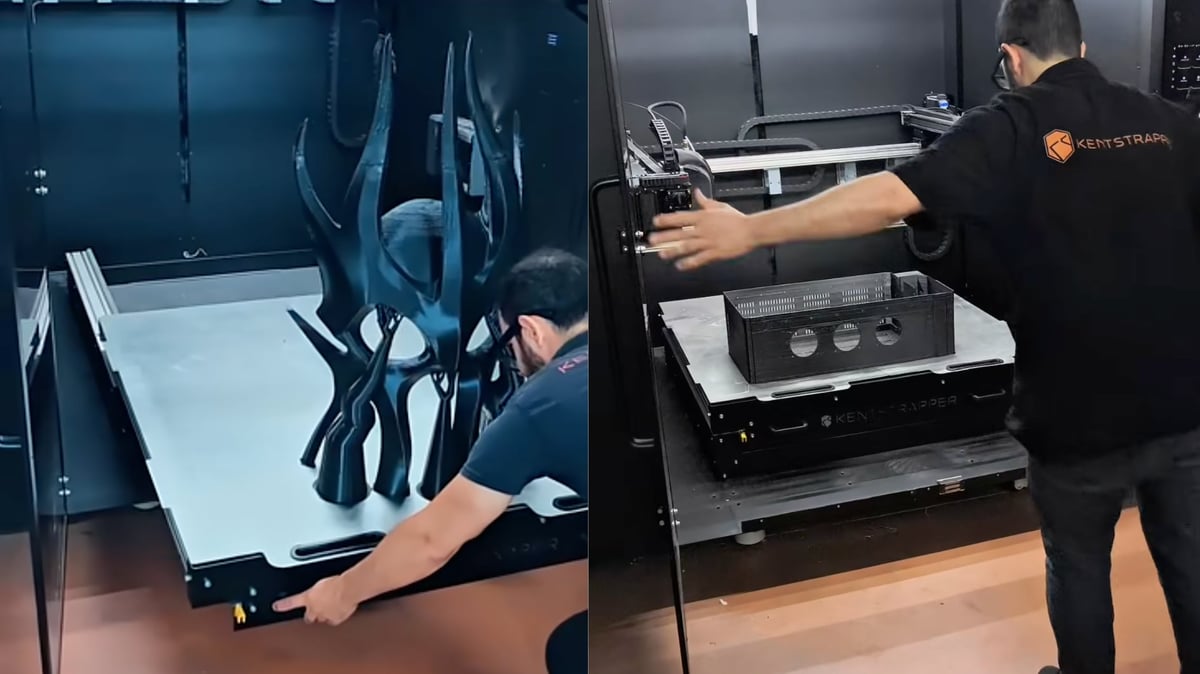
On paper, these specs are what enable the Mille to turn out parts that are big and structurally sound: enough heat to stop a meter-scale print from warping, and enough flow to fuse thick layers solidly rather than just quickly. A scanner-based system auto-levels that meter-wide bed before each print, sparing operators what would otherwise be a tedious manual job.
The rest of the feature set shifts focus from raw printing capability to day-to-day usability. Its control system runs on Kentstrapper’s own Klipper fork, hosted on a 32-bit board paired with a Raspberry Pi and accessed through a 10.1-inch (26 cm) touchscreen that includes Clara, an onboard AI assistant for operational guidance and troubleshooting. Marketed for 48-72 hour jobs, it comes with a reassuring safeguard capability of resuming a print job automatically after an interruption.
Hotends mount via Kentstrapper’s S.E.M. (“Sistema di Estrusione Magnetico,” or Magnetic Extrusion System), a magnetic quick-change mechanism that lets operators swap them in under 30 seconds without tools, and a dual-extruder configuration is available as an option. Slicing goes through OrcaSlicer.
On the connectivity side, it supports USB, Wi-Fi, and LAN, plus API-level integration with manufacturing execution systems (MES) and other Industry 4.0 factory software, the kind of connected, automated production tools increasingly common on modern factory floors.
Since this printer is intended for industrial use, its range of materials includes filled engineering plastics like glass and carbon-fiber nylon, PPS-CF, and ASA-CF, along with ESD- and UL 94 V-0-certified options, on top of the standard range of PLA, PETG, ABS, and TPU. And given its size, Kentstrapper is targeting automotive, boating, aerospace, heavy machinery, and defense customers who need large tooling, molds, or one-off structural parts.
To back that pitch, the company offers a free online tool that lets buyers estimate their own cost savings, comparing an in-house print cost of ~$90–$290 per part to ~$690–$2,300 through a contract manufacturer.
Kentstrapper Mille: Specs at a Glance
How the Mille compares
A full cubic meter of heated build volume puts the Mille in rare company. Moidix, Builder, CreatBot and WASP, also have meter-size FDMs. The closest filament-based rival is probably BigRep’s Pro, which offers a similar volume and an enclosed chamber and a price historically running near the six figures.
Aon3D’s Aon M2+ takes the opposite trade-off, it’s a bit smaller but has a hotter chamber suited to high-performance polymers like PEEK and PEKK. Pellet-fed systems from Titan Robotics or CEAD can go bigger still, but trade filament’s precision and material variety for throughput, at a higher cost and weight.
Kentstrapper’s published starting price of ~$46,000 doesn’t yet include shipping, import duties, VAT, or optional configurations like the dual extruder, but even that bare figure is still a fraction of what large-format industrial FFF systems can typically cost.
What sets the Mille apart, then, isn’t just the cubic meter of build space, but the combination of that scale with tool-free serviceability, native factory-system integration, and, notably, a sticker price the company is willing to publish upfront. Each unit is also built to order in the company’s Florence workshop rather than assembled from third-party parts.
Kentstrapper hasn’t published a specific shipping timeline and the starting price will likely climb with custom configurations like the optional dual extruder. Still, for shops that need to print large structural parts in one piece without renting six-figure industrial hardware, the Mille looks like a pointed bet on an underserved middle ground.
You May Also Like:


License: The text of "Kentstrapper’s New Mille FDM Prints a Cubic Meter in One Piece, Without the Six-Figure Price Tag" by All3DP Pro is licensed under a Creative Commons Attribution 4.0 International License.