Is This U.S. Start-Up Really Building the World’s Fastest Metal 3D Printer?

Precision Additive claims its new PA series hits speeds of 10,000 cm³/h — ten times faster than industry leaders — but is it a breakthrough or just bold marketing?
If U.S.-based Precision Additive, a 3D printer start-up hoping to make its first metal laser powder bed fusion machine commercially available soon, wanted to grab some headlines, its new claim to be the “world’s fastest” may work — while simultaneously raising some eyebrows.
The company says its “PA series of 3D printers will have speeds up to 10,000 cm³/hour,” which is substantially higher than the 1,000 cm³/hour you might see on a Nikon SLM Solutions NXG XII 600, for example (like in this Bosh case study). Arguably, throughput matters more than raw speed in metal laser powder bed fusion, with production dependent on part geometry, material, laser power, and a host of other factors. But still, we’re intrigued.
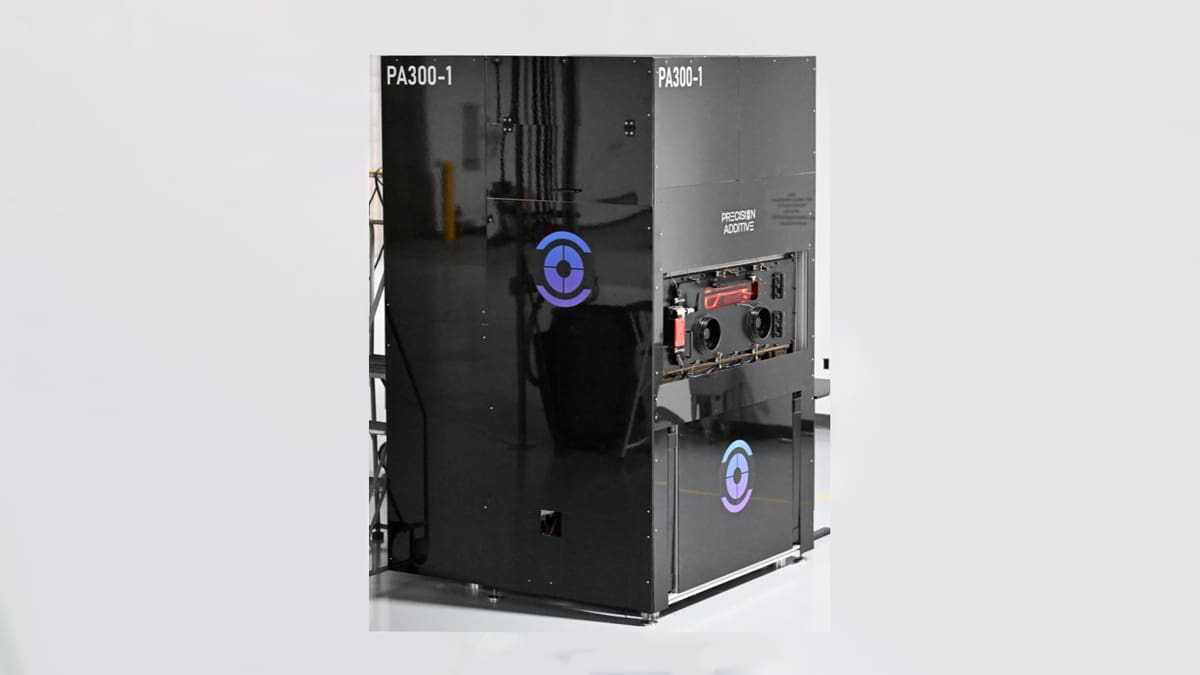
Although there’s no evidence to back up Precision Additive’s speed claim, that’s not completely unusual in this market. The lack of custom stories, technical specifications of any kind, or even one photo of a printed part, though, definitely leaves us wanting more. The image above of the machine is the only one made public.
Proprietary, Patented & Advanced
Aside from the obfuscation of the brief press materials, all we can gather from the information provided is that the speed comes from a proprietary “SSLM” technology, but there’s no mention of what SSLM even stands for anywhere on the company’s site (trade media reports it as “Selective Stepped Laser Melting”).
There is mention of AI-driven process control with real-time monitoring and closed-loop feedback, a “self-healing process architecture” that detects and corrects build deviations during production, in-situ sensing and traceability to support qualification and certification requirements, and technology to reduce spatter and improve microstructure. This all sounds promising, although not entirely ground-breaking.
One distinguishing feature of the PA-300, with a small 300 x 300 x 300 mm build volume, is its U.S. roots. While some Nikon SLM and EOS metal laser powder bed fusion systems are made in America, Precision Additive focuses on the flag-waving quite a bit in its materials — and considering how much money the Pentagon is securing to modernize the military, that’s probably a smart move.
For example, the following Precision Additive claim: “Metal additive manufacturing was invented in the United States, yet much of today’s commercial LPBF production capacity and system manufacturing is based overseas.”
Certainly, there’s a clear line from University of Texas scientist Carl Deckard‘s invention of laser-based powder bed sintering for polymers to the later development of using lasers with metal powder. Yet it was Germany’s EOS and Concept Laser that turned metal LPBF into a real manufacturing process, not just an academic idea.
Precision Additive’s press information goes on to mention that “53% of global metal 3D printer shipments” come from China, and European companies represent “roughly 38.5% of global market revenue.”
It’s true that the U.S. accounts for a tiny fraction of global metal LBPF sales. Precision Additive says this has “contributed to longer lead times, supply chain fragility, and increased risk for defense and aerospace programs that rely on foreign-built equipment and components.”
The hint here is clear: Buy American.
Materials Capability: Magnesium and Nickel Alloys
The PA-300 is initially configured for nickel-based alloys and magnesium, targeting aerospace and defense applications. Magnesium is a rarity on the material menus of most metal LPBF 3D printer manufacturers, so Precision Additive should have a leg up in this niche.
Forthcoming machines include the PA-700, a multi-laser system with a 700 x 700 x 700 mm build volume, and the PA-1200 with a 1,200 x 1,200 x 1,200 mm build volume.
Precision Additive did not disclose specific pricing or delivery timelines for the PA-300 at the time of its press announcement.
You May Also Like:

Listen to All3DP’s News Podcast:
License: The text of "Is This U.S. Start-Up Really Building the World’s Fastest Metal 3D Printer?" by All3DP Pro is licensed under a Creative Commons Attribution 4.0 International License.