How ExxonMobil Turned to 3D Printing to Solve Its Leaky Part Problem

Research proves that a 3D printed redesign of a traditional oil industry device can consolidate complex assemblies into a single, high-performance part.
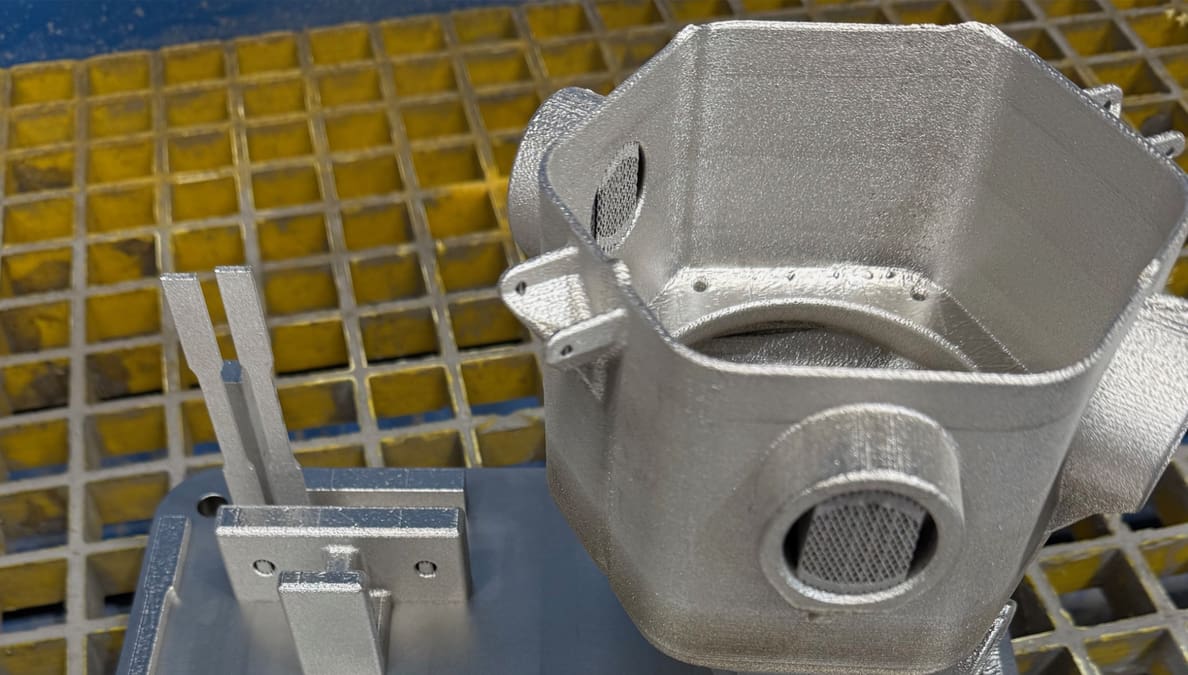
In the high-stakes world of energy infrastructure, a single leaky part can trigger a cascade of costly downtime and maintenance nightmares. For ExxonMobil, a complex anti-wicking device has long been a reliability hurdle, one that traditional manufacturing struggled to perfect. Now, a collaborative research project with Nikon SLM Solutions, Louisiana State University, and Howco Group, has demonstrated a potential 3D printed solution: a monolithic redesign that consolidates multiple parts into one and 3D prints in just 31 hours.
The redesign of an anti-wicking device used in turbine and compressor systems focuses on preventing oil from traveling along thermocouple wiring into sensitive instrument panels — a failure mode that can lead to contamination, downtime, and costly maintenance. According to the case study, additive manufacturing enabled a complete redesign that improves sealing reliability while reducing assembly complexity.
Redesigning a Failure-Prone Component With AM
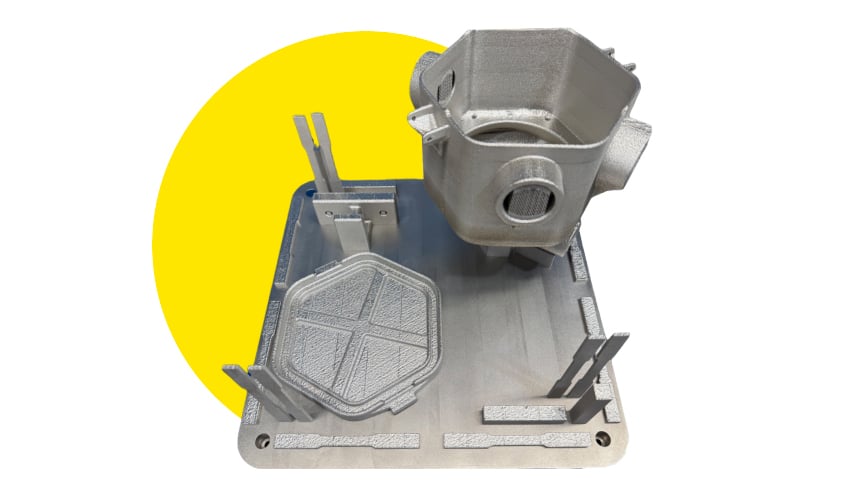
The anti-wicking device sits between electrical cabinets and rotating machinery bearings, where it diverts excess oil away from critical instrumentation. Historically, the component was manufactured as a multi-part welded assembly that created maintenance challenges and sealing weaknesses.
Using laser powder bed fusion (L-PBF), engineers consolidated the design into a single part and introduced several performance upgrades:
- Multi-component consolidation into a single monolithic part
- Modular assembly for easier field servicing
- Wall thickness reduction from 8 mm to 2 mm
- High-precision geometry enabled by 50 μm layer thickness printing
The part was produced in 316L stainless steel on an SLM 280 system using Materialise Magics software, with a build time of approximately 31 hours and one part per build plate. Final dimensions were roughly 164 × 186 × 173 mm.
Lead Time and Reliability Gains
The project addressed several longstanding challenges:
- Oil leakage caused by inadequate sealing
- Difficult maintenance due to complex assemblies
- Non-serviceable internal plates
- Previous redesigns that failed to meet ExxonMobil quality standards
By switching to additive manufacturing, the team reduced production lead times from months to days while improving reliability and maintainability. The redesign also eliminated multiple potential failure points by removing welds and joints.
Academia-Industry Collaboration as a Development Model
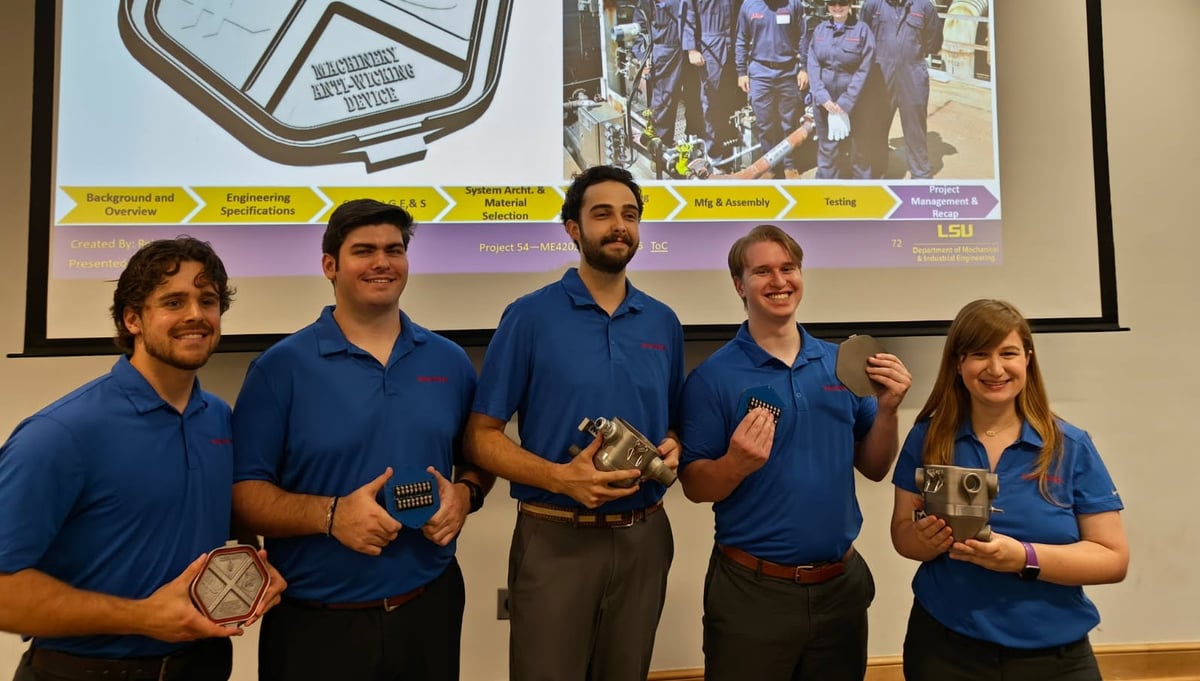
Over the course of the project, LSU’s Capstone Team 54 (comprised of Brennon Broussard, Jude Rogers, Matthew Shannon, Garrett Valley, and Robin Torres ) worked alongside Nikon SLM Solutions DFAM experts Cody Durand and Brenna Dowrey, with David Ramirez from Howco Additive providing additional design-for-AM support and printing expertise.
Industry participants emphasized the broader implications for oil and gas adoption of additive manufacturing, particularly given strict qualification requirements and regulatory oversight. The case study positions the project as a step toward wider deployment of AM-enabled energy components.
Expanding Metal AM Use in Energy Applications
The case study reflects a broader trend: energy companies are increasingly exploring metal AM for mission-critical components where performance improvements justify qualification efforts. The combination of faster iteration, complex geometry, and part consolidation aligns well with high-value industrial applications.
“This capstone project really shows how additive manufacturing can enable academia, industry, service providers, and OEMs to work together to produce a part that is superior in every way,” says ExxonMobil’s Additive Manufacturing Lead for the Baton Rouge area, Christopher Beeson. “We’re proud to sponsor university capstone projects that limit students almost only by their imagination to improve the safety, efficiency, and reliability of our operations.”
Although the part was not field tested and a cost comparison vs. traditional manufacturing was not provided, for metal AM OEMs, the project demonstrates how DFAM expertise and industry collaboration can accelerate adoption in traditionally conservative sectors.
You May Also Like:



Listen to All3DP’s News Podcast:
License: The text of "How ExxonMobil Turned to 3D Printing to Solve Its Leaky Part Problem" by All3DP Pro is licensed under a Creative Commons Attribution 4.0 International License.