Creality’s Next Generation of 3D Printer to Be a KliTek-Powered Toolchanger

There’s a new toolchanger in town – or, rather, there will be, when Creality releases its next flagship printer, the K3, later this year. Powering the toolchanging is a new system the company calls KliTek.
We now know a little more about Creality’s vision for the future of desktop printing after the company revealed its new toolchanging mechanism, KliTek.
The KliTek was detailed as a part of Creality’s 12th anniversary celebration, which also coincided with the company finally achieving its initial public offering on the Hong Kong stock exchange (that’s right, you can own Creality stock now, if that’s your kind of thing).
In short, it’s a proprietary nozzle-changing system, set to ship on the Creality K3, a new printer targeted for release in Q3 2026. The system’s name isn’t particularly descriptive about what’s going on with it, but beneath the name is an interesting looking system that cements the idea that toolchanging, in its various forms, is well on its way to becoming mainstream in desktop printing.
What is KliTek?
Terminology matters here, because it seems like with every toolchanging system that launches, they’re all different ways of achieving the same effect using a shared pool of parts and terms: it can make discussion of the technologies a bit confusing.
KliTek swaps what Creality calls a “nozzle assembly” – comprising a nozzle, hotend, and filament path combined – rather than an entire toolhead. Conceptually, the system looks like and handles filament similar to Bondtech’s INDX, but doesn’t bother with any of the wireless heating or data transfer functions that help define it. Instead, the KliTek’s hot ends appear to be regular K-series style ceramic units, albeit integrated into a complete nozzle assembly – they’re powered independently, meaning they can preheat while one tool is in use printing.
This is more “full” toolchanger in filament handling and melting behavior, just without a full printhead (and their associated mass) for each filament path.
Creality says the KliTek’s assembly weighs around one-fifth of a full toolchanger’s printhead, a reduction they credit for the claimed sub-5-second tool swap time. Factoring in the processes around the physical act of swapping the tool, the company claims full color or material changes in under 15 seconds.
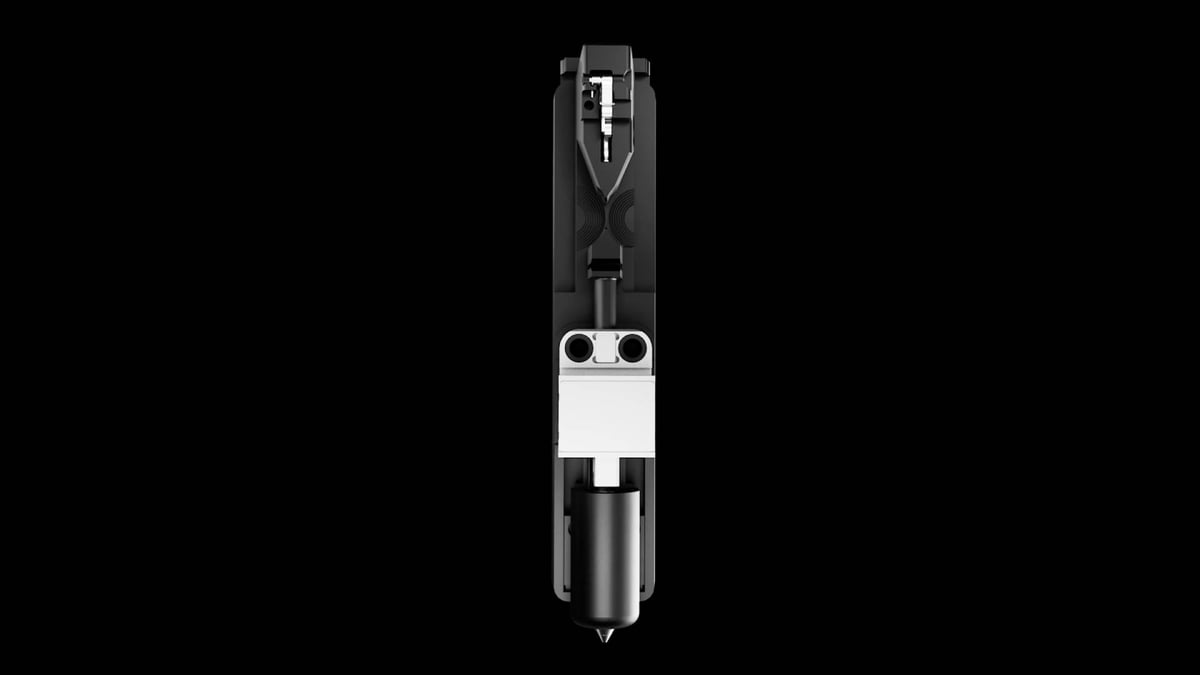
Creality’s KliTek nozzle kit features what appears to be the company’s standard ceramic hot end, beneath an alignment mechanism and open filament path (Source: Creality)The claimed filament waste reduction from Creality’s lab is 80% against single-nozzle printing, primarily by eliminating purge cycles. Given each toolhead is a discrete filament path, we can presume that remaining 20% “waste” is allocated to nozzle priming.
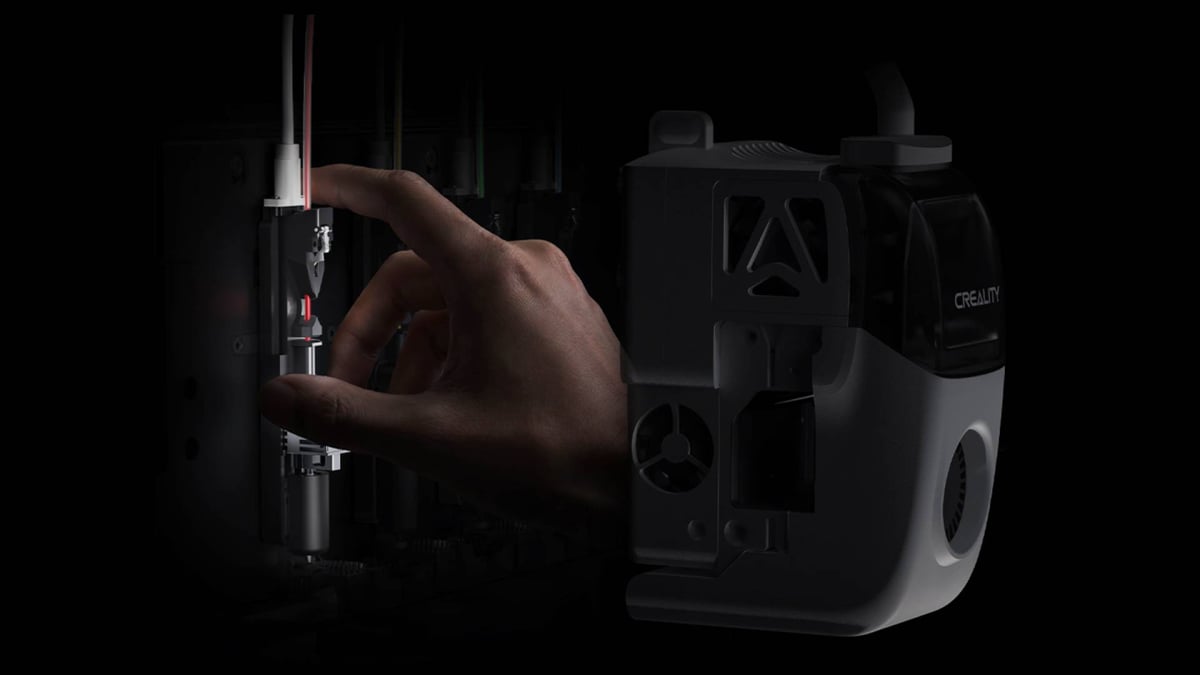
Like INDX, Creality’s KliTek tools expose the filament in-tool to the carriage. When a tool is picked up, the extruder – which remains inside the printhead carriage – pinches the filament to feed it. The visual similarities are striking, and sure to draw attention in light of Bondtech’s patent pending on the extruder portion of that system.
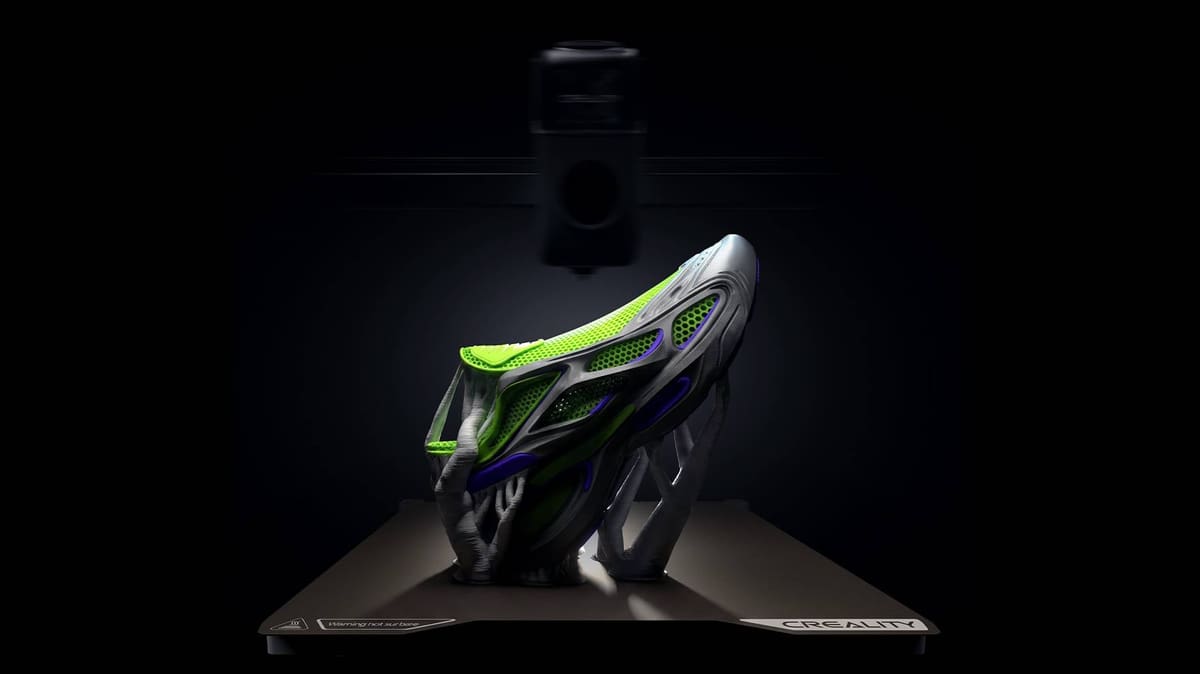
It appears the key difference is what Creality describes as the KliTek’s S-Drive extruder, which is perhaps best described as an offset dual-drive feed mechanism the company (also) says is patent-pending. A lot of the messaging around KliTek hangs on the systems stated ability to print soft TPUs – as soft as 80A shore hardness – competently. The implication here is that, given the expectation of there being multiple KliTek tools available in a print, that you could be printing objects with multiple grades of TPU, such as shoes with tougher midsoles and softer uppers, for example.
With the KliTek, Creality is also promoting the ability to mix nozzle sizes in jobs. It’s technically possible for other toolchanging systems to do it, though typically only outside expected usage – basically unsupported. But Creality puts it right there in the launch materials – giving the example of using a 0.8 mm nozzle for fast infill and a 0.4 mm nozzle for detailed walls of a print.
Changing tools – by which we mean physically swapping the tool out of its dock for another, say a different nozzle type or size for use in a print – is not a toolless process, with power and data served to the tools via a screw-secured USB C cable, you’ll need a hex key to release and secure them as you go.
An estimated tool price of $14 is given for the nozzle assemblies, though caveated that the price is subject to change.
How Do I Get KliTek? What’s the K3?
Here’s where things go into fuzzier “we don’t really know” territory.
Creality introduced the KliTek with the announcement of the K3 3D printer coming Q3 2026. While an animated render of the KliTek in action shows what looks like an enclosed five-tool setup, it’s not clear if that’s how we should expect the K3 to look.
Some small details revealed alongside the KliTek do start to paint the picture, though. The company says there are 37 “sensors” in the K3, 12 of which are tasked exclusively to the tool swapping process. Likewise, FOC step servo motors feature: basically, closed-loop motor control for quieter, precise movement. Filament RFID identification will also be present for the K3, according to the announcement.
Historically Creality’s base flagship models (the K1 and K2) are fully enclosed printers with around what we’d consider “standard” build volumes (~220mm³ and 260mm³, respectively.) Active chamber heating and compatibility with higher end engineering materials was left to variant models in those series, rather than the base printer. Likewise larger build volumes. It would not be unreasonable to expect there to be larger more feature-rich (or higher tool-count?) K3 models that follow.
For now, we’ll have to wait until later in the year. Q3 is a while aways, but we know there are key tech happening shows in that timeframe. IFA, a consumer tech show in Berlin with a growing 3D printing presence, is in September – Creality made their IFA debut last year, picking up Innovation Awards for the K2 Pro, so we’d say it’s a sure thing we’ll see the K3 with KliTek in action there.
For now, you can register your interest in the K3 over on Creality’s website.
Read more recent news:
License: The text of "Creality’s Next Generation of 3D Printer to Be a KliTek-Powered Toolchanger" by All3DP is licensed under a Creative Commons Attribution 4.0 International License.