
Creality Launches Sermoon P1S, a Versatile Standalone Laser 3D Scanner for Less

Creality is launching the Sermoon P1S today, a standalone blue-laser and NIR 3D scanner that joins March's Sermoon P1 at the forefront of Creality's pro-focused, but not expert difficulty handheld scanners.
According to specs and pricing Creality shared ahead of the launch, the Creality Sermoon P1S carries an MSRP of $2,299, with an early-bird price of $2,099 running through October 12. Both price points undercuts the P1’s current $3,299 price by over $1,000, making it a pretty attractive (and, more likely, competitive) device in an increasingly crowded standalone scanner market.
The P1S’ core hardware presents a refresh over the P1. Where the P1 used 22 cross laser lines, the P1S steps up to 34, alongside the same 7 parallel lines and single blue laser line as before. The near-infrared sensing isn’t attributed to dual VCSEL like the P1, but to something Creality is calling “Mask Technology”. It’s unclear whether this is new technology or marketing nonsense, but something clearly pointed is the P1S’ “exclusive” NIR tech is used to scan small to medium sized objects. Unlike the P1, the P1S doesn’t need to switch between near and far scan modes, either. Point accuracy holds at 0.02mm, but volumetric accuracy loosens slightly, from 0.02mm+0.06mm/m on the P1 to 0.02mm+0.08mm/m here.
Something that benefits every scanner from a usability perspective is a wide field of view, which the P1S improves, too: 500 x 400 mm at 550 mm distance using the laser modes, compared to the P1’s 380 x 365 mm – significantly more of the object is covered by the lasers in a given frame.
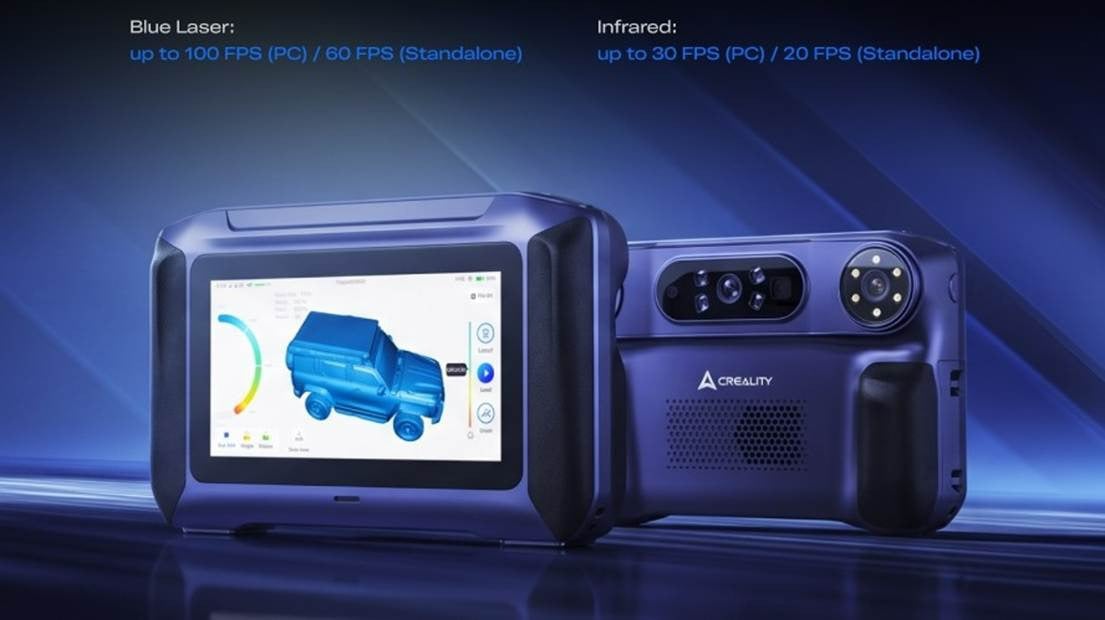
Elsewhere the spec sheet trims back: 16GB of LPDDR5X RAM against the P1’s 24GB, though the same Qualcomm 8-core chip, Adreno 740 GPU, and 256GB of UFS 4.0 storage carry over. The 6-inch touchscreen drops from Full HD to HD. Scan range and the standalone/wireless-PC/wired-PC modes carry over unchanged, as does outdoor use rated to 100,000 lux and 3,300mAh dual hot-swappable batteries.
The jump to 34 laser lines is a significant feature bump that should result in an improvement in the data capture, and even though there’s a drop in RAM to help process the data captured, at 16 GB the P1S still lands spec-wise alongside the likes of Revopoint’s Miraco and Miraco Plus, the Einstar Vega, and 3DMakerPro’s Turtle. To compare, Creality’s flagship laser scanner, the RaptorX, uses 41 crossed laser lines for its capture.
Creality itself positions the P1S as the accessible version of the metrology-chasing P1. It’s certainly not a direct spec- and price drop, with usability improvements and, theoretically, at least, more capable scanning modes. The Creality Sermoon P1S is available to preorder now via the Creality webstore – shipping is estimated to begin in October.
You’ve read that; Now read these…


License: The text of "Creality Launches Sermoon P1S, a Versatile Standalone Laser 3D Scanner for Less" by All3DP is licensed under a Creative Commons Attribution 4.0 International License.