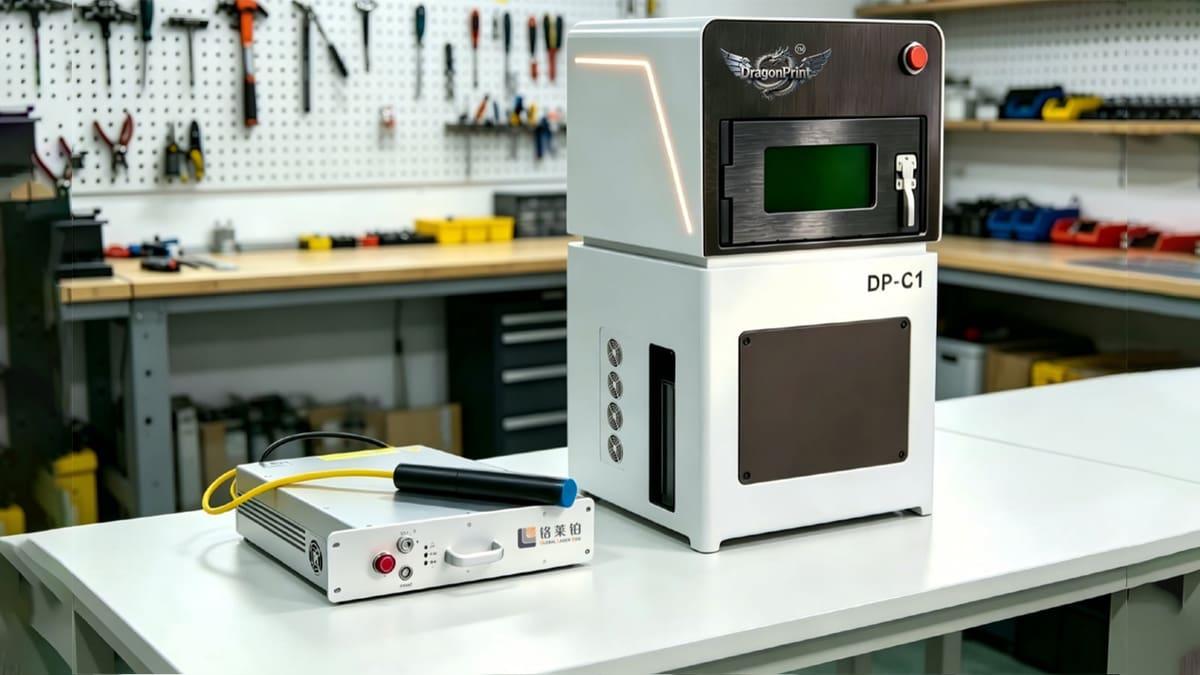
Can the GLB DP-C1 Safely Bring Industrial Laser Metal 3D Printing to Home Workshops?

The compact laser powder bed fusion system is being hyped up as a consumer-grade, garage-friendly 'household' metal 3D printer for $4,888, but its safety remains obscured behind a wall of AI images.
Chinese metal additive manufacturing equipment maker Global Laser Box, or GLB, has announced the DP-C1, a super-compact metal 3D printer that it says is designed for consumers, makers, schools, and small customization businesses.
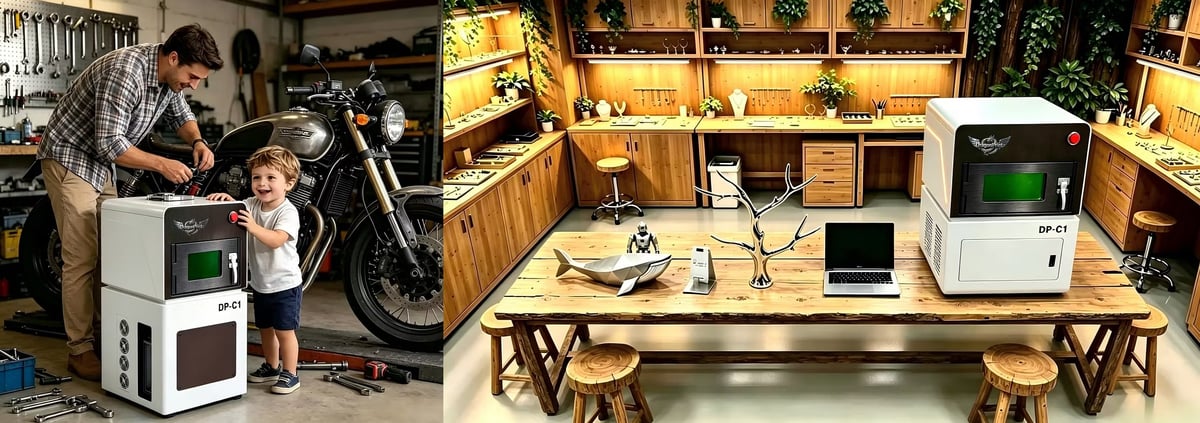
The company says that users will be able to produce personalized jewelry, decorative objects, small mechanical parts, vehicle and motorcycle accessories, camping equipment, fishing accessories, and educational projects. It is also promoting the machine for classroom training and light commercial production.
The printer just made its public debut at the Global Consumer Electronics Expo in Shenzhen, China, on June 24. It boasts a 100 × 100 × 100 mm build volume, claimed ±0.1 mm accuracy, and a package ecosystem involving nitrogen, powder recovery, filtration, and post-processing. There are a plethora of AI images accompanying the release that depict various sizes of the machine in various environments. But even as a concept, it’s too intriguing to write off. Let’s take a look at the printer aiming to bring voice-controlled, AI-driven, metal laser powder bed fusion to your garage.
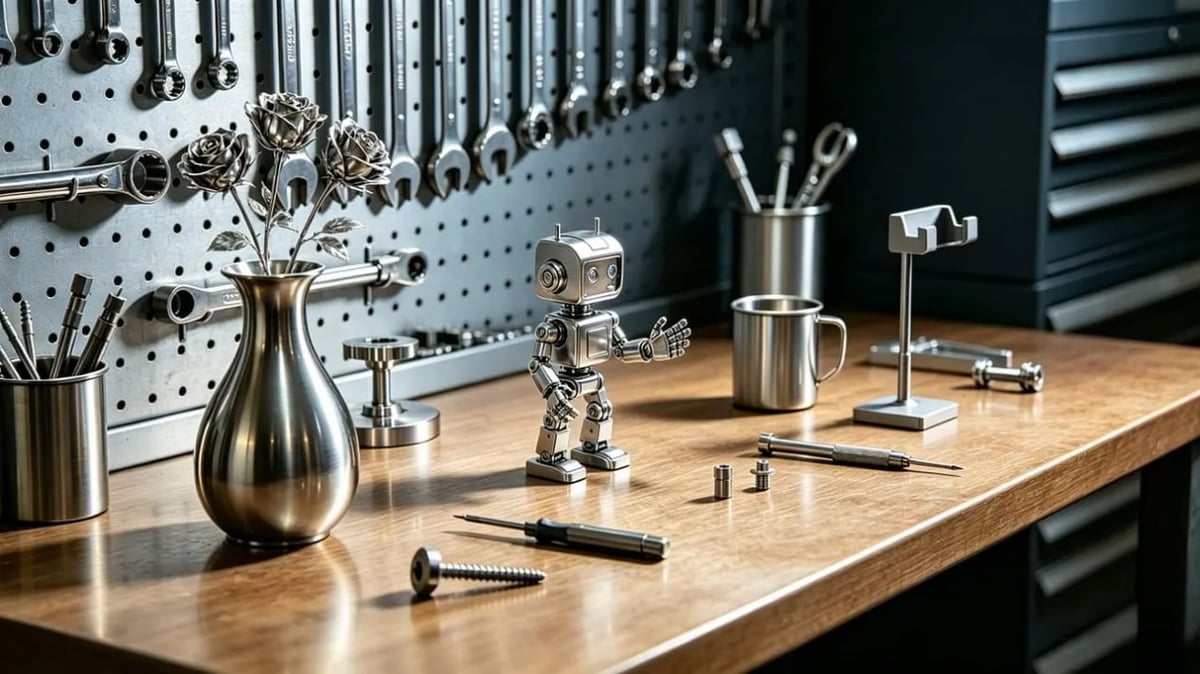
The printer manufacturer, known in China as Jiangsu Global Laser Box Digital Technology, but identified publicly in English as Global Laser Box or GLB, already offers a range of industrial laser powder bed fusion systems. The DP-C1 appears to extend that portfolio into a new, explicitly consumer-oriented category — a significant expansion of laser powder bed fusion beyond its usual industrial setting.
GLB describes the DP-C1 as a “consumer-grade AI metal 3D printer” and says it lowers the financial and technical barriers associated with metal additive manufacturing.
GLB’s newly published packages and auxiliary-equipment catalog provide a clearer picture of the installation and workflow: the system uses metal powder and a nitrogen supply, while GLB offers a powder vacuum, vibrating sifter, filters, nitrogen generator, drying oven, cutting saw, sandblaster, and annealing furnace as separate equipment. This suggests that, despite being marketed for placement in homes and ordinary workshops, the DP-C1 is not an entirely self-contained appliance.
GLB has yet to publish detailed requirements for grounding, room ventilation, oxygen monitoring, personal protective equipment, or fire- and explosion-risk controls. As with LPBF systems generally, users must manage fine metal powder and an inert processing atmosphere, while completed parts may still require depowdering, removal from the build plate, support removal, heat treatment, machining, grinding, or surface finishing.
A Consumer Pitch for an Industrial Process
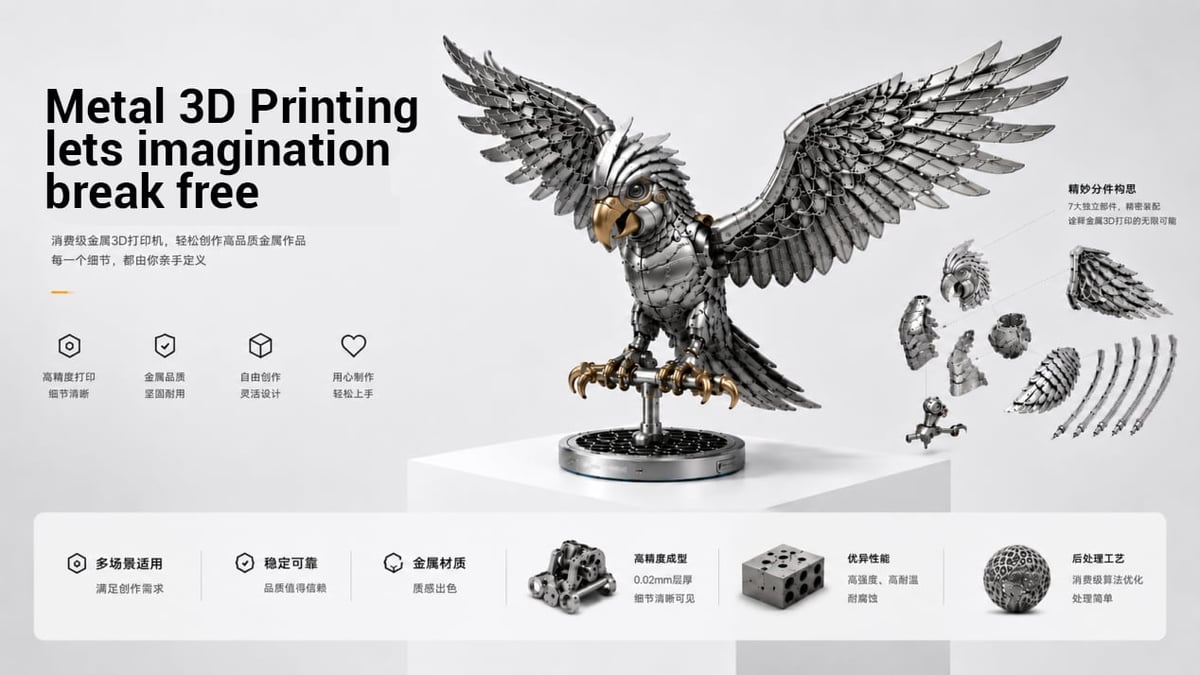
Laser powder bed fusion, which uses a laser to selectively melt layers of fine metal powder, can produce dense, complex metal parts, but it is normally carried out in controlled industrial environments. Yet, the size-range of these machines has been expanding for years; smaller machines on one end and much larger machines on the other. Home-use however, is new.
According to GLB, the DP-C1 features a proprietary 300 W air-cooled fiber laser. GLB says eliminating a conventional water-cooling laser system helped it reduce the printer’s size, energy use, and mechanical complexity while maintaining stable laser output.
The manufacturer also intends to sell the laser separately to other equipment makers, which it says could support the development of additional compact metal 3D printers.
Specifications and performance figures are manufacturer-supplied claims. GLB publishes conflicting descriptions of the build area. Independent test data and complete installationand safety specifications have not been published.
AI Tools Intended to Lower the Modeling Barrier
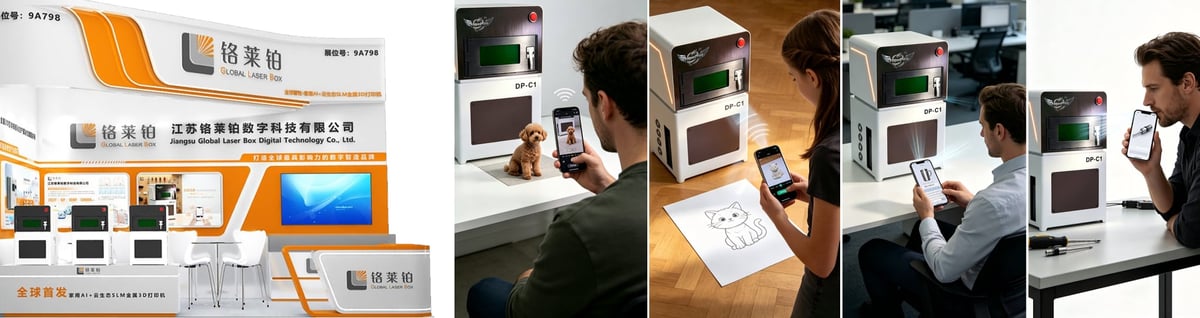
This is where the new offering really gets interesting. GLB is placing significant emphasis on the DP-C1’s software. The company says the printer will include four AI-assisted ways of creating models: image-to-3D conversion, 2D-to-3D conversion, text-based modeling, and voice-prompted modeling.
In one proposed workflow, users could photograph an object and have the software generate a three-dimensional model before preparing it for printing through cloud-based slicing.
Logos, sketches, illustrations, and other two-dimensional designs could reportedly be converted into raised or fully three-dimensional objects. Text and voice commands could be used to generate customized plaques, ornaments, signs, and similar products.
The company says the software creates an automated chain covering “creation, modeling, slicing, and printing.”
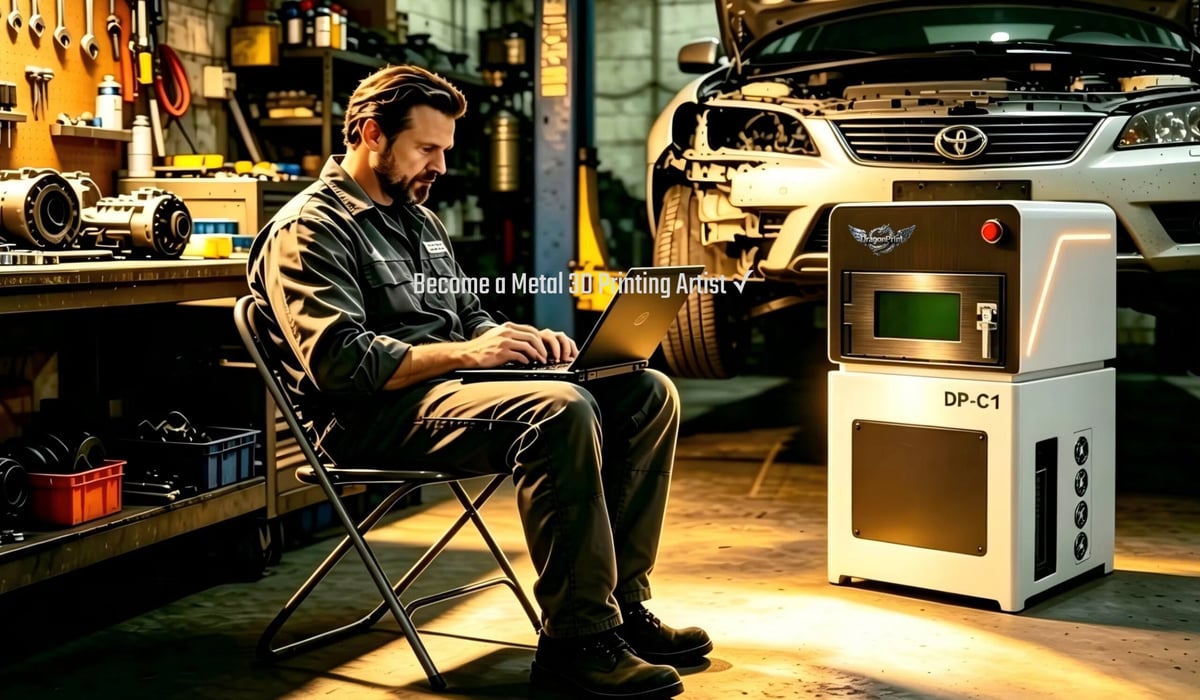
It has not yet provided an unedited demonstration of those tools or explained which functions run locally and which depend on cloud services. Details about supported languages, subscription fees, file ownership, privacy, and the level of manual intervention required are also absent.
Generating geometry is only one part of preparing a model for laser powder bed fusion. Parts may require orientation changes, support structures, minimum-wall checks, machining allowances, and modifications to reduce distortion or trapped powder. GLB has not said whether its software handles those manufacturing constraints automatically.
The DP-C1 reportedly includes dynamic path optimization and error-correction software intended to adjust laser trajectories and compensate for deviations during printing. GLB says these functions can reduce warping, voids, and other defects, like they do on industrial-size machines.
Models and a Maker Community
Alongside the printer, GLB says it is developing an online community called IronNova and a “Creative Workshop” model library. The library will provide more than 10,000 metal-printing designs.
Ultimately, innovation in affordable metal additive manufacturing should be welcomed. But reducing the price and footprint of industrial equipment does not automatically reduce the hazards associated with the process. Until that evidence is published, the DP-C1 should be treated as an experimental compact industrial system not a proven consumer appliance.
You May Also Like:

License: The text of "Can the GLB DP-C1 Safely Bring Industrial Laser Metal 3D Printing to Home Workshops?" by All3DP Pro is licensed under a Creative Commons Attribution 4.0 International License.