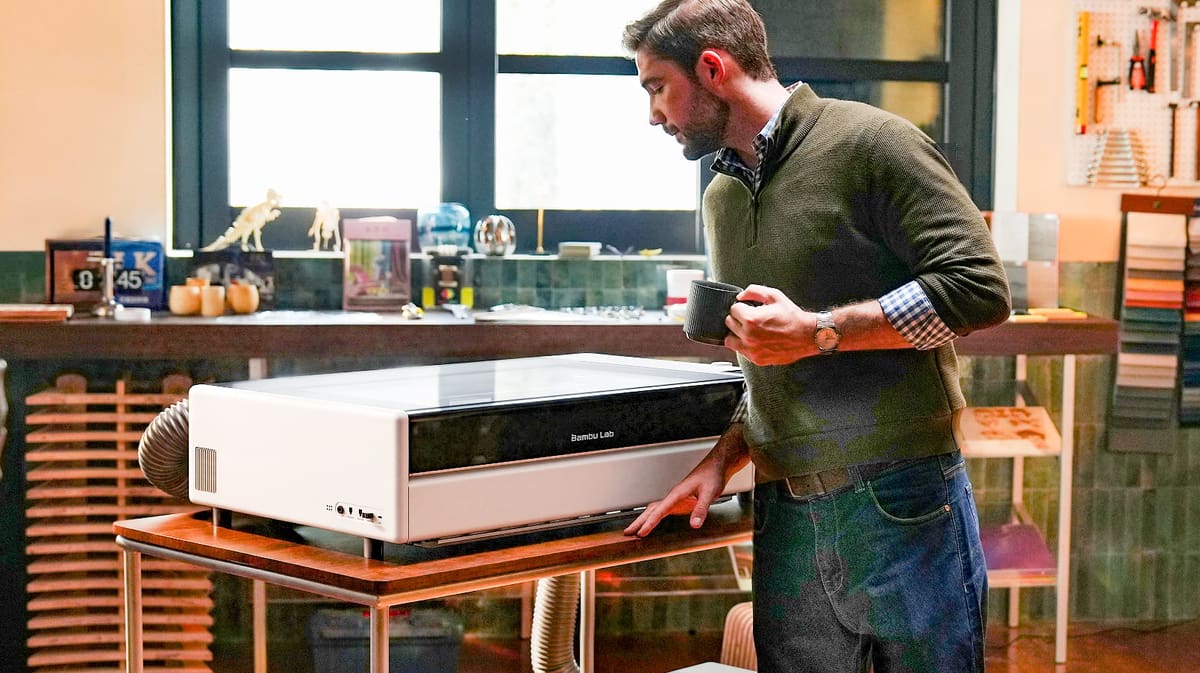
Beyond 3D Printing: Inside Bambu Lab’s New Standalone Laser Cutter

The R1 cuts wood, acrylic, leather, fabric, and paper, plus engraves on glass and stone.
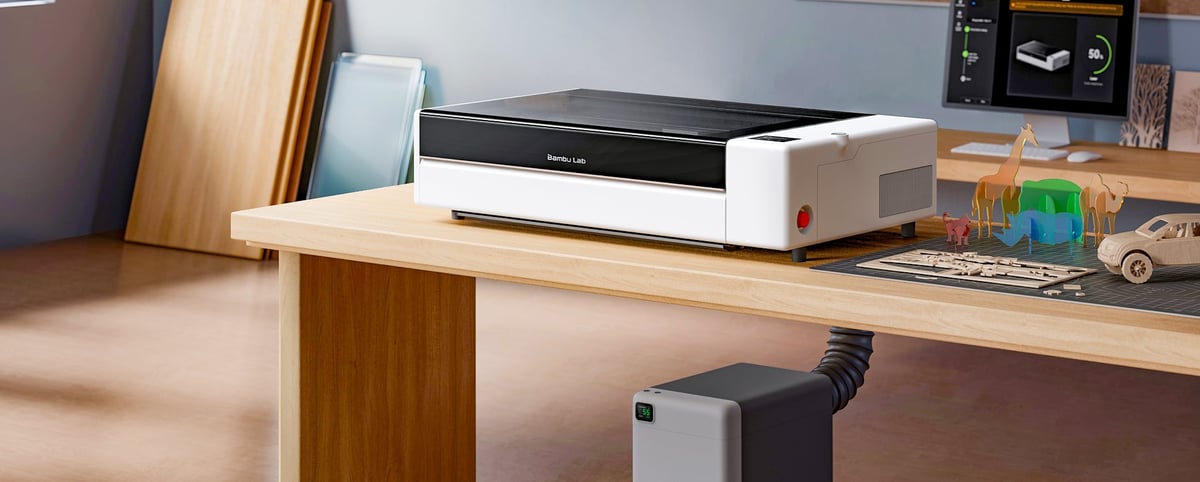
Bambu Lab just branched out beyond 3D printers (that also laser cut) with the R1, a standalone high-power CO₂ laser cutter and engraver priced at $2,499.
Setting the R1 apart from the laser cutters that are modular units for the company’s H2D, H2C, and H2S 3D printers, is a more powerful and more capable laser, a larger build area, more material options, and more accessories.
Bambu Lab is positioning the R1 as a complementary machine for existing printer owners who want to add materials like wood, leather, fabric, and clear acrylic to their 3D printing projects. It may also appeals to small businesses, workshops, woodworkers and crafters. It represents a not-unanticipated strategic broadening for Bambu Lab further into the realm of personal manufacturing.
Rather than reinventing the desktop CO₂ laser cutter; the company is trying to give laser cutters the appliance-like calibration and automation that made its 3D printers successful. If its new beam alignment, motion calibration, vibration contril, focusing and workpiece positioning systems work reliably, the R1’s significance may be less about what it can cut than how little users need to know about maintaining and calibrating the machine before using it.
Has Plug-and-Play Laser Cutting Finally Arrived?
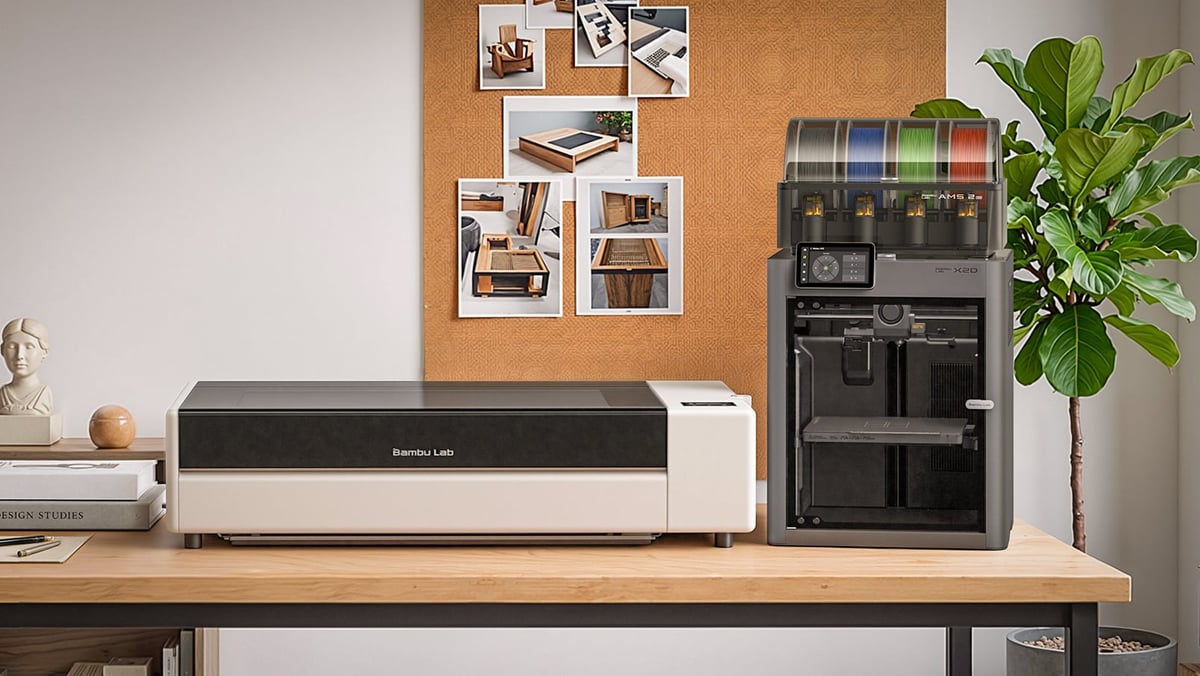
On basic specifications, the R1 lands squarely in the established 55W desktop CO₂ category occupied by machines, such as the xTool P2S ($2,799) and OMTech Polar Lite ($2,199). Bambu Lab’s differentiator is less the laser itself than the amount of calibration and positioning work it is attempting to automate, making the R1’s most unusual feature is its automatic optical alignment system.
CO₂ laser cutters typically direct their beam through several mirrors before it reaches the cutting head. Those mirrors need to stay precisely aligned; otherwise, cutting power and accuracy can deteriorate. Alignment is traditionally a manual process involving test shots and repeated adjustments to the mirror mounts.
Bambu Lab’s Auto Laser Alignment system instead uses motorized mirror actuators and a removable Laser Alignment Sensor mounted to the toolhead. According to the company, the R1 measures the laser path and corrects the mirror alignment automatically in about one minute.
Bambu Lab describes the system as a first for a laser cutter. Automated beam alignment has existed in industrial laser systems for decades, but motorized self-alignment appears highly unusual among desktop CO₂ cutters in this price class.
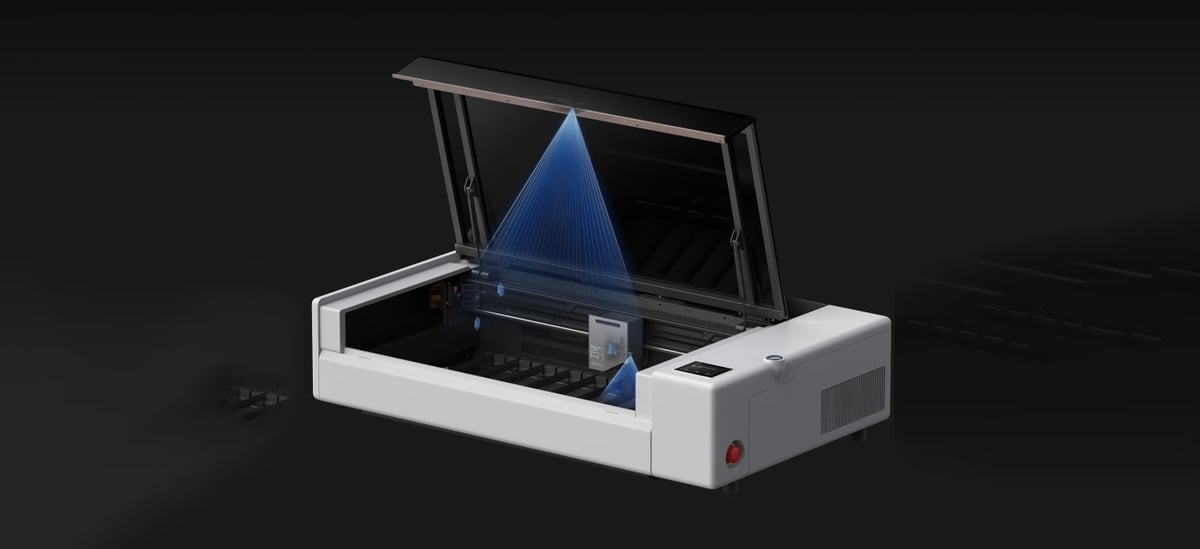
The company is also bringing some of the motion-control ideas familiar from its 3D printers to the R1. That includes vibration compensation intended to reduce artifacts when the toolhead rapidly changes direction. The R1 additionally varies laser output with motion speed to keep energy delivery more consistent, which is a useful feature, although speed-dependent laser-power modulation itself is already common in modern laser controllers.
Bambu Lab says the R1 can operate at speeds of up to 1,000 mm/s. For a desktop glass-tube CO₂ machine in this price class, this speed is fast when compared to xTool P2S’s 600 mm/s, OMTech Polar Lite’s 500 mm/s. More expensive laster cutters, like the xTool 80W P3 reache 1,200 mm/s, while OMTech’s 50W RF-tube Polar 2 advertises 2,000 mm/s. The speed figure primarily describes high-speed engraving and motion, rather than the speed at which the machine will cut thick wood or acrylic.
An optional Vision Encoder calibration board can be used to compensate for mechanical drift in the motion system. Bambu Lab says this can maintain absolute motion accuracy within 0.1 mm across 600 mm of travel. That is different from simply quoting the theoretical step resolution of the motors: the calibration board is intended to measure actual mechanical positioning errors across the machine and compensate for them.
How the R1 Stacks Up
Usual Dimensions, but Extra Speed
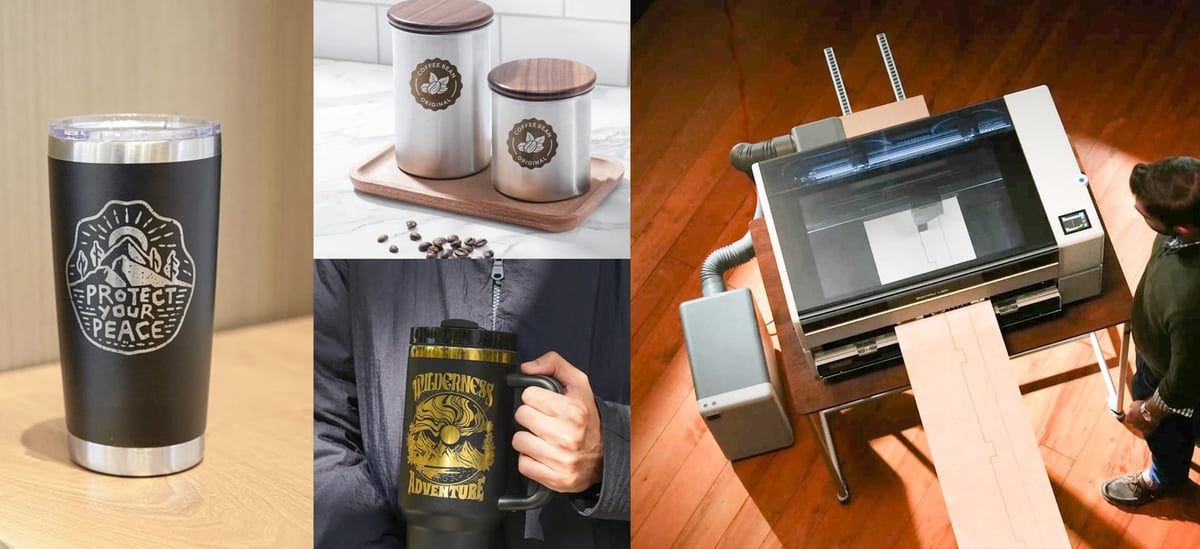
The R1 has a 600 x 300 mm working area with an optional conveyor accessory to handle stock up to three meters long, opening the door to larger signs, boards, and furniture-scale components. A rotary attachment for cylindrical or curved workpieces is also available separately.
The R1 has a 55W CO₂ laser compared with the visible-light diode lasers found in the Bambu Lab desktop 3D printer/laser cutter combos. Those units, the H2D, H2C can be equipped with 10W or 40W lasers.
The CO₂ laser can cut clear acrylic, something not possible with the diode lasers, and etch glass. Bambu Lab says the R1 can cut black walnut plywood up to 18 mm thick and acrylic up to 20 mm. Those figures are competitive rather than unprecedented. xTool makes nearly identical one-pass claims for its 55W P2S (18 mm basswood and 20 mm acrylic) although wood species and plywood construction make manufacturer thickness figures difficult to compare directly.
Positioning and Sensor Hardware
The R1 also uses what Bambu Lab calls its “TriSense System” for positioning, focusing, and motion tracking.
A BirdsEye Camera provides a view of the entire working area, while a camera mounted on the toolhead assists with more precise positioning. A pinpoint laser shows the intended position directly on the material.
Another laser measures the distance to the workpiece and automatically sets the focus, including when working on curved surfaces. XY encoders meanwhile track the position of the toolhead.
None of those sensing technologies is unprecedented individually. xTool’s P2S already combines dual cameras, autofocus and curved-surface engraving, while newer machines such as the xTool P3 add LiDAR. Bambu’s differentiator is the way it combines camera vision, direct laser indication, ranging and motion calibration into one positioning system.
Bambu Lab says this combination allows the R1 to trace printed artwork and cut around it with accuracy of under 0.2 mm, as well as engrave curved objects more consistently.
Class 1 – With an Important Caveat
In its standard enclosed configuration, the R1 is classified as a Class 1 laser product under IEC 60825-1, meaning the laser beam remains contained during normal enclosed use, so safety glasses are not required, the company says.
The machine includes an interlock that stops the laser when the lid is opened, a flame sensor, emergency stop, and a crossflow ventilation system designed to carry smoke toward the exhaust.
Bambu Lab will additionally sell an E1 Pro Air Purifier and an Auto Fire Extinguishing System as optional accessories.
There is, however, an important distinction when using larger-material accessories. Bambu Lab says fitting either the Riser Base or Conveyor means the enclosure is no longer complete. In those configurations, the R1 becomes a Class 4 laser device and requires appropriate CO₂ laser-safety eyewear. The company says those setups are intended for professional use by trained personnel.
Rather than creating a separate software environment for the laser, Bambu Lab is folding the R1 into its existing ecosystem. The machine uses Bambu Suite on Windows and macOS, along with the same Bambu account and MakerWorld platform used by its 3D printers.
Pricing, Specifications, and Availability
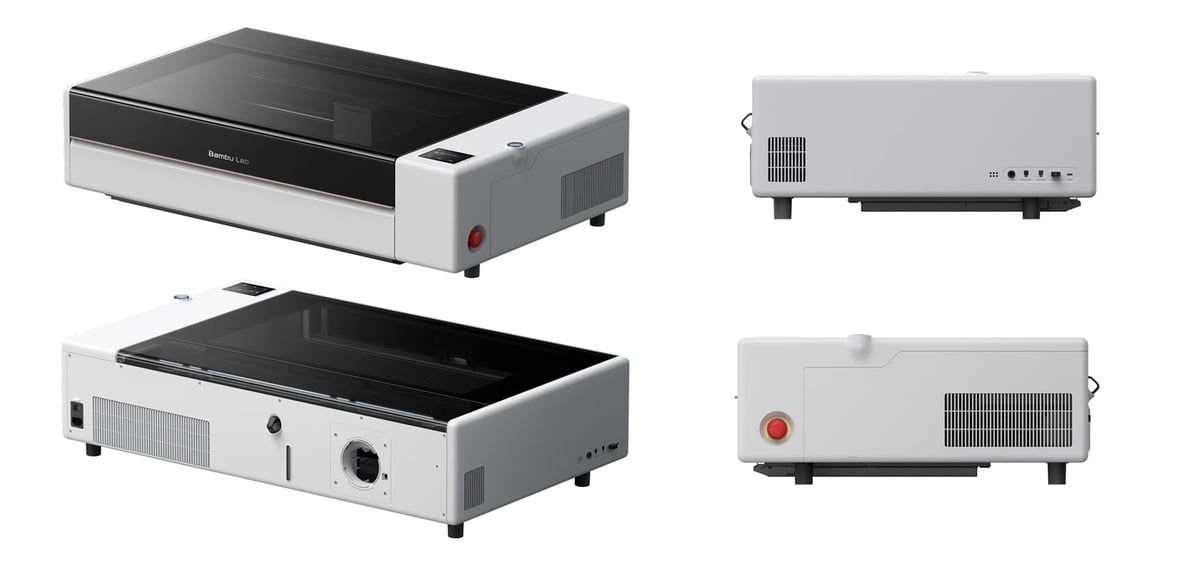
Unlike most Bambu Lab 3D printers, the R1 comes with a wide range of accessories.
A short-focus lens comes with the R1, but the medium- and long-focus lenses are optional. The interchangeable lenses trade engraving resolution against depth of focus: the included short-focus lens produces a smaller spot suited to fine detail and thin stock; medium- and long-focus lenses provide greater depth of focus, which is useful for thicker or less-flat material, at the expense of some fine-detail resolution.
The Riser Base, Conveyor, Rotary attachment, Vision Encoder, E1 Pro Air Purifier, and Auto Fire Extinguishing System are all sold separately.
Pre-orders begin at the Bambu Lab online store September 22, with the first R1 units due to ship in October.
The price is $2,499 in the U.S., excluding tax but including shipping, and €2,499 in the EU, including tax but excluding shipping.
You May Also Like:

License: The text of "Beyond 3D Printing: Inside Bambu Lab’s New Standalone Laser Cutter" by All3DP is licensed under a Creative Commons Attribution 4.0 International License.