Bambu Lab Researchers Are Teaching AI to Split Models Into 3D Printable Parts

The experimental SegviGen system can automatically identify individual components within a 3D model, and its researchers have already released the code, pretrained models, and an interactive demo.
An open-source AI model can now find the seams in almost any 3D file with no CAD skills required. Researchers from Bambu Lab and several Chinese universities have developed an AI system capable of breaking a 3D model into its constituent parts, which is a technology that could eventually make complex models far easier to prepare for 3D printing.
And this isn’t research that’s locked away in a lab. Called SegviGen, the project has been released as open-source software under the MIT License, with code and pretrained checkpoints available on GitHub. Its project page also includes an interactive demo, while the repository provides inference tools for automatic, interactive, and 2D-guided segmentation.
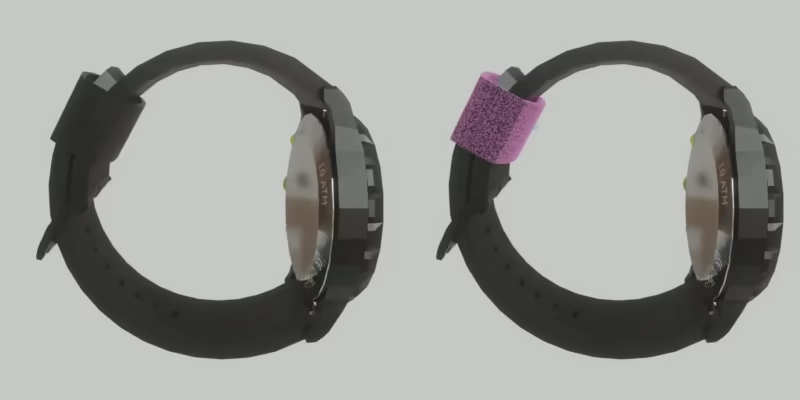
For hobbyists, this isn’t a tool you can use today, but it points at a future where AI can look at any 3D model and intelligently figure out where the natural, printable seams are. This not only makes large models easier to print on smaller print bed and assemble, but splitting lets you orient parts independently to reduce overhangs and support material, plus identifying joints and part boundaries is the first step toward posable, articulated prints.
AI-powered model splitting is already becoming a commercial 3D printing feature. Hi3D and Meshy, for example, now offer tools that divide models into printable components, with Hi3D going as far as generating assembly connectors. SegviGen approaches the problem further upstream: rather than developing a print-preparation tool, the researchers are investigating whether the structural knowledge inside a 3D generative AI model can be repurposed to recognize meaningful parts in almost any 3D asset.
Turning Segmentation Into Colorization
Rather than generating new 3D models, SegviGen repurposes knowledge contained in an existing generative AI model to understand how objects are put together.
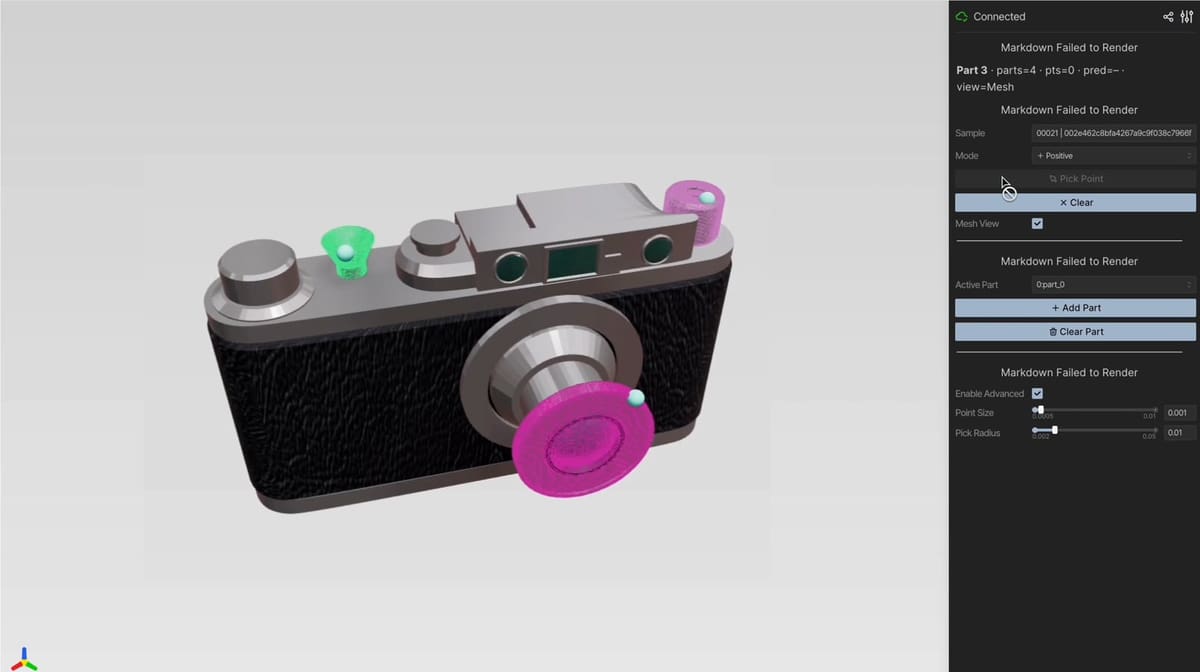
The researchers frame part segmentation as a colorization problem. SegviGen reconstructs an input model while assigning different colors to regions it determines are distinct components. Those regions can then be treated as separate parts.
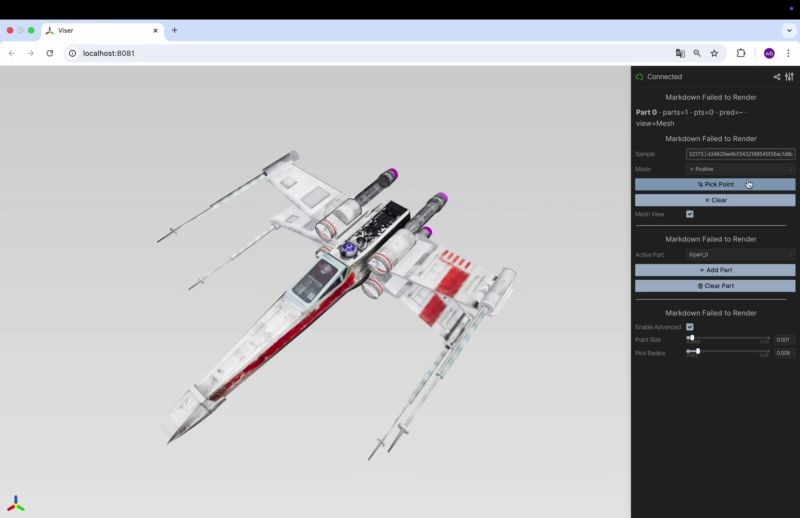
The system supports three approaches. Full segmentation attempts to divide an entire object automatically. Interactive segmentation lets a user click part of a model and asks the AI to identify the complete corresponding component. A third mode uses a segmented 2D image to guide the process and give users greater control over how finely the model is divided.
The researchers specifically identify 3D printing as a potential application, alongside tasks such as part-level editing and animation rigging.
For printing, the interesting prospect is going beyond a conventional planar cut. An AI that understands that a single mesh consists of a body, cover, buttons, handles, or other logical components could potentially help turn monolithic or AI-generated models into parts that can be handled individually further down a manufacturing workflow.
There are some important limits. SegviGen doesn’t currently take an arbitrary mesh and automatically produce correctly toleranced, print-ready components, and Bambu Lab has announced no integration with Bambu Studio, MakerWorld, or its printers. This remains a research project.
SegviGen also isn’t a new proprietary Bambu Lab 3D foundation model. The researchers built it by repurposing Trellis.2, an existing pretrained 3D generative model, and fine-tuning part of it for segmentation. Running SegviGen locally requires rather beefier hardware than Bambu Studio, however: the researchers specify Linux and an Nvidia GPU with at least 24 GB of memory.
Still, having both the research and working code available makes SegviGen more than a glimpse at a hypothetical future feature. Anyone with sufficiently capable hardware can already experiment with the technique — even if getting from AI-generated segmentation to a one-click “split this model for printing” button remains work for another day.
__________
The research includes Bambu Lab researchers Sheng Wang and Buyu Li alongside researchers from Renmin University of China, Tsinghua University, and Beihang UniversityWha. The work was published in ACM Transactions on Graphics as part of SigGraph 2026, the expo on Computer Graphics & Interactive Techniques in Los Angelas.
You May Also Like:



License: The text of "Bambu Lab Researchers Are Teaching AI to Split Models Into 3D Printable Parts" by All3DP is licensed under a Creative Commons Attribution 4.0 International License.