
Backer or Buyer? When Million-Dollar Companies Crowdfund, You Still Carry the Risk

Some 3D printer Kickstarter campaigns look like global product releases with finished, guaranteed products. I always assumed Kickstarter wouldn't be cool with this, but digging deeper I see it's an evolution to a new status quo. But shouldn't Kickstarter evolve with it?
Multi-million dollar companies like Snapmaker are using Kickstarter to launch new products, and frankly, this seems like a problem to me. While it might look like you’re just pre-ordering a 3D printer, the reality is different: you’re backing an idea with none of the usual consumer protections. The way the campaigns present themselves go against Kickstarter’s own written rules and set seemingly arbitrary goals that are quickly exceeded.
So indulge my thoughts on the topic for a few paragraphs, and then sound off in the comments. Agree, disagree, whatever your stance: I’m keen to learn if I’m overthinking this or not.
I’ll begin by prefacing things with what my understanding of Kickstarter has always been, which I’m sure anyone with a long-term familiarity with the platform loosely shares. This is important, because Kickstarter itself has weighed in and paints a different picture, as I’ll get to later.
Kickstarter is a crowdfunding platform. Obviously. Others exist, but it’s the one that’s virtually verbified at this point. In my minds-eye, the purpose of such a platform is that a resource-strapped creator can pitch their product or idea for interested backers to contribute token amounts of money, often in exchange for privileged early access to the product. But not always. The idea and endeavor is what is being backed, and the material “reward” is a non-binding promise. That’s my interpretation, at least, and was how the platform started, I’m sure. Depending on where you look on its site, Kickstarter’s description of itself echoes this, too.
It should be the case that backers know where their money is going. Historically, this has been through campaigns outlining what they intend to use the funds for – say, materials, tooling, staffing, etc. As a backer you are brought along for the ride. Kickstarter’s own “rules” about how campaigns should be conducted assert this. They state that campaigns:
"Do :

- Talk about your project in its current state and what you’re hoping to achieve with your backers’ support.
- Use language that speaks to your hopes and dreams, such as “I want to…” rather than language like “it will,” which suggests that your product is finished and ready to ship.

Do not :

- Talk about your rewards as if they already exist, if they don’t yet.
- Make assumptions about whether you’ll be able to sell your product after Kickstarter, such as referring to its retail value (ex. “50% off retail price” or “35% off MRSP”)
- Make guarantees or promises you can’t keep."
The platform’s guidance regarding project claims goes on to advise campaigns not to “describe your rewards as ‘preorders’ or ‘presales’, or otherwise give the impression that your project is a storefront.”
This is exactly what campaigns like the Snapmaker U1 and EufyMake E1 do; long lists of rewards at x% off MRSP, descriptions of “what’s in the box” and, basically, the comforting, familiar presentation of things you can buy.
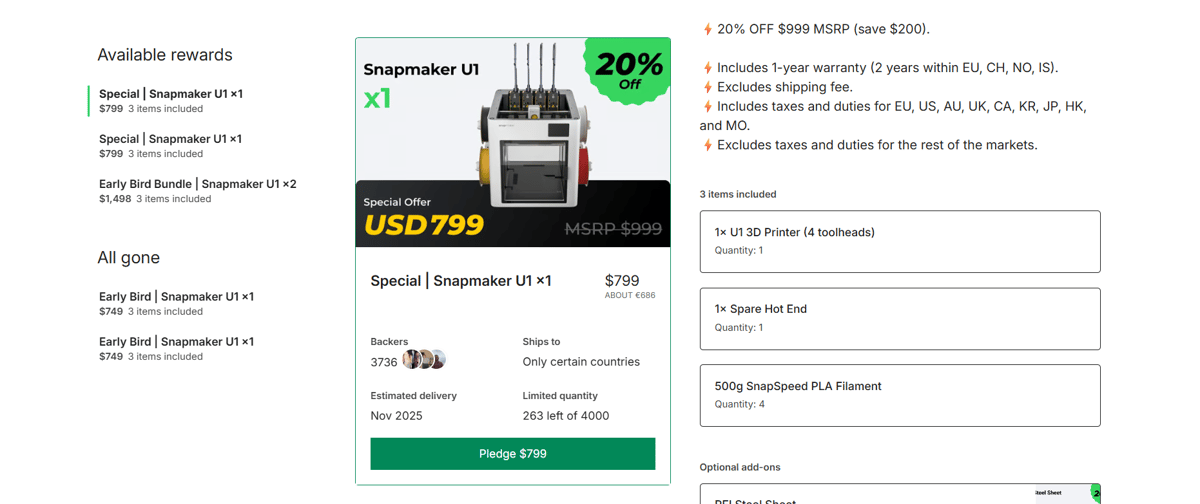
The funding targets for campaigns are supposed to be realistic and, importantly, explainable. I approached a PR contact for Snapmaker, who I’ve communicated with throughout the U1 campaign to explain Snapmaker’s goal for the U1, which is set at $100,000. Napkin math tells me that Snapmaker has made 15,000 printers available through all backer levels of its campaign, which equates to approximately $6 per printer from the desired funding. The response? The number is either a mistake, or a “default goal, instead of a realistic one”. Many campaigns in 3D printing use the same $100,000 as the crowdfunding goal. Hmm.
So we can assume that, at least in some cases, the target funding amounts set by campaigns are irrelevant. That money isn’t needed in any meaningful sense of the development of the product.
I can make my peace with this being the accepted nature of Kickstarter, as an easily promotable storefront for product preorders. Dropping the pretence of “required” funding for such campaigns would be one small step towards remedying what I see as a superficial level of transparency in the current state of campaigns like this.
However, my biggest problem with this new status quo is that the relationship between backer and campaign that Kickstarter facilitates is unchanged.
From the campaign’s side, it is exactly the same between an inexperienced solo operator bootstrapping an idea out of their bedroom as it is for an established manufacturer and retailer, with millions in turnover each year, hundreds of employees and recently secured venture capital backing. (In case you hadn’t guessed, that describes Snapmaker.) On paper, there’s a massive difference between those two situations, but as a backer giving your money to them, however, there’s zero difference. You can even contribute money just because you like the idea through the “Make a pledge without a reward” option.
For campaigns like this I see it as the equivalent of slinging Samsung a few dollars because you like the next smartphone they plan to release. It’s absurd, and clearly a collision of two systems that haven’t yet arranged themselves properly.
This is a drum we bang a lot on All3DP whenever we cover a Kickstarter campaign. While we recognize the platform’s importance in bringing new hardware to the market, Kickstarter is not a shop. Your money is not technically “buying” anything, you have no legal recourse or protection if something goes wrong and your money disappears into the ether of financial mismanagement or misfortune. There is no legal obligation on a company to fulfil the reward attached to your pledge, or refund you if the collected funds have, for whatever reason, disappeared.
There is, of course, an inverse relationship at play; the larger the company Kickstarting a product, the less likely something major happens to jeopardize the rewards. I recognize it, but I also don’t think it’s good enough to rely on this assumption. Even if the risk is minimized, it’s still a risk, and companies with resources magnitudes greater than the small-scale creators are held to the same “best-effort” standards that do not apply to any purchase of their products from elsewhere.
When questioned about the discrepancy between what its own guidance for campaigns details, the threat of censure for failing to follow them, and the campaigns that are achieving big-money success (along with promotion from Kickstarter itself via its “Project We Love” badge), a representative told me:
"As crowdfunding has evolved, so has the way people use it. Today, it's not only about raising money; it’s also a way to launch with transparency, learn from your earliest adopters, and build momentum and buzz. Backers often help shape the product through their input, questions, and suggestions. Even when a product is close to release, that kind of feedback loop can be critical. And it benefits backers to have the opportunity to make a product more responsive to their real needs.

Ultimately, it’s backers who decide which projects to support. They do so with the understanding that Kickstarter isn’t a traditional store; it’s a way to be among the first to discover and support new ideas.

Our rules and review processes are designed to ensure campaigns are honest and transparent about what backers are supporting. Projects of all sizes must follow these guidelines, and our Trust & Safety team monitors reports and enforces policies when necessary. Products that are ready – or close to ready – to release aren’t prohibited, as long as creators clearly communicate what stage they’re in and what backers can expect."
I’m not sure that I agree all backers do so fully aware of the nature of the transaction that’s happening, and note that even if Kickstarter does not considers itself a “traditional” store, the implication is there. Regardless, the company’s words signal that Kickstarter is all aboard this new reality of it being a platform for preorders, whether or not this is at loggerheads with the some of the rules it suggests to campaigns.
Considering pre-order campaigns are entirely possible via an established manufacturer’s own webstore with local governments’ consumer protections bodies in place for those purchases, I believe that change is needed to alter that relationship between backer and campaign. Moreso when by Kickstarter’s own admission these products can already be “ready” when they arrive on the platform.
This article picks on Snapmaker because they’re the freshest example I can point to, but I do not blame them. And nor are they alone. Plenty of other “big enough” companies have released products through Kickstarter that I’m sure were ready enough and could have gone through their own channels, including: Creality, which is preparing to float a public IPO; EufyMake, a part of the massive Anker Innovations group; and Elegoo, which has launched a healthy lineup of 3D printers without the need for specific funding via Kickstarter. In the 3D scanning space, Revopoint regularly released its scanners via Kickstarter campaigns, too.
I am not opposed to Kickstarter being used as a preorder platform by these companies – they’re simply using the tools available to them. As a writer on a site that gives oxygen to such campaigns, I’m under no illusions about the role that All3DP no doubt plays in all this, too. But in my view, if Kickstarter is comfortable with the way crowdfunding has “evolved”, than it should evolve to better cover the public funnelling money to it, too. Particularly when what’s on offer is, effectively, a ready-to-ship product. That’s not a creative collaboration between the public and a creator – it’s a shop. But remember, Kickstarter is not a shop.
Agree? Disagree? Let me know in the comments.
Other stuff we’ve published recently:
License: The text of "Backer or Buyer? When Million-Dollar Companies Crowdfund, You Still Carry the Risk" by All3DP is licensed under a Creative Commons Attribution 4.0 International License.