Alveo3D Expands into Shop Fume Extraction with FE150 & FE350

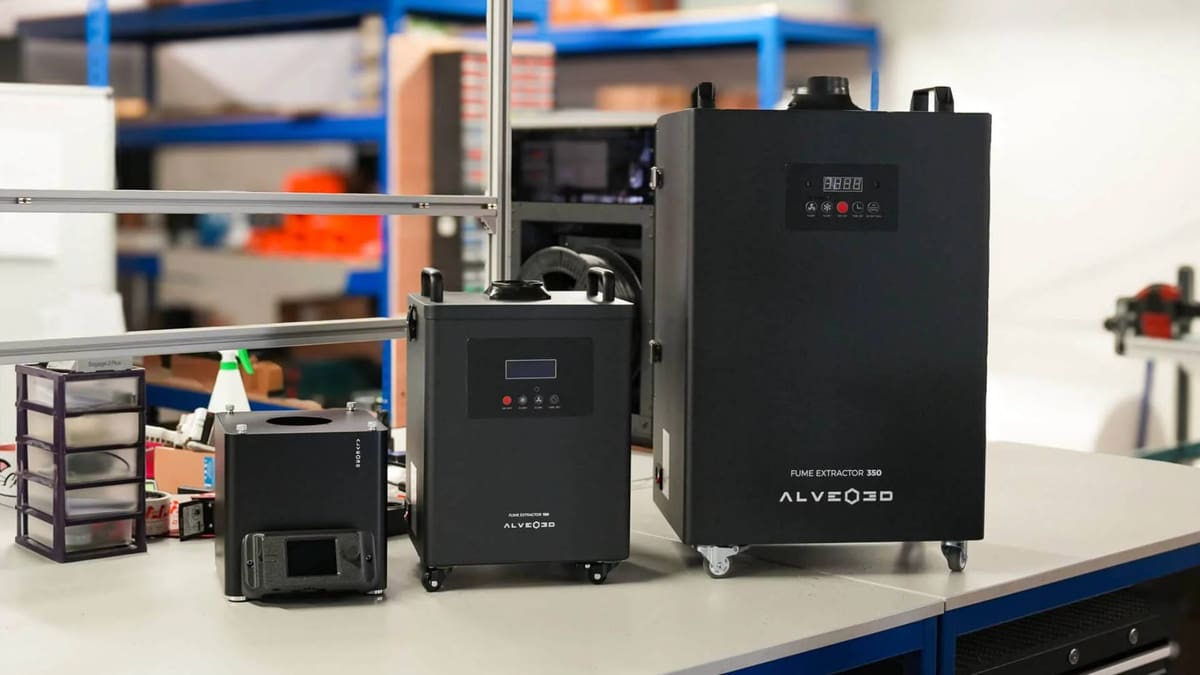
Alveo3D, the French 3D printing air filtration specialist, has released two new workshop-class fume extractors. FE150 and FE350 join the company's smaller, enclosure-specific solutions and mark an expansion into general purpose extraction suitable for heavier duty tasks and environments.
The smaller of the two, the FE150, claims 258 m³/h airflow through a choice of HEPA 13 or HEPA 14 filters and an activated carbon filter stack, at around 55 decibels. Each filter includes a G4-grade prefilter for larger particles, plus an activated carbon stage for volatile organic compound (VOC) capture. The unit itself goes for €720 (~$830), with replacement filters starting at €156 (~$180). Alveo3D rates the FE150’s filters as good for around 1,500 hours of operation.
The larger FE350 provides airflow at 460 m³/h through a three-stage filter that comes in HEPA 13 and HEPA 14 variants. The G4-grade prefilter is also present here, but with two layers of activated carbon to deal with VOCs, odors, and gas. Louder than the FE150, the FE350 tops out around 68 decibels. That scaling of size and power is matched by the price: €1,848 (~$2,130), with the combo filter packages starting at €624 (~$719). Alveo3D rates the FE350 filters for up to 3,000 hours – double the FE150’s.
These filtration units are several times more powerful than Alveo’s single-enclosure-specific AlveoPro unit. Why you’d pick any one over another is dependent on your setup and working environment. The AlveoPro (which costs more than the FE150, oddly) is a compact device best suited to scrubbing a single enclosure’s 3D printing emissions. The FE150 is a powerful step up suited to workshops with various devices requiring filtration, including smoke extraction. The FE350 stands as the heavy-duty version, “built for industrial environments,” says Alveo3D.
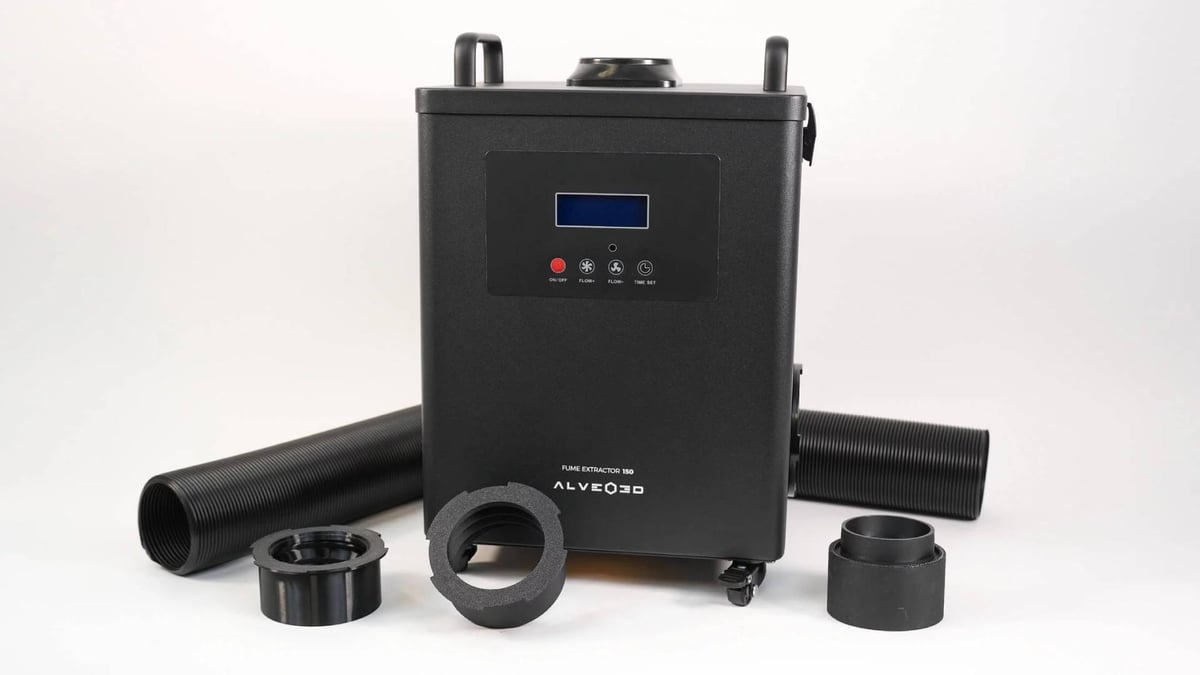
Both the FE150 and FE350 capture the emissions at their source. You position the inlet hose or hood close to the active work – Alveo3D recommends within 150 mm – and the unit pulls contaminated air through the filter stack, returning cleaned air to the room via a separate exhaust outlet duct. No external venting is required, which simplifies installation but means the room’s air quality depends entirely on filter condition. That means you need to change the filters when they’ve reached the end of their operational lifespan or, per Alveo3D’s recommendation, at the latest every 12 months.
On that note, Alveo3D’s blog describes internal testing of the FE150 and FE350 with “encouraging” preliminary results, but publishes no actual filtration performance data beyond the HEPA spec sheet rating. Neither unit includes a VOC sensor or saturation indicator – only a working-hours counter. A degree of operator vigilance is necessary to ensure the filter quality and replacement is tracked. Both FE models include remote controls, adjustable fan speeds, operational timers, and safety locks to prevent tampering.
The FE150 and FE350 are rated for particulates from 3D printing, laser cutting, CNC routing, and soldering, making them less a 3D printing-specific solution than we typically see from the brand, and more a workshop unit you can move between different production processes. For makerspaces and fablabs that currently vent to a window or run no extraction at all on their non-printing equipment, a multi-process unit at this price seems to present a fairly novel solution.
Earlier this month, Alveo3D launched a print-at-home HEPA 14-equipped kit for the Bambu Lab P2S (€89), plus a companion kit for the H2 series, indicating a progressive move to offer air-quality systems for most use cases and price points. The FE150 and FE350 are available now from the Alveo3D webstore.
Read more recent news:
- Anycubic's Spring Sale Drops the Multicolor-Printing Kobra X to $279
- Prusa's MMU3 Gets a Farewell Firmware Boost, Shifts to DIY Path for Core One L
- Snapmaker U1 Hits Retail April 10 – Price to Jump to $899
Tired of Reading? Try Listening
License: The text of "Alveo3D Expands into Shop Fume Extraction with FE150 & FE350" by All3DP is licensed under a Creative Commons Attribution 4.0 International License.