SLS 3D Printing Services: 10 Options Compared for Nylon Parts and Prototypes

We uploaded the same test part to 10 online SLS 3D printing services to compare pricing, lead times, materials, and quoting quirks for functional nylon parts.
Prototypes & End-Use Parts
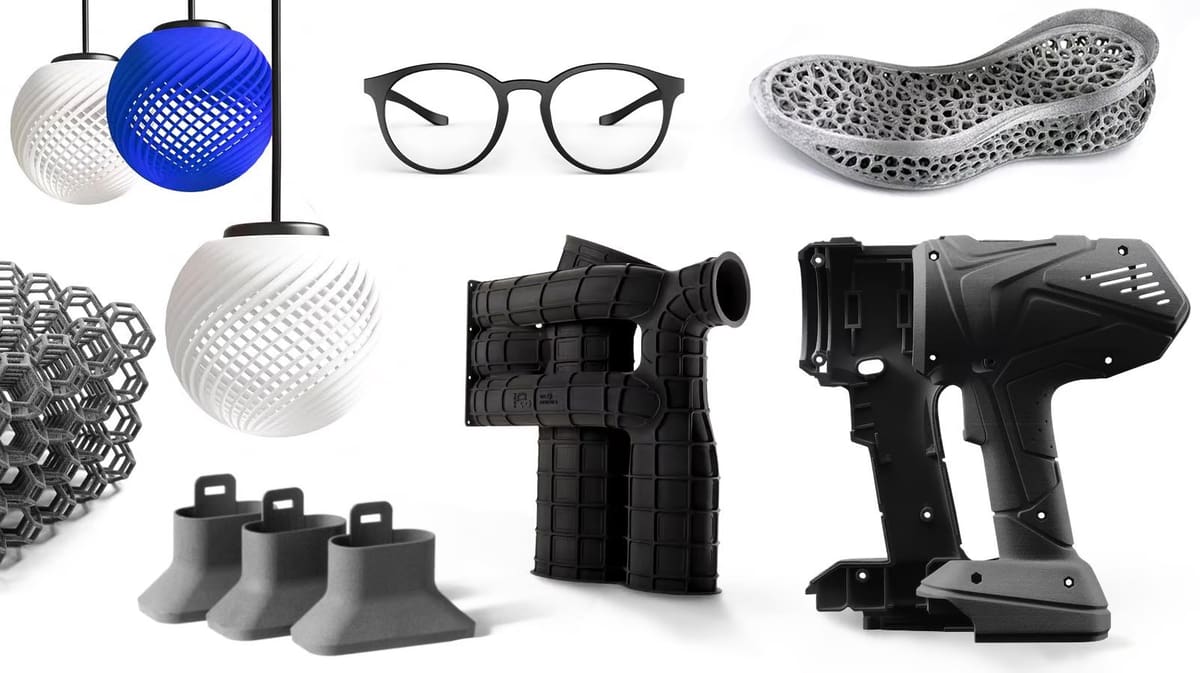
If you need spare parts, shop tools, factory aids, rugged parts or prototypes, then SLS is the 3D printing technology you’re looking for, and it’s more accessible than you thought.
You don’t need to own your own printers or even know much about the technology to get the part you need produced fast. Instead, try an on-demand 3D printing service. With the growing number of these services, you can get your single part or small batches of parts printed without making large investments. With a printing service, it’s a good way to see if the technology suits your application before committing to a printer purchase.
If you’d like to understand SLS printing technology a bit more, skip to the SLS 3D Printing Explained section below.
Who’s On The List
To make our list of best services, on SLS provided needed to meet or exceed a few basics in the following categories:
- User-friendliness: A website where you can easily upload your designs and access resources.
- Free Instant Quote: Today, there’s almost no reason a company can’t provide an quick quote on a straightforward part.
- Material selection: The ability to print in a variety of SLS materials, such as nylon (also carbon-fiber filled), polypropylene (PP), and flexible materials (TPE, TPU).
- SLS printer brand: Although not every service provider listed which SLS printers they print with, most on our list did. This is important when you’re looking to evaluate the technology before you make your own printer purchase.
- Free guidance or troubleshooting: If you’re new to SLS or don’t have a printable digital file of your part, can you find self-help resources or reach out for live help?
- Post-processing: SLS parts don’t require much post-processing, but services that offered coloring and finishing options got bonus points.
What to Know Before Ordering:
Our Test Part Quoted at 10 SLS 3D Printing Services
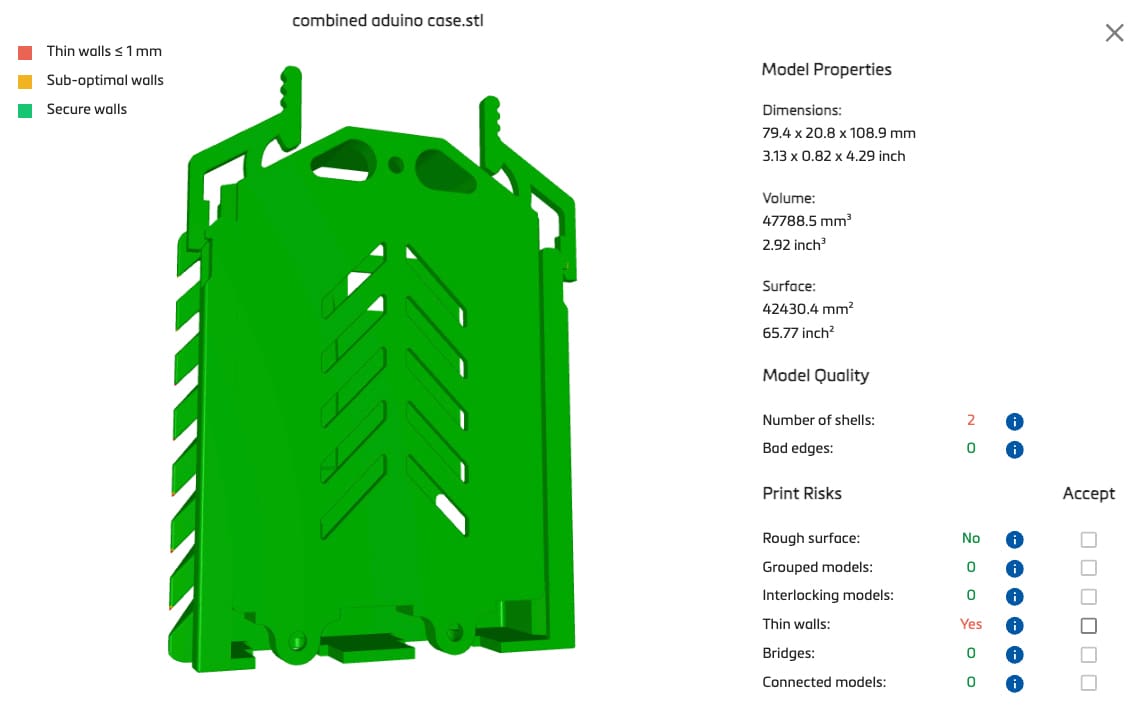
To give you a sense of the prices you can expect from these services, we uploaded the same sample part to each and requested a volume of 1, 10, and 50, 3D printed using SLS technology in nylon 12, and dyed black if not already in a black material.
Our part, a small electronics enclosure with a snap-fit lid, represents the kind of functional, end-use geometry SLS is especially good at producing: thin walls, internal ribs, screw bosses, cable openings, and interlocking features that need to fit together without supports.
Tops for getting an accurate online quote:
- Investigate where the company does it’s manufacturing so you can know if there will be import tariffs and substantial shipping fees
- Some systems default to SLS printing, while others don’t. Be sure you’ve selected SLS.
- Ensure you’re informed of any extra fees or taxes
- Review wall thickness and feature-size rules in the service’s design guideline before uploading.
- Beware of Look for minimum order charges
- Look for certification or documentation options if these are relevant to you
- Check IP and confidentiality terms
*(without shipping, import fees). Prices as of June 10, 2026.
Craftcloud
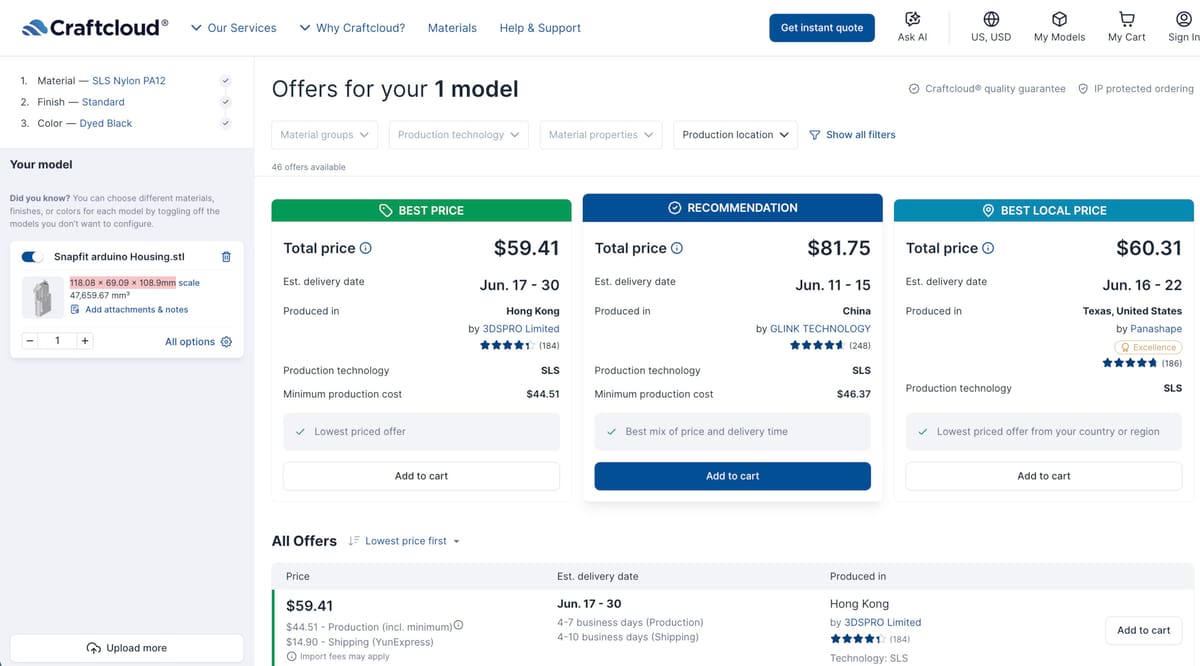
Craftcloud, by All3DP, is a global manufacturing marketplace, not a single production facility. It enables you to instantly compare prices and lead times from more than 150 printing service providers across the globe. Partners in 95 countries have produced more than 8 million parts for Craftcloud customers across 31 technologies and hundreds of materials.
All you need to do is upload your digital model, pick the material and the type of finish you need, and browse through the generated list to find a quote that fits your needs. Craftcloud generates quotes in real time without hidden fees, so you will always get an accurate quote.
When it comes to SLS, you can choose between nine materials suitable for a wide range of applications. The materials can be dyed to dozens of colors, offering a high level of customizability. The service works for both one-off prints, like gifts or prototype samples, and small batches of fully functional industrial-grade parts.
Craftcloud also offers an AI interface (plus an extensive library of material and support documentation) to help you quickly and accurately choose the right material and technology for your part.
- Maximum build volume: Varies by supplier
- Detail level: Varies by supplier
- SLS Materials: nylon PA12, nylon PA6, nylon PA11, nylon PA11 CF, TPU, nylon PA66, nylon PA11-ESD, alumide, PP
- Turnaround: Varies by supplier
- Finishing: Color dyeing, waterproofing, satin polishing
Fictiv
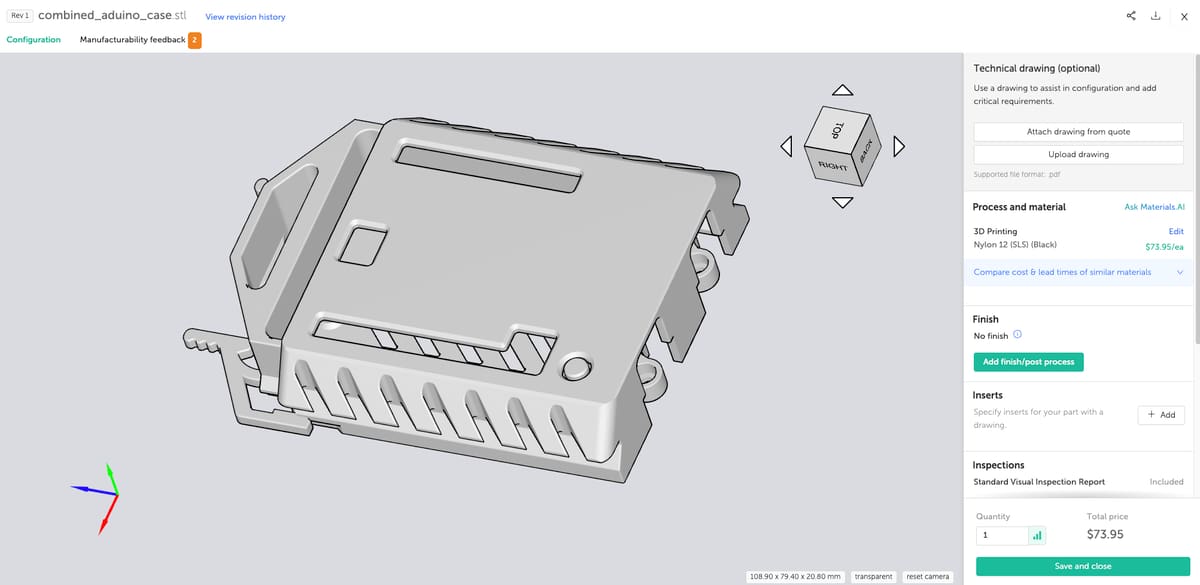
Fictiv is an on-demand digital manufacturing platform that offers 3D printing, CNC machining, sheet metal, injection molding, urethane casting, die casting, and other custom manufacturing services through a vetted supplier network. For 3D printing, the company supports online file upload, instant quoting for most jobs, configurable material and lead-time selections, DFM feedback, and order management, making it a strong fit for engineers who want fast pricing without starting with a sales call.
Fictiv offers several 3D printing processes, including SLS, MJF, SLA, FDM, PolyJet, and Carbon DLS. Its SLS service is aimed at functional testing and low-to-mid-volume prototyping, especially for strong nylon parts, durable enclosures, brackets, housings, fixtures, and other components where support-free powder-bed printing is useful. Because Fictiv offers both SLS and MJF nylon options, be careful to select SLS specifically if that is what you want; the company’s material pages list some nylon materials under both SLS and MJF, and the available colors, resolution, build size, and pricing can differ by process.
For SLS, Fictiv lists Nylon, Nylon 12 Flame Retardant, and TPU 88A. Its standard SLS nylon can be ordered in white or black, while Nylon 12 Flame Retardant is listed in white and TPU 88A in black. Fictiv publishes useful design rules for SLS, including 0.5 mm clearance between mating features, 1.0 mm minimum wall thickness for production, 1.5 mm for consistent measurement or mechanical properties, and tolerance of ±0.25 mm plus 0.002 mm/mm.
- Maximum build volume: 700 x 380 x 580 mm for SLS nylon and Nylon 12 Flame Retardant; 680 x 380 x 580 mm for SLS TPU 88A
- Detail level: 0.1 mm resolution
- SLS Materials: Nylon, Nylon 12 Flame Retardant, TPU 88A
- Turnaround: 3 days for SLS; 3D printed parts can be available as fast as next-day depending on process and configuration
- Finishing: Assembly, Clear Coat, Dyeing, Media Blasting, Painting, Polishing, Sanding, Vapor Smoothing
Materialise OnSite
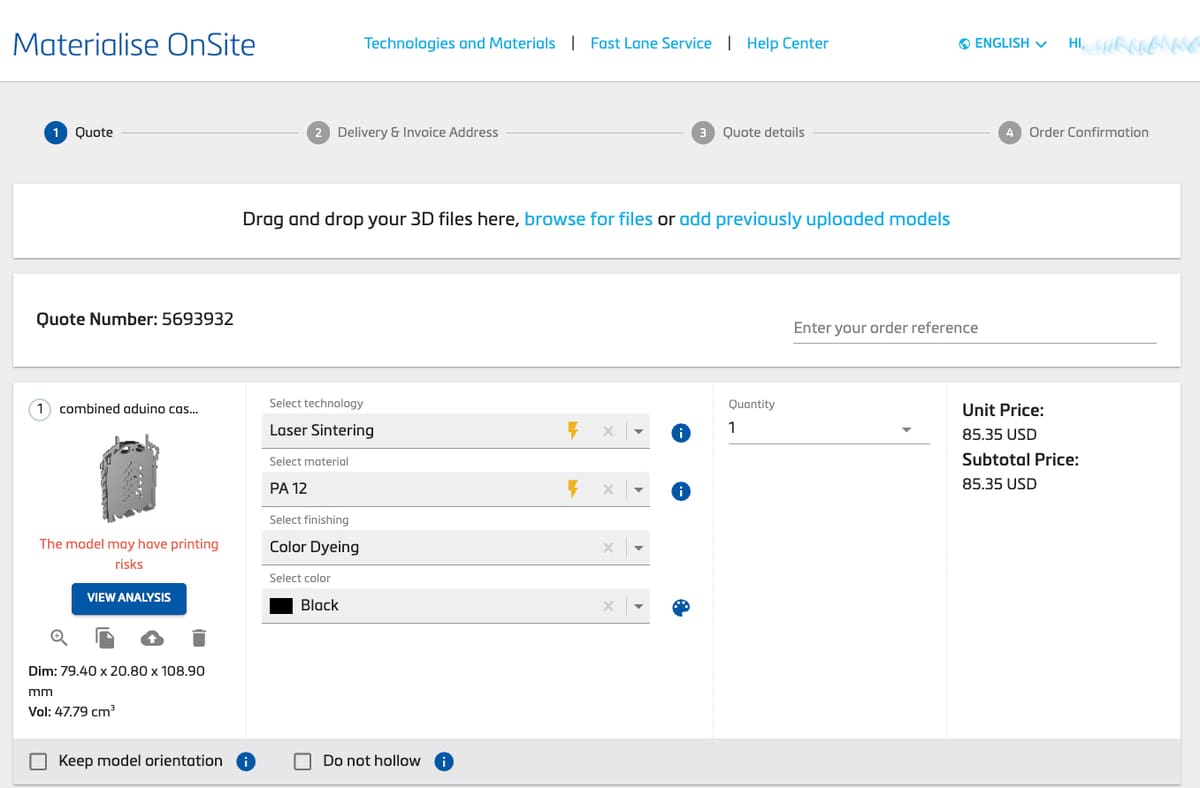
Materialise has been active in additive manufacturing for more than 30 years. Over this long history, they’ve built a reputation with their software solutions, but the company also offers a large range of on-demand 3D printing services, including SLS printing technology.
Materialise offers an instant quoting service, called Materalise OnSite, and another service aimed at manufacturers that want larger quantities. OnSite offers seven materials including specialty options such as Bluesint PA12 consisting of 100% recycled powder and flame-resistant PA 2210 and 2241 FR materials. Materialise is a great option for environmentally-conscious users or those requiring high-grade parts for demanding applications.
It is interesting to note that although the size of single parts is limited to a maximum dimension of 630 x 330 x 550 mm, Materialise says it can create parts with practically unlimited dimensions by splitting prints into several sub-components. Post-processing options include sandblasting, polishing, sealant treatment, dyeing, and painting.
Delivery times aren’t the fastest — starting at 4 business days for most materials, while some, like PA-GF, require up to 8 days. However, Materialise can produce parts smaller than 200 x 100 x 100 mm with only two-day lead times.
Their catalog also lists design, engineering, and rapid prototyping services for additive manufacturing, in addition to consultation and training. Ordering online is quick and easy, with instant quotes.
- Maximum build volume: 630 x 330 x 550 mm
- Detail level: 120 microns
- SLS materials: Bluesint nylon PA12, nylon PA12, PA-AF (Aluminum Filled), nylon PA-GF, PP, nylon PA 2210 FR, nylon PA 2241 FR
- Turnaround: From 4 business days
Protolabs
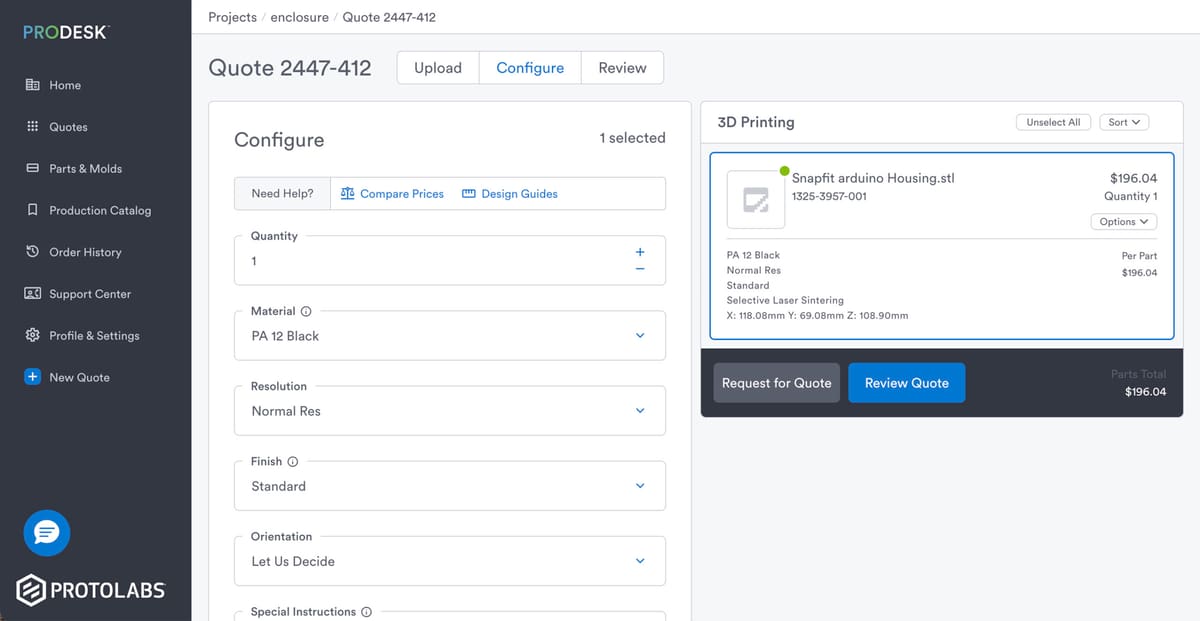
Protolabs was founded in 1999 with the goal of reducing lead times with prototyping. Its 3D printing service launched in 2014 and has been expanding it ever since. In 2021, for example, Hubs came under the Protolabs family. Today, the company operates 12 manufacturing centers in the U.S., Europe, and Japan.
Protolabs’ SLS 3D printing service has a good material range, covering eight options from standard nylon PA12 to glass- and mineral-filled options and more. The company can produce parts at great speeds. Protolabs says lead times for SLS-printed prototypes and functional parts can be as short as one business day. A new low-cost economy shipping option was recently added to Protolabs’ delivery methods.
For post-processing services, Protolabs’ standard SLS service includes bead blasting. It also offers priming and dyeing options. Other post-processing methods that may be available for certain SLS parts include clear coating, nickel plating, decaling, and polishing.
Unlike many other companies on this list, Protolabs doesn’t offer design services for CAD models. They do however, have a nice library of design tips and guide materials available to help businesses new to 3D printing. With very fast production speeds and simple instant quoting, Protolabs is a good prototyping partner.
- Maximum build volume: 482 x 482 x 431 mm
- Detail level: 100 microns
- SLS Materials: nylon PA12, nylon PA12 GF/MF, nylon PA11, PP, TPU
- Turnaround: From 1 business day
- Finishing: clear coating, nickel plating, polishing
JawsTec
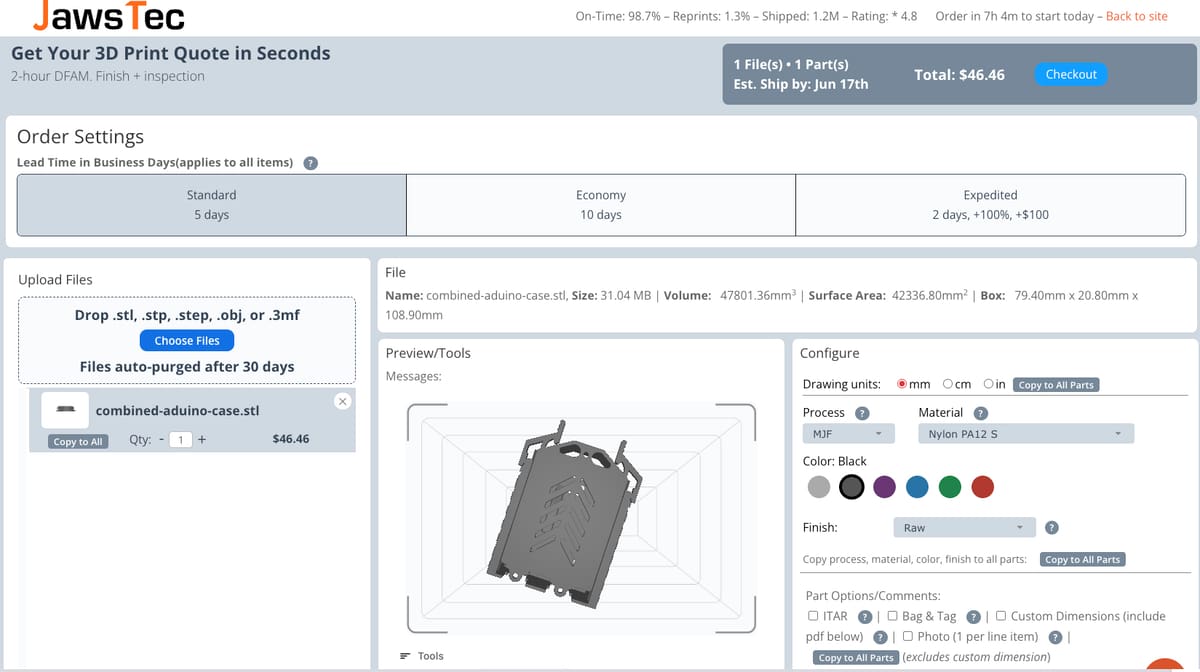
JawsTec is a U.S.-based additive manufacturing service bureau located in American Falls, Idaho. The company focuses heavily on functional nylon 3D printing and offers online instant quoting for uploaded CAD files, along with additional services such as CNC machining, metal fabrication, 3D design help, tapping, threading, and finishing. JawsTec is a good fit for buyers who want a smaller U.S. service provider with fast online pricing, strong nylon powder-bed capabilities, and support for both prototyping and production runs.
JawsTec offers several additive manufacturing processes, including SLS, MJF, SLA, SLM, VCJ, and FDM. Its instant quote page lists SLS materials including Nylon PA2200, Nylon PA12, and TPU. PA2200 is described as a white laser-sintered nylon with high dimensional accuracy and good strength, while SLS Nylon PA12 is an off-white laser-sintered nylon with similar strength and dimensional accuracy but lower manufacturing cost and smaller box constraints. The company also offers SLS TPU, a rubber-like material for applications such as soles, padding, cases, protective gear, and clips.
Be careful when using the quote tool, because JawsTec offers both SLS and HP Multi Jet Fusion, and its MJF material menu is broader than its SLS menu. If you specifically want laser-sintered parts, select SLS rather than MJF. Also note that the expedited-order option is limited to MJF PA12 or MJF PA12S; selecting expedited service can convert non-MJF parts to MJF nylon. For SLS, standard or economy lead-time options are more relevant.
- Maximum build volume: Not clearly published in the quote tool; SLS PA12 is described as having smaller box constraints than PA2200
- Detail level: wall thickness guidance is 1 mm for SLS PA2200 and SLS PA12, and 0.75 mm or greater for SLS TPU
- SLS Materials: Nylon PA2200, Nylon PA12, TPU
- Turnaround: Standard and economy lead times vary by process and material; expedited 2-business-day service is listed for MJF PA12 / PA12S, not SLS
- Finishing: Dyeing for SLS PA2200, PA12, and TPU; texture tool available for SLS PA2200 and PA12; raw, tumbled, polished, and vapor-polished finishes are also referenced by the company
Protiq
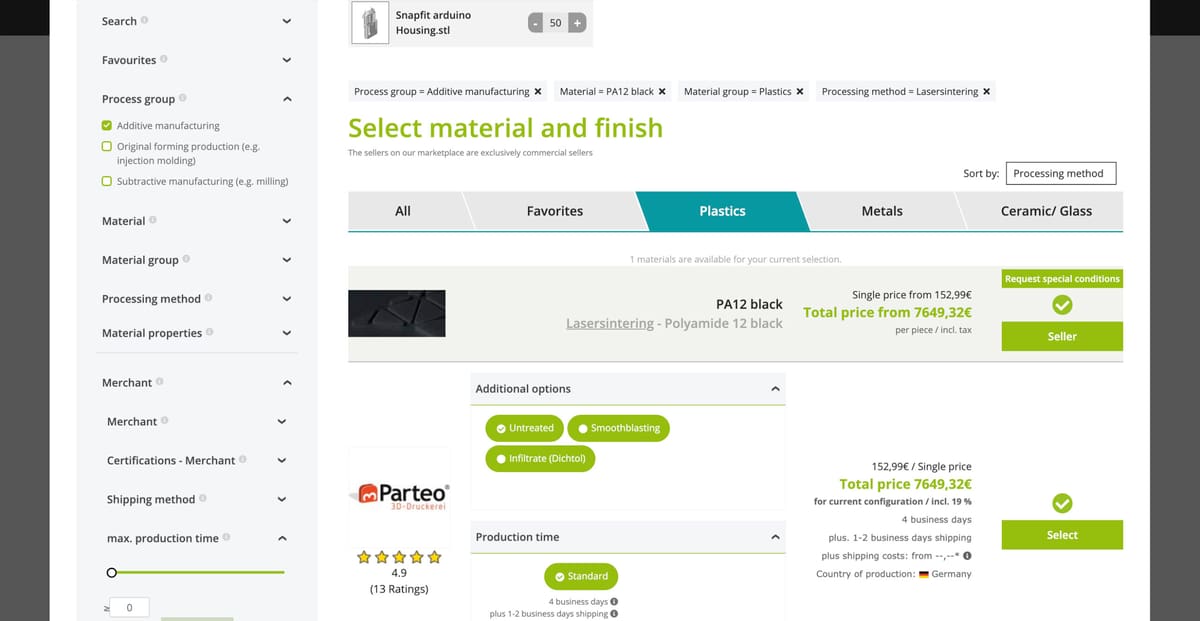
Protiq is a Germany-based manufacturing service provider that offers a range of additive manufacturing solutions including SLS. Like other companies on our list Protiq offers rapid prototyping, on-demand production, and custom manufacturing for customers who upload their 3D models, choose the desired material. Setting Protiq apart, however, is its focus on industrial manufacturing.
Protiq is a marketplace of manufacturing partners. It’s interface is not especially user friendly. After you’ve uploaded your part you need to configure your 3D printing technology, materials, and finish from a very long drop down menu that pops up in a new window. If you want SLS, you’ll need to select the “processing method” of “lasersintering”, which feels like an auto-translation to English of the literal German. You’d only select Protiq if you were in Germany or Europe anyway, but we did convert the Euros to Dollars for our part quote comparison.
The marketplace does disclose who will be printing your part, which is a nice touch, similar to how Craftcloud does it.
After you select your materials and technology, in the shopping cart, you can save individual offers, forward your projects to colleagues or go straight to checkout.
Protiq has been the additive manufacturing wing of the Phoenix Contact Group, the electronics and automation manufacturer, since 2010.
- Maximum build volume: 660 x 360 x 550 mm
- Detail level: 60 microns
- SLS Materials: PA12 (PA 2200), PA12, PA12 glass bead, PA12 aluminum-filled, PA12 FR, TPU-90, PEEK, PA6X, PP
- Turnaround: 6-7 business days within Germany
- Finishing: depends of vendor
Quickparts
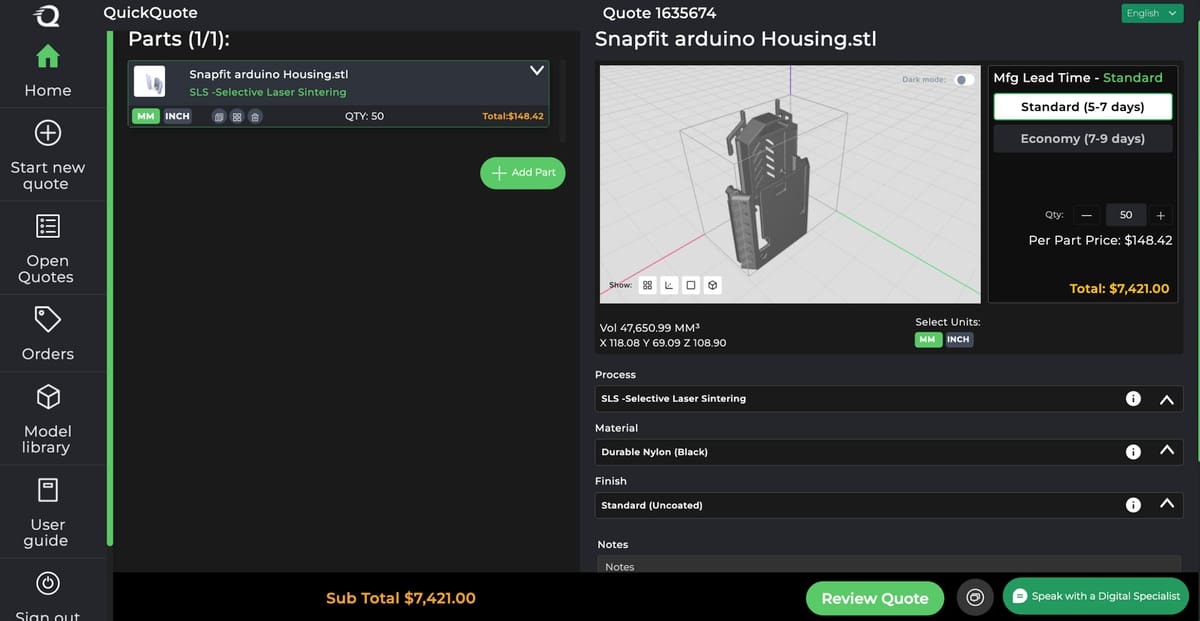
Quickparts’ on-demand print service and global network of providers offering a wide range of plastics and metal printing along with design and engineering services. The company has been SLS 3D printing parts for many years and has the expertise to recommend materials and finishes if you’re not certain what you need.
Be careful that a method of 3D printing (FDM, SLA, SLS, etc.) is automatically chosen for you so if it’s not what you want be sure to change it. When we uploaded our enclosure, the interface defaulted to SLA. Under the SLS menu you can pick generic “nylon”, but if you dig deeper you can find that it’s DuraForm PA, which is a PA 12. The instant quoting system flipped to a manual quoting system the minute we added “dyed black” to our order.
The company uses SLS 3D printers by 3D Systems exclusively because they used to be the on-demand service provider of that company before breaking off on their own.
- Maximum build volume: 340 x 340 x 600 mm
- Detail level: 60 microns
- SLS Materials: nylon PA12, nylon PA12 GF, nylon PA12 high temperature, TPU
- Turnaround: 1 business day
- Finishing: Color dyeing, spray painting, vapor smoothed, custom
Stratasys Direct
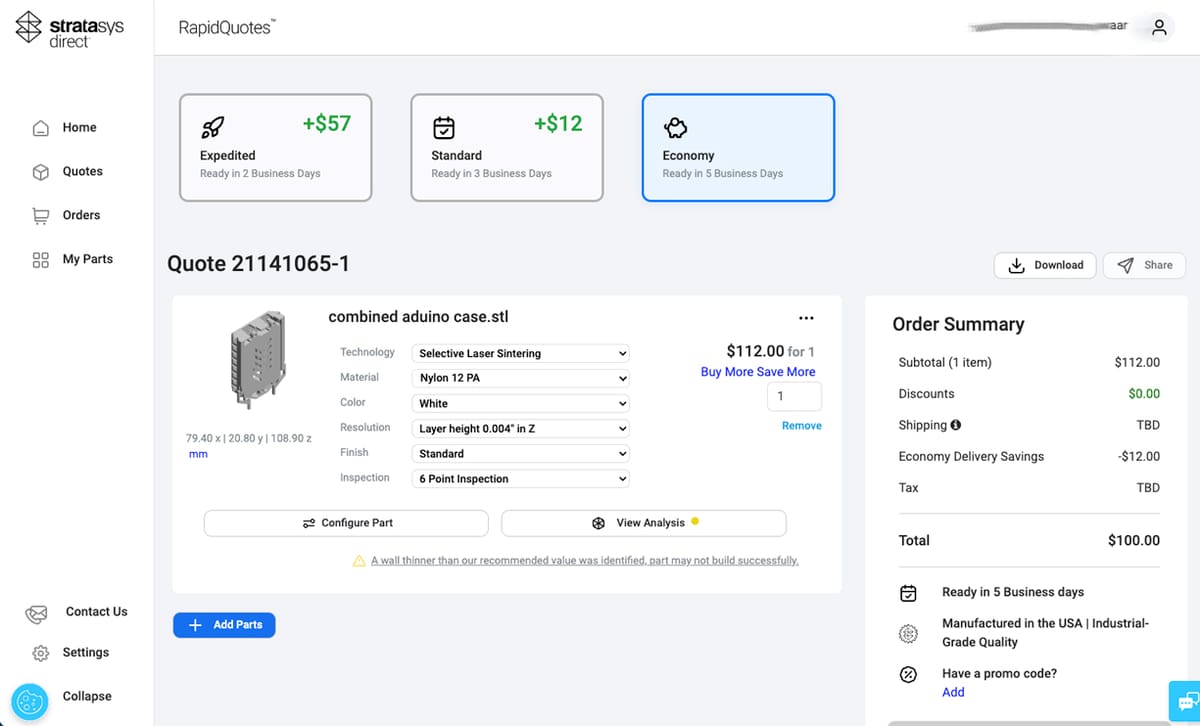
Stratasys Direct is the on-demand manufacturing arm of Stratasys, one of the best-known names in industrial 3D printing. The company offers online ordering through its RapidQuotes system, which was a bit buggy and couldn’t quote our part in a quantity above one.
Stratasys Direct emphasizes quality systems and compliance, including ISO 9001, ISO 13485, AS9100, and ITAR registration.
The company has deep SLS experience and promotes more than 30 years of laser-sintering know-how, with a Texas facility that it describes as having North America’s largest collection of large-format SLS printers. Its SLS service is aimed at functional prototypes, aerospace ducting, housings, enclosures, snap-fit parts, complex ductwork, manufacturing aids, and low-volume end-use production. Because Stratasys Direct also offers FDM, PolyJet, SLA, MJF, SAF, P3/DLP, and other processes, make sure the online quote is actually set to SLS if that is what you want. Stratasys does not manufacture traditional laser-sintering machines, and Stratasys Direct does not clearly publish the current make or model of its SLS fleet.
For SLS, Stratasys Direct offers one of the more complete SLS material selections among online service bureaus, covering general-purpose PA12, tougher PA11 options, glass-filled and mineral-filled grades, carbon-filled material, aluminum-filled material, and flame-retardant aerospace-oriented materials. The company also highlights process control, material traceability, mechanical-property verification, and dimensional inspection.
- Maximum build volume: Not clearly published on the current SLS service page; Stratasys Direct does advertise large-format SLS capacity
- Detail level: Not clearly published
- SLS Materials: Nylon 11, Nylon 11 EX, Nylon 11 FR, Nylon 12 PA, Nylon 12 GF, Nylon 12 HST, Nylon 12 CF, Nylon 12 AF, Nylon 12 FR
- Turnaround: SLS parts in as few as 3 days
- Finishing: Bead blasting, thermal smoothing, dyeing, painting, inspection, and light assembly
Shapeways
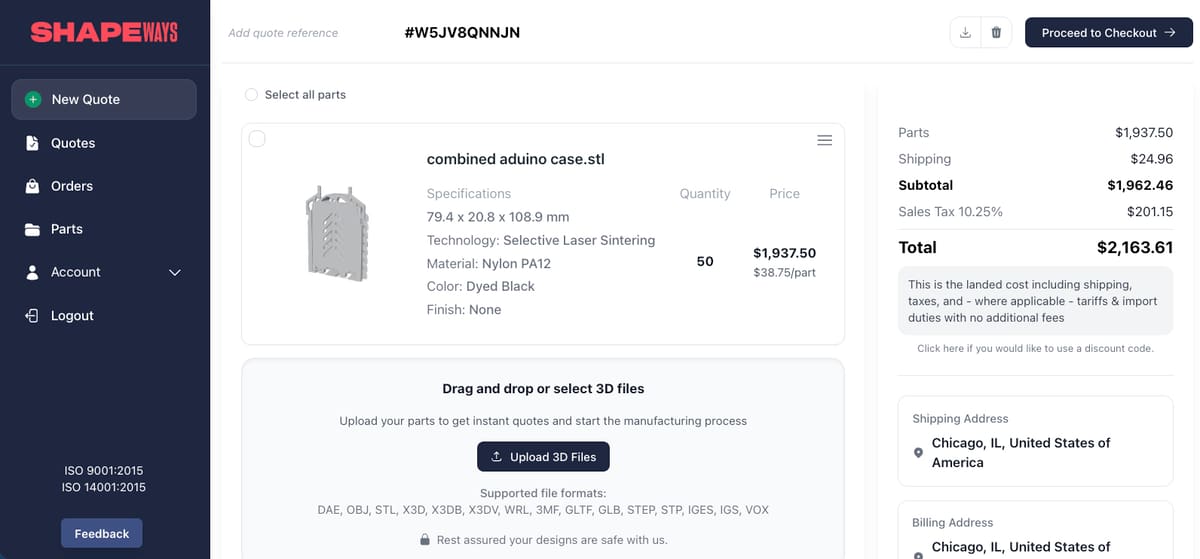
Shapeways is one of the better-known online 3D printing service bureaus, with a long history serving designers, engineers, hobbyists, and small businesses through upload-and-order manufacturing. The original Shapeways filed for bankruptcy in 2024, but the brand and website were later acquired by WVS International/Manuevo, with operations continuing from the Eindhoven, Netherlands facility under new ownership. Because of that restart, it is worth treating Shapeways as an active but recently reorganized service provider rather than the same U.S.-based company it once was.
For SLS, Shapeways offers several nylon and elastomeric materials, led by Nylon 12 / PA12, which it markets as a strong, flexible “Versatile Plastic” suitable for prototypes, interlocking parts, hinges, springs, structural components, and end-use parts. Shapeways also lists Nylon 11 / PA11, Thermoplastic Elastomer / TPE, and Carbon Lightweight Nylon 12 / PA640 GSL under its SLS material menu. Its PA12 parts are shot-peened by default, with white and dyed color options available in standard and smooth finishes. The smooth option is a vapor-smoothed finish, and special requests such as spray painting or heat inserts may require contacting sales.
Be careful when using the quoting interface, because Shapeways offers many processes and materials beyond SLS, including MJF, SLA, FDM, binder jetting, cast metals, and metal printing. If you specifically want SLS, select the SLS material family rather than assuming the upload system chose it for you. Also note that some options, large parts, smooth finishes, or special post-processing requests may change pricing, manufacturability rules, or require additional review.
- Maximum build volume: 650 x 350 x 550 mm for standard white PA12; smaller limits apply to smooth or dyed PA12
- Detail level: 0.2 mm embossed/engraved details for standard PA12; 0.5 mm minimum text
- SLS Materials: Nylon 12, PA12, Nylon 11, PA11, TPE, Carbon Lightweight Nylon 12, PA640 GSL
- Turnaround: Quoted by material, finish, and order details
- Finishing: Standard shot-peened, dyed colors, smooth/vapor smoothed, spray painting or heat inserts by request
Sculpteo / 3D Prod
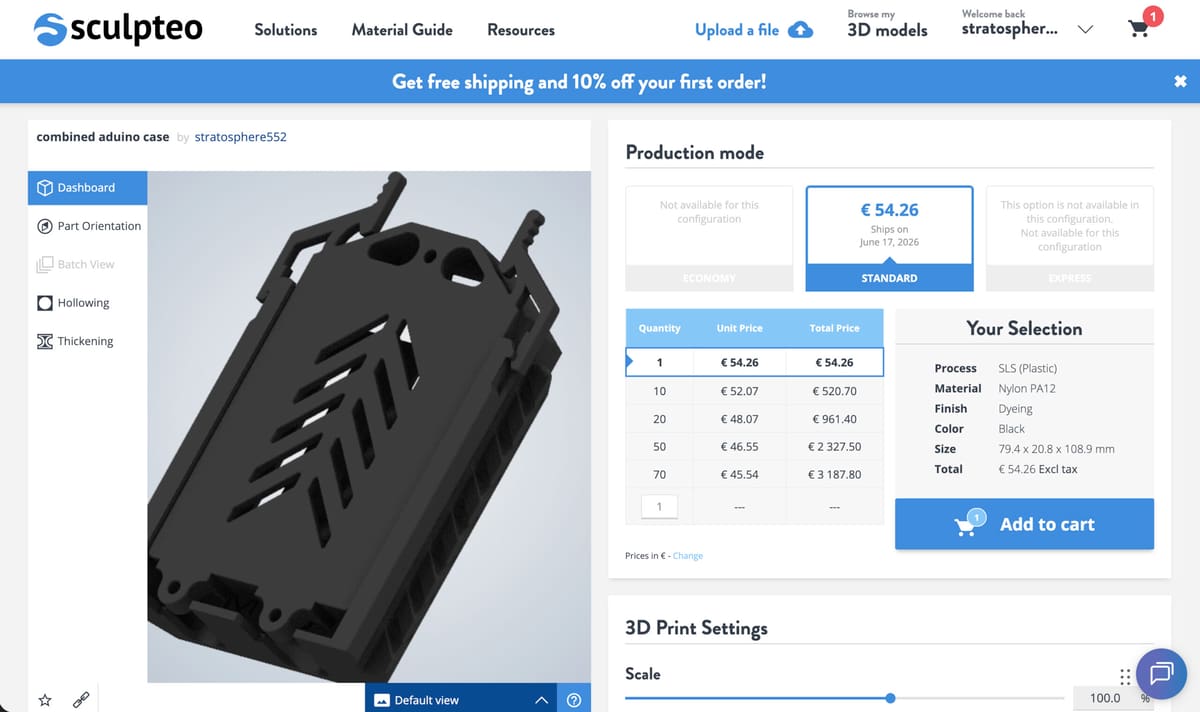
Sculpteo has been in business since 2009 and is one of the biggest names in 3D printing services based in France. In 2026, the company was acquired by 3D Prod, another French service bureau. The combined company has more than 78 industrial 3D printers and delivers to 61 countries, although the focus in Europe.
Sculpteo/3DProd offers about 10 materials for SLS printing, including a newly launched blue food-grade SLS powder. Thanks to the breadth of materials choices, the company can SLS print parts for practically any application, from detailed demonstration models and prototypes to functional technical components. With standard nylon PA12, the service can also produce very large parts.
The company also offers a wide range of post-processing options, although the availability depends on the material. Options include polishing and chemical smoothing, as well as dyeing or painting certain materials with up to 19 colors.
Sculpteo’s SLS-printed parts have lead times ranging from 2-15 business days, depending on part complexity, material, and surface finishing. The ordering process gives instant quotes and includes handy CAD analysis and repair tools. Sculpteo also provides 3D part design and consultation, laser cutting services, and an extensive library of support and educational documents.
- Maximum build volume: 675 x 366 x 545 mm
- Detail level: 100 microns
- SLS materials: nylon PA12/PA12 (gray), nylon 3200 GF, alumide, Ultrasint TPU 88A, Ultrasint PA6 MF, Ultrasint PA11 carbon fiber, Ultrasint PA 11, Ultrasint PA 11 ESD, PA12 Blue food-grade
- Turnaround: 2-15 business days
- Finishing: Painting and color dyeing, chemical smoothing, satin polishing, electroplating
SLS 3D Printing Explained
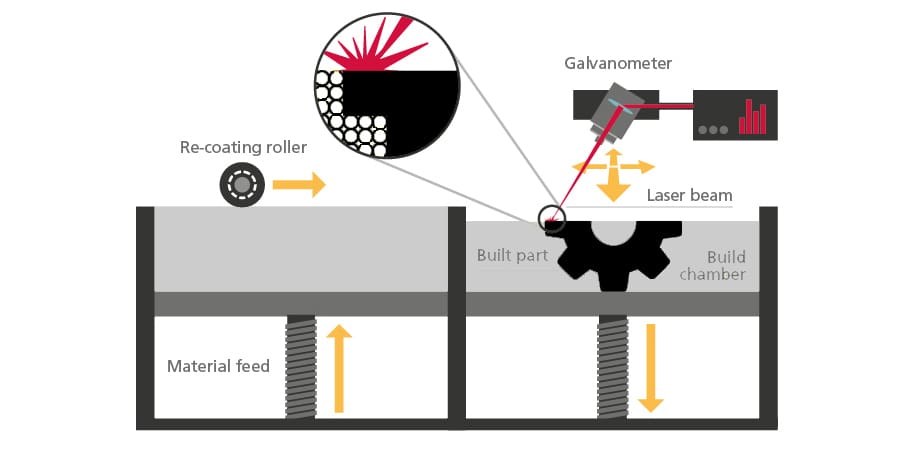
SLS printers harden thermoplastic powders into solid objects using a high-powered laser (generally CO2, diode, or fiber). Due to the intensity of the laser beam, SLS printers are typically considered more difficult to operate than other technologies, like FDM or SLA, which further reinforces their industrial reputation. SLS is the printing technology of choice for everything from consumer goods to factory tools to aerospace components. These 3D printers, coupled with tough materials, such as carbon-fiber-infused nylon, produce accurate, strong parts at high speeds.
At the beginning of the printing process, a fin or a roller spreads a very thin layer of plastic powder across the printing bed. The laser beam then scans the printing bed according to the desired part geometry, selectively sintering (fusing materials together using heat and pressure) parts of the powder together — hence the technology’s name.

Once the laser has finished melting one layer, the print bed lowers by the height of one layer. The coating apparatus then re-coats the chamber with powder, and this process repeats until the part is finished. SLS is already a fast technology, but some printers feature two-way coaters that can spread powder from both directions, achieving even higher print speeds.
A great advantage of SLS printing is that the parts generally don’t require supports. The unfused powder in the printing chamber props up the part and provides all the support it needs. As a result, SLS printing can easily produce very complex geometries, such as overhangs, hollowed or latticed internal structures, and sharp corners.
The laser technology, combined with the lack of supports, allows operators to fill the chamber with multiple parts. SLS is an ideal 3D printing method for low-volume manufacturing. With larger SLS printers, one print run could produce dozens or even hundreds of individual parts.
One more advantage of the technology is the ability to recycle unused powder. The average recycling rate is around 50%, but some machines and services — such as Materialise — offer options for 100% powder recycling rates. Recycling material can deliver great cost savings while also helping preserve resources and the environment.
But SLS does have its drawbacks as well. The parts take a long time to cool after printing, which can somewhat hinder the fast production speeds. Additionally, due to the powder material, raw SLS parts have an unevenly colored and relatively rough surface. To get completely smooth surfaces and uniform colors, the parts need post-processing, such as polishing and dyeing.
Understand SLS Materials
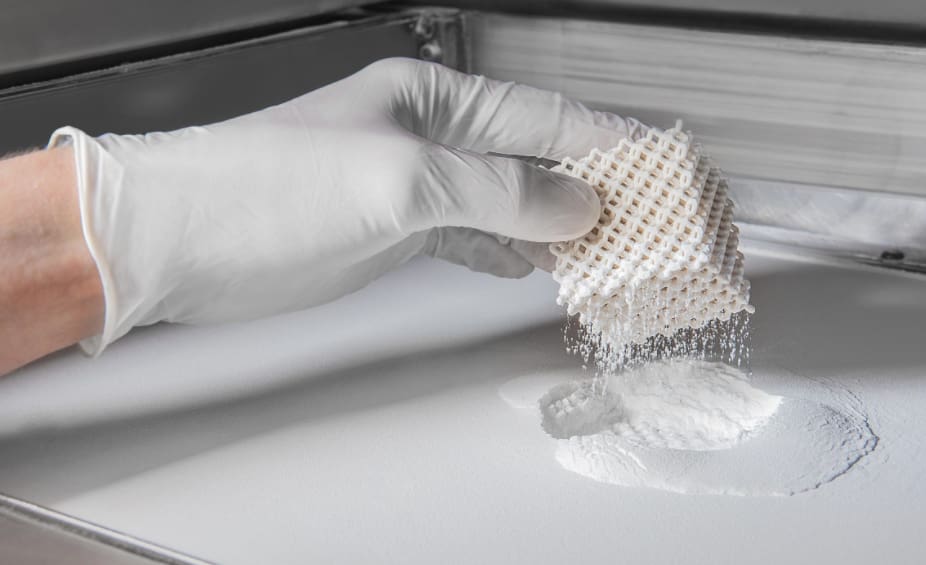
All SLS materials come in powder form and all are in the plastic family. Their properties range from stronger than solid aluminium to softer than rubber and everything in between.
Of course, you can sinter metal powder, however that’s a relatively new process called Cold Metal Fusion and to date, All3DP does not know of any 3D printing service provider offering this material.
For selective laser sintering (SLS), these are the most commonly used types of powders:
License: The text of "SLS 3D Printing Services: 10 Options Compared for Nylon Parts and Prototypes" by All3DP Pro is licensed under a Creative Commons Attribution 4.0 International License.