The Ultimate 3D Printing Filament for Anything You Leave Outdoors is ASA

Trying ASA filament? Check out our guide to the best ASA filament brands and learn about their properties, benefits, and uses.
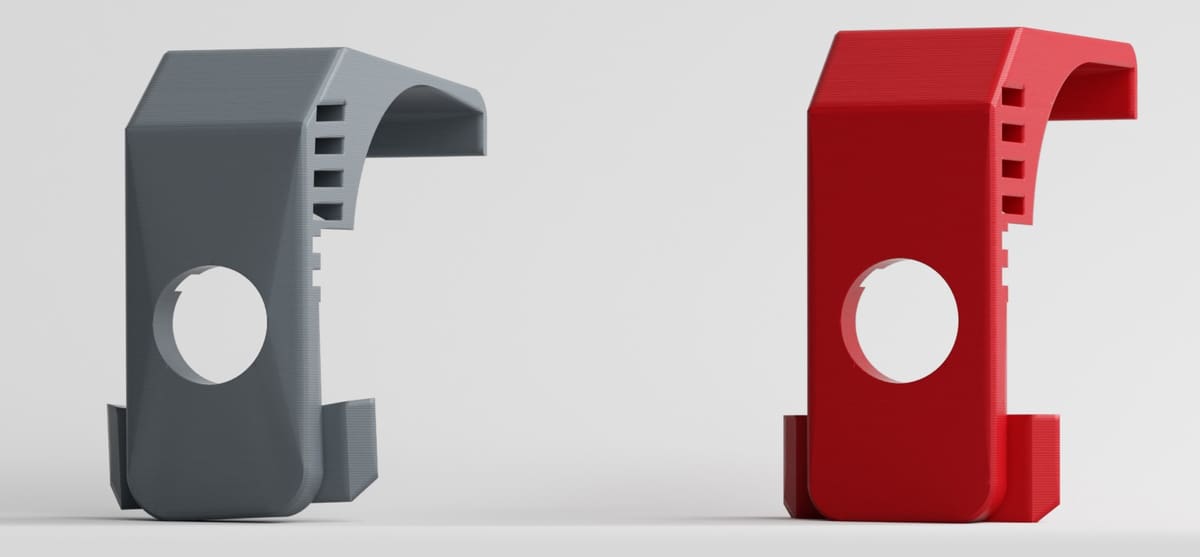
Ever wonder what the tough, durable plastic on your car’s side mirrors is made of? There’s a good chance it’s ASA (acrylonitrile styrene acrylate). You can, of course, use that same industrial-strength, UV-resistant material for your own 3D prints.
In fact, ASA filament is the secret weapon for creating parts that can truly withstand the elements — from custom garden tools to rugged drone frames. It’s a professional-grade material that solves the age-old problem of PLA prints warping in the sun or ABS parts cracking over time.
You may not be using ASA yet because it’s a little difficult to 3D print. It’s sensitive to heat while being printed and tends to warp as it cools. It emits noticeable fumes requiring good ventilation and absorbs water from the air, which can cause surface defects.
Yet, after printing, ASA parts are very heat-resistant and durable. They’re also rigid and strong, even more so than the same parts made from ABS, and won’t turn yellow when left outside.
Below, we cover more pros, cons, and uses of the material and provide you with the printing tips you need for successful parts in ASA. Of course, we have our favorite ASA filament brands, and we explain what we considered when narrowing down the ASA options.

All About ASA
If you’re interested in printing with ASA, it’s helpful to know what it can be used for, as well as some of the reasons you might want to try your hand at this special filament (or not). It’s a great choice for outdoor projects or functional prototypes. If you’re currently printing with ABS, you should consider trying out ASA because they print similarly, but ASA has some extra benefits.
Composite ASA
ASA is typically sold as a pure filament, not a composite — but carbon-, kevlar-, or glass-fiber-reinforced ASA does exist, just less commonly than with ABS or nylon. Turn to brands like Fillamentum, Bambu Lab, or Spectrum if your specific applications require extra stiffness and lower warping, but be prepared to experiment with the perfect settings.
ASA Pros
- Strong UV, chemical, and water resistance
- Easy surface smoothing with acetone
- High impact resistance
- Tough and durable
- Nice finish, even without smoothing
- Anti-static
ASA Cons
- Releases potentially dangerous fumes
- More expensive in comparison to other 3D printing filaments
- High extruder and bed temperature required, enclosure recommended
- Consumes a lot of energy for printing
- Parts can crack, warp, and shrink
ASA Uses
Although it can be expensive to buy and difficult to print with, ASA’s quality makes it a fantastic filament for rough and tough use cases. With the advantages and disadvantages of ASA in mind, you might be wondering what type of models this thermoplastic is best suited for. In the bullet points below, we’ve gone over a few popular categories of items you can 3D print in ASA.
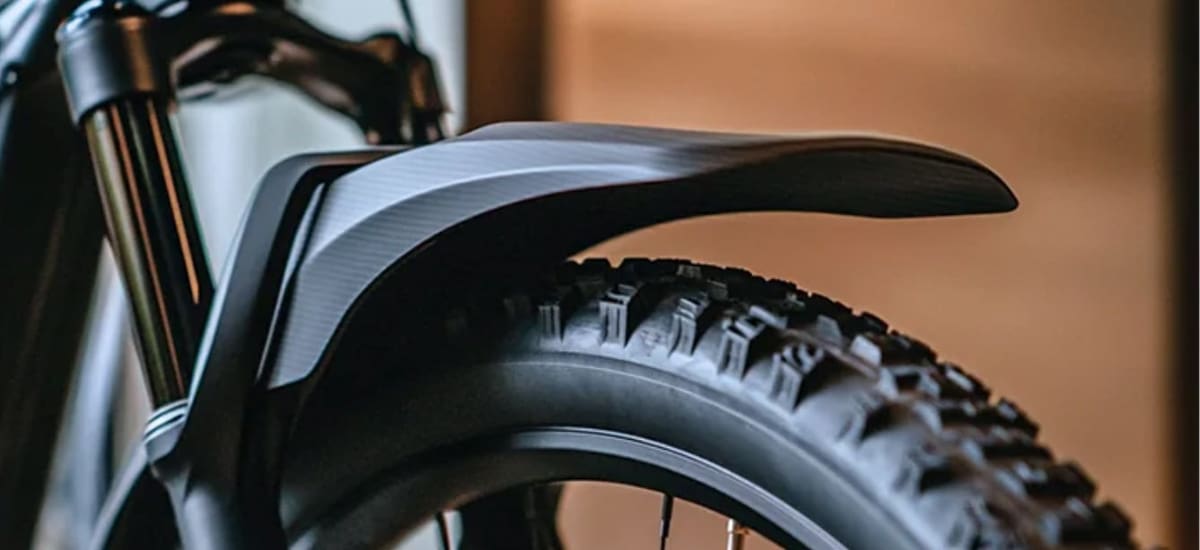
- Automotive exterior parts
- Housing components (protective covers for equipment exposed to the elements)
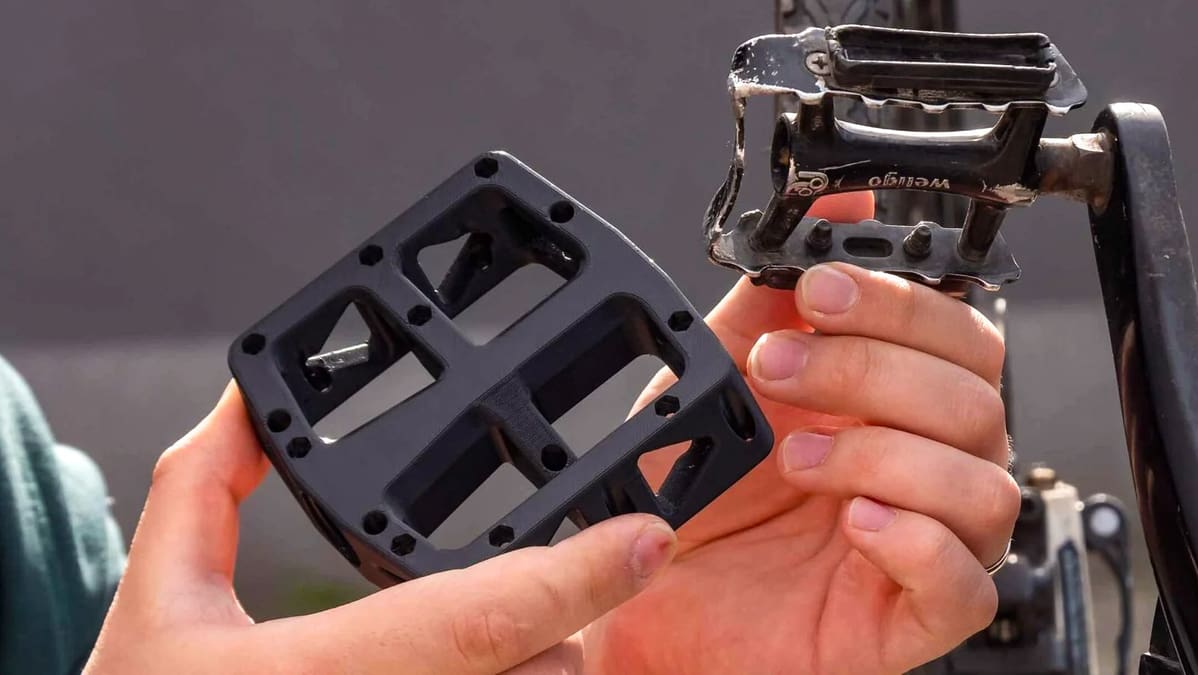
- Sporting goods (kayak or paddle board accessories; bicycle mounts, reflectors, holders)
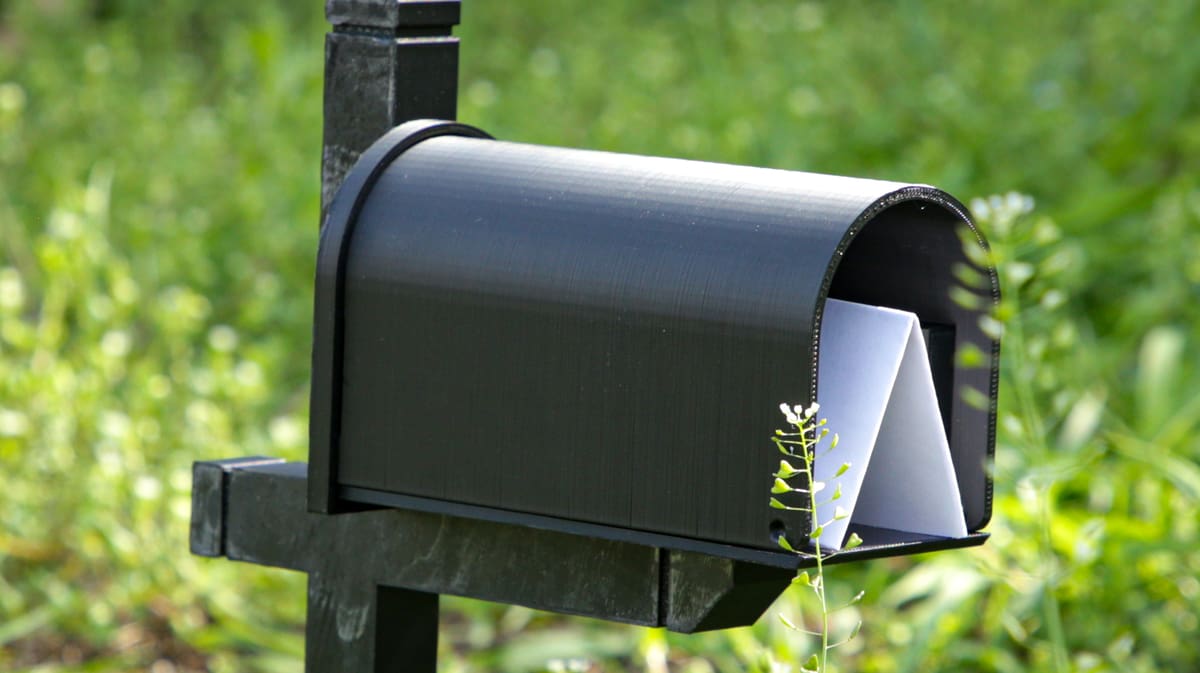
- Exterior signage (street or trail markers; informational plaques and stands; mounting brackets for signage)
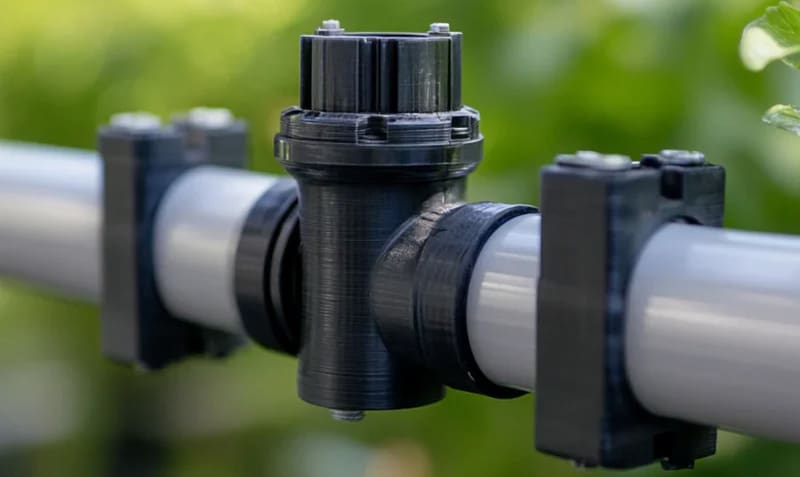
- Garden equipment (tool handles and grips; hose connectors and sprinkler components; birdhouse or feeder parts)
- Outdoor parts and fixtures (tent connectors, clips, stakes; outdoor furniture accessories; patio lighting housings
Now that we know more about where we could use ASA parts, let’s take a look at printing it before we get to the best brands to use!
What Makes a Good ASA?
There are plenty of brands out there that include ASA in their catalog, and while we haven’t tried all of them, we’ve coupled our personal favorites with some others based on the following criteria:
- Easily accessible: The filaments included are readily available and should be purchasable without hassle (that is to say, at the time of writing, they’re in stock).
- Reviews: Products have a minimum number of reviews or ratings (at least 100), showing that they’ve been vetted by the community, and they’re also recommended on a variety of platforms (e.g. Reddit).
- Ratings: All products have a rating of at least 4.0 (averaging it from different platforms where they may be available).
- Material variety: The different options offer a range of compositions that are meant to cater to a variety of uses. While some may be pricier, they may be better suited for professional goals, while the more accessible options should still excel at hobbyist-level productions.
Most ASA 3D printed parts will have a tensile strength (ISO 527-1) in the 40-45 MPa range with a flexural strength of around 65 MPa (ISO 178), but it isn’t possible to make a nice handy chart of the mechanical properties of the filaments below because, like with every filament brand, there are various testing standards and often some vague or missing data. Because of this, we’ve added links to the technical data sheets or online information provided so you can ensure that the mechanical attributes that your parts require can be met.
Prusament
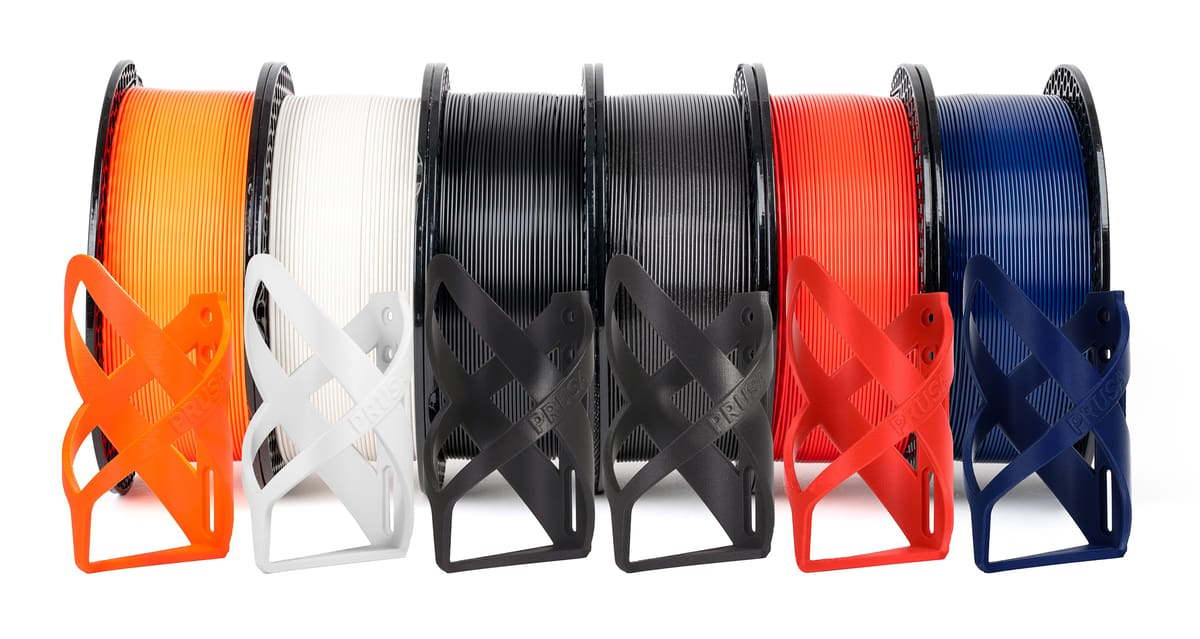
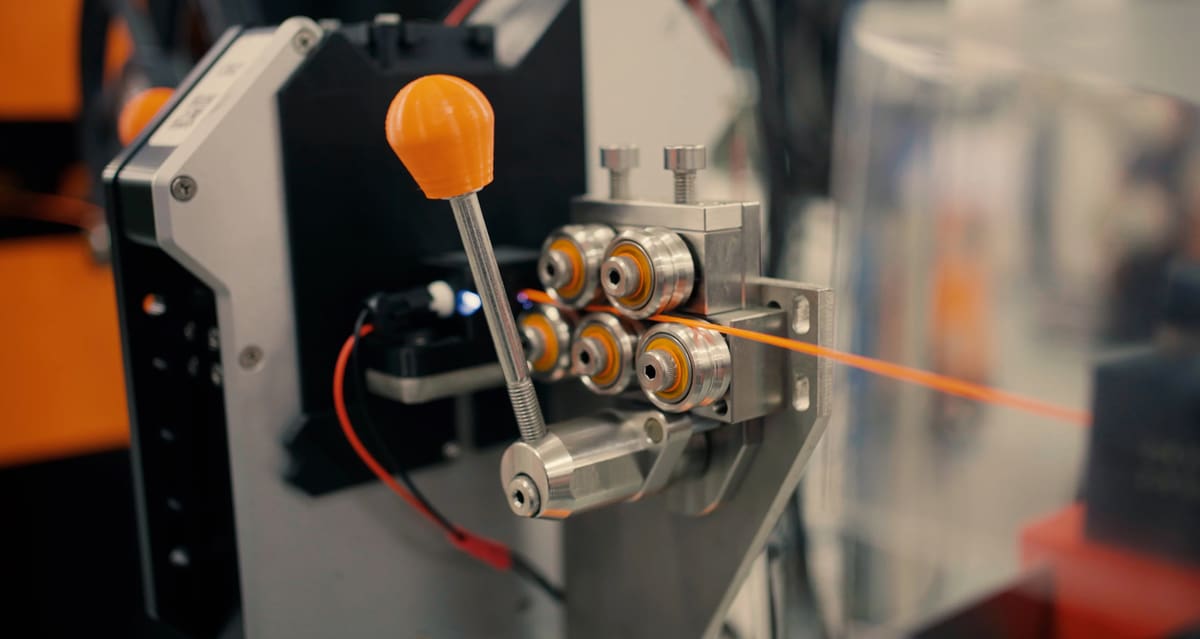
Prusa Research makes its own filament, known as Prusament, in its own factory in Prague, which All3DP has had the pleasure of visiting several times. They make a wide range of filament materials and two kinds of ASA, which have been steadily priced at $30/850g for a while. Among its other qualities, Prusament ASA is very easy to post-process, and parts made of this material respond very well to acetone vapor smoothing and other solvents.
Prusa Research also notes that their filament is great for detail on prints without any stringing (like on PETG). Additionally, many reviews suggest that this filament yields high-quality prints that are also very strong and durable. Prusa recommends their stain sheet, a smooth PEI sheet of a powder-coated sheet for the bed, and says that a 3 mm brim (or taller) can improve the adhesion of edges and corners of larger objects to the print sheet.
- Colors: Galaxy Black, Jet Black, Natural, Prusa Orange, Signal White, Sapphire Blue, Lipstick Red, Prusa Pro Green, Olive Green
- Size: 1.75 mm (0.85 kg)
- Tolerance: ±0.03 mm
- Recommended settings: Hot end 250-270 °C; heated bed 105-115 °C
- Price per kg: ~$35 (~$30 per 0.85-kg spool)
Bambu Lab
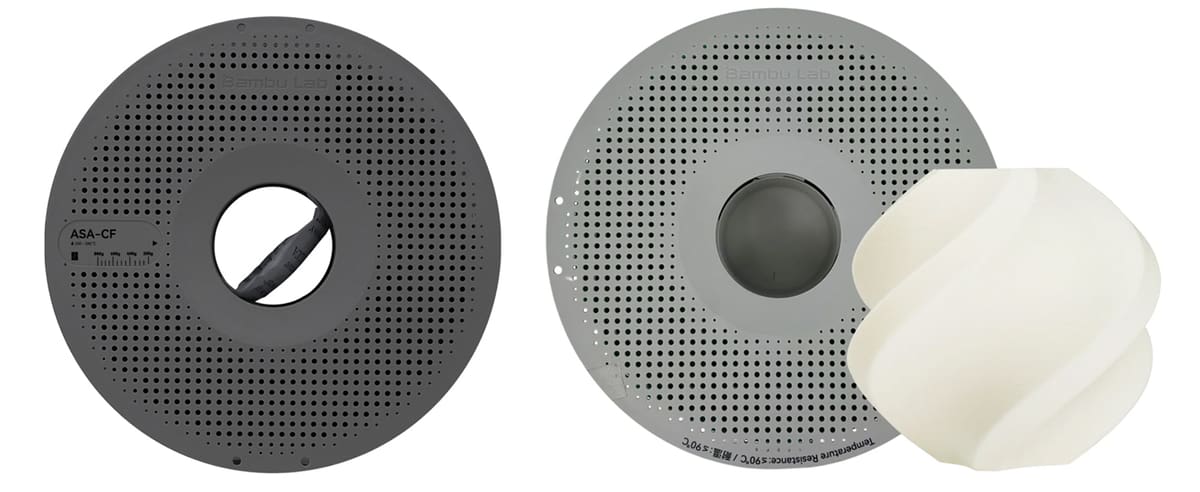
Bambu Lab’s ASA is a modified version of ABS that contains an additional acrylate component, which improves its weather adaptability and UV resistance, the company says. It’s ASA retains the impact resistance and processability of ABS while providing better resistance to fading, yellowing, and degradation from sunlight exposure. The company says there’s a risk of pungent and unpleasant odors during printing (like all ASA), but it’s less than the company’s ABS.
Bambu Lab recommends drying ASA before use and using a printer with an enclosure. To avoid warping, the company says to simply avoid printing parts that are large or require a high infill density. But it also offers a carbon-fiber-filled ASA specifically for these large projects that need extra protection against warping.
Bambu Lab has another type of ASA, that’s a self-foaming ASA-based material with high durability and toughness that enables extremely lightweight yet robust parts. ASA Aero filament produces parts with a matte surface structure has excellent resistance to heat, water and UV rays, making it ideal for long-lasting outdoor models like RC planes.
- Colors: Black, White, Grey, Red, Green, Blue
- Sizes: 1.75 mm
- Tolerance: ±0.05 mm
- Recommended settings: Hot end 240-255 °C; heated bed 80-105 °C
- Price per kg: ~$30
Flashforge
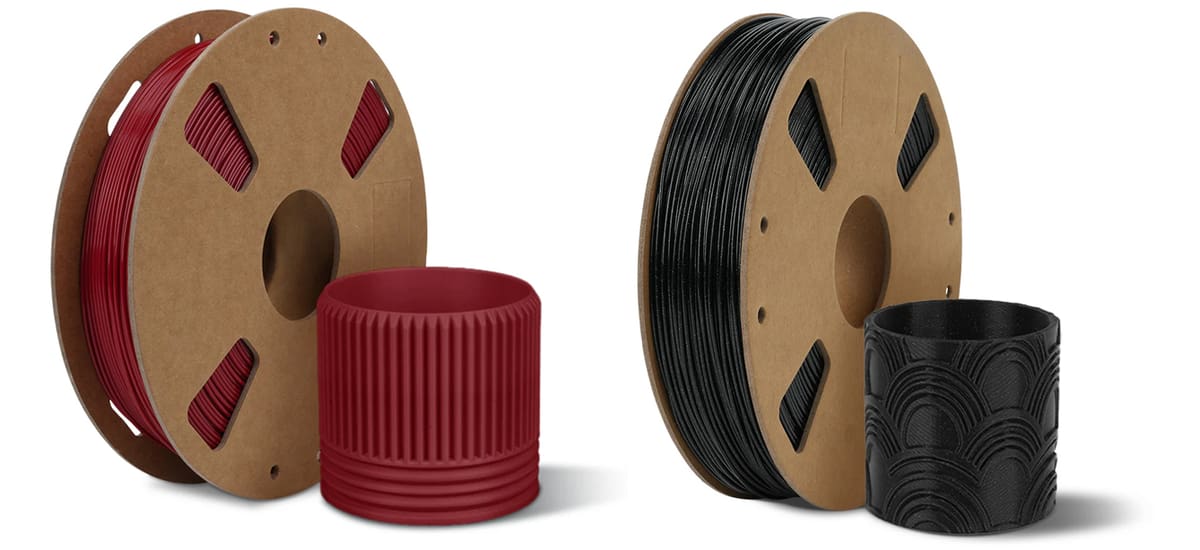
Flashforge, a well-known 3D printer manufacturer, also makes its own industrial-grade ASA filament. It comes highly recommended by customers for its ease of printing, superior layer adhesion, and glossy finish. In addition, users report minimal warping and stringing.
While initially there were fewer colors available, the brand has grown to include sparkling options of the base colors. Flashforge recommends applying a thin layer of water-washable glue to the build plate to improve adhesion. If your model is adhering strongly, let it cool down after printing and then heat the plate back up to 70 °C.
- Colors: Black, White, Burnt Titanium, Iron Grey, Natural, Ruby Red, Sparkle Black
- Size: 1.75 mm (1 kg)
- Tolerance: ±0.02 mm
- Recommended settings: Hot end 230-250 °C; heated bed 100-110 °C
- Price per kg: ~$26
Kexcelled
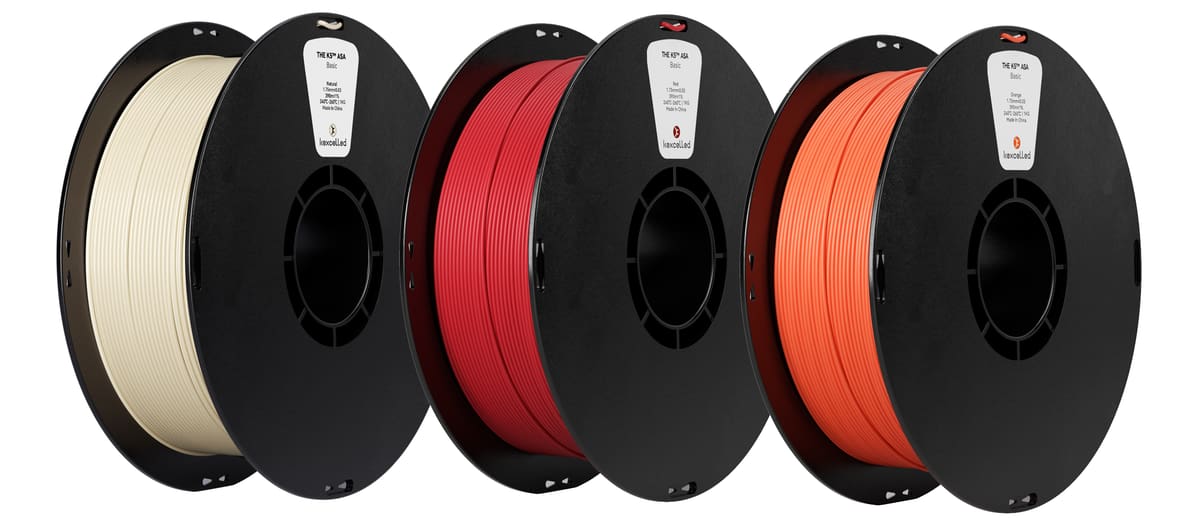
Kexcelled is another company offering a range of ASA specifically for outdoor applications. The company says that parts made with its ASA maintain their appearance with minimal performance degradation and resist yellowing even after long-term exposure to sunlight and water.
Kexcelled recommends an enclosed printer to keep the printing temperature around 50-70°C. The ASA filaments are dried for 24 hours before vacuum packing, and packages are filled with a moisture absorbent to ensure that the filaments are in good condition when the package is first opened.
- Colors: Black, Blue, Grey, Green, Ivory White, Off-White, Orange, Red
- Sizes: 1.75 mm
- Tolerance: ±0.05 mm
- Recommended settings: Hot end 240-260°C; heated bed 80-100 °C
- Price per kg: ~$28
Sunlu
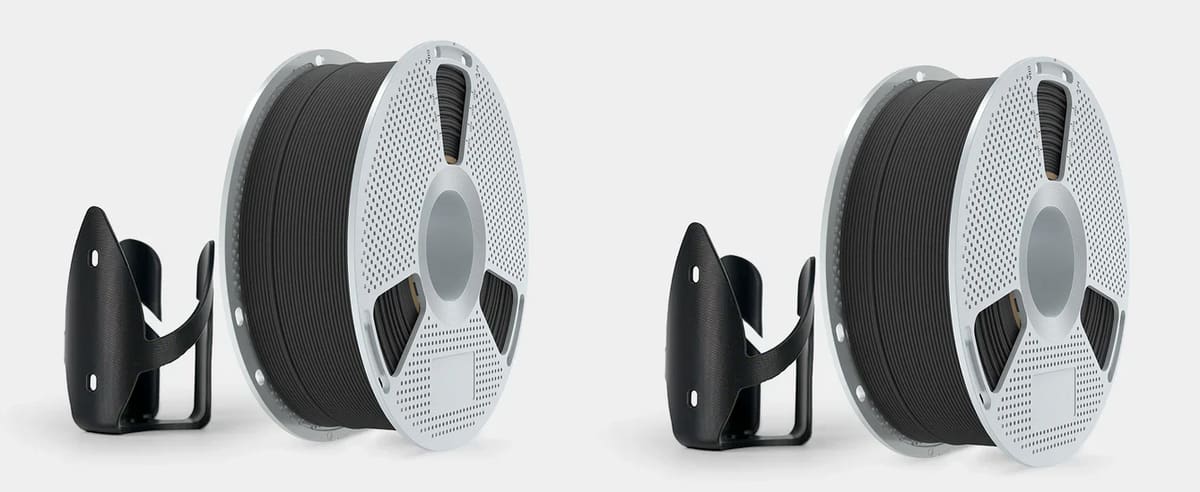
Sunlu, a reputable name in the filament world, also offers a high-strength ASA capable of withstanding outdoor elements and wear and tear. Don’t be fooled by its relatively low price. Sunlu claims a dimensional accuracy of ±0.02 mm and a smooth printing experience.
With a rating of 4.3 stars at Amazon, customers seem to be experiencing positive results. However, some users mentioned that the ASA had a hard time sticking to the build surface and between layers. Using an enclosure will improve print quality and save your nose from the unpleasant odor.
For small businesses and print farms, Sunlu offers a 5kg spool.
- Colors: Black, White
- Size: 1.75 mm (1 kg)
- Tolerance: ±0.02 mm
- Recommended settings: Hot end 245-255 °C; heated bed 80-120 °C
- Price per kg: ~$25
Overture
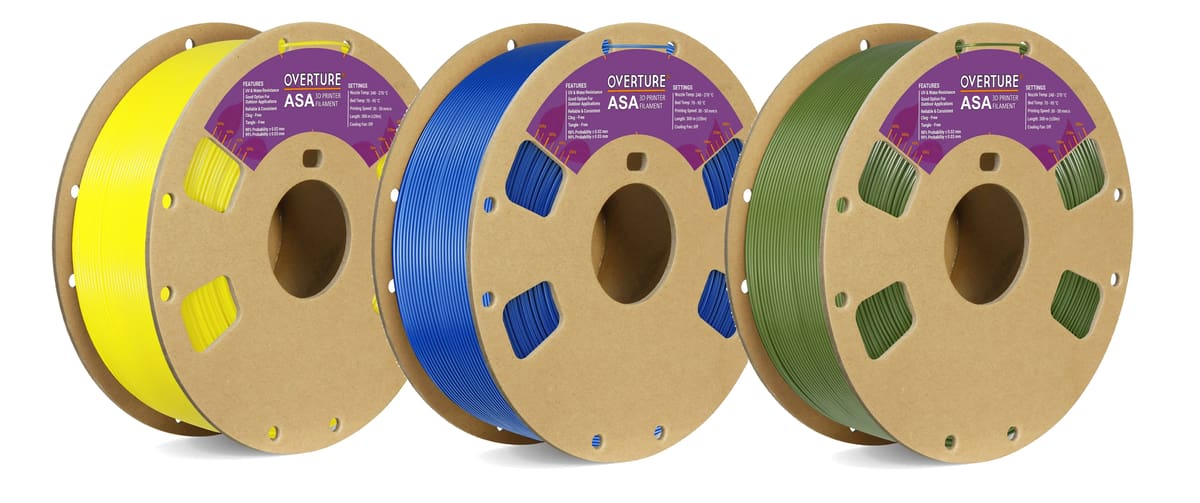
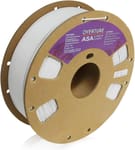
Overture ASA is a user-friendly option that yields nice printing results. Customers recommend this filament for its buttery smooth finish, good adhesion, and durability. However, some reviewers experienced warping and other issues. It’s recommended to dial in your print settings, use hair spray or other adhesives on the build plate, and print with an enclosure.
Overture carries several unique and hard-to-find colors, such as diamond blue, olive green, and purple. Like many other brands on this list, Overture vacuum seals their ASA filament, which is crucial to avoid moisture seeping into the material.
- Colors: Black, White, Grey, Red, Brown, Orange, Yellow, Natural, Olive Green, Green, Blue, Diamond Blue, Diamond Red, Diamond Green
- Size: 1.75 mm (1 kg)
- Tolerance: ±0.05 mm
- Recommended settings: Hot end 240-270 °C; heated bed 70-95 °C
- Price per kg: ~$30
PolyLite
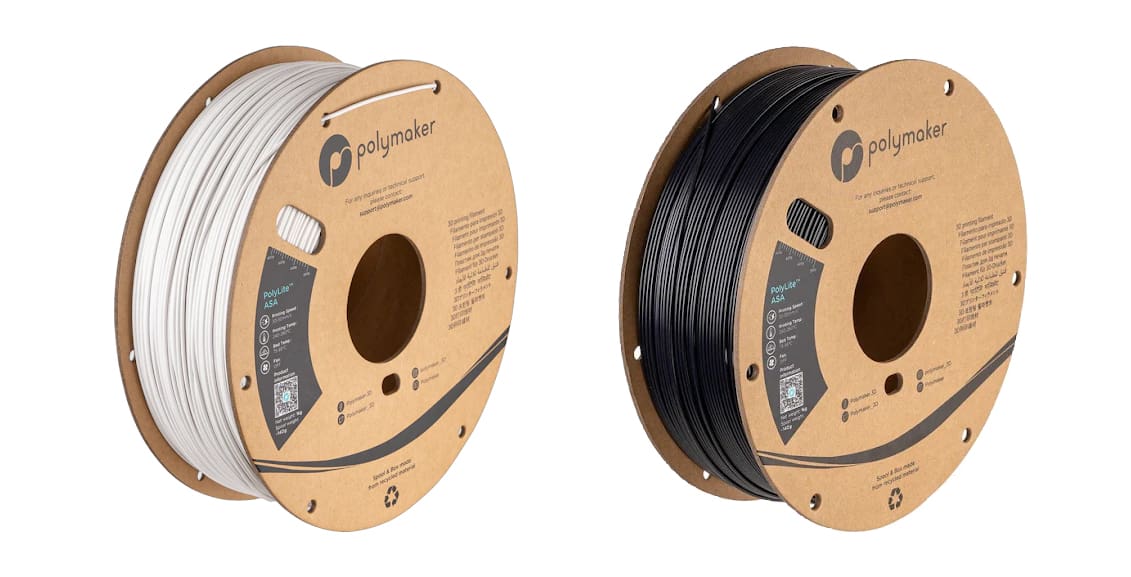
PolyLite ASA, from Polymaker, is an excellent filament with a low tolerance of just ±0.03 mm. PolyLite provides a lot of information about their ASA filament, including mechanical properties such as tensile and bending strength. This brand of ASA has a glass transition temperature of 97.8 °C, and the manufacturer recommends drying the filament at 80 °C for eight hours before use.
Polymaker sources its plastic from JF Polymers and has a 4.6 out of 5-star rating at Amazon from over 2,400 ratings. Some users have commented about how this ASA warps a lot when printed. For this reason, PolyLite recommends using a BuildTak print bed or applying Magigoo.
- Colors: Black, White
- Sizes: 1.75, 2.85 mm (1 kg, 3 kg, 5 kg; also a six-pack option)
- Tolerance: ±0.03 mm
- Recommended settings: Hot end 240-260 °C; heated bed 75-95 °C
- Price per kg: ~$30
Inslogic
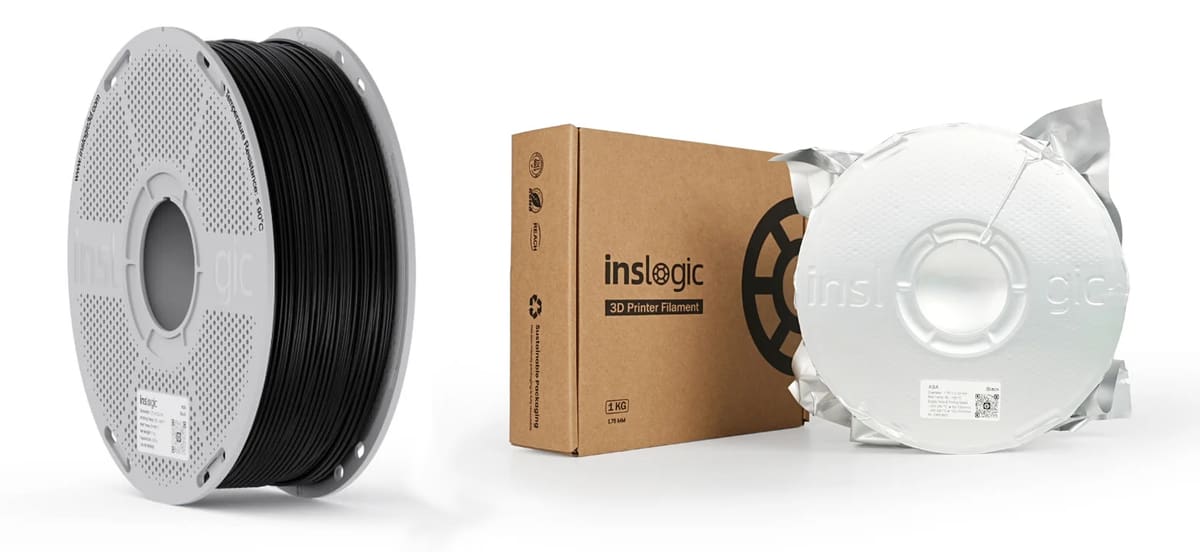
When Inslogic became a site sponsor at All3DP (this recommendation is not sponsored, by the way), we got our hands on a lot of their filament and were impressed. The company’s ASA, which worked in our Bambu Lab AMS, had a wonderfully smooth surface finish without any chemical smoothing.
For strong adhesion and a successful print, the company recommends using an adhesive on your build plate as a protective layer, which turned out to be true in our tests. For larger prints, they recommend 3D printing in a heated chamber, but it’s a good idea regardless of the print size. Wait until the print platform and chamber of your 3D printer have cooled down to room temperature before removing your part. Keep the room well-ventilated throughout the entire process.
- Colors: Vertigo Grey, Snow Whit, Dijon Mustard, Vivid Pink, Traffic White, Natural, White Aluminium, Metallic Grey, Anthracite Grey, Traffic Black, Grey Blue, Green Grass, Sky Blue, Traffic Red, Traffic Yellow
- Sizes: 1.75 mm, 2.85 mm (0.75, 2.5 kg; also a 15-m sample option)
- Tolerance: ±0.05 mm
- Recommended settings: Hot end 240-255 °C; heated bed 80-105 °C
- Price per kg: ~$27
Fillamentum Extrafill
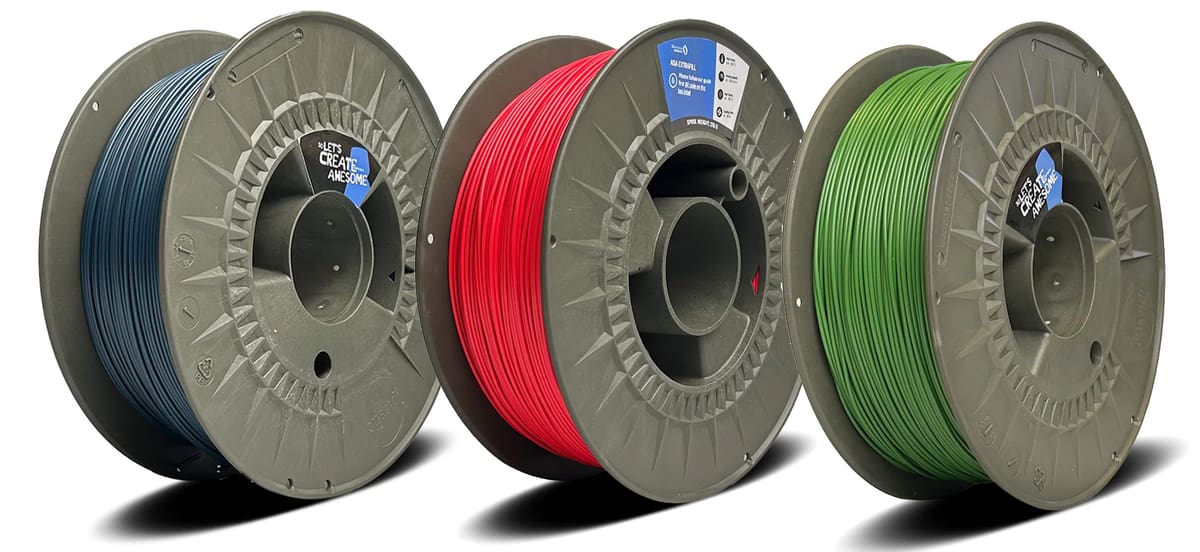
Fillamentum, a popular filament brand, offers a great option called ASA Extrafill. Their filament has a dimensional tolerance of ±0.05 mm, so it’s not the best of the best, but it’s not too bad. At around $35 for only 0.75 kg, this filament is a bit expensive compared to some of the other ones on this list.
One nice thing is that Extrafill comes in a large variety of colors and has two choices of diameter size: 1.75 and 1.85 mm. The manufacturer also claims that this material is recyclable and isn’t very hygroscopic.
- Colors: Vertigo Grey, Snow Whit, Dijon Mustard, Vivid Pink, Traffic White, Natural, White Aluminium, Metallic Grey, Anthracite Grey, Traffic Black, Grey Blue, Green Grass, Sky Blue, Traffic Red, Traffic Yellow
- Sizes: 1.75 mm, 2.85 mm (0.75, 2.5 kg; also a 15-m sample option)
- Tolerance: ±0.05 mm
- Recommended settings: Hot end 240-255 °C; heated bed 80-105 °C
- Price per kg: ~$27
ASA Printing Tips
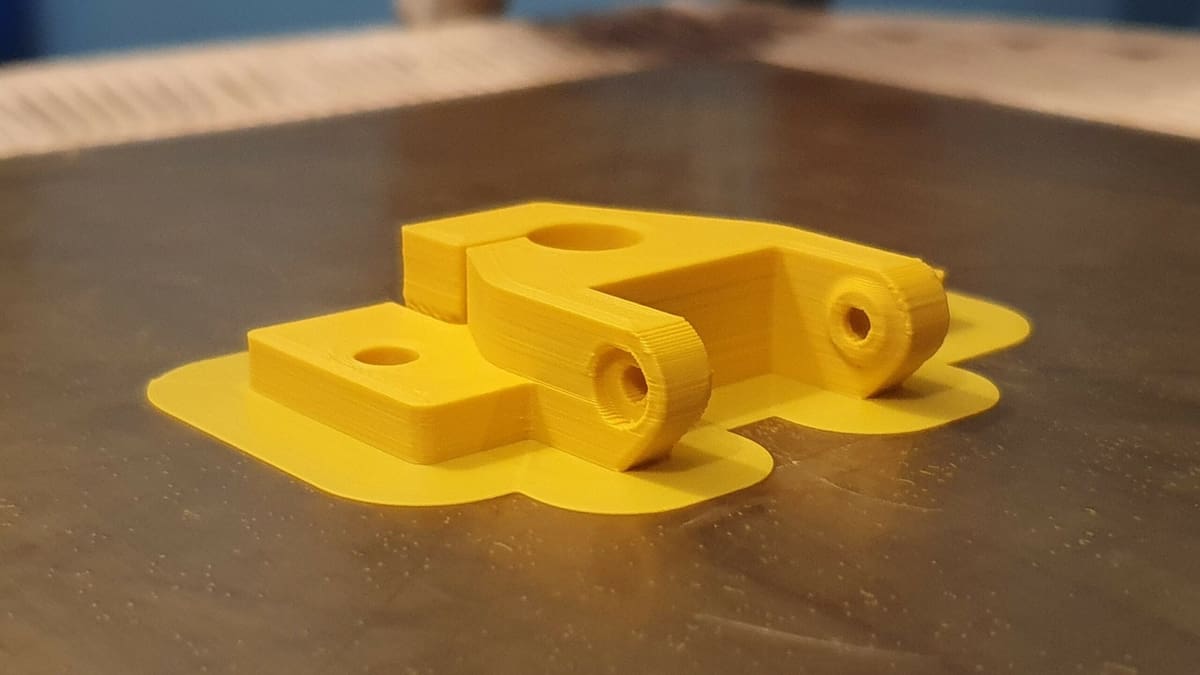
ASA can be a sensitive material to print, so print settings play a key role in how a model will turn out. You should always default to the settings provided by the manufacturer of the specific ASA filament you’re using, yet some experimentation is to be expected.
Typical ASA Printing Specs (varies by brand)
- Bed temp: 90–110 °C, use adhesives (PEI, glue stick, ABS slurry).
- Nozzle temp: 240–260 °C (depending on brand).
- Chamber: Enclosure strongly recommended.
- Cooling: Little to no part cooling fan—minimizes warping and layer cracking.
- Dry storage: Keep filament in a dry box or dry before printing.
Trouble Shooting Tips
The following tips help reduce common problems when printing with ASA:
- Make sure you have the right bed surface: PEI Sheet (textured or smooth), Glass with Adhesive, Garolite (G10/FR4)
- Use a bed adhesive such as ABS glue, Kapton tape, glue, or hairspray with glass
- Use an enclosure.
- Adjust temperature to prevent overheating.
- Set the cooling fan to a slow speed (5-10% after the first layer).
- Make sure the bed is level.
- Test your temperatures (start with 250 °C for the extruder and 110 °C for the print bed).
- Change the nozzle when switching materials.
License: The text of "The Ultimate 3D Printing Filament for Anything You Leave Outdoors is ASA" by All3DP Pro is licensed under a Creative Commons Attribution 4.0 International License.
CERTAIN CONTENT THAT APPEARS ON THIS SITE COMES FROM AMAZON. THIS CONTENT IS PROVIDED ‘AS IS’ AND IS SUBJECT TO CHANGE OR REMOVAL AT ANY TIME.