3D Printed Guns: Origins, Legality, Types & Status

Are 3D printed guns something to be concerned about? We break down the news, facts, history, and fast-moving legislative battles now reshaping the future of 3D printing.
As desktop 3D printing has gotten easier, cheaper, and more reliable, concerns and evidence of the proliferation of 3D printed firearms has grown. Should it be possible to print crucial components for firearms quickly, quietly, and easily in a bedroom or garage? And regardless of this technical reality, how and where could, or should regulations go to intervene, if at all?
The matter is controversial and the subject of heated debates across the internet, the media, and political halls. It stems back to the 2010s and the initial 3D printing bubble – but in 2026, it has entered a new and more consequential phase.
Legislatures across the United States are actively passing laws targeting not just the guns, but the files used to design them and, in a chilling turn for ordinary users with no connection to guns, the 3D printers used to make them. Courts are settling long-running questions about federal regulatory authority as the weapons themselves have moved from headline-grabbing theoretical curiosity to a quantifiable and documented presence at crime scenes.
There is an interplay of technical, social, political, and legal aspects to consider when delving into the subject. This article gives an overview on the topic of 3D printed firearms, presenting the history, key events, communities, cultures, and facets that make this a timely and complicated matter.
History
Homemade Firearms
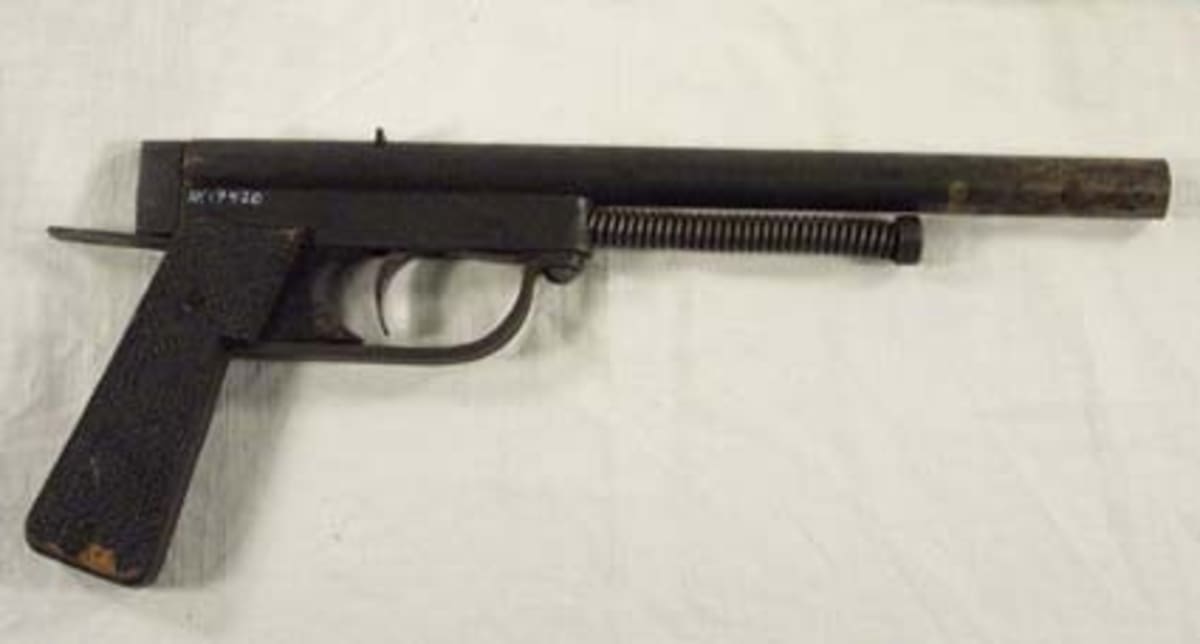
The history of homemade firearms goes as far back as conventional guns themselves. Since the invention of gunpowder, improvised replicas of conventional arms and weapons that vaguely resembled guns have cobbled together from scraps and repurposed materials.
Firearms of this kind found use with resistance groups in armed guerrilla conflicts during the Second World War and by insurgent forces in Iraq, Syria, and Yemen since. After World War II, rudimentary firearms known as “zip guns” – simple designs using wooden handles, rubber bands as triggers, and weak tubing – became widespread in the U.S.
Today, the internet makes it easy to share instructions and designs for DIY gun-making. It consolidated an already strong gun culture, especially in the U.S., paving the way for the dissemination of the designs and know-how to create a firearm in your garage with no more than basic technical skills and a few carpentry tools.
The maturation of home 3D printing technology has found an engaged community of gun-makers ready to leverage the process. Though it’s worthwhile noting that even the early, sensational examples of 3D printed guns – pointedly, the Liberator single-shot pistol created by Cody Wilson – was printed on a second-hand Stratasys machine, not your typical desktop 3D printer.
The Advent of 3D Printing
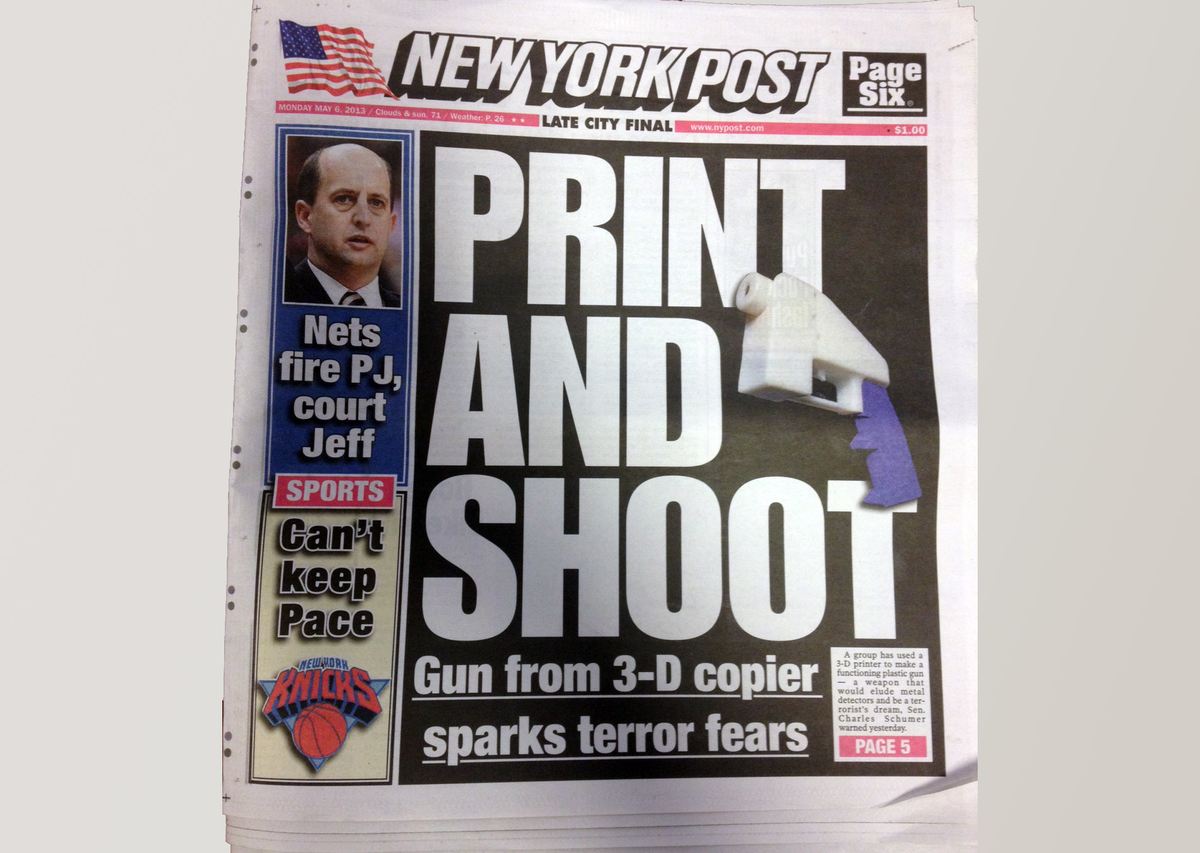
As 3D printing gained popularity in the early 2000s, new possibilities emerged for do-it-yourself enthusiasts. Private owners of the first 3D printing machines were able to access CAD files and print simple objects from a variety of plastics.
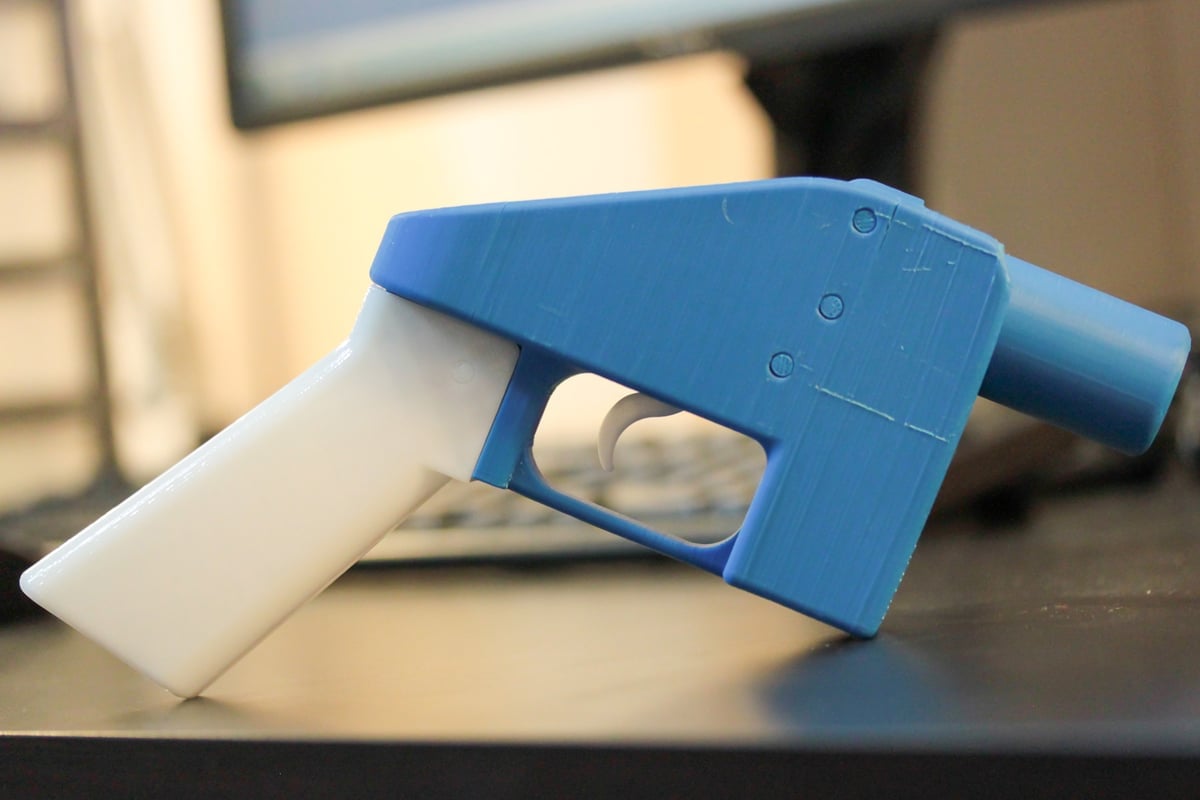
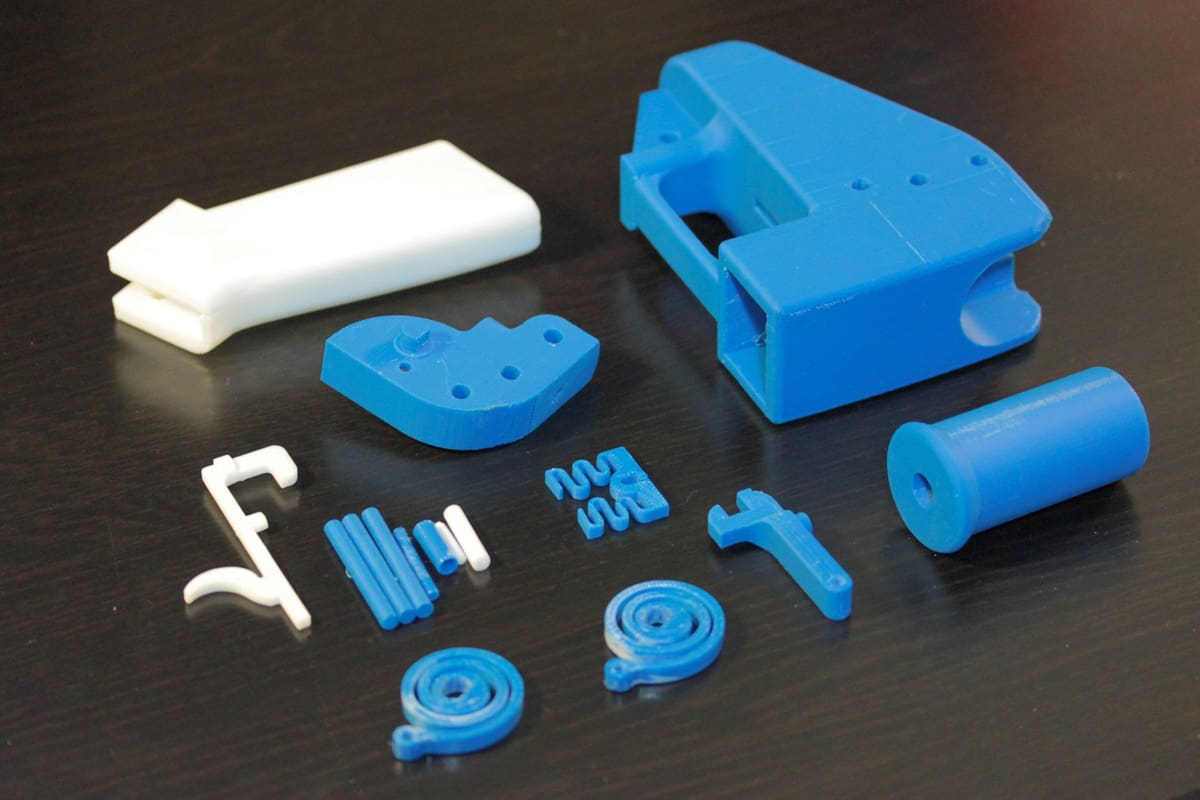
The first widely-reported incident of a 3D printed gun came in 2012 in the form of a 3D printed lower receiver for an AR15 at the hands of HaveBlue, who successfully shot dozens of rounds through the part. It wasn’t until 2013 that the first near 100% fully functional 3D printed gun, the Liberator, made its appearance.
The Liberator is a single-shot, polymer-based pistol created by Cody Wilson, founder of Defense Distributed, printed using a second-hand Stratasys Dimension SST 3D printer and published on the company’s open-source file repository, DefCad, in May 2013.
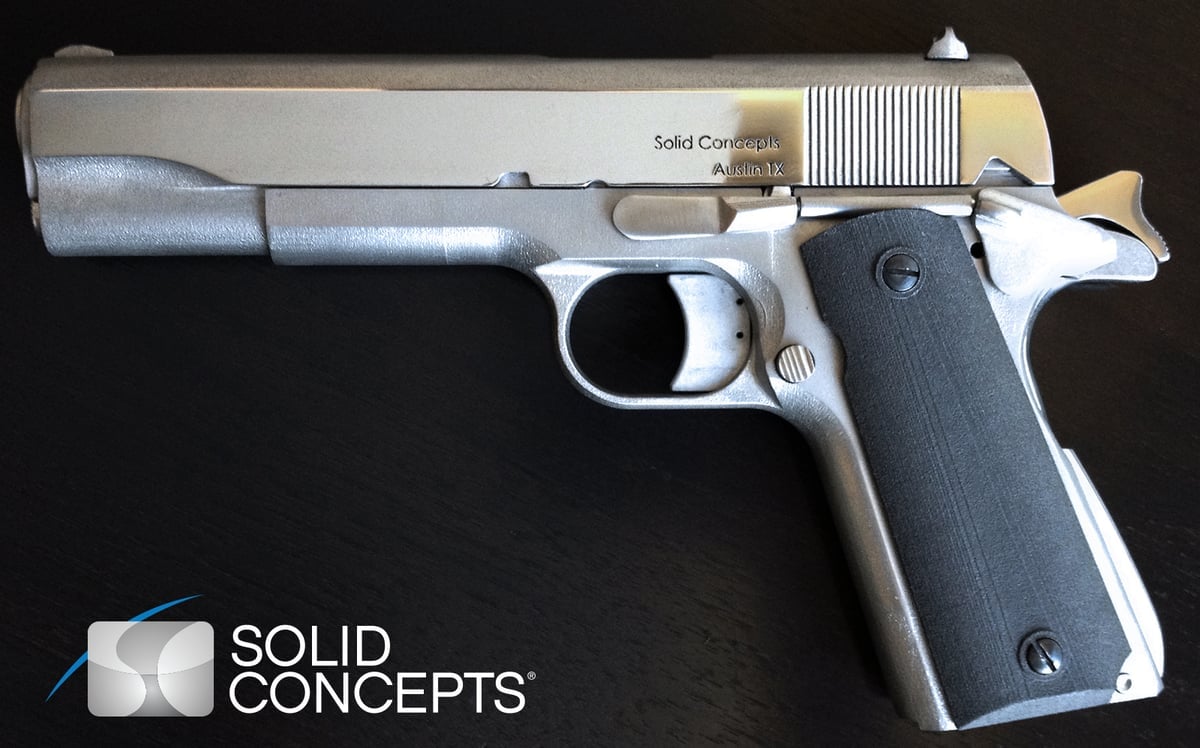
The same year that the Liberator ignited a fiery debate about 3D printed guns, additive manufacturing company Solid Concepts printed what the company claimed to be the first industrially additively manufactured gun. Made from 17-4 stainless steel and Inconel using the EOS EOSINT M270 DMLS (Direct Metal Laser Sintering) 3D printer – a machine costing a six-figure sum and expertise no regular, consumer user of 3D printing could ever achieve. The gun is called the 1911 DMLS and is a replica of the Colt Government Model 1911.
Inspired by Wilson, several advocacy groups have emerged since, sharing designs for near-fully 3D printable guns on forums and social media. Groups like Deterrence Dispensed and Fosscad foster thousands-strong communities that publish new and improved gun designs, including sub-machine guns and rifles. From the simple single-shot Liberator, today it is possible to print semi-automatic firearms such as the FGC-9 (Fuck Gun Control-9) by Deterrence Dispensed or the Scz0rpion by Are We Cool Yet.
In 2021, such improved and reliable designs including the FGC-9 were seen in the hands of guerrilla fighters in Myanmar, reports The Diplomat, making them the first 3D printed firearms used in an armed conflict.
This broader ecosystem – the GunCAD community, groups like Deterrence Dispensed, and decentralized design archives like the Gatalog – now operates largely independently of any single organization. The Gatalog in particular has gained infamy, operating without the membership fees or residency requirements that govern access to DefCad – though not without challenge.
At the time of updating this article, primary figures associated with the Gatalog, including IP lawyer Matthew Larosiere, are party to two court cases, one proactively brought against Wilson over copyright – a case that could spill over into wider rulings on the copyrightability of 3D printable models – and another brought against it by the State of California over the distribution of code and instructions for the assembly of firearms.
Designs developed and refined within these communities are what most law enforcement agencies encounter in the field today where a “3D printed firearm” is concerned.
Industrial & Military Applications
Like many others in manufacturing, the firearms and military industries have picked up on the advantages that additive manufacturing offers. Sig Sauer is famously forward in it’s promotion of the use of advanced industrial additive manufacturing for its firearm suppressors, while Solid Concepts as early as 2013 proved the possibility to fully 3D print a functioning pistol. The materials and machines, and business models that facilitate such production cost orders of magnitude more than the consumer materials and hardware, bringing the disruptive force that consumer-grade desktop 3D printing brings to the table today.
Outside of conventional production, 3D printing has a role in the field and other “active” environments.

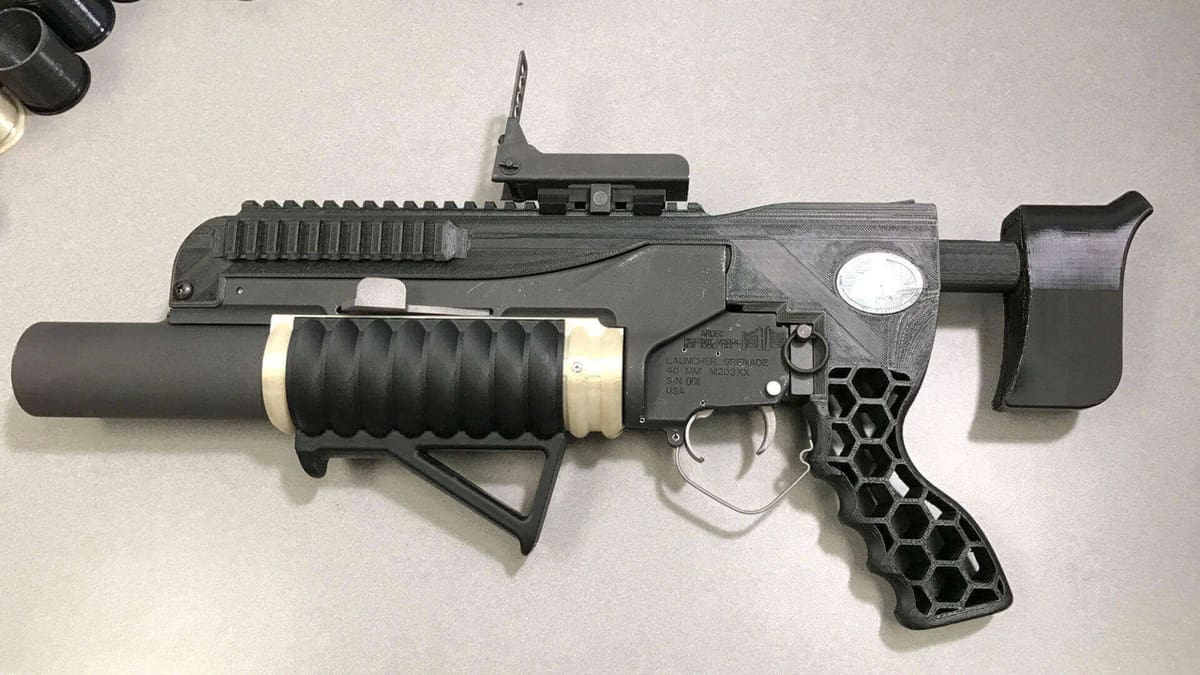
In 2017, the U.S. Army’s Armament Research, Development and Engineering Center (ARDEC) experimented with a 3D printed grenade launcher system called RAMBO (Rapid Additively Manufactured Ballistics Ordnance). Firing 40 mm 3D printed grenades, RAMBO is modeled on the army’s M203 grenade launcher and demonstrates how rapid, localized production could bridge or replace traditional supply chains.
Separate from isolated projects away from active combat to explore viability, the technology — particularly low-cost desktop 3D printers — has been the catalyst for a new era of warfare. Simple, inexpensive remote-controlled drones carrying explosives have definitively shaped the frontline in Ukraine. While a drone is not a gun, the speed and proliferation enabled by the technology validates the distributed power of 3D printing, and sharpens the conversation around gun safety and control.
Covid-19: (Short) Supply & Demand
During the COVID-19 pandemic, personal firearm applications surged significantly. According to FBI National Instant Criminal Background Check System (NICS) data – the standard federal proxy for gun sales – more background checks were processed in March 2021 than in any single month since the system was established in 1998. It’s estimated firearm background checks rose from approximately 28.4 million in 2019 to 39.7 million in 2020.
A peer-reviewed National Firearms Survey estimated that approximately 300,000 people per month became first-time gun owners between January 2020 and April 2021.
The perceived urgency to prepare for armed conflict – sometimes referred to as a “bunker mentality” – is one of the myriad reasons exacerbated by the pandemic and its pressures on global and societal norms. High demand, alongside supply chain disruptions due to the pandemic, plus loose regulations on the purchase of gun kits translated to greater numbers producing the firearms at home, reported Vice News in 2020.
Concurrently, this period also marked the a surge in cases involving ghost guns, including 3D printed guns, a trend that continued post-pandemic.
The Print-Blocking Laws
The most consequential and contested legislative development of 2026 is the attempt to make the printer itself the enforcement mechanism against 3D printed guns – a fundamental shift in how lawmakers are approaching the broader issue of unserialized firearms. There are two notable, active provisions.
On May 27, 2026, New York Governor Kathy Hochul signed that state’s FY2027 budget (PDF) into law, including a first-in-nation provision requiring all 3D printers sold in the state to be equipped with “blocking technology” – defined broadly as any hardware, firmware, or software that evaluates a print file against a firearm’s blueprint detection algorithm and prevents the print job from proceeding if a “firearm or illegal firearm parts” is identified. The law also bans the distribution or sale of digital gun design files in New York, and bans possession of such files by anyone intending to use them to manufacture a firearm without a federal firearms manufacturing license.
The law does not immediately take effect as a sales ban – the technology it mandates does not yet exist in certified form. Within 90 days of the budget’s signing on May 27, 2026, the state must convene a working group of experts in additive manufacturing, AI, and digital security to define minimum standards for the blocking technology. That group has one year to report its findings, which then form the basis for compliance standards. The ban on selling non-compliant printers takes effect only after those regulations are finalized. Civil penalties are set at $5,000 per product sold in violation.
California’s AB 2047, the California Firearm Printing Prevention Act, passed the full Assembly on May 19, 2026, and is now moving through the state Senate. It takes a more prescriptive approach: all 3D printers sold in the state must be DOJ-approved models on a state-maintained roster. To qualify, a printer must integrate an algorithmic system that detects and blocks print jobs producing firearms or illegal firearm parts. The compliance deadline for this is March 1, 2029, though the timeline for the definition and mechanism of standards lands sooner than New York’s, presenting a complication for manufacturers in that these standards may not be the same. AB 2047 also makes it a criminal misdemeanor to knowingly disable or circumvent the mandated blocking software.
Supporters of both laws argue that regulating at the point of manufacture is the only approach that can keep pace with design proliferation, and it logically follows that, after closing the loophole of unfinished, unserialized firearm parts, a significant path remains open in homemade 3D printed guns.
File-based enforcement has a demonstrably poor track record; the Liberator files reached BitTorrent within hours of the 2013 State Department takedown order and have remained continuously available since, a pattern repeated with every subsequent suppression attempt: once published, designs propagate through mirrors and archives that are effectively impossible to fully suppress. That leaves the hardware itself in the firing line.
Criticism of this approach from the technology community is pointed. The Electronic Frontier Foundation published a detailed analysis of both bills in April 2026, describing the mandated software as technically unsolvable as specified. The core problem outline is one of geometry: firearm components share shapes with countless ordinary mechanical parts. Any algorithm calibrated to catch gun components will also flag legitimate prints. Put simply, any algorithm tuned to avoid false positives will miss modified firearm files.
Both laws also create an unresolved conflict with the open-source firmware ecosystem that underpins the most of consumer 3D printing. The two dominant printer firmware platforms – Marlin and Klipper – are open-source, GPL-licensed projects that manufacturers and personal users routinely install, modify, and redistribute.
California’s anti-circumvention clause would effectively criminalize installing any open-source firmware as currently exist on a certified printer. The EFF also warns this risks locking consumers into manufacturer ecosystems and disadvantaging smaller manufacturers and new entrants who rely on open firmware.
Critics across the political spectrum have also questioned who these laws will actually affect in practice. The GunCAD community operates in a regulatory environment it has consistently adapted to. Printing components separately and assembling them, or manipulating G-code directly, are circumventions that printer-blocking software cannot address. The people most likely to be interrupted by mandatory blocking software are educators, hobbyists, medical device designers, and small manufacturers – not determined bad actors.
Whether the technology can be built to a standard that satisfies the legal requirements, survives constitutional challenge under the Second and First Amendments, and avoids serious costs on legitimate users remains completely open. Attempts to prevent such bills from passing have, so far, failed; New York’s and California’s process will be the first real-world test of whether viable blocking technology can be defined, let alone deployed.
What is a 3D Printed Gun?
Types & Models
A 3D printed gun is in part or entirely manufactured with a 3D printer. There are three types of 3D printed firearms: fully 3D printed (F3DP), hybrids, and parts kit completions (or parts kit conversions – both abbreviate as ‘PKC.’)
Some firearms, like the Liberator, can be made almost entirely with a 3D printer. These fully 3D printed models are, as the term suggests, virtually all plastic from printed components. They may use negligible household objects such as a nail as a firing pin and an elastic band to drive it, but all pressure-bearing parts are printed. Because of this, it’s thought that they’re of limited use and predictably break after some small number of shots, if even that many.
Following the Liberator, a few F3DP models have gained widespread attention, such as the Songbird, the Washbear, and the ZigZag.
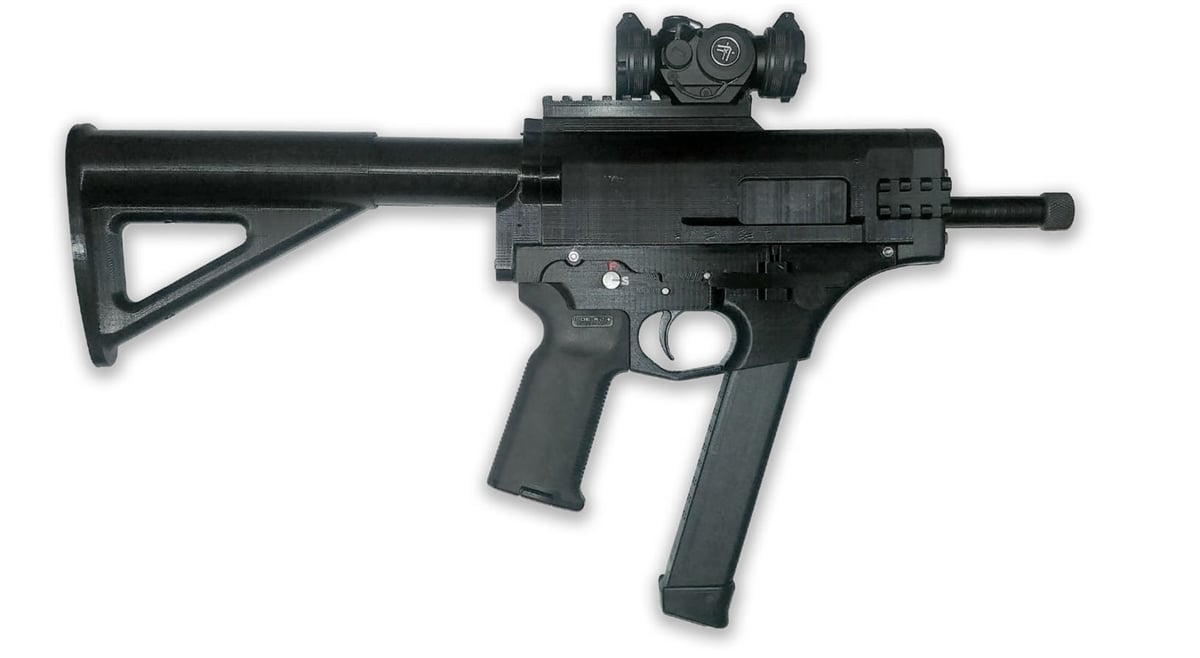
The weapon recovered in connection with the December 2024 killing of UnitedHealthcare CEO Brian Thompson in New York was a hybrid: a printed polymer frame paired with a metal slide and barrel, capable of accepting a standard Glock magazine.
Parts kit completions are kits that make use of ready-to-use or near-ready-to-use parts and require the user to print or acquire the missing components separately.
Some gun retailers in the US specialize in selling kits that do not require 3D printing at all, providing so-called “80% receivers” or “unfinished receivers” instead. These must be completed at home using additional tools, often included in the kit. It is worth noting that the majority of ghost gun seizures by law enforcement involve kit-built weapons of this type rather than fully or partially 3D-printed ones – the two categories are related but distinct phenomena that media coverage often conflates. The Trace reports that ghost gun recoveries are actually declining, though campaign groups contend that 3D printed gun recoveries are up.
What is a "Ghost Gun"?

Ghost guns are guns that do not have a serial number and are therefore unmarked and untraceable.
According to the Bureau of Alcohol, Tobacco, Firearms, and Explosives (ATF), in most states of the US, prospective gun owners have to pass a background check and apply for a serial number for the firearm before they can purchase them in-store. While exemptions such as purchases at public gun shows circumvent the ATF check, retailers have explored other ways around this. Until 2022, companies could take advantage of a loophole in the legislation by selling kits with 80% receivers – firearms were subject to regulation only insofar as they featured a completed receiver. As a result, such PKCs could be sold and bought without being subject to federal law.
This means that all 3D printed guns are ghost guns too. Some states in the U.S. compel the registration of such firearms, though no public data is available on the number of registrations of PMFs.
The ATF amended the definitions of “firearm frame or receiver”, “complete weapon,” and “privately made firearm” in 2022, effectively closing the loophole of disqualified parties being able to acquire a firearm by purchasing and finishing a kit. As of April 2022, the legal meaning includes split receivers and “buy build shoot” kits within the definition of a firearm, compelling manufacturers selling such components to secure licenses and to add serial numbers to each of the pieces. Customer background checks should be carried out before completing any sales, as is already done with other commercially made guns.
This change was challenged in Bondi v. VanDerStok, with the U.S. Supreme Court upholding the rule in March 2025 and confirming that the ATF did not exceed its statutory authority in issuing it.
How to Make a 3D Printed Gun
Technologies
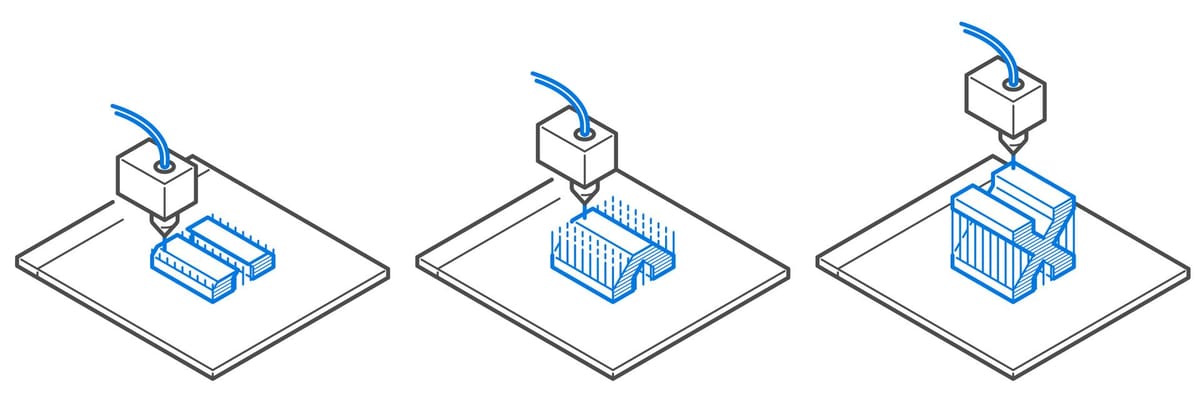
The printed parts of a 3D printed gun can be made using a standard FDM (Fused Deposition Modeling) desktop printer. This technology works by extruding thin plastic lines, building layer upon layer on a build plate until you have a complete 3D model.
In consumer-grade 3D printing, users typically use thermoplastic polymers such as PLA, its tougher variant PLA+, ABS, or PETG. PLA generally is cheap, readily available, but relatively brittle compared to the other materials mentioned.
Engineering-grade materials such as Nylon and polycarbonate are also possible, but they’re difficult to print using today’s prolific and inexpensive consumer-level 3D printers.
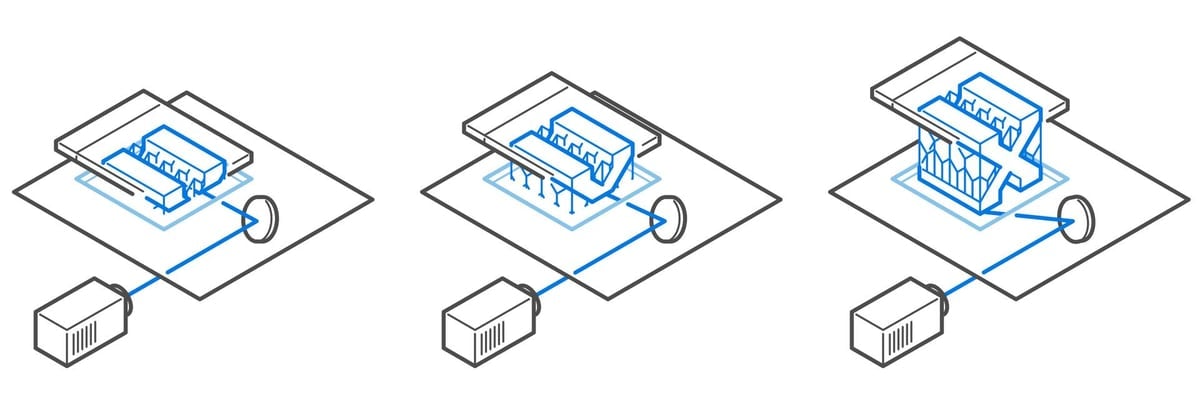
Alternatively, vat polymerization 3D printers use UV light to harden liquid resin photopolymer. Increasingly popular for home 3D printing, the materials are usually quite brittle, although a wider variety is changing this picture in recent years. One advantage vat polymerization holds over FDM prints is homogeneity, with strength in all directions of a print.
The designs that you print can come in many forms. While CAD data and associated file types from design software are possible, typically, users will download models as STL files from the internet or create them themselves. These files are then processed in slicing software (which designates the 2D “slices” for the printer to follow,) resulting in a machine-readable file that you load onto the printer for printing.
3D Printing vs CNC Milling
Historically, basic milling and lathing equipment was all you needed to make a self-made firearm. Machines using computer-controlled motion systems modernized this, with CNC (Computer Numerical Control) milling generally considered more desirable and effective than 3D printing for durable self-made firearms. While 3D printing works by deposing layers of plastic, CNC milling uses software and cutting end mills to carve much tougher materials – usually metal.
Defense Distributed has focused in recent years on refining and selling CNC machines for completing unfinished receivers for automatic rifles. As advertised on the Ghost Gunner website, no prior expertise is required to operate this CNC machine. With its software, the company claims that it allows you to “legally manufacture unserialized rifles and pistols in the comfort and privacy of your home”.
File Repositories
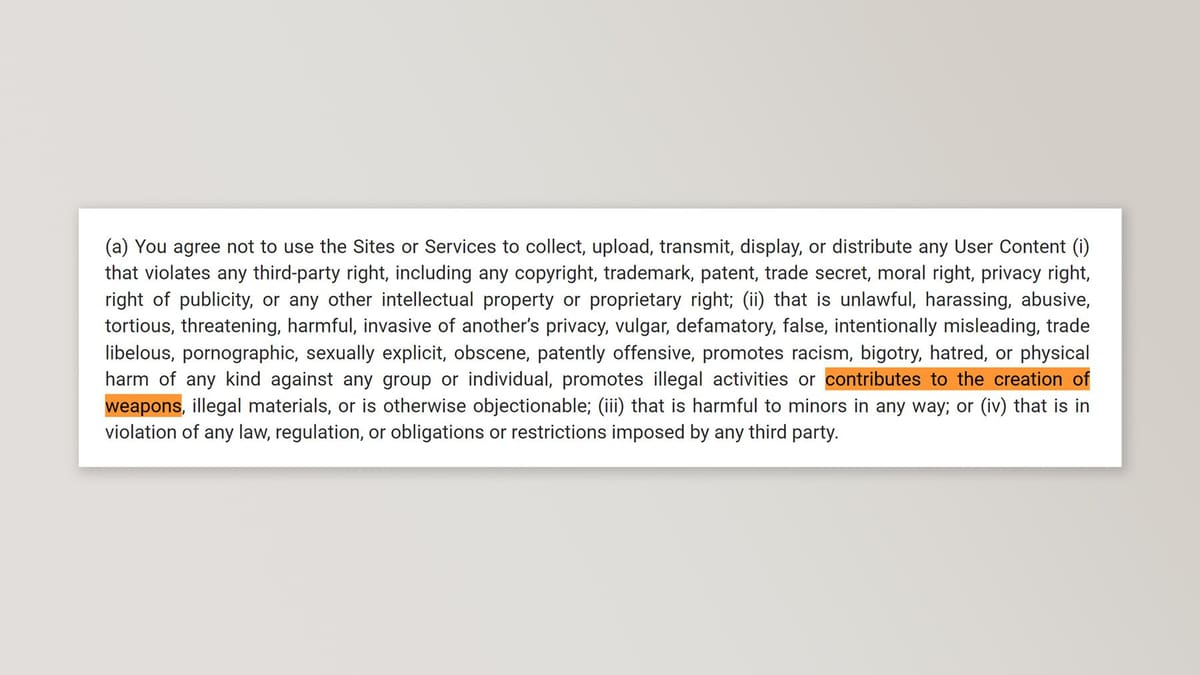
In addition to the general-purpose 3D model repositories, there are popular sites that primarily host the designs for firearms parts. Possibly the most well-known, likely due to Wilson and the high-profile legal proceedings by and against him, is DefCad.
Users that pay its annual membership fee get access to a breadth of CAD files for download and then printing or milling. Gun files are available on other selected 3D printing-related repositories, though geography and policy dictate how much is tolerated and available on each.
However, many more designs are shared on closed forums and private chat rooms, sometimes backed by blockchain technology, which can decentralize the distribution of blueprints, making them virtually impossible to control.
Open-source gun advocacy group Deterrence Dispensed has been known to share its files via Spee.ch, a hosting site backed by the LBRY blockchain.
Some hosting services censor the designs, prompting firearm-sharing communities to move to new, less scrutinized corners of the Internet and continue sharing their work without regulatory oversight.
A particularly visible case of this is with the encrypted platform Keybase, shortly after it was acquired by videoconferencing giant Zoom. The service was noted for its encryption and respect for privacy before the acquisition, booting homemade gun enthusiast communities from the platform in December 2020 as its policies aligned with its new parent company.
Tensions within the GunCAD community itself have also surfaced publicly. In January 2024, prominent designer “Ivan the Troll” publicly accused Cody Wilson and DefCad of misappropriating other designers’ work. Defense Distributed subsequently filed a civil RICO counterclaim – described by Wilson as the first of its kind – against the Gatalog and its associated operators, alleging criminal racketeering, ITAR violations, and alleging connection between Gatalog-distributed files and the weapon found in association with the United Healthcare CEO shooting. California’s Attorney General separately sued the Gatalog Foundation and CTRLPew LLC in February 2026, alleging unlawful distribution of digital firearm manufacturing code to California residents in violation of state law. Both cases were active as of mid-2026.
3D Printing Services
Those without access to a 3D printer can turn to a 3D printing service. These businesses typically let you upload a 3D printable file to their platform, generate a quote considering the materials and technologies used to print, and then have the object printed on your behalf.
Since the creation of the printed part is the legally ambiguous bit, 3D printing service providers vary on whether or not they accept jobs printing gun parts.
Notable 3D printing services Materialise and Sculpteo made it clear that they reserve the right to reject jobs, including the printing of gun parts, as it conflicts with their values.
A representative from Craftcloud, All3DP’s 3D printing marketplace, gave the following statement for the service’s part policy:
“Since we do not always know the purpose of the designs ordered on our service, we can also not always be an accurate judge of its intended use. However, we obligate every customer on our service, as they sign the T&C’s of our platform, that they do not request a print for ill-use or to cause any harm or damage.”
Who Uses 3D Printed Guns?
Hobbyists, Anarchists, FoS & Second Amendment Advocates

The design and manufacture of guns using 3D printing technology appear to be a contact point between two cultures.
On the one hand, we have hobbyists: technophiles and engineering buffs who experiment with new technologies and self-sufficiency in designing and creating the objects they use. Here, a printed gun could be considered an object of design and expression.
There are now 3D printed gun competitions that further this aspect of the hobby. The National Gun Maker’s Match, founded in 2021 and held in Florida, gained widespread attention after featuring prominently in a Vice short documentary (link below) on the subject.
Are We Cool Yet maintains that its guns are works of art and are protected not only by the Second Amendment (as “Arms”) but by the First Amendment, too. Wilson successfully used this argument to defend his and DefCad’s publication of designs, closing a three-year-long lawsuit in 2018.
On the other hand, some groups see 3D printed firearms less as an artistic expression, and more as a fundamental right and activistic tool.
Wilson describes himself as a crypto-anarchist and is a fierce Second Amendment advocate. Many active 3D printed gun community members pair their passion for DIY with fervent political beliefs. Communities Deterrence Dispensed and Defense Distributed promote themselves with Second Amendment-aligned slogans such as “Come and Take It,” “Live Free or Die,” and “Free Men Don’t Ask,” and are overt about their intent to oppose gun control.
Criminals & Extremists
Criminals and violent extremists have also been known to seek 3D printing technology and blueprints to acquire undetectable firearms. A leaked report from the Joint Counterterrorism Assessment Team notes two occasions in 2020 and 2021 when gun files and privately manufactured machine gun parts ended up in the hands of racially-motivated extremists. Wired points to the purchase of illegal gun parts online by the so-called Boogaloo, a group described by the Institute of Strategic Dialogue as an “anti-government, anti-law enforcement extremist militia movement.”
Other high-profile instances of 3D printed firearms coming to light in criminality include discovering a workshop of 3D printed guns and white supremacist material in Tenerife, Spain, in 2021, the Halle Synagogue shooting (German) in Germany in 2019, and the December 2024 killing of UnitedHealthcare CEO Brian Thompson in New York – in which the suspect was found with a 3D printed 9mm pistol and a 3D printed suppressor, both untraceable. The last case attracted global attention and is a named incident that lobbying group Everytown for Gun Safety cites in its campaign material lobbying for state-level legislative activity in recent years.
The Law
United States – Federal
Under the Gun Control Act of 1968, although it is illegal to sell homemade firearms without a license, it is not illegal to manufacture and own homemade guns.
Selling or transferring an unserialized firearm is illegal in all 50 states under existing federal law, regardless of how it was manufactured.
Federal rules governing homemade firearms also include the Undetectable Firearms Act, which requires that every homemade firearm include a minimum of 105 g of metal. This ensures that a metal detector can pick them up. The act was most recently renewed in March 2024 and remains in force until 2031.
The ATF’s 2022 rule expanding the definition of “firearm frame or receiver” to cover ghost gun kits and unfinished components was challenged in federal court but ultimately upheld.
The ruling means sellers of ghost gun kits must be federally licensed, serialize their products, and conduct background checks on buyers. The decision settled the central federal legal question around ghost gun regulation.
There is currently no federal law prohibiting the online distribution of digital files for 3D printed firearms. In June 2025, companion bills H.R. 4143 and S. 2165 – the 3D Printed Gun Safety Act of 2025 – were introduced in both chambers of Congress. These would make it a federal crime to intentionally distribute such files over the internet. Both bills were referred to the respective Judiciary Committees and had not advanced further as of mid-2026.
Even though this is the current situation at the federal level, the laws vary significantly according to state.
Since 2018, it is strictly illegal to buy parts to manufacture an unserialized gun at home in New Jersey. To 3D print a gun, you need a license for manufacturing.
In California, even homemade guns need a serial number. From January 1, 2024, any firearm owner or new resident of the state with a firearm that does not have a valid state or federal serial number or mark of identification should apply for one at the Department of Justice within 60 days after arriving in the state. Makers are expected to apply for a number before manufacturing the gun. Other strict rules about safety apply there, too, including operational safety and the means to imprint identifying marks onto the bullet casings.
Other states have similar laws or are planning to enforce their own restrictions based on the new national legislation amendments.
United States – States
The state-level picture has changed dramatically since 2020 and is actively evolving. The following reflects the position as of June 2026.
States that have enacted explicit manufacture bans include Colorado (HB 1144, 2026), Delaware (HB 125, 2021, though portions were subject to a federal injunction pending litigation as of mid-2026), Hawaii, and Rhode Island.
States with serialization requirements or unserialized possession bans include Connecticut, Maine (LD 1126, 2026), New Jersey (AB 4975, 2026), Oregon, and Virginia (HB 40, April 2026). Since 2018, it has been strictly illegal in New Jersey to buy parts to manufacture an unserialized gun at home. In California, homemade guns require a serial number; from January 1, 2024, any firearm owner or new state resident with an unserialized firearm must apply for one within 60 days.
Washington State (HB 2320, March 2026) enacted legislation prohibiting both the 3D printing of firearms and the distribution of digital instructions enabling a 3D printer to produce them, with penalties scaling from a $500 fine for a first offense to a gross misdemeanor for a third.
Active legislation pending or moving as of mid-2026 includes bills in Hawaii, Iowa, Michigan, Minnesota, North Carolina, and Pennsylvania. New York has several standalone measures in play beyond the provision described below.
Europe
Things are quite different in Europe.
Making and owning homemade firearms, including 3D printed guns, is prohibited in EU countries. Beyond such organization-wide legislation, nations apply and enforce their own, more specific regulations. In some parts of Europe, even the possession of 3D printable files for firearms is considered a crime.
In the UK, for example, Home Office Guidelines of Firearm Licensing Law were updated in 2013 to specifically criminalize the manufacture, purchase, and sale of 3D printed guns and gun parts. The first known conviction in the UK for producing a fireable 3D printed gun came in 2018.
Despite strict national laws, the fact that the files are freely available on the Internet makes it difficult to enforce some of these laws. The FGC-9 – a semiautomatic carbine developed by a European designer – has been found in the hands of extremist groups across Europe, illustrating how designs developed within the GunCAD community move across borders regardless of national restrictions. Analysis of documented 3D printed firearm incidents through mid-2024 found a significant rise in European arrests after 2021.
Some draw parallels between the futility of controlling gun designs and attempts to stop the piracy of movies, video games, and other digital material. The EU has not enacted harmonized legislation specifically targeting 3D printed firearms, leaving enforcement primarily to national law.
Other Notable Legislation
In other parts of the world, some countries pay special attention to the issue of 3D printed guns.
To combat the rise of 3D printed guns, New South Wales, Australia, passed a law equating possession of 3D gun files to actual possession of a 3D printed gun. In 2015, the state amended its firearms act to include a clause that says, “A person must not possess a digital blueprint for the manufacture of a firearm on a 3D printer or on an electronic milling machine… [or face a] maximum penalty: imprisonment for 14 years.” From February 2026, South Australia also made it an offence to possess blueprints enabling 3D printing of a firearm or firearm part, with defined exemptions.
Some parts of China have also taken extreme measures to monitor and prevent 3D printed guns and other weapons from surfacing. The police in Chongqing require all companies with 3D printers to register themselves as “special industries,” asking for details about the equipment in use, the security measures they have in place, and even information on all employees.
In Singapore, the Arms Offences Act of 1973 stipulates that possession of a firearm – 3D printed guns very much included – carries a prison sentence; attempted use of a firearm carries the death penalty.
Safety
Do 3D Printed Guns Explode?
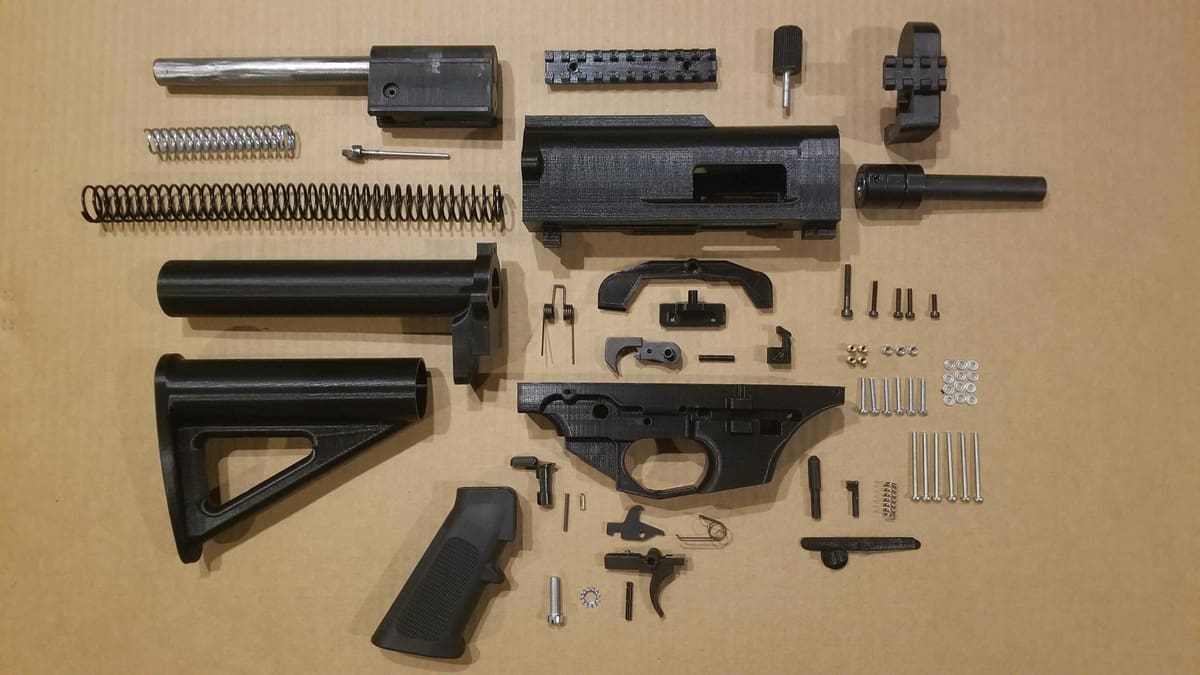
Since the advent of the first models, 3D printed guns have maintained a reputation for jamming, possibly even blowing up in the user’s hand. A popular opinion on the internet is that 3D printed guns are more dangerous for users than others. A 2021 Vice documentary on Ghost Guns shows several malfunctioning self-made guns at the first 3D printed gun competition, but it’s worth noting that the well-built 3D printed examples worked perfectly.
The Halle Synagogue shooter, who captured the crime on camera, could be heard commenting that he had “certainly managed to prove how absurd improvised weapons are” after repeated jams.
Because 3D printed guns are homemade, the proficiency of the firearm depends on the skill of the builder.
As accessible 3D printing technology improves and the pool of shared knowledge on 3D printing grows, it’s clear that such improvised firearms are becoming increasingly effective.
Proliferation & Public Safety
In addition to becoming sophisticated and more reliable than ever, 3D printed guns are now also cheaper and easier to manufacture. Co-founder of Deterrence Dispensed, Ivan the Troll, told Slate that the FGC-9 needs no technical expertise to build and is the easiest, cheapest, most accessible, and most reliable semi-automatic DIY firearm he’s aware of. He also said that someone with experience could make an FGC-9 in a week or less, while a motivated novice could take as little as two weeks. Just $200 today will comfortably buy a 3D printer capable of such prints, plus spools of material.
The advancements and greater accessibility of the technology have caused concerns over the possibility that 3D printed guns might be misused. A popular counterclaim from 3D printed gun supporters is that it would be far easier for a criminal to acquire a gun illegally in the streets or on the black market. At the same time, criminals are reportedly taking advantage of the reduced prices, lower barrier to entry of the technology, and improved and freely accessible designs.
Evidence for growing real-world use is becoming harder to dismiss. According to an Everytown for Gun Safety analysis of data provided voluntarily by 20 US city police departments, 3D-printed gun recoveries at crime scenes rose from approximately 32 in 2020 to 325 in 2024 across those cities – a tenfold increase over five years.
The data was provided exclusively to Everytown rather than through public records, and the underlying figures have not been independently verified; however, the directional trend is consistent with separate ATF reporting on the broader rise in privately made firearms, and with individual city-level data reported independently by departments including the NYPD. It should be noted that 3D-printed guns represent a small fraction of total crime gun recoveries, and the majority of ghost gun seizures involve kit-built rather than printed weapons — categories that are related but distinct.
Some statistics show that ghost gun-related crimes are rising in America, with a fact sheet produced by the Policing Institute noting an increase in some areas. It should be noted, however, that it is not entirely clear just how many of these ghost guns are 3D printed.
The same institute also acknowledges inconsistencies in how law enforcement agencies collect and collate their data on ghost guns, making it difficult to paint an accurate, nationwide picture of the reality of ghost gun recovery in crime.
Auto sears – small 3D-printed components that can convert semiautomatic pistols to fire automatically – have also emerged as a distinct and growing enforcement concern, adding a further dimension to the proliferation picture beyond complete printed firearms.
Public safety threats related to 3D printed guns are a sensitive topic in countries with stricter or non-existent public ownership of firearms. Growth in 3D printing technology provides a new and accessible tool that can be used by those with ill intentions to bypass gun laws and manufacture illegal weapons that would otherwise be difficult to acquire.
Attempts to prevent 3D printed guns from falling into the wrong hands are further hindered by the controversial nature of enacting laws that might be considered an infringement on freedom of speech and the near impossibility of regulating the spread of information on the internet. As the current wave of US state legislation demonstrates, the debate over where the regulatory line should fall – and whether it can be technically enforced – is far from settled.
What Next?
As a byproduct of a manufacturing technology proven to have many beneficial applications, it will never be an easy task to regulate 3D printed firearms.
The legal landscape is now moving faster than at any point since the Liberator’s release in 2013. The Supreme Court has settled the federal question around ghost gun kit regulation. More than a dozen US states have enacted or are actively moving legislation targeting manufacture, possession, or the distribution of design files. And in New York and California, the regulatory frontier has moved to the printer itself – an approach with no historical precedent that will spend the next two years being defined by working groups and then tested in courts.
The contested question is no longer whether 3D printed guns are dangerous – the evidence for that is clear. It is whether the technology exists to regulate them, and whether any implementation of this will come at the expense of software and hardware freedoms for the majority who have no interest in 3D printing firearms. The answer to that question will shape not just gun policy but the future of consumer 3D printing as a technology.
For now, enthusiasts will continue to perfect and show off their designs. Law-makers in some parts of the world, particularly in the U.S., will continue to wrestle with how to reconcile the technological and cultural aspects of 3D printed, self-made firearms with existing legislation. Achieving this in the manner currently proposed has the potential to transform desktop 3D printing in a way that many are uncomfortable with. And regardless of that change, workarounds will no doubt be found to keep 3D printing guns anyway.
Lead image source: cottonbro, via Pexels
License: The text of "3D Printed Guns: Origins, Legality, Types & Status" by All3DP is licensed under a Creative Commons Attribution 4.0 International License.