VulcanForms Orders 200 EOS Metal 3D Printers, Raising Questions About Its Own Technology

With 35 EOS systems already in production, the massive equipment order marks a substantial commitment to an outside supplier. But what does it mean for VulcanForms' proprietary Gen 3 platform?
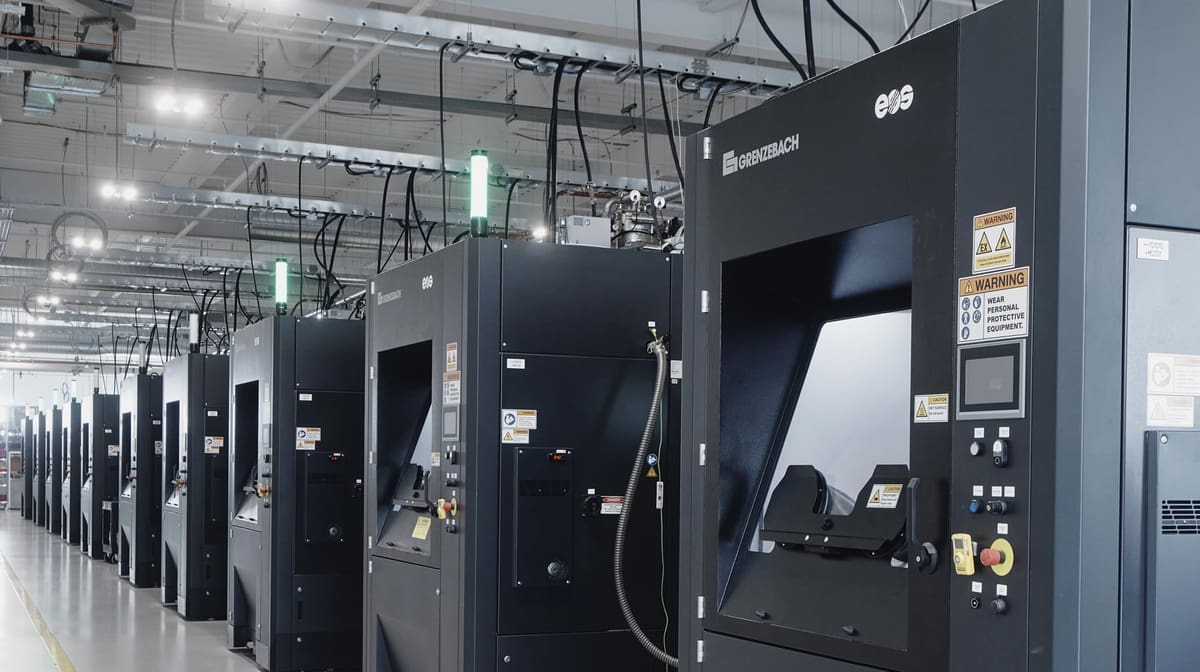
U.S.-based VulcanForms just placed an order for 200 EOS M4 Onyx metal 3D printers and ancillary equipment, representing the largest single order in EOS history.
The deal will significantly expand production capacity at VulcanForms’ facilities in Devens, Mass., where 35 EOS M4 Onyx systems are already operating alongside other metal additive manufacturing platforms. VulcanForms serves customers in sectors including medical devices, consumer goods, industrial equipment and mission systems, producing finished metal components rather than selling printing equipment.
Launched in late 2025, the EOS M4 Onyx features six 400-watt lasers, a 450 × 450 × 400 mm build volume, advanced filtration and process control technology. The agreement also includes materials, software and application support from EOS, with an emphasis on achieving consistent quality and repeatable manufacturing processes across the expanding fleet.
EOS told All3DP that 200 machines can be built and delivered in the next 12 months.
Neither company disclosed the value of the contract but an order of this magnitude would represent an investment of several hundred million dollars.
What Happened to Gen 3?
The scale of the purchase is particularly noteworthy given VulcanForms’ origins as a developer of proprietary, high-productivity metal 3D printing technology.
VulcanForms built much of its early reputation around its own laser powder bed fusion technology. Its Gen 3 printer reportedly features 75 lasers, each rated at 550 watts, delivering approximately 40 kW of total laser power. Designed and built in-house, the machines were intended to enable high-throughput, cost-effective production of industrial metal components, buy the company was always secretive about technology details.
Unlike traditional 3D printer manufacturers, VulcanForms does not sell its machines. Instead, it uses them in its own factories to provide finished metal parts to customers.
While the company has now committed to 200 additional EOS machines, it has disclosed no comparable expansion plans for its proprietary Gen 3 technology.
CEO Kevin Kassekert insists the two platforms will coexist, stating that the EOS systems will operate “along with our proprietary printer technology.” However, VulcanForms has not revealed how many of its own printers are currently in production or whether it intends to manufacture more.
The distinction is significant. Supplementing an in-house technology with commercially available equipment is one thing. Relying on that equipment for the bulk of future capacity expansion would represent a more fundamental change in strategy.
A Turbulent Path to Scale
Founded as an MIT spinout, VulcanForms attracted considerable attention in 2022 when it announced $355 million in funding and a valuation exceeding $1 billion. Its ambitious approach to metal additive manufacturing promised to combine highly productive proprietary printers with automated, vertically integrated production facilities.
Turning that vision into a reliable industrial operation proved challenging. Reports of layoffs in 2024 accompanied a leadership change, with former Tesla executive Kevin Kassekert replacing founder Martin Feldmann as CEO.
More recently, VulcanForms has demonstrated renewed access to substantial financing. In January 2026, it announced a $220 million Series D funding round, followed in November by a $500 million financing agreement led by J.P. Morgan and Apollo funds to support construction of three additional manufacturing facilities.
With expansion plans on that scale, established industrial printing equipment offers a potential route to increasing capacity without relying exclusively on further development and deployment of proprietary machines.
That does not necessarily indicate problems with Gen 3, of course. The decision could equally reflect the need to add production capacity quickly, accommodate customer qualification requirements or diversify manufacturing capabilities. VulcanForms has not explained how these considerations influenced its choice.
A Major Commitment to EOS
For EOS, the agreement represents an unprecedented order and a substantial expansion of its presence within VulcanForms’ manufacturing operations.
The two companies are collaborating on more than hardware deployment. EOS will provide technical expertise to help integrate the printers into a production environment that combines metal additive manufacturing, precision machining, automation, inspection and proprietary software.
EOS CTO Joachim Zettler emphasized that operating 235 M4 Onyx systems presents challenges extending beyond printing throughput, particularly maintaining repeatable processes and consistent part quality throughout the fleet.
License: The text of "VulcanForms Orders 200 EOS Metal 3D Printers, Raising Questions About Its Own Technology" by All3DP Pro is licensed under a Creative Commons Attribution 4.0 International License.