This Low-Cost 3D Printer Fume Control Achieves 99% Particle-Capture, but Practical Gaps Remain

A new study suggests that well-designed nozzle extraction and fully ventilated enclosures can reduce particles released while printing ABS by 99%, but leaves users without a practical safety solution.
Researchers from the U.S. National Institute for Occupational Safety and Health (NIOSH) recently tested four relatively inexpensive methods for capturing particle emissions from desktop FDM 3D printers. Under controlled laboratory conditions, the strongest designs removed more than 99% of measured particles.
The most interesting finding in NIOSH’s “Design and Evaluation of Four Low-Cost Engineering Controls for Reducing Particle Emissions from 3D Printing” is not that a fully ventilated enclosure can trap airborne particles. It is that an open-frame printer can also achieve very high particle capture while printing ABS—although the solution is inelegant, printer-specific, and potentially cumbersome.
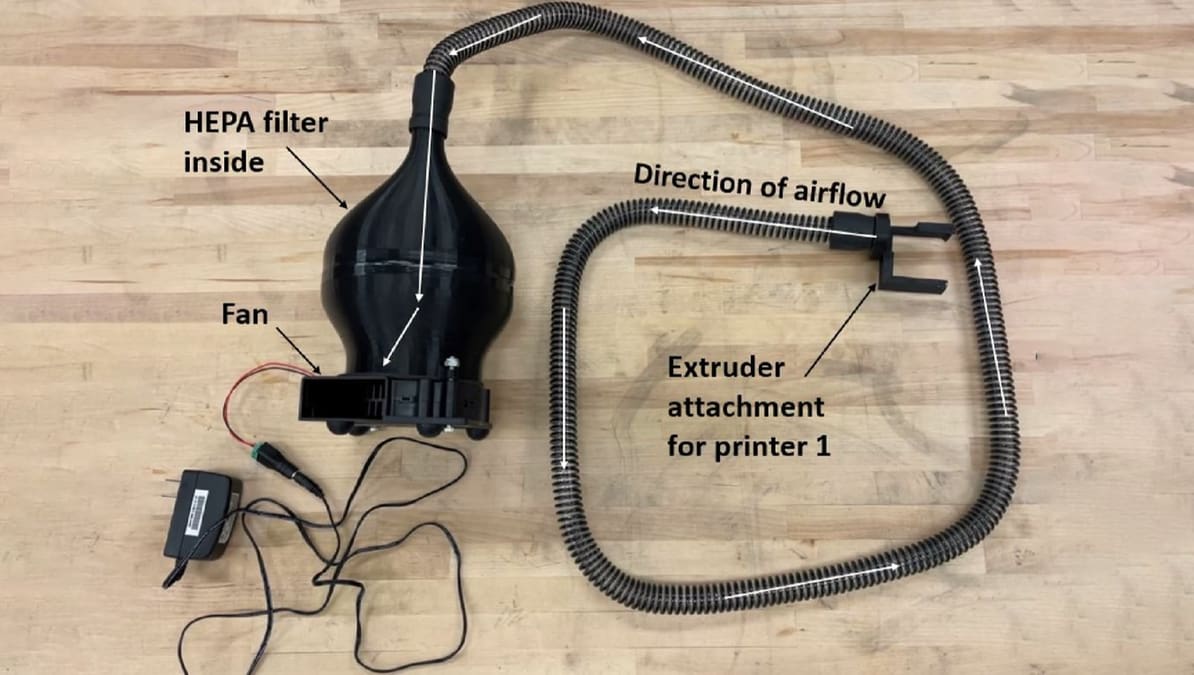
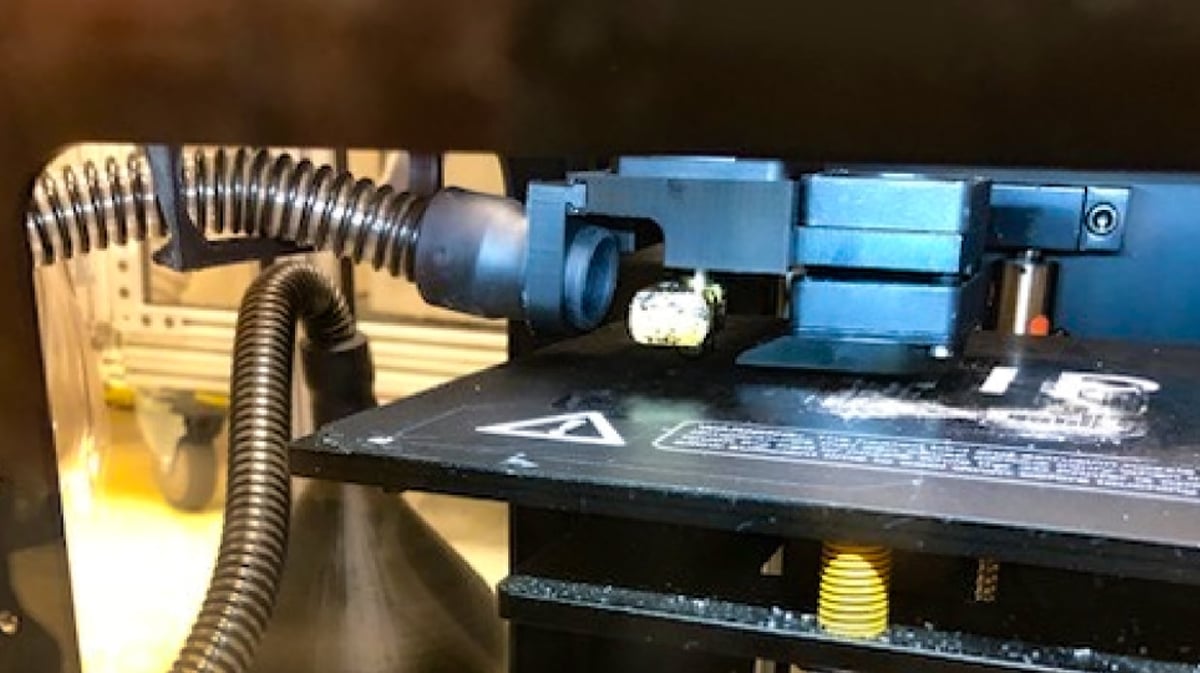
NIOSH researchers designed a custom capture hood mounted to the printhead and aimed at the nozzle. A hose connected the hood to a separate blower and high-efficiency filter. On one open-frame printer, the system achieved a minimum particle-capture efficiency of 99.72%.
The study did not examine whether the added attachment and hose affected print speed, motion, reliability, or part quality. It also measured only particles, not gases or volatile organic compounds (VOCs). The design builds on NIOSH’s earlier work with nozzle-level extraction rather than introducing the concept for the first time.
A second version of the nozzle extractor performed less consistently, achieving a minimum capture efficiency of 91.55%. The researchers attributed the difference to tighter space around the extruder, narrower internal passages, and lower airflow—not simply to the presence of a smaller attachment.
ABS fume particle capture rates:
- Nozzle Control A: 99.72%
- Nozzle Control B: 91.55%
- Commercial build-area enclosure: 28.59%
- Whole-printer enclosure: 99.78%
Despite being less groundbreaking than we’re used to when it comes to NIOSH’s 3D printer research, it reinforces two important findings: carefully engineered nozzle extraction and ventilated enclosures can capture nearly all measured particles, while placing a build area inside an acrylic box does not necessarily mean that ABS particle emissions are being contained.
An Enclosure Is Only as Good as Its Airflow
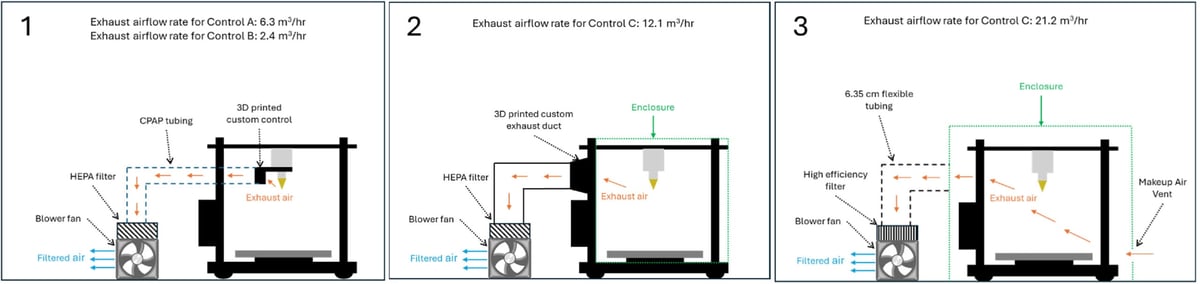
Another important lesson concerns the design of printer enclosures. Simply surrounding a printer—or part of one—with panels does not guarantee effective particle capture. The airflow, vents, fans, and enclosure boundary must all be considered as part of the individual machine.
One printer, which appears from the paper’s photographs to be a LulzBot Mini, was tested with a commercially available, printer-specific enclosure. Its particle capture was poor because the enclosure surrounded the build area but did not contain the machine’s complete airflow system.
An exposed electronics-cooling fan pushed particle-laden air through openings outside the enclosure’s filtered exhaust path. The result demonstrates that an effective enclosure must control fans and vents, not merely surround the print bed.
Most contemporary printer enclosures surround the entire machine, so this finding may be most relevant as an airflow lesson and a warning for DIY enclosure designs. It also shows why an enclosure built primarily for temperature stability should not automatically be treated as an emissions-control system.
Strong Results, but Little Users Can Replicate
Over roughly the past decade, NIOSH has helped build much of the evidence base used to make desktop 3D printing safer in workplaces, schools, makerspaces, and laboratories. Its research has moved the discussion beyond the vague warning that printers “produce fumes” by identifying what is emitted, when emissions become worse, how workers may be exposed, and which engineering controls can reduce that exposure.
For occupational safety professionals and hobbyists alike, however, this latest study is more proof of concept than practical guidance. It demonstrates two sound principles: capture emissions close to the nozzle, or enclose the entire process while maintaining controlled inward airflow. But what it does not provide is a complete, validated, downloadable system that users can install and reproduce. Although NIOSH has previously published files for a related extraction system, the paper does not supply printable files or full construction instructions for the new printer-specific capture hoods that produced these results.
The study also does not evaluate the complete mixture of emissions released while printing ABS. The authors explicitly state that the controls were not designed to mitigate gaseous emissions, so the reported 99% figures cannot be interpreted as 99% removal of all ABS emissions. A high-efficiency particle filter can capture airborne particles while allowing gaseous contaminants to pass through. The research has significant gaps, but is not scientifically pointless. While it confirms that inexpensive source extraction can dramatically reduce ultrafine-particle release when it is correctly engineered, it also cautions that enclosure design is more complicated than it may appear.
Users should not rely on cosmetic covers. Emission control should account for both particles and gases, and every possible airflow route should be considered when designing an enclosure. The paper also recommends conducting a risk assessment before fitting retrofit controls or improvised modifications, including consideration of fire hazards, warranty implications, and possible effects on equipment certifications.
You May Also Like:
License: The text of "This Low-Cost 3D Printer Fume Control Achieves 99% Particle-Capture, but Practical Gaps Remain" by All3DP is licensed under a Creative Commons Attribution 4.0 International License.