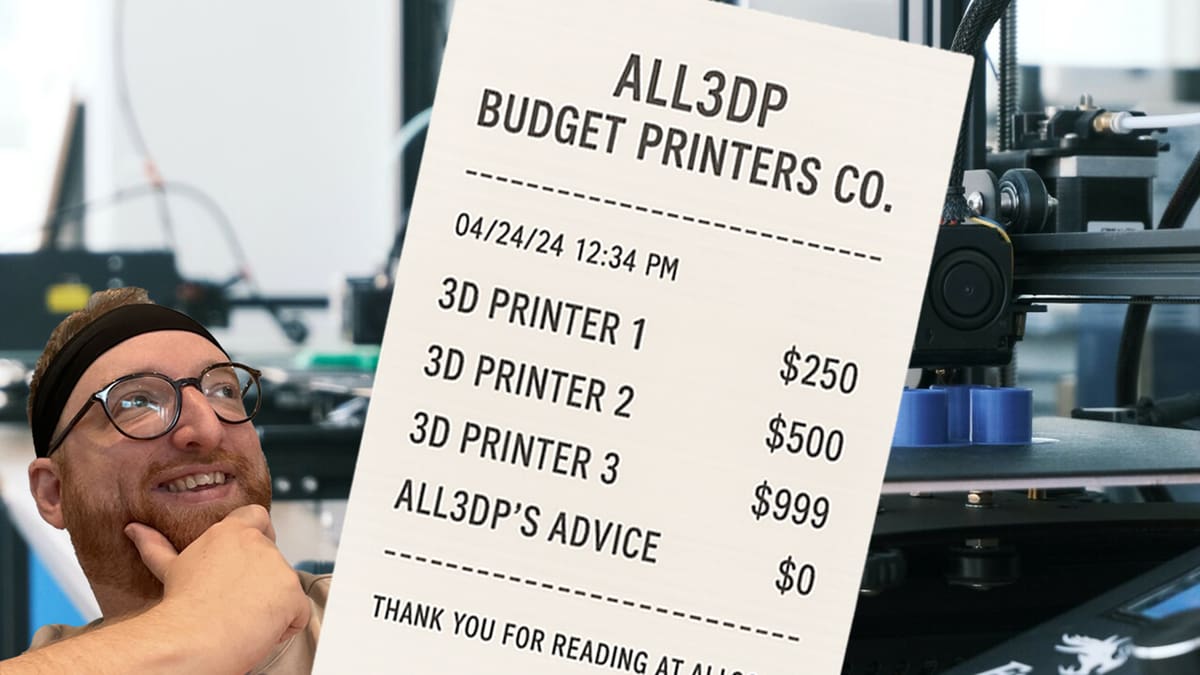
The Only 3 Budget 3D Printers I Would Buy Today, According to Your Expert Editor Who Is Always Short on Cash

Jonny holds onto money like a butter-fingered wide receiver holds onto a football – is he the best man to write about 3D printers on a budget?
I am actually. Because if anyone on this planet has managed to flirtatiously dance up to the line of bankruptcy and still walk away with something worth owning, it’s me. I make poor financial decisions about as reliably as office meetings kicking off with “Can everyone see my screen?” No, Sandra, no we can’t. We never can.
Unless you’re some kind of Saudi Prince (and congratulations if you are) you probably love getting the most for your money. You might not always buy the cheapest products, but you unequivocally want the best value on the market.
In many markets, it’s the budget products that serve as the benchmark: Sturdy, trustworthy, and much better than their price would suggest. 3D printers are no different. An excellent cheap printer is often more tempting than its excellent but pricier counterpart. Over time, the budget offerings can even takeover. Where do you go if you want a digital watch? Casio, that’s where.
My tendency to get lured in by whatever the current Lamborghini of 3D printers happens to be is well documented, and regrettable. It is through that exact financial recklessness that I’ve learned exactly where the true value is though. Especially in 3D printers. Get in losers, we’re going printing.
In the spirit of my “do as I say, not as I do” editorial approach, I’m here to show you exactly how and why you can stick to a budget and still come out with one of the best 3D printers around. It’s personal growth for me, and important knowledge for you.
Thank me later in the comments section. Or donate to me directly at jonny@all3dp.com. I’m hungry.
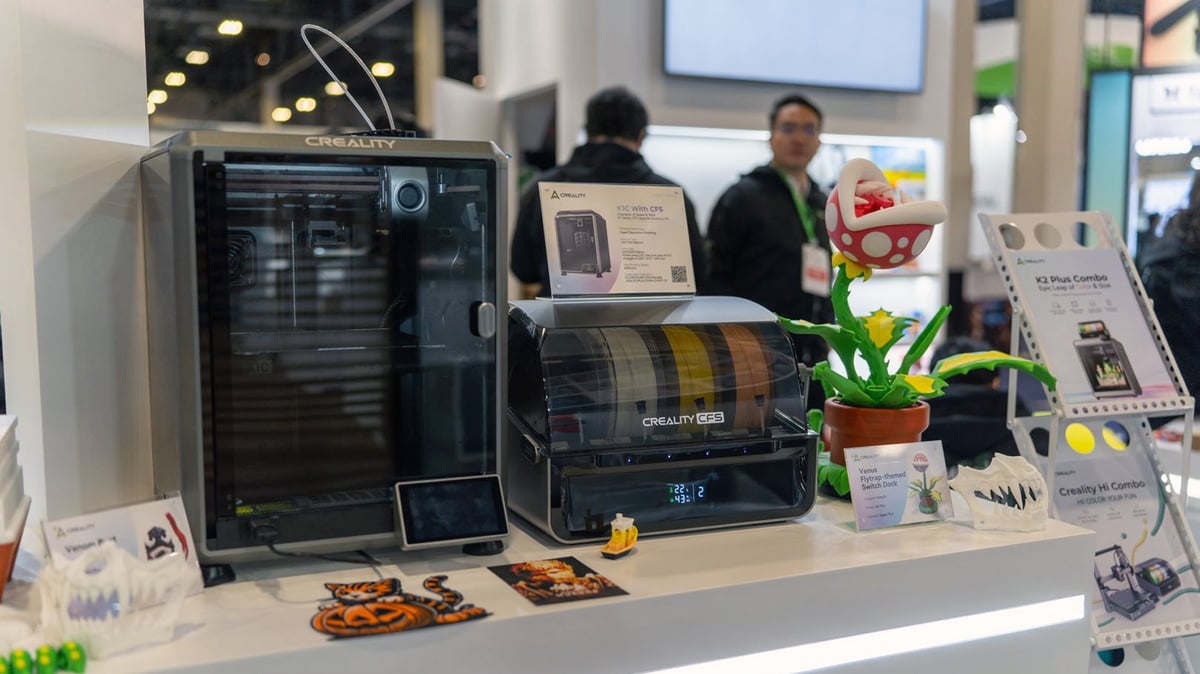
The Rules of Engagement
Before we begin, it’s time to break out the rulebook. We’re going to look at three different budgets; $250, $500, and $999 – because anything into four figures is expensive, no matter what you say. What are you, some kind of Saudi Prince?!
We’ll be picking reliable machines from trustworthy brands, capable of producing impressive prints on the regular. We want them to be capable of producing prints from an array of different filaments, and perhaps even have some scope for upgrading. If possible, these babies should strive to be as cool as possible too, so we can tell our friends and family “I got this … guess how much it cost?”
What’s better than grabbing a bargain? Grabbing a bargain and rubbing it deep into the faces of your loved ones, that’s what.
$250 – God, I wish I had more to spend.
In the 3D printing landscape, $250 isn’t a great deal of money. Down here, quality 3D printers can get scarce. That doesn’t mean they aren’t out there though. Like your soulmate, you just have to keep telling yourself they exist.
Two, three years ago this sort of budget wouldn’t have bagged you much more than an Ender 3 V-something. machines that are now beginning to look like relics of a bygone age. Thank God it’s 2025 then, because you can grab yourself a Bambu Lab A1 Mini for a little over $200 – sometimes even under if you keep your finger on the pulse of deals. That’s a sign of how far things have come, as well as how fast things can move in 3D printing. It’s still a young, dynamic realm.
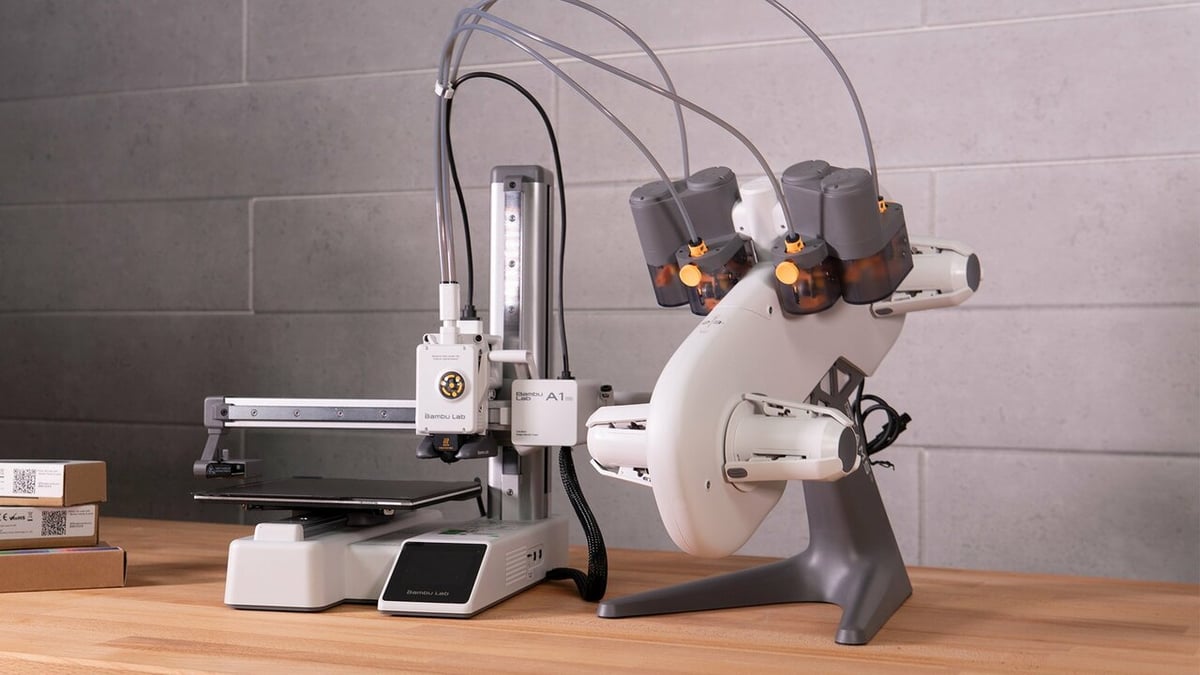
Clever Cantilever
The A1 Mini is a fabulous little baby Bambu that features an unusual cantilever design. That means you’ll see the hotend dangling out on its Y-axis supported only on one side. That makes it look unsteady, but it isn’t. We’ve tested the A1 Mini a lot. It sits on a desk in the All3DP editorial suite actually, and regularly sees use. Not only does its design work, it works brilliantly, even printing at speeds you might consider abnormally quick for a cantilever.
Its size is what allows it to hang out with us in here, instead of the print lab. It has dimensions of 347 x 315 x 365 mm and weighs in at 5.5 kg. In many ways, it’s a perfect office desk companion, provided you’re not printing something like ABS, the fumes from which could give even the Lord himself a migraine.
If it were too noisy, it wouldn’t be all that suitable either. Bambu says that it produces only 48 dB running in silent mode, and that’s probably thanks in large part to the intelligent motor noise cancelling. The A1 mini can actually calibrate itself to match the individual differences between each drive motor.
Space – the final frontier.
Ok, the build space isn’t expansive: 180 mm³ doesn’t leave you with the sort of room you might need for printing things like shoes, helmets, or other garments, but if you’re getting into printing for the first time, this sort of space is likely plenty. That reminds me, I’ve typed up advice for beginner 3D printers too.
What you can print within its limited space of creation is large though. A maximum hotend temperature of 300 °C means exotic filaments are within reach, even though Bambu Lab recommend avoiding ABS, ASA, PC, PA, PET, and carbon/glass fiber reinforced ones. That’s not to say you couldn’t experiment with a hardened steel nozzle and a self-developed enclosure.
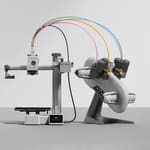
Being a Bambu Lab printer it also comes with vibration and flow rate compensation as well as all the automatic calibration tech Bambuites love so dearly. When the time comes for an upgrade, you could snag an AMS Mini, and open the golden doors of multicolor printing too. There’s really a great deal of value in this baby Bambu.
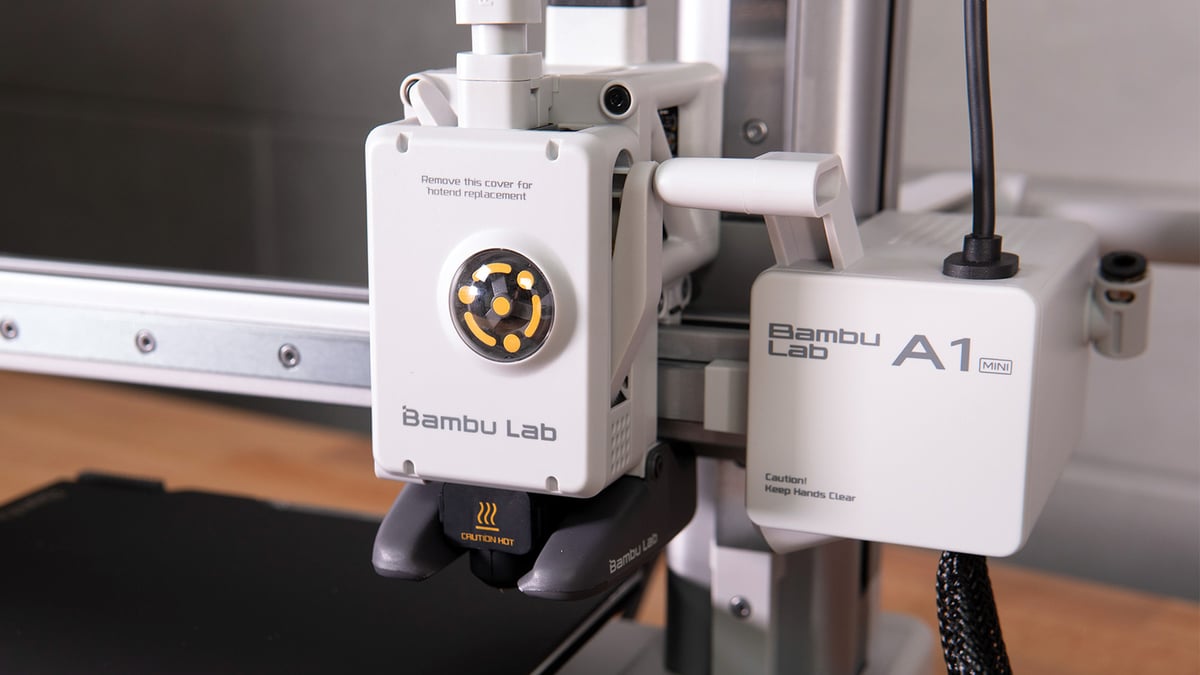
Bambu Lab A1 Mini: Takeaways
- Why it’s Great: Cheap but extremely capable and distinctive throughout.
- Why it’s Meh: Damn, I don’t have enough space to print this childish and somewhat stereotypical print of a Marvel helmet.
- Who’d Love it: Newcomers on a budget who want to print quick and easily.
As we can see, the A1 Mini would be a pretty good scorer. It’s pretty much eights across the board, and for around $200, that’s really, really good. Think of it as the Stewie Griffin of 3D printers. Small, crafty, and substantially more grown up compared to others of its size. Sings a good tune too.

$500 – Now we’re talking!
Picture if you will, a reputable liquor store. It’s packed with tempting spirits stored safely across a selection of shelves. On the bottom, we’ve the bottles of smartly-marketed wound cleansers. Think Jameson, Smirnoff, or Fireball. Oh God, anything but the Fireball…
There’s a top shelf. It doesn’t matter what’s up there. It’s limited edition, short supply, both, or Japanese. You’d need to mortgage a kidney just to enter a ballot to be allowed to look at that shelf.
Home is the middle shelf. Is that a bottle of Glenmorangie? Ooh, LeBron edition Henny? Glengoolie Blue would be stocked here. In the spirits world, this here middle shelf is where the high quality but reasonably affordable stuff is. Funnily enough, it’s not all that different in 3D printers.
Carbon Copy
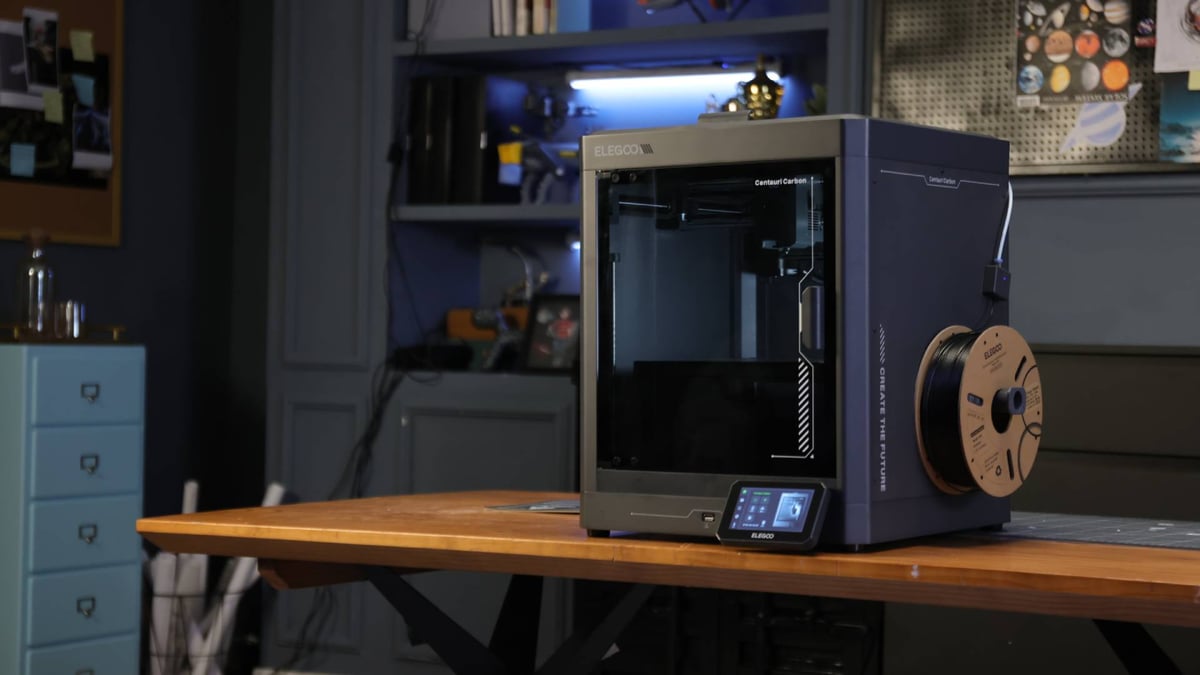
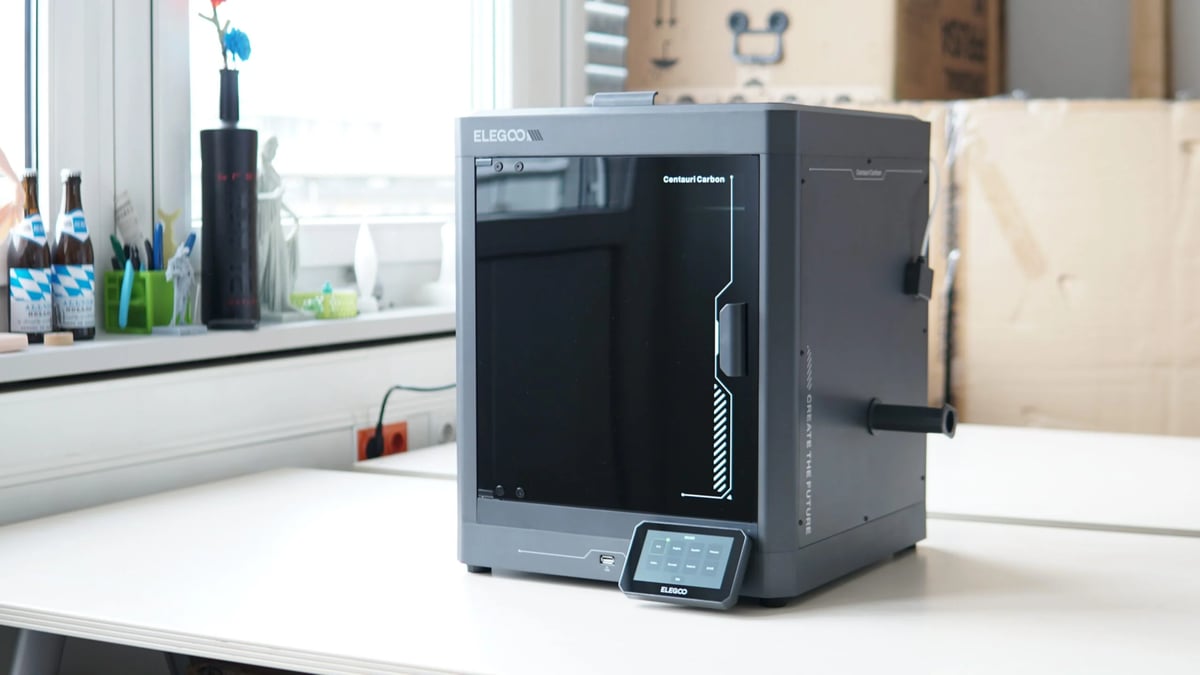
On the middle shelf of All3DP’s Budget 3D Printers Store you’ll find the Elegoo Centauri Carbon. This cat proof, CoreXY kinematic-blessed, fully enclosed Bambu Lab X1C impersonator is one of the most impressive “cheap” printers we’ve ever tested. Sure, it’s easy to know the recipe when somebody else has already written it for you, but it isn’t easy to take the winning formula, dilute it down to something a third of the price, and retain at least 75% of the famous flavor. That’s what Elegoo’s done though, so hats off to them.
The CC has such a high degree of Bambu Lab X1C DNA, that you’d be quietly hoping they weren’t dating. Such is the 3D printing industry, however. Somebody takes the innovative first step, and everyone else gets the tracing paper out, copies the design, and attempts to offer the same thing at a lower price. It’s annoying 90% of the time, but for the remaining 10%, it means some tech previously out of the reach of consumers now becomes obtainable and more importantly, worth paying for.
Alpha Centauri?
An X1C (my favorite printer) will set you back four numbers, and as we’ve already discussed, we’re not going there. An Elegoo Centauri Carbon on the other hand, will cost you just $300. We’re getting Eagle Rare for Jack Daniels money here, folks. It doesn’t feel like it’s been built to a financial restriction either – excluding the spool holder. It’s a quality product.
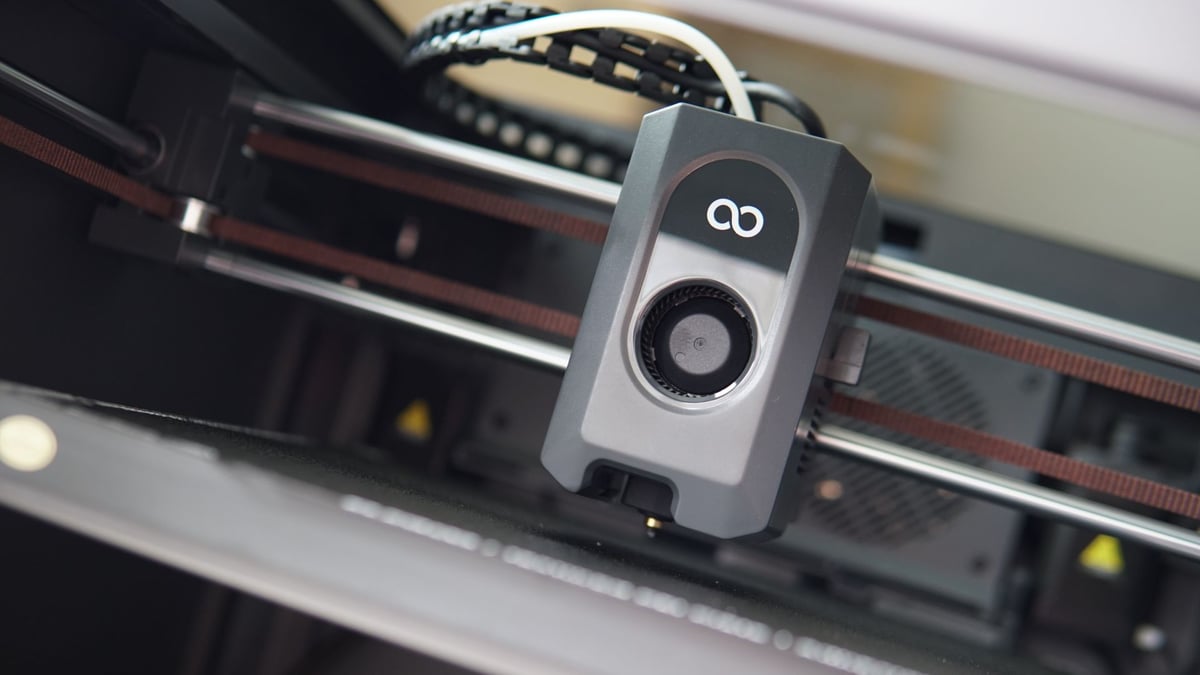
Let’s take a dip into the specifications. A high-speed CoreXY motion is the current reigning consumer champion of hotend transportation, and it whizzes around the 256 mm³ build area with a pace and poise Cartesian machines get rabidly jealous of. Hotends themselves are all around the 300 °C mark nowadays, the CC’s hitting 320 °C. Some might call that overkill, but overkill is fun isn’t it? Speaking of which, the heated bed on this thing gets hotter about as quickly as any bed we’ve seen. It’s peregrine falcon fast.
It doesn’t have the intelligence or the refinement in the printing experience that the Bambu X1C has, but you can’t expect that. It’s less than a third of the price. It also doesn’t have the option to purchase a multicolor, multi-filament system. Elegoo has been proudly shouting about something along those lines arriving in Q3 2025, however. So, watch that space.
Elegoo Centauri Carbon: Takeaways
- Why it’s Great: “It’s so much cheaper than that fancy Bambu Lab!”
- Why it’s Meh: “…but what I really wanted was that fancy Bambu Lab.”
- Who’d Love it: “I couldn’t afford that fancy Bambu Lab, but this is great!”
The Centauri Carbon isn’t going to go down in history as some sort of groundbreaking, highly celebrated printer, but it will likely be remembered fondly by those who purchased it. It is, in the words of my Senior Ed, “wicked”.
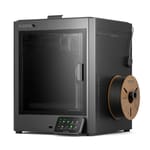
$999 – *belts out “Big Spender” by Shirley Bassey*
Lovely rendition. Ok, here we are at the high end of what might be considered “budget”. We’ve saved up, we’ve sold an old printer, I’ve you’ve applied for a credit card. Anyway, it doesn’t matter how we got here, we’re here. Now we ascend to the top of the budget printer tree using the power of what is thought to be the largest three figure number ever made – 999.
What we need to do now is drag the most prestigious printer we can down into our budget dungeon, wrap it up in chains, and never let it see the light of day again. This is easier said than done. The very best 3D printers are packed with leading-edge tech, clever software, and premium – dare I say even sexy – components.
Unfortunately, that sort of stuff doesn’t come cheap, and as a matter of fact, I have it on good authority that machines like this are allergic to the sort of budget we’re glued to. Compromises have to be made. If only we were a Saudi Prince…
The Unparalleled Horror of Manual Labor
A 3D printer kit is what we’re going to need: A printer kit from costs less than one pre-built printer. This has allowed us to bag a huge win: a Prusa Core One, for $949 of our $999 budget. Yes, you really can get one of the best 3D printers in the world for under four figures – if you build it yourself.
There’s not really a way I can describe the misery I feel when confronted by a task involving manual labor. If there’s an option to pay somebody to build something for me, I take it. I built a 174 cm cat tree for unofficial All3DP Cat Montgomery this weekend and hated every moment of it. Don’t look at me like that, he wasn’t going to do it, was he?
With $999, we’re aiming to jump into a 3D printer with the prestige and performance of a Lamborghini. It’s just, if we want to do that, we’re going to need to build the Lamborghini.
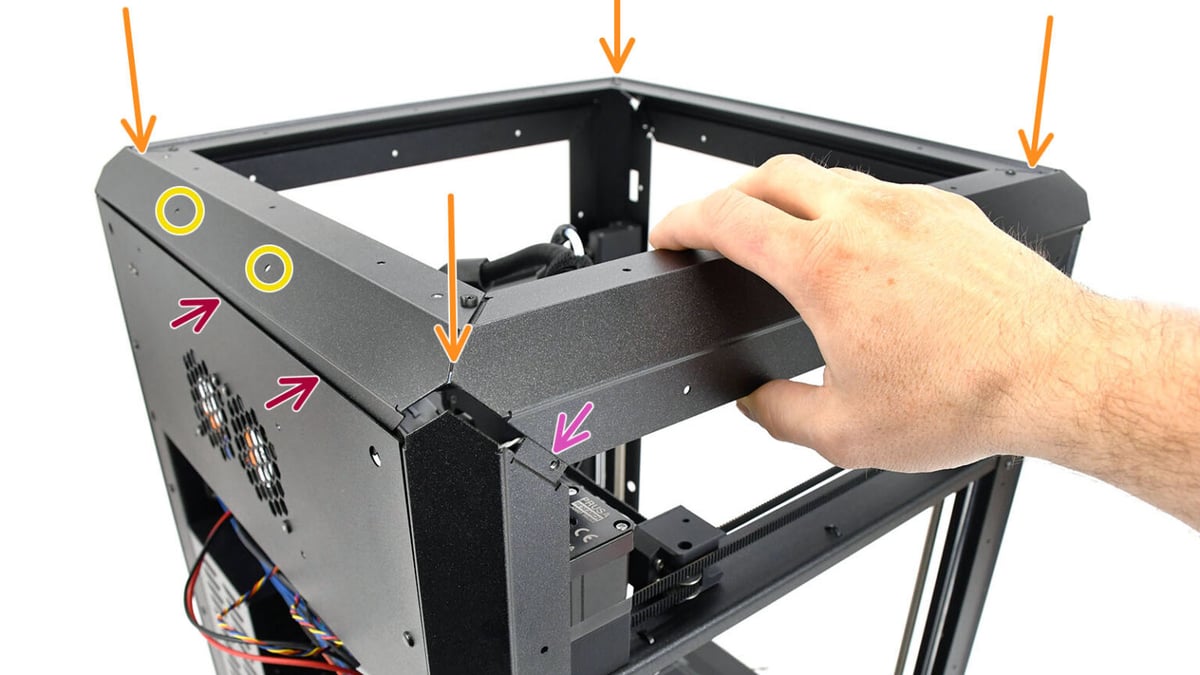
As you can imagine, not everyone will be up for that. The quality of the product you get at the end depends entirely on your construction. If left to my own devices, the Lambo I’d built (or more likely got a quarter of the way in before giving up in the haze of a tantrum) would likely be sub-par. I am the most ham-fisted person in this office by quite some margin.
You won’t be without a guiding hand. 3D printers can be relatively complex bits of kit – especially when broken down into tiny pieces – but Prusa is known for providing excellent instructions and reliable, trustworthy customer support. There’s plenty of reasons why the brand is often considered as the go-to for a top-to-bottom quality printing experience.
Bambu’s Bane
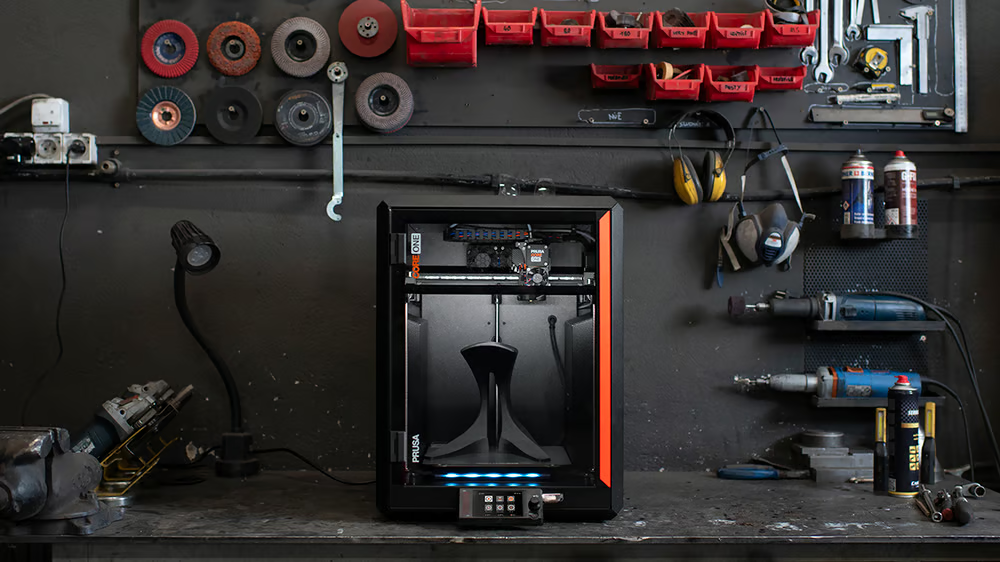
As with a lot of other industries and art forms, 3D printing has fashion. For over two years now, the fashion in 3D printing has been fast, capable, fully-enclosed, and connected. The Prusa Core One was significantly late to the show but when it arrived, it sure made an impact, competing with – and even exceeding in some cases – the abilities of the machine that started the craze off; the Bambu Lab X1C, which is considerably out of our budget.
The fact it can go toe-to-toe with such a machine and still come in under $1,000 is impressive, albeit with that asterisk of needing to construct it. It ticks all the boxes – CoreXY kinematics, an enclosed build area, connectivity, reliability, filament handling capability… It’s a complete 3D printer.

Unlike Bambu Lab’s machines, it’s also open-source, something people with a Reddit account get particularly flared up about. For some this is even a deal breaker, and for those who really want to keep drowning in detail there’s even a GPIO “Hackerboard” set so they can really experiment with the machine’s capabilities. Add about $15 to the price for that.
You may well be adding more than that too, because the Core One has significant upgrades available to it, for a price. The camera and the air filtration system’s DLC-like purchasability is a sore point for some, and buying them will leave us over the budget anyway. You know the rules.
So, it isn’t perfect, but at least one of us here ranks the Core One as better even than the X1C, and if that’s the case, a $949 outlay is a bargain. But it does feel as if Prusa is getting into a EA/Treyarch-style DLC scheme by not including some components other manufacturers throw in for free.
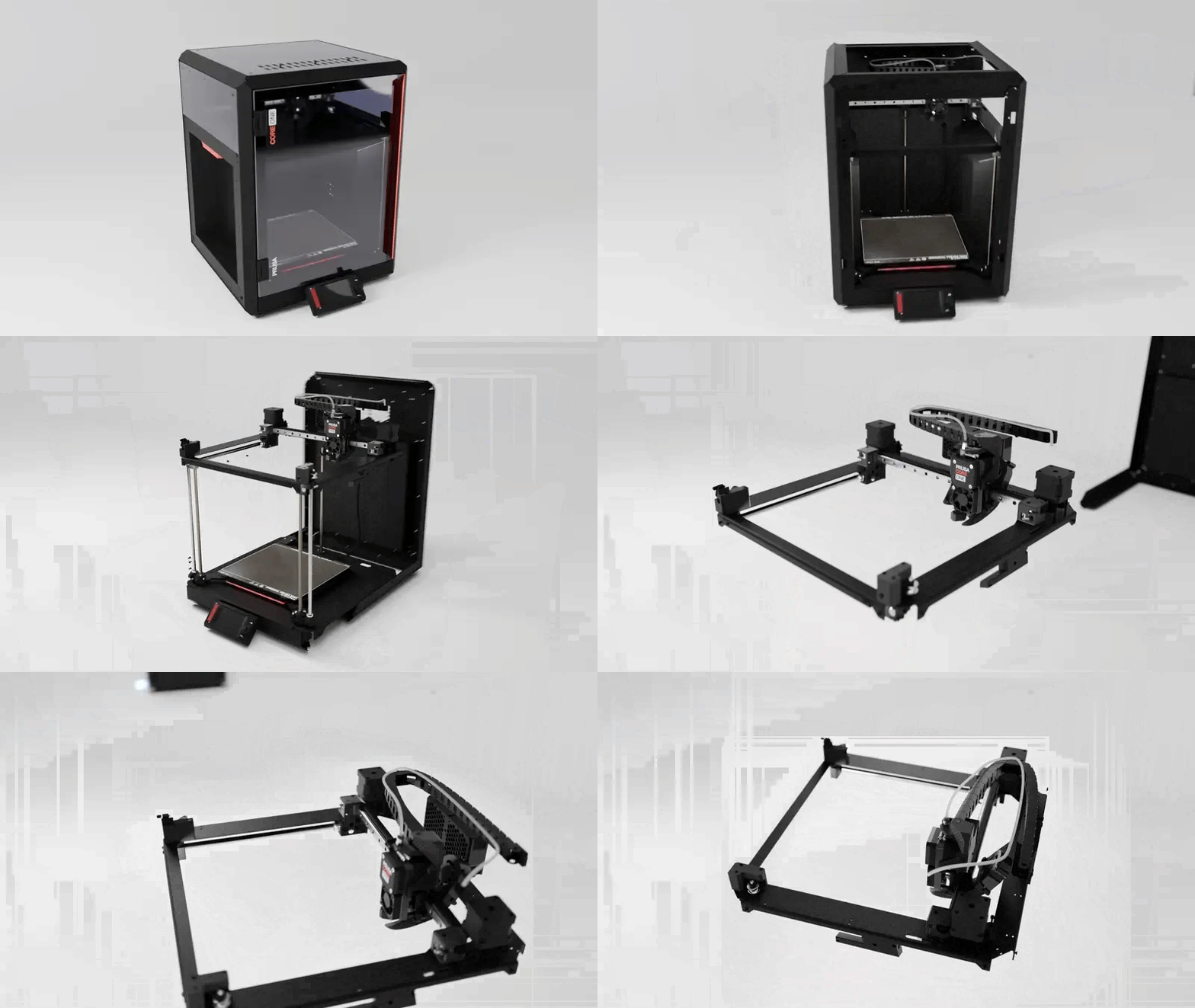
Prusa Core One: Takeaways
- Why it’s Great: It’s one of the greats.
- Why it’s Meh: That greatness could depend on how good you are following instructions.
- Who’d Love it: People with overly-arranged toolboxes, Redditors, and people who like orange.
An exceptional machine if you’re good at building things and probably even if you’re not, providing you can read instructions and be patient with yourself. The fact you can bag such a great machine under a grand is exciting, if not somewhat daunting to those not prepared for the task of construction.
Jonny’s Final Thoughts
So, there you go. Three exceptional printers at three different budgets. Save up and get one, you’ll have a lot of fun. Did I get it right? Did I get it wrong? Please write all glowing praise for my work in the comments below, and address all disagreements and complaints to: junk@all3dp.com. I’m sure I’ll get around to reading them at some point.
Thanks for taking the time to read, and if you want to help keep me employed (and by extension keep me and Monty fed) please consider using one of our affiliation links below if you choose to buy one of these three machines. Trust me when I say, it really helps!
License: The text of "The Only 3 Budget 3D Printers I Would Buy Today, According to Your Expert Editor Who Is Always Short on Cash" by All3DP is licensed under a Creative Commons Attribution 4.0 International License.
CERTAIN CONTENT THAT APPEARS ON THIS SITE COMES FROM AMAZON. THIS CONTENT IS PROVIDED ‘AS IS’ AND IS SUBJECT TO CHANGE OR REMOVAL AT ANY TIME.