Technical Ceramic 3D Printing on the Desktop? Meet the Admaflex Discovery

The €75,000 ceramic 3D printer offers an open material system and an upgrade path for users looking to scale up.
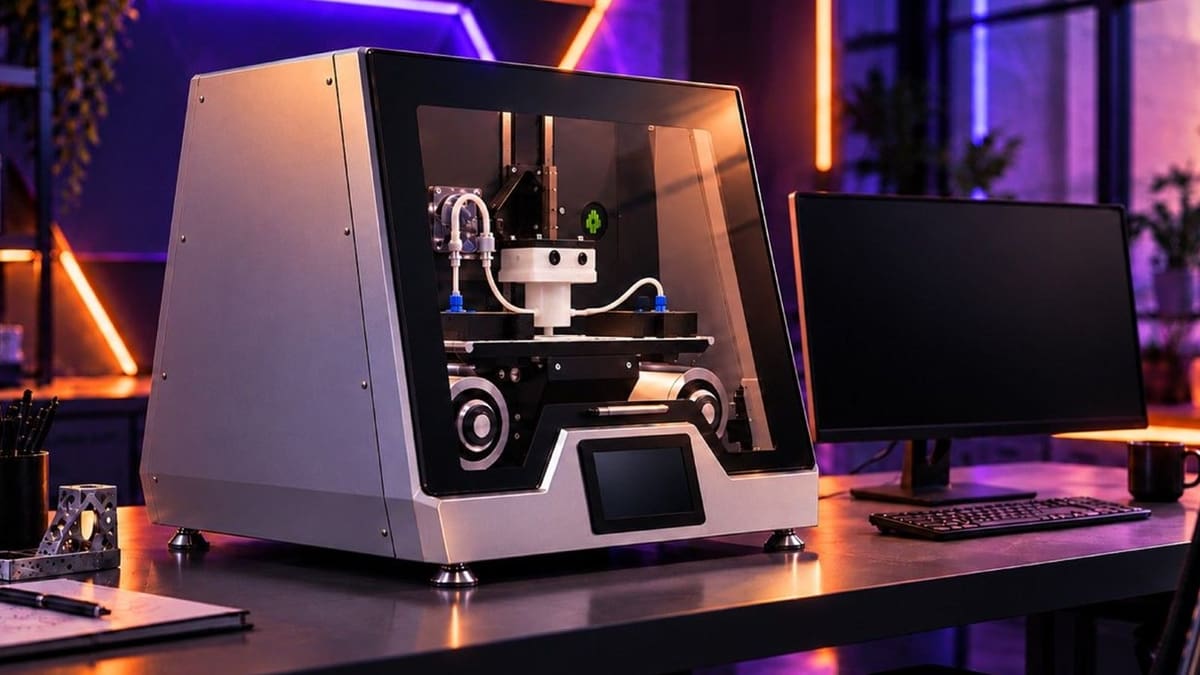
Dutch 3D printer manufacturer Admatec announced the Admaflex Discovery, its first desktop ceramic 3D printer that’s planned to be officially unveiled at the Formnext Expo in November.
Designed for universities, research institutes, and industrial R&D teams, the new machine aims to make technical ceramic additive manufacturing more accessible. Potential applications range from developing new ceramic materials and testing complex lattice structures to prototyping electrical insulators, wear-resistant components, and intricate casting cores for turbine blades. Research teams could also use the system to experiment with porous catalyst supports or miniature chemical reactor components. Its open material system makes it particularly interesting for universities and laboratories developing their own ceramic formulations.
The Discovery uses Digital Light Processing (DLP) technology and offers a build volume of 96 x 54 x 110 mm, a 50-micron image resolution, and layer thicknesses ranging from 20 to 200 microns.
It supports an open material approach, allowing users to work with Admatec’s ceramic slurries or develop their own formulations. Supported materials include alumina, silica, and base resins.
One of the machine’s main selling points is its upgradeable design. Users can start with the compact desktop configuration and later expand to a larger, more powerful system with an increased build volume, higher projection resolution, and dual-resolution capabilities.
The Discovery also introduces Admaflex software 3.0, featuring a redesigned interface accessible through an integrated 7-inch touchscreen or a connected computer.
Orders are set to open in November 2026, with first deliveries expected in late Q1 or early Q2 2027.
You Might Also Like:


License: The text of "Technical Ceramic 3D Printing on the Desktop? Meet the Admaflex Discovery" by All3DP Pro is licensed under a Creative Commons Attribution 4.0 International License.