
Top Ceramic 3D Printers for Technical Ceramics

Deepen your understanding of technical ceramics and why 3D printing is the fasting growing method of manufacturing ceramic parts and products.
Even though there are countless metals and plastics to 3D print with, ceramic materials have unique properties that are extremely valuable in the high-tech manufacturing of everything from semiconductors and bone implants to rocket engines and cutting tools.
Add 3D printing technology, and you can create ceramic parts in shapes and with features not possible with any other manufacturing process. This combination of material and technology is not only enabling better and more efficient ceramic parts, but it is positioning ceramics as an alternative to metals and plastics for a wide range of new applications.

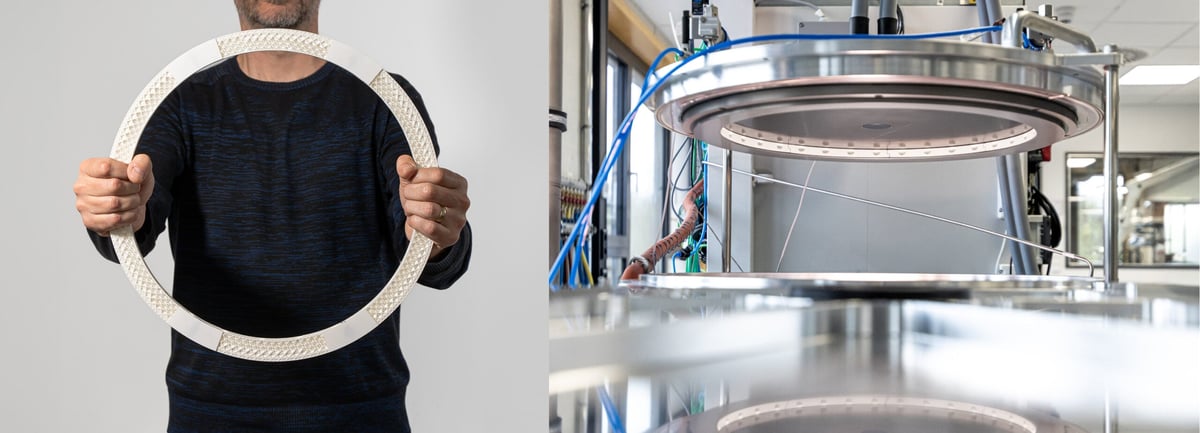
Take, for example, a gas distribution ring developed by German companies Plasway-Technologies and Alumina Systems using 3D printing technology from Lithoz. Unveiled in its latest 500-mm-diameter version in 2026, the component is designed to precisely distribute reactive gases inside semiconductor manufacturing equipment. Made from high-purity alumina, it contains two independent networks of intricate internal channels that allow gases to flow quickly and uniformly without mixing prematurely. This complex geometry would be impossible to produce using conventional ceramic manufacturing methods, while the ceramic material withstands the corrosive environment far better than metal. The ring is 3D printed in eight segments that are joined after sintering, with a single Lithoz CeraFab S320 capable of producing 14 segments in one print job. Testing of an earlier version demonstrated an increase in equipment uptime from one to nine months compared with a conventional metal ring.
Another reason manufacturers in a wide range of industries are taking a new look at ceramics is cost. 3D printing is often far more cost-effective and faster than traditionally producing ceramic parts, particularly for low-volume industrial applications and prototypes. Functional prototypes made of ceramic are also economical, even in small series, since no large investments in tools are necessary.
Despite its vast potential, 3D printing with technical ceramics remains a niche industry. Successful applications require design for additive manufacturing skills and thorough knowledge of the manufacturing process. Still a growing market of ceramic part suppliers now using 3D printer may turn the tide.
According to the Ceramic AM Market 2026 by VoxelMatters: “By 2030, total market revenue is projected to reach $635 million, with services becoming the largest segment by some margin.”
Among the established 3D printed ceramic parts suppliers are Germany’s CeramTec, Schunk Technical Ceramics, Steinbach AG, Alumina Systems, WZR Ceramic Solutions, Hilgenberg-Ceramics, and Kyocera Fineceramics Europe, along with Sinto Advanced Ceramics, formerly Bosch Advanced Ceramics.
Other supplier options include France’s 3DC-ACE, Switzerland’s Ceramaret and BSQ TECH, and US-based Adva Cera, Precipart, and SINTX Technologies. Japanese manufacturers Mitsui Kinzoku and Yugyokuen Ceramics also offer specialized ceramic additive manufacturing services. For customers seeking parts made with NanoParticle Jetting technology, XJet provides access to a global network of production partners.
Let’s dive deep into this technology to uncover how technical ceramics is set to rival traditional manufacturing and metal 3D printing in a wide range of applications.
| Printer | Technology | Materials | Size (mm) |
|---|---|---|---|
| Formlabs Form 4 | LCD (masked SLA) | Alumina (Al₂O₃), using Alumina 4N Resin | 200 × 125 × 210 |
| Tethon 3D Bison 1000 | Digital Light Processing (DLP) | Alumina, Aluminum Silicate, Zirconia, Flex Ceramic, Glass Ceramic, Mullite, more. | 110 x 60 x 138 |
| 3DCeram Sinto C3601 Ultimate | Stereolithography (SLA) | Alumina, Zirconia, Silicore, Aluminium Nitride, Silicon Nitride, HAP, more. | 600 × 600 × 300 |
| Lithoz CeraFab System S320 | Digital Light Processing (DLP) | Alumina, Zirconia-toughened Alumina, Zirconia, Tricalcium Phosphate, Lead Zirconate Titanate, Hydroxyapatite, Silicon Nitride, more. | 257.6 × 135.8 × 320 |
| XJet Carmel 1400C & Carmel Pro | Material Jetting | Alumina, Zirconia, Soluble Support Material | 500 x 140 x 200 |
| D3-AM LAB II | Material Jetting | Alumina, sintered silicon carbide (SSiC) | 400 × 480 × 160 |
| Admatec Admaflex 130 Evolution | Digital Light Processing (DLP) | Alumina, zirconia, silica, hydroxyapatite; metals | 64 × 40 × 400 to 160 × 100 × 400 |
| Concr3De Armadillo Blue | Binder Jetting | Silicon-infiltrated silicon carbide (SiSiC), alumina | 370 × 260 × 250 |
| Prodways Ceram Pro 365 Max | Digital Light Processing (DLP) | Alumina (A100), silica (SiCast 1200) | 264 × 328 × 350 |
What Are Technical Ceramics

Unlike the ceramic material used in pottery, technical ceramics (also called industrial or engineering ceramics) have nothing to do with clay. They are available in various properties: strong as the hardest metal, heat resistant enough for deep space, porous to enable cellular growth in human implants, wear-resistant for demanding oil & gas industry applications, completely transparent but harder and stronger than glass, and electrically insulating.

The properties of 3D printed ceramic parts are equal to or better than traditionally manufactured ceramics as long as the density of ceramic material is high (we cover this more in the next section).
Technical ceramics come in a wide variety of formulas ranging from aluminum oxide (Al2O3), which is the most common to zirconium oxide (ZrO2), commonly called “ceramic steel”. There’s also tricalcium phosphate (TCP) used as a functional material for implants and bone replacement, and silicon carbide (SiC) and boron carbide (B4C) are used in oil & gas and automotive applications. Lithium disilicate is used for near-natural-looking dental restorations.
Advantages of technical ceramics:
- Extremely high heat resistant
- Ware and abrasion resistant
- Low thermal expansion
- Chemically inert (no corrosion)
- Electrically insulating
- High dimensional stability
- Bioinert and, in some cases, bio-reabsorbable
The technical ceramic materials themselves come in powders, viscus slurries and resins, and filaments. They are definitely some of the more expensive materials to 3D print with but their characteristics are unmatchable. Despite the current costs, more affordable technical ceramics may be on the horizon as new ceramic resins and filaments expand accessibility to this unique material family.
One of the newest ceramic 3D printing technologies, laser-induced slipcasting (LIS) from Lithoz, uses a water-based ceramic slurry very similar to the material used in conventional ceramic manufacturing at nearly the same cost.
How to 3D Print Ceramics

Technical ceramic 3D printing uses several technologies, the most established being vat photopolymerization methods such as digital light processing (DLP) and stereolithography (SLA). Both use light to selectively cure ceramic-filled resins or slurries, producing highly detailed parts that can achieve excellent density after sintering. Other methods include binder jetting, which deposits a binding agent onto layers of ceramic powder; material jetting, which deposits droplets of ceramic suspensions; and laser-induced slipcasting (LIS), which uses a laser to selectively dry ceramic slurry.
A growing range of ceramic resins and slurries is also becoming compatible with third-party 3D printers, expanding the options beyond dedicated ceramic machines. However, not all ceramic-filled resins produce genuine technical ceramics. Some retain a polymer matrix in the finished part rather than producing a fully ceramic component.
Regardless of the printing technology, ceramic parts require thermal processing to achieve their final properties. Most undergo debinding to remove organic binders, followed by high-temperature sintering, which densifies the material. Binder-jetted parts must also be removed from the surrounding powder and cleaned, while some processes require additional steps such as infiltration.
Sintering causes significant shrinkage, which must be accounted for during part design. Uneven shrinkage, warping, and cracking can be challenging, particularly for complex geometries. Carefully controlled heating and cooling cycles are essential, and post-processing can take many hours or even days. Although these steps add complexity, printer manufacturers and specialist service providers have developed reliable workflows for commonly used technical ceramics such as alumina and zirconia.
Top Applications for 3D Printed Ceramics

Not only does 3D printing expand the design possibilities for parts already manufactured in ceramic, but it positions ceramic as a material option that would be unfeasible by other manufacturing methods. A number of areas have benefited from the technique.
- Foundry cores
- Surgical instruments
- Patient-specific implants (reabsorbed by the body)
- Dental implants, crowns, veneers
- Investment casting shells
- Fluid & gas filters
- Engine injectors and nozzles
- Heating components
- Semiconductor wafers
- Heat exchangers
- Solar absorbers and antennas (satellites, 5G, drones, etc.)
- Microfilters
Desktop & Lab
Genuine technical-ceramic printing is now possible on lower-cost general-purpose platforms such as Form 4 with Alumina 4N, even though the complete furnace and post-processing workflow still adds considerable cost.
Formlabs Form 4
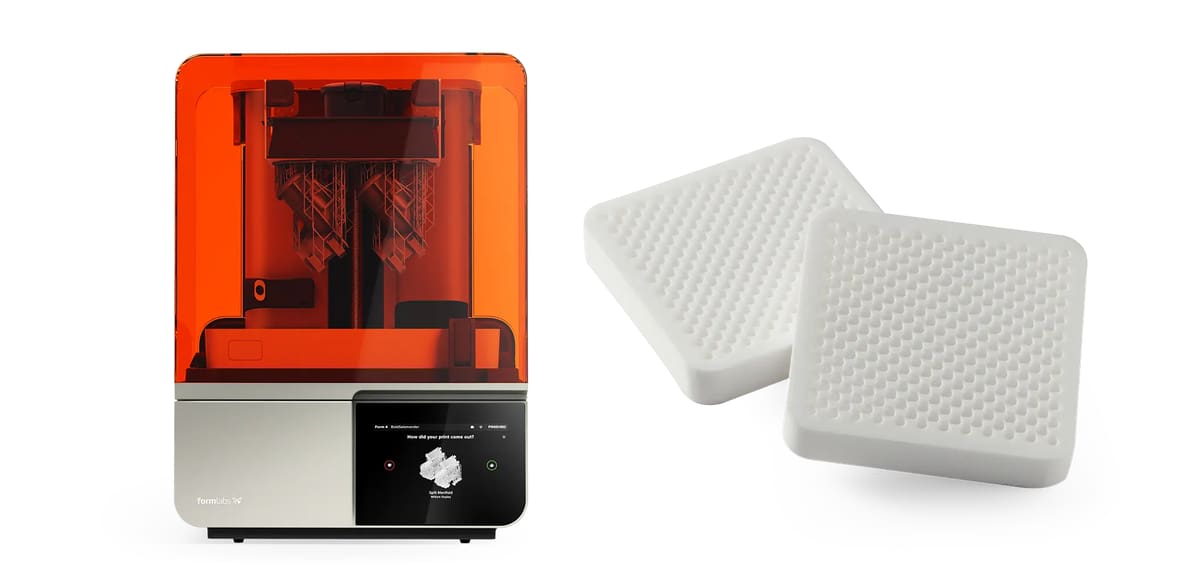
American 3D printer manufacturer Formlabs offers one of the more accessible routes to technical ceramic 3D printing with its Form 4 resin printer and Alumina 4N Resin. Unlike most industrial ceramic 3D printers, the Form 4 is a general-purpose desktop machine that can produce both polymer and ceramic parts, making it an attractive option for research laboratories, engineers, and manufacturers looking to experiment with technical ceramics without investing in a dedicated industrial system.
Introduced in 2024, the Form 4 uses Formlabs’ Low Force Display (LFD) technology, a masked stereolithography process that cures liquid photopolymer resin using an LCD screen and powerful backlight. It features a 200 × 125 × 210 mm build volume and supports 50-micron layers when printing with Alumina 4N Resin. The ceramic-filled resin, introduced in 2023, produces sintered alumina parts with 99.99% purity and 98.6% relative density, offering excellent thermal stability, electrical insulation, chemical resistance, and wear resistance. Applications include high-voltage components, heat-resistant fixtures, and industrial tooling.
Printing technical ceramics on the Form 4 requires a more involved workflow than standard resin printing. Parts must be cleaned using a dedicated ceramic wash solution, dried, and then debound and sintered in a kiln capable of reaching at least 1,600 °C. Significant shrinkage during firing must also be accounted for in the design. While the additional equipment and processing increase the overall cost, the Form 4 remains a relatively affordable entry point into producing functional technical ceramic parts.
Alumina 4N Resin is also compatible with Formlabs’ earlier Form 3 series and the Form 4B, although not the larger Form 4L.
Tethon 3D Bison 1000

US-based Tethon 3D focuses on making ceramic materials for industrial, consumer, and design industries. It manufactures ceramic powders for binder jetting and photocurable ceramic polymers for SLA and DLP machines and holds several patents related to ceramic 3D printing.
The company’s Bison 1000 can print with all of the company’s ceramic resins in ceramic, glass-ceramic, and even flexible ceramic that produces parts that can be positioned by stretching and molding then sintered in place to become 100% solid inflexible ceramic.
Although you can use many Bison materials in other vat polymerization machines, some are tuned only for the Bison 1000.
Large Format & Production
3DCeram Sinto C3601 Ultimate
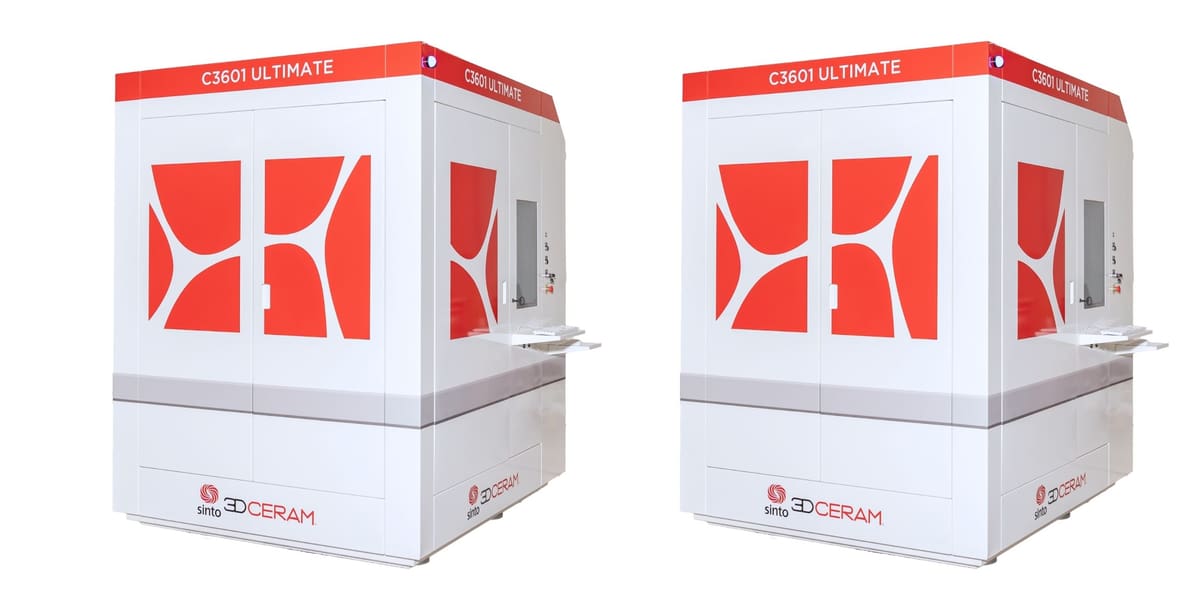
With more than 20 years of expertise in ceramic 3D printing, French manufacturer 3DCeram Sinto offers a range of industrial printers, ceramic materials, and production services. Its flagship C3601 Ultimate is designed for large-scale production, whether manufacturing sizable technical ceramic components in a single piece or producing large batches of smaller parts.
The C3601 Ultimate features an impressive 600 × 600 × 300 mm build volume, one of the largest available for technical ceramic stereolithography. It uses four UV lasers with an approximately 60-micron laser spot to selectively cure layers of ceramic-filled slurry. Like the company’s other SLA printers, it employs a top-down printing process and proprietary support-link-free technology, reducing the need for support structures and subsequent cleaning. The machine also supports 3DCeram’s CERIA AI software, designed to optimize print preparation and improve production efficiency.
For smaller-scale applications, 3DCeram offers the C101 Easy Lab for materials research, the C101 Easy Fab for prototyping and smaller production runs, and the C101 Hybrid. The C1000 Flexmatic is a semi-automated system aimed at serial production, while the company’s M.A.T. platform takes a different approach, combining interchangeable extrusion technologies for ceramic and metal filaments, pellets, and pastes with CNC machining.
3DCeram offers a broad selection of oxide and non-oxide ceramic materials, including alumina, zirconia, aluminum nitride, and silicon nitride, as well as custom material development services.
Lithoz CeraFab System S320
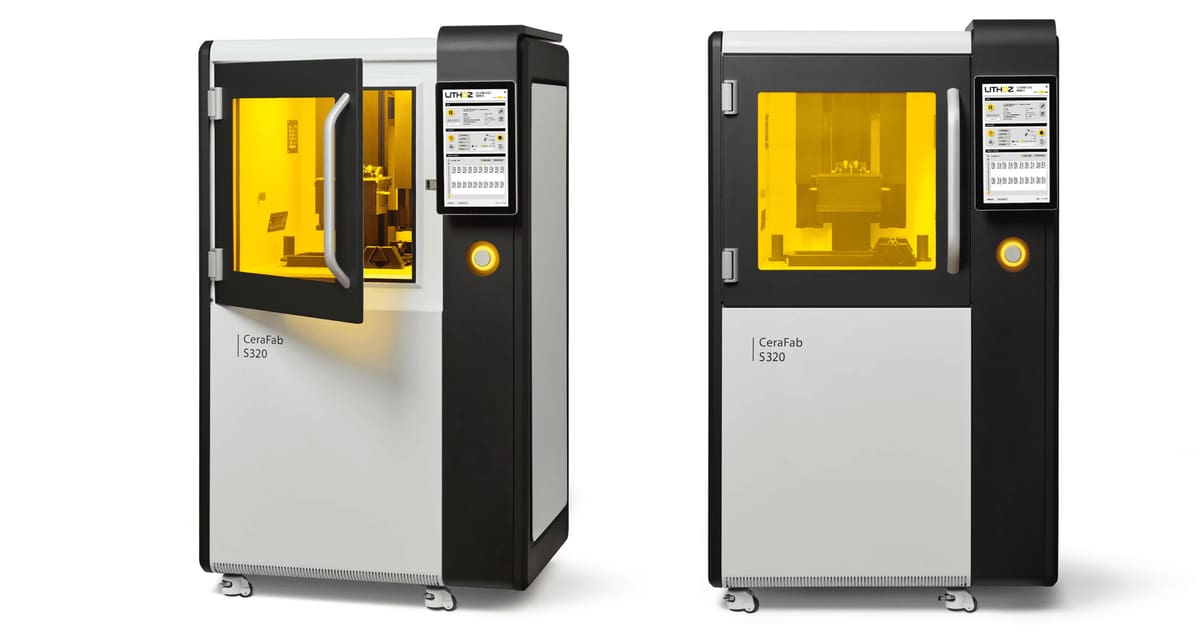
Austrian additive manufacturing company Lithoz specializes in technical ceramics, offering a range of industrial 3D printers, ceramic materials, and production solutions for applications from medical implants to semiconductor manufacturing.
The company’s CeraFab systems use a vat photopolymerization technology it calls lithography-based ceramic manufacturing (LCM). Similar to digital light processing (DLP), the process uses projected light to solidify layers of ceramic-filled liquid. The printed parts are subsequently debound and sintered to produce dense, functional ceramic components.
Introduced in 2024, the CeraFab System S320 is designed for the high-volume production of mid-sized technical ceramic parts. It features the largest build platform of any Lithoz CeraFab LCM printer, with five times the build area of the smaller S65 despite having the same external dimensions. Its 257.6 × 135.8 × 320 mm build volume and 4K projection system, delivering 63-micron lateral resolution, make it suitable for manufacturing larger components or multiple smaller parts in a single print job.
For continuous production, the S320 features dual automatic material dispensers, a heated process chamber, and software that can coordinate production across multiple machines. Lithoz offers a wide range of ceramic materials, including alumina, zirconia, and silica-based formulations, for applications such as industrial filters, casting cores, and semiconductor components.
Lithoz also offers its CeraFab Multi line for multi-material printing and CeraMax Vario machines, which use a different technology called laser-induced slipcasting (LIS).
XJet Carmel 1400C & Carmel Pro
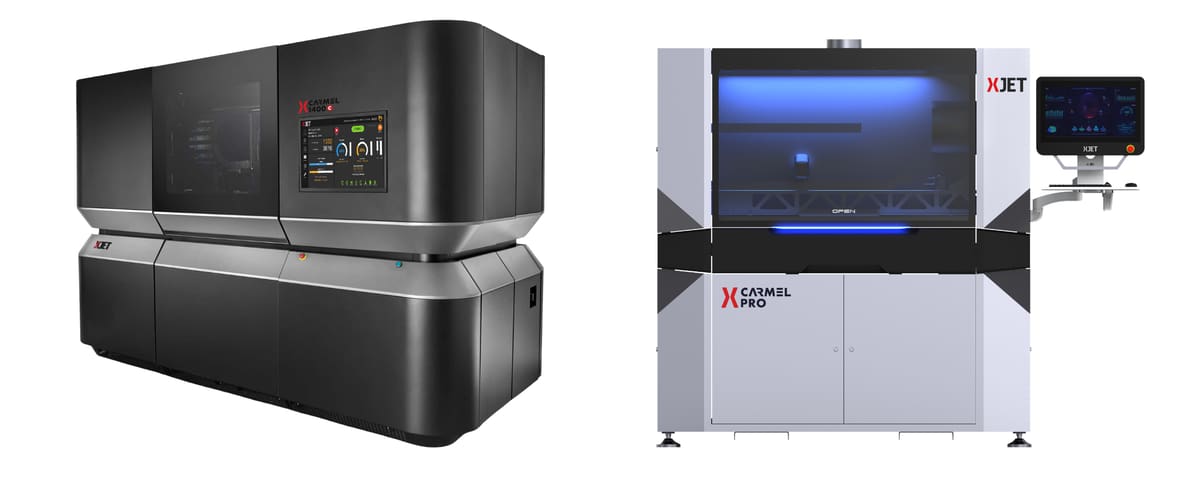
Israeli manufacturer XJet takes a unique approach to industrial ceramic 3D printing with a material jetting technology it calls NanoParticle Jetting (NPJ). Unlike other ceramic printers, the company’s Carmel systems do not use ceramic powder or a vat of ceramic slurry. Instead, thousands of tiny inkjet nozzles deposit droplets of liquid containing ceramic nanoparticles, along with a separate soluble support material, to build parts layer by layer.
The Carmel 1400C is designed for industrial production, featuring a 500 × 140 mm build tray and layer thicknesses of 7 to 10 microns. The system can produce multiple complex ceramic parts simultaneously, using materials such as zirconia and alumina supplied in sealed cartridges. After printing, parts are transferred to XJet’s SMART (Support Material Automatic Removal Technology) station, which automatically dissolves the support material. The parts are then sintered in a furnace to achieve their final ceramic properties.
In November 2025, XJet introduced the Carmel Pro, a more compact and affordable system aimed at small and medium-sized manufacturers, research institutions, and specialized production facilities. Featuring a 350 × 140 mm build area, the Carmel Pro supports both metal and ceramic materials and has four material channels for greater printing flexibility. It also features automated job preparation and ink recirculation to reduce material waste. According to XJet, the new machine requires an initial investment 60% to 70% lower than its previous Carmel systems, making industrial NanoParticle Jetting more accessible.
D3-AM LAB II
Italian manufacturer D3-AM, a subsidiary of Durst Group, a specialist in industrial 2D inkjet printing, draws on its parent company’s expertise to produce technical ceramics using its proprietary Micro Particle Jetting (MPJ) technology.
Introduced in 2023 and expanded with a larger-format version in 2024, the company’s LAB II uses a specially developed inkjet printhead to deposit droplets of highly concentrated, water-based ceramic suspensions, building parts layer by layer.
One of the LAB II’s biggest advantages over the resin-based ceramic printers on this list is its material flexibility. The process can use conventional ceramic powders, including dark and abrasive materials that are difficult to process using light-based technologies. D3-AM currently offers alumina and sintered silicon carbide (SSiC), the latter being particularly valuable for applications requiring exceptional hardness, wear resistance, and thermal stability. The water-based process also eliminates the separate debinding step required by most ceramic vat photopolymerization systems, allowing printed parts to proceed to sintering after appropriate preparation.
The LAB II features a generous 400 × 480 × 160 mm build volume, making it suitable for producing either large ceramic components or batches of smaller parts. According to D3-AM, its technology can produce delicate features alongside thick, crack-free walls exceeding 20 mm, overcoming a common challenge in ceramic additive manufacturing. This combination makes the machine particularly attractive for structural components, heat exchangers, pumps, and other demanding industrial applications.
While the LAB II isn’t intended to compete with the finest resolution of ceramic stereolithography systems, its ability to process a wider range of powders, manufacture substantial components, and simplify post-processing gives it some distinct advantages for industrial ceramic production.
Admatec Admaflex 130 Evolution
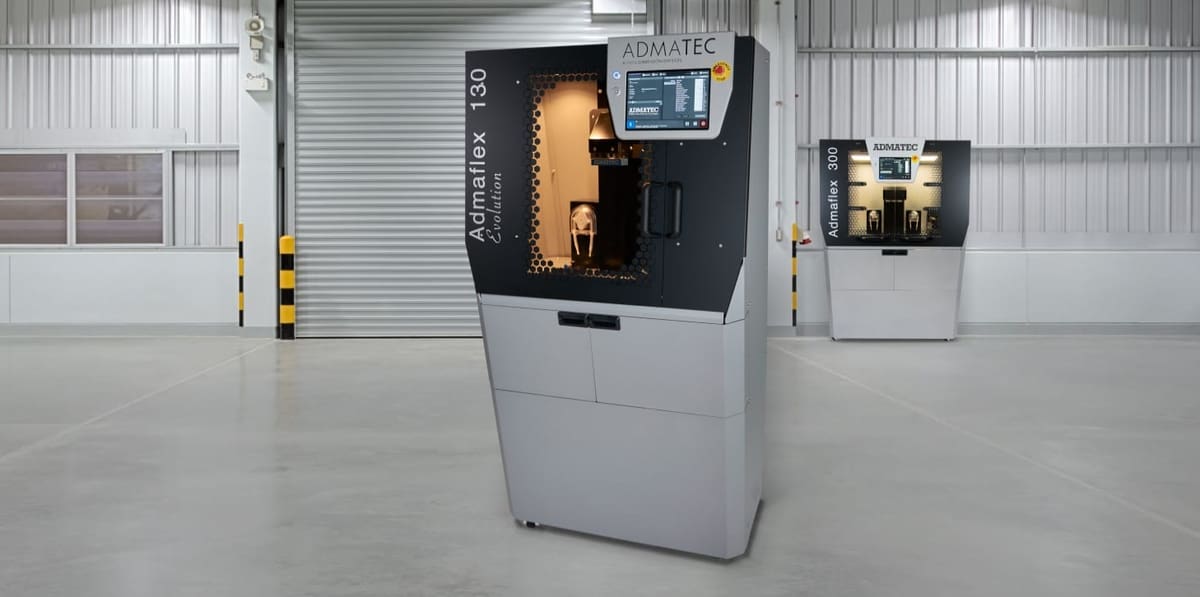
Dutch manufacturer Admatec Additive Solutions specializes in ceramic and metal 3D printing, offering industrial machines, materials, and post-processing equipment. Its Admaflex 130 Evolution is designed for both research and serial production, with the unusual ability to print technical ceramics and metals on the same machine.
The Admaflex 130 Evolution uses Digital Light Processing (DLP) technology combined with a proprietary material feeding system that can handle highly viscous ceramic and metal slurries. It offers five interchangeable build configurations, ranging from 64 × 40 × 400 mm at 25-micron resolution to 160 × 100 × 400 mm at 62.5-micron resolution. With layer thicknesses between 10 and 200 microns and printing speeds of up to 300 layers per hour, the machine is suited to producing intricate ceramic components as well as batches of smaller parts. An integrated camera-based monitoring system provides real-time process control and quality tracking.
One of the system’s main advantages is its open material platform, allowing users to adjust printing parameters and develop their own ceramic formulations. Admatec supplies validated materials including alumina, zirconia, silica, and hydroxyapatite, as well as metal feedstocks. Applications range from semiconductor components and industrial tooling to investment casting and medical implants. The company also offers the larger Admaflex 300 for industrial-scale production.
In October 2026, Admatec announced the Admaflex Discovery, its first desktop ceramic 3D printer, designed to make the technology more accessible to universities, research laboratories, and smaller manufacturers. Priced at €75,000, the DLP machine features a 96 × 54 × 110 mm build volume, 50-micron resolution, and an open material system supporting alumina, silica, and custom formulations. Its most interesting feature is an upgradeable architecture, allowing users to expand the build volume and improve resolution as their needs grow. Orders are scheduled to open in November 2026, with first deliveries expected in early 2027.
Concr3De Armadillo Blue
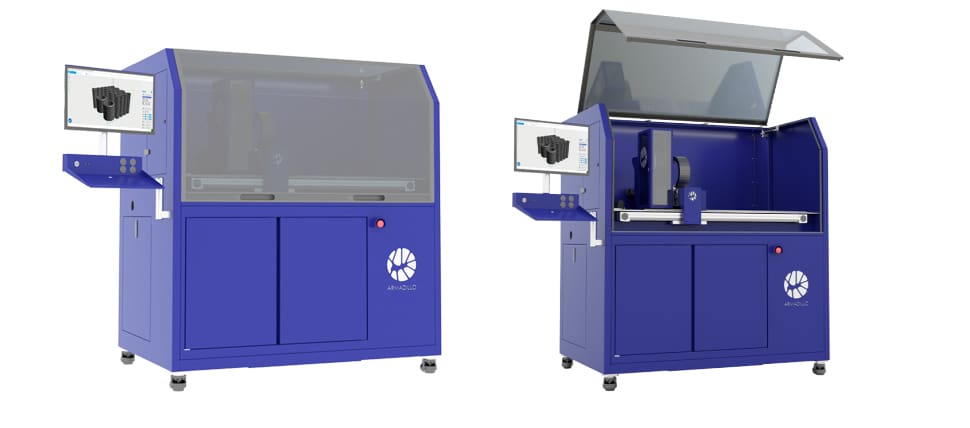
Dutch manufacturer Concr3De specializes in binder jetting 3D printing, offering machines for everything from construction materials to industrial ceramics. Its Armadillo Blue is specifically designed for technical ceramic production, with a particular focus on silicon carbide and alumina components.
Unlike the resin-based ceramic printers on this list, the Armadillo Blue uses a powder-based process, selectively depositing a liquid binder onto successive layers of ceramic powder. The surrounding powder supports the parts during printing, allowing complex geometries to be produced without dedicated support structures. After printing, the parts are removed from the powder bed and undergo further processing, including debinding, sintering, or infiltration, depending on the material.
One of the Armadillo Blue’s biggest advantages is its ability to print silicon-infiltrated silicon carbide (SiSiC), a material valued for its exceptional hardness, wear resistance, and thermal stability. Developed in collaboration with ceramic specialist WZR, Concr3De’s validated silicon carbide printing process is offered alongside several alumina formulations. The machine also supports custom ceramic powders, providing flexibility for manufacturers developing specialized materials.
The Armadillo Blue has a 370 × 260 × 250 mm build volume, a 400-DPI printhead, and layer heights of 100 to 150 microns. According to Concr3De, it can print up to 24 liters of parts per day, while the larger Armadillo Blue XL, with a 440 × 440 × 250 mm build volume, doubles that capacity. Both machines feature an infrared print-bed heater and Concr3De’s Noah production software. For considerably larger components, the company also offers its industrial-scale Elephant Blue binder jetting system.
Prodways Ceram Pro 365 Max
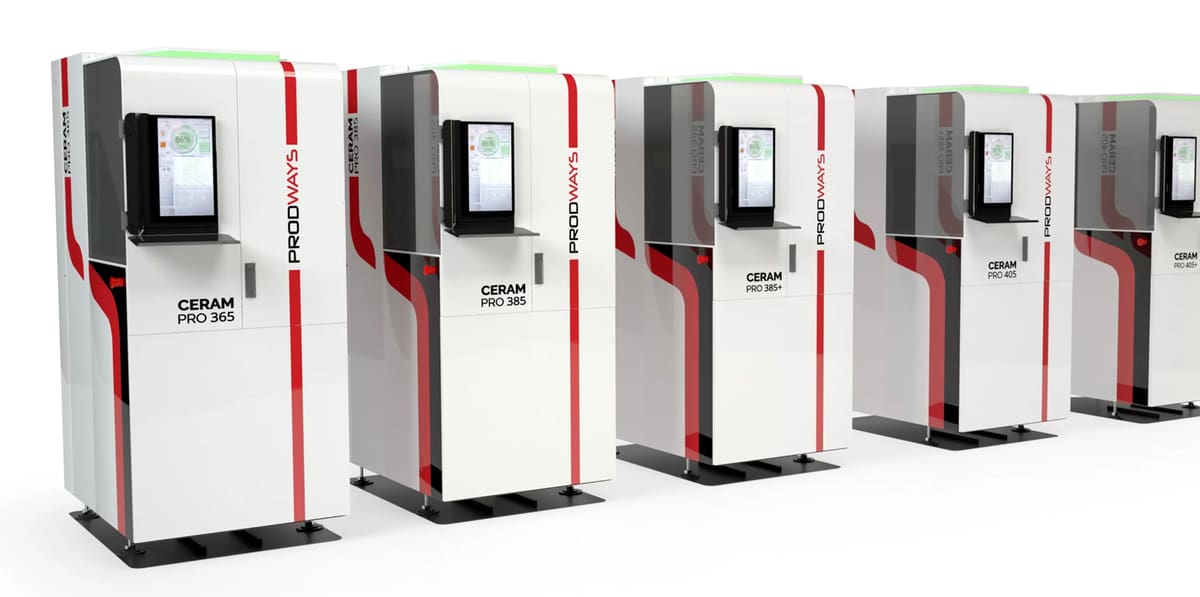
French 3D printer manufacturer Prodways offers a range of industrial ceramic 3D printers based on its proprietary MovingLight technology, a variation of Digital Light Processing (DLP). Unlike conventional DLP systems, which project an image over a fixed area, MovingLight uses one or two moving projectors to cure ceramic-filled resin across a larger build platform, maintaining high resolution while accommodating bigger parts and production batches.
The company’s Ceram Pro 365 Max is designed for technical ceramic manufacturing, particularly investment casting applications, where intricate ceramic cores are used to produce complex metal components such as turbine blades. The machine features a 264 × 328 × 350 mm build volume, 31-micron pixel resolution, and layer thicknesses between 50 and 175 microns. Its interchangeable build platforms range from just 66 × 41 mm to the full build area, allowing users to tailor the machine to different part sizes and production requirements while minimizing material consumption.
Developed in partnership with ceramic materials specialist Tethon 3D, the Ceram Pro 365 Max supports Silica SiCast 1200, a ceramic resin formulated for investment casting, and Alumina A100 for high-temperature industrial applications. Its open process parameters also offer flexibility for material development and specialized applications. Printed components undergo debinding and thermal processing to obtain their final ceramic properties.
Prodways also offers Ceram Pro 385 and 405 systems, which operate at different UV wavelengths and support open material development. These feature larger build envelopes of up to 300 × 445 × 350 mm, with dual-projector versions that Prodways claims can increase printing speeds by up to 40%. The range targets industries including aerospace, automotive, semiconductors, and energy, where complex ceramic geometries and repeatable production are particularly valuable.
Get Your Ceramic Parts 3D Printed
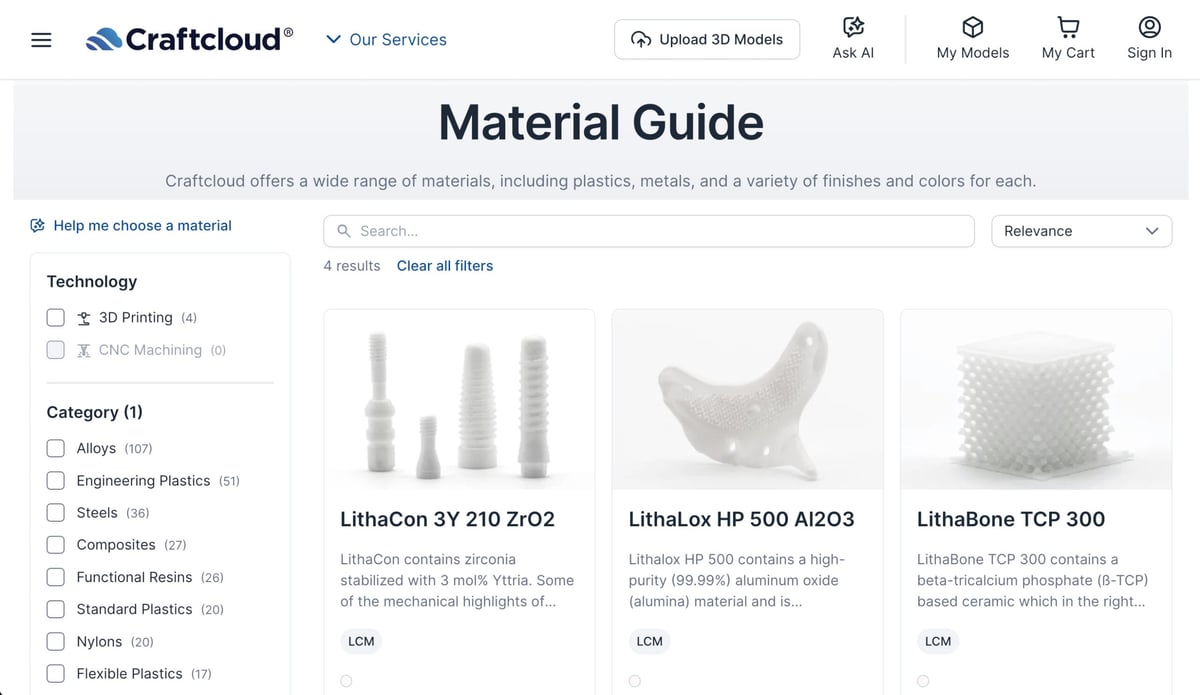
As technical ceramic 3D printing has matured, the number of companies offering on-demand printing services has grown considerably. Today, a wide range of specialist service providers, such as Craftcloud by All3DP, can produce custom ceramic components, from one-off prototypes to larger production runs, using materials such as alumina, zirconia, and silicon carbide. For businesses considering investing in a ceramic 3D printer, outsourcing is an excellent way to test the technology before committing to the substantial cost of a machine and its associated post-processing equipment. Ordering a few sample parts allows you to evaluate whether 3D printing can achieve the required geometry, dimensional accuracy, surface finish, and material properties for your application. It also provides an opportunity to compare different printing technologies and materials, helping you make a more informed decision about which machine, if any, is right for your needs.
*How Much Do Ceramic 3D Printers Cost?
Professional 3D printers cost anywhere from $10,000 to a million, which is not a helpful answer at all, we know. The truth is that for machines in the $10K to $90K range, you’ll usually find a consistent and public sticker price.
However, when you get above $100K, and especially when you approach $250K, there can be many factors that affect the final price you’ll pay, such as customizations, options, your location vs. where the machine is manufactured (import duties, taxes), how many you’re buying, discounting for education, research, or case study partnerships, long-term agreements, marketing agreements, instillation and training, optional warranties, and more.
The price of one machine with every possible add-on and customization going to a high-cost location can be three times the price per unit of a 10-machine order to major city.
That said, manufacturers should provide you with a ballpark figure for your CapEx request upon first contact. OEMs don’t want to spend time and resources serving a potential customer when their machine is clearly out of reach, so early transparency on prices is a win-win.
License: The text of "Top Ceramic 3D Printers for Technical Ceramics" by All3DP Pro is licensed under a Creative Commons Attribution 4.0 International License.